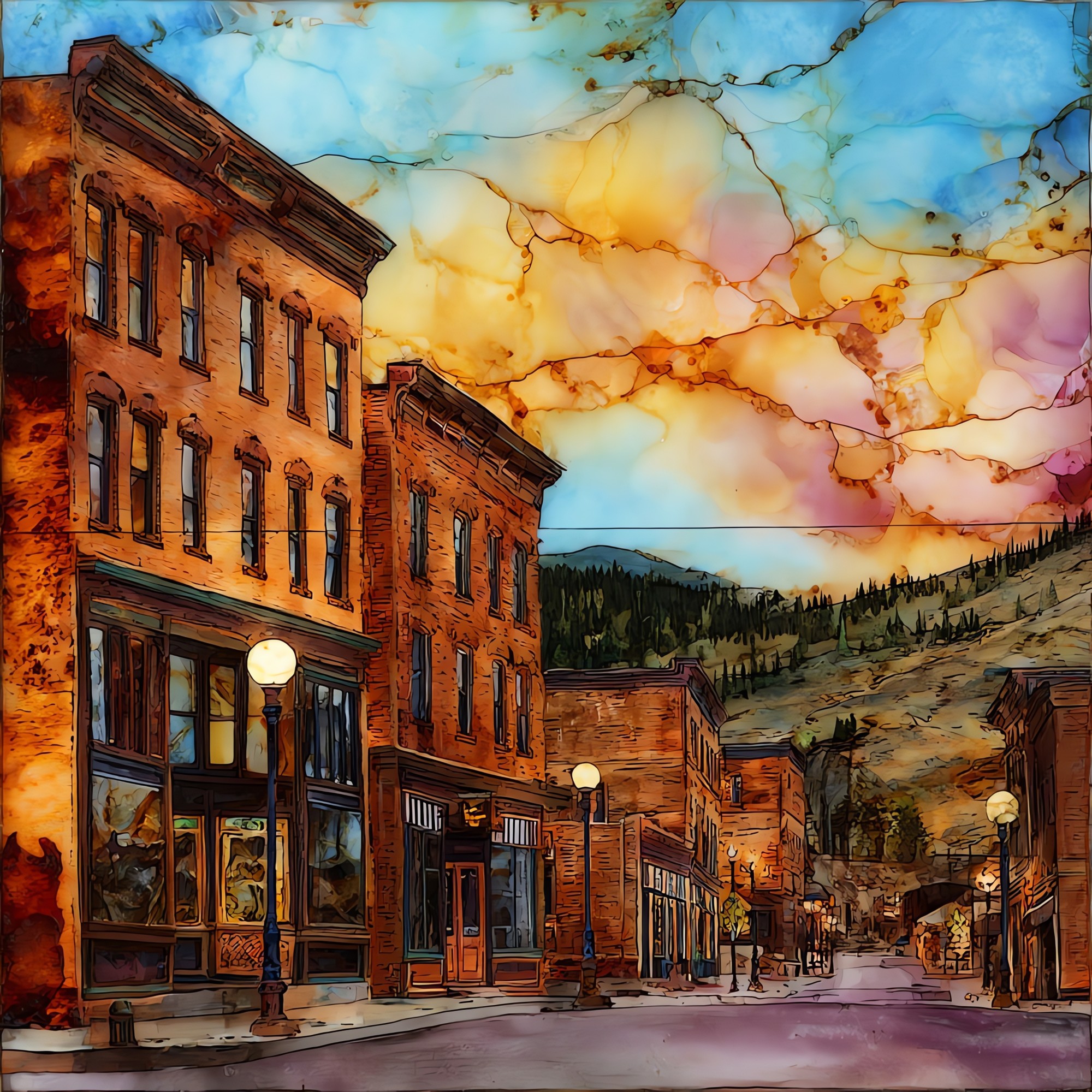
Victor mining town Front Range Ceramic Art Tile
— — a brick town the gold left standing.
Not only on a wall.





“A high town in the Cripple Creek mining district, on the southwest flank of Pikes Peak. Eighteen thousand people lived here in 1900. Three hundred and seventy-nine do now. The brick storefronts on Victor Avenue are the rebuild after the August 1899 fire took the wooden town in five hours. Battle Mountain still works above. Newmont's open pit moves ore most days, but the city under it has gone quiet. Most of the buildings that went up in 1899 are still standing. That happens less often than you'd think.
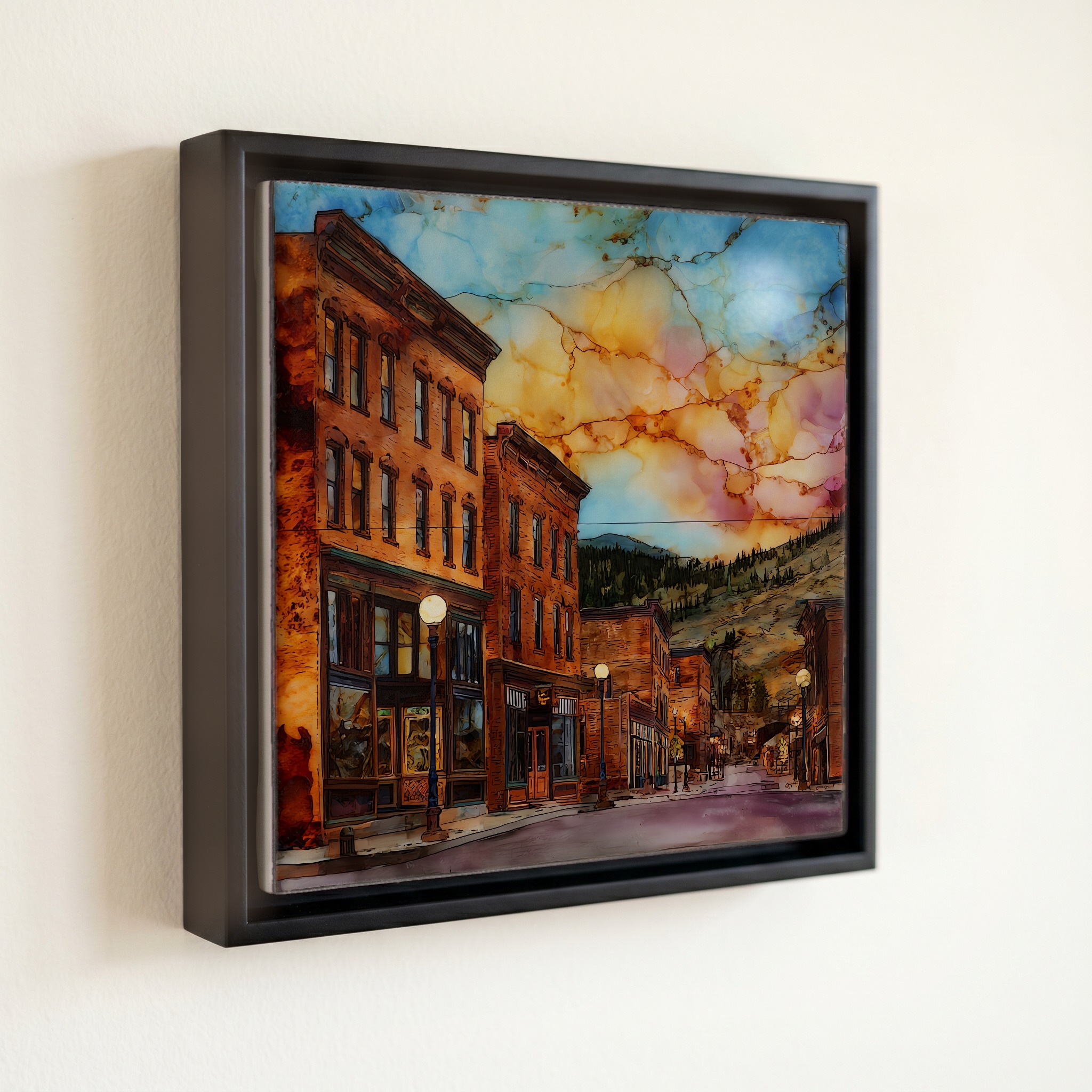
Victor mining town Front Range Ceramic Art Tile, on ceramic.
Each tile is finished by hand in our Knoxville studio. Artwork is slowly infused into the ceramic surface under high heat and pressure, and rests beneath a thin glossy finish. The colour lives in the surface, not on top of it.
Pick any four 4-inch tiles — National Parks you've been to, a Smokies set, the four seasons of one place. $ for a set of , cork-backed, ready to live on the table.

Each tile ships in a kraft box, tied with cream ribbon, with a handwritten note from the studio if you'd like to add one.

Three or five different vistas, hung together — a chapter of places you've been, or want to go.
The place, in three passes.
Victor sits at 9,708 feet (2,959 metres) on the southwest flank of Pikes Peak, in Teller County, Colorado. It is part of the Cripple Creek mining district, the second-largest gold-producing district in United States history, and lies five miles south of Cripple Creek itself, about an hour west of Colorado Springs. The town was founded in 1891, named for the nearby Victor Mine, and incorporated in 1894. Battle Mountain rises directly above the streets and held the four richest mines in the district: the Portland, the Independence, the Ajax, and the Cresson. The Cripple Creek & Victor Gold Mine, now operated by Newmont, still works the same ore body and ships roughly 250,000 troy ounces of gold a year.
The brick and stone fronts along Victor Avenue date almost entirely to a single autumn. On August 21, 1899, a fire that began in a dance hall took the wooden business district in about five hours, and the town rebuilt the next year in brick, stone, and pressed metal. The Victor Hotel, the Gold Coin Club, and most of the storefronts a visitor walks past today went up between 1899 and 1900. The 22-acre Victor Downtown Historic District was added to the National Register of Historic Places in 1985. The union hall of the Western Federation of Miners on Fourth Street still carries the bullet holes from the labour wars of the early 1900s, a working surface the town never patched.
At its 1900 peak Victor was the fourth-largest city in Colorado, with about 18,000 residents and a daily newspaper called the Victor Daily Record, edited at age eighteen by a local boy named Lowell Thomas. The 2020 census recorded 379. Most of the original buildings remain because so few people came back to tear them down. The Cripple Creek & Victor Gold Mine works the mountain above on the same scale it always did, but the city under it functions on a different clock now. The Victor Lowell Thomas Museum opens Memorial Day through Labor Day. The Stratton Outdoor Amphitheater carries a short summer programme. The rest of the year the brick blocks stand mostly to themselves, and the wind moves through the alleys behind the storefronts unbothered.