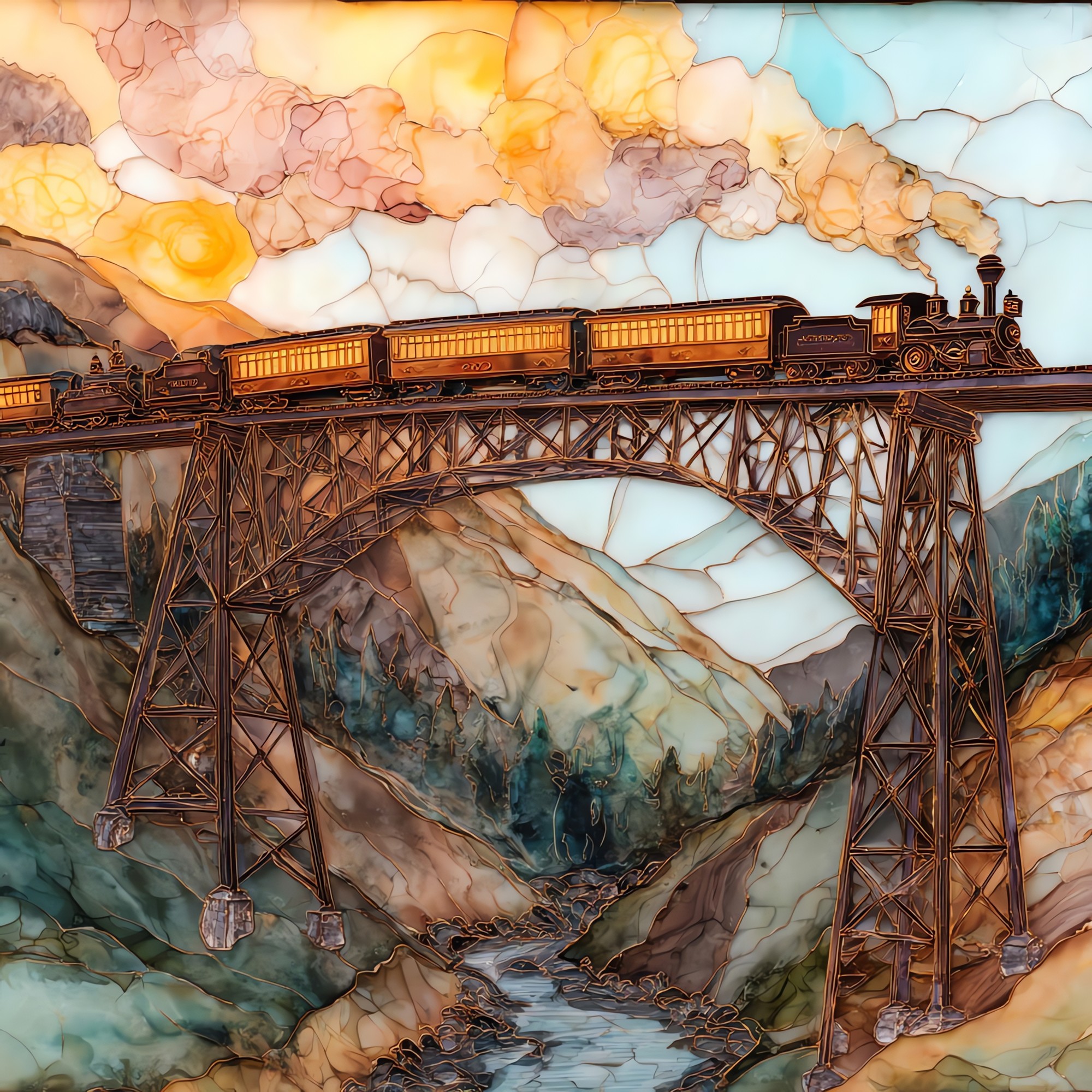
Georgetown Loop steam train Front Range Ceramic Art Tile
— — a line that has to cross itself to climb.
Not only on a wall.


“The Devil's Gate Viaduct, the curved steel bridge where the line passes above itself, was first completed in 1884 to serve silver mines. The line ran until 1939, then sat quiet for forty years before the Colorado Historical Society laid the track back. Today narrow-gauge steam locomotives still climb the 638 feet of grade between Georgetown and Silver Plume. Three miles of route, two miles of straight-line distance, the difference made up by the loop. The whistle carries down Clear Creek Canyon. The pines hold the smoke for a long time.
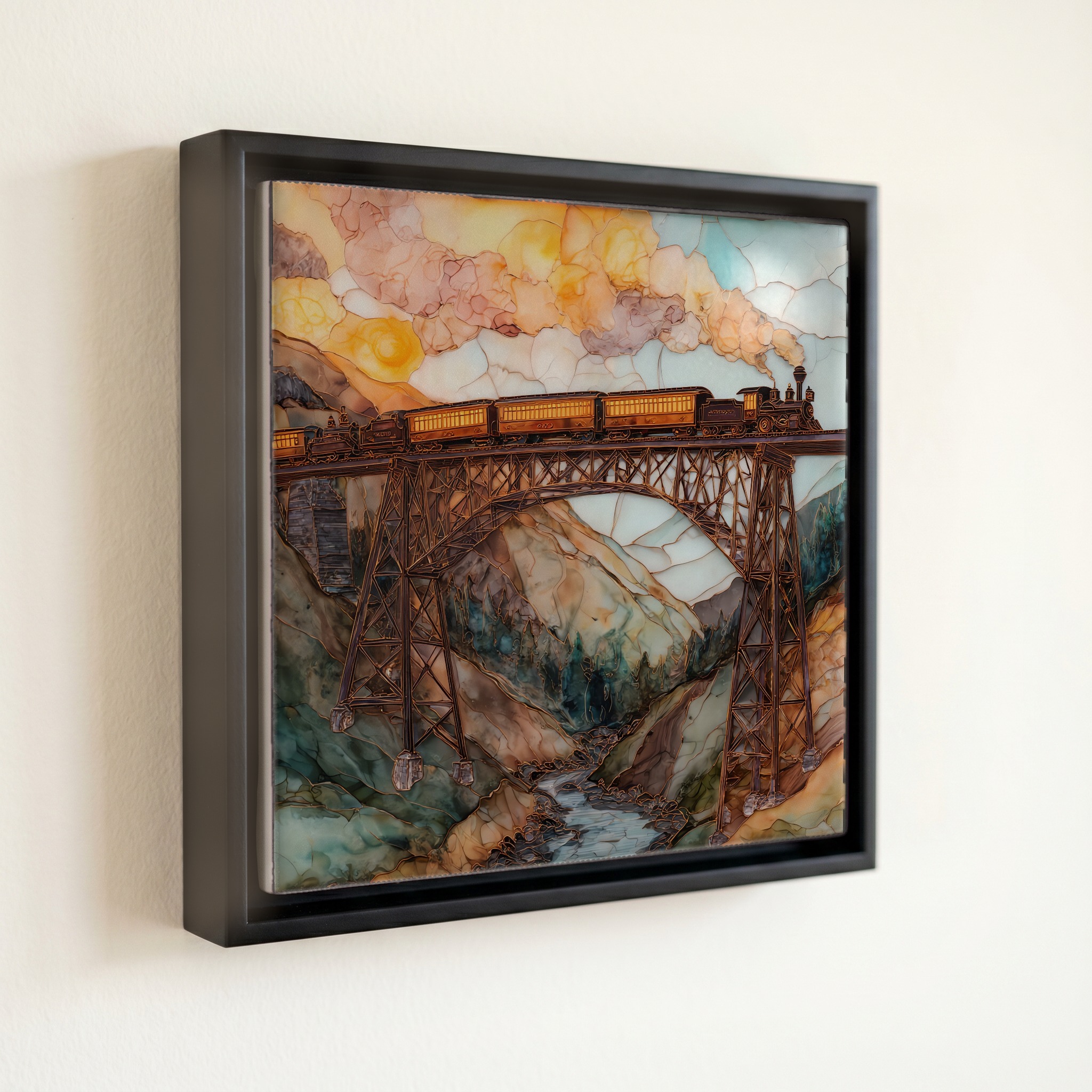
Georgetown Loop steam train Front Range Ceramic Art Tile, on ceramic.
Each tile is finished by hand in our Knoxville studio. Artwork is slowly infused into the ceramic surface under high heat and pressure, and rests beneath a thin glossy finish. The colour lives in the surface, not on top of it.
Pick any four 4-inch tiles — National Parks you've been to, a Smokies set, the four seasons of one place. $ for a set of , cork-backed, ready to live on the table.
Each tile ships in a kraft box, tied with cream ribbon, with a handwritten note from the studio if you'd like to add one.

Three or five different vistas, hung together — a chapter of places you've been, or want to go.
The place, in three passes.
The Georgetown Loop Railroad runs three miles of three-foot narrow gauge between Georgetown and Silver Plume, two former silver-mining towns in Clear Creek County, Colorado, about 45 miles west of Denver on Interstate 70. The route climbs roughly 638 feet of grade in just two miles of straight-line distance, an engineering problem the line resolves by crossing itself on the Devil's Gate Viaduct, a curved steel bridge first completed in 1884 to a design by Robert Blickensderfer. The line served the silver mines of the eastern Front Range until 1939, then was dismantled. The Colorado Historical Society began the restoration in 1973, and the rebuilt line carried its first revenue train in 1984.
The railroad operates a public season from late May through early October, with additional Santa-themed runs on weekends in late November and December. Trains depart from the Devil's Gate station just west of Georgetown and from the Silver Plume station two miles up the canyon, and the full out-and-back round trip takes about seventy minutes. Both stations sit above 8,500 feet, where the air thins and afternoon weather can change quickly. The Lebanon Silver Mine tour is offered as an optional add-on and includes a short walk through a hard-rock adit; a light jacket is asked for regardless of the surface temperature. The right-of-way and the structures sit on land owned by History Colorado, the state historical society.
The regular season opens in late May, after the high-country snow recedes from the right-of-way, and closes in early October, when the aspen on the canyon walls turn gold. Late September is the most-photographed window: the cottonwoods along Clear Creek hold their colour for about ten days, and the steam reads strongest against the cooling air. Winter Santa runs in late November and December are shorter, slower, and lit; they pass through the same canyon under snow. Spring and fall shoulder weeks see fewer crowds and quieter cars, though the morning trains can leave with frost still on the rail. Storms move fast across the eastern Front Range, and the canyon walls shorten the warning.