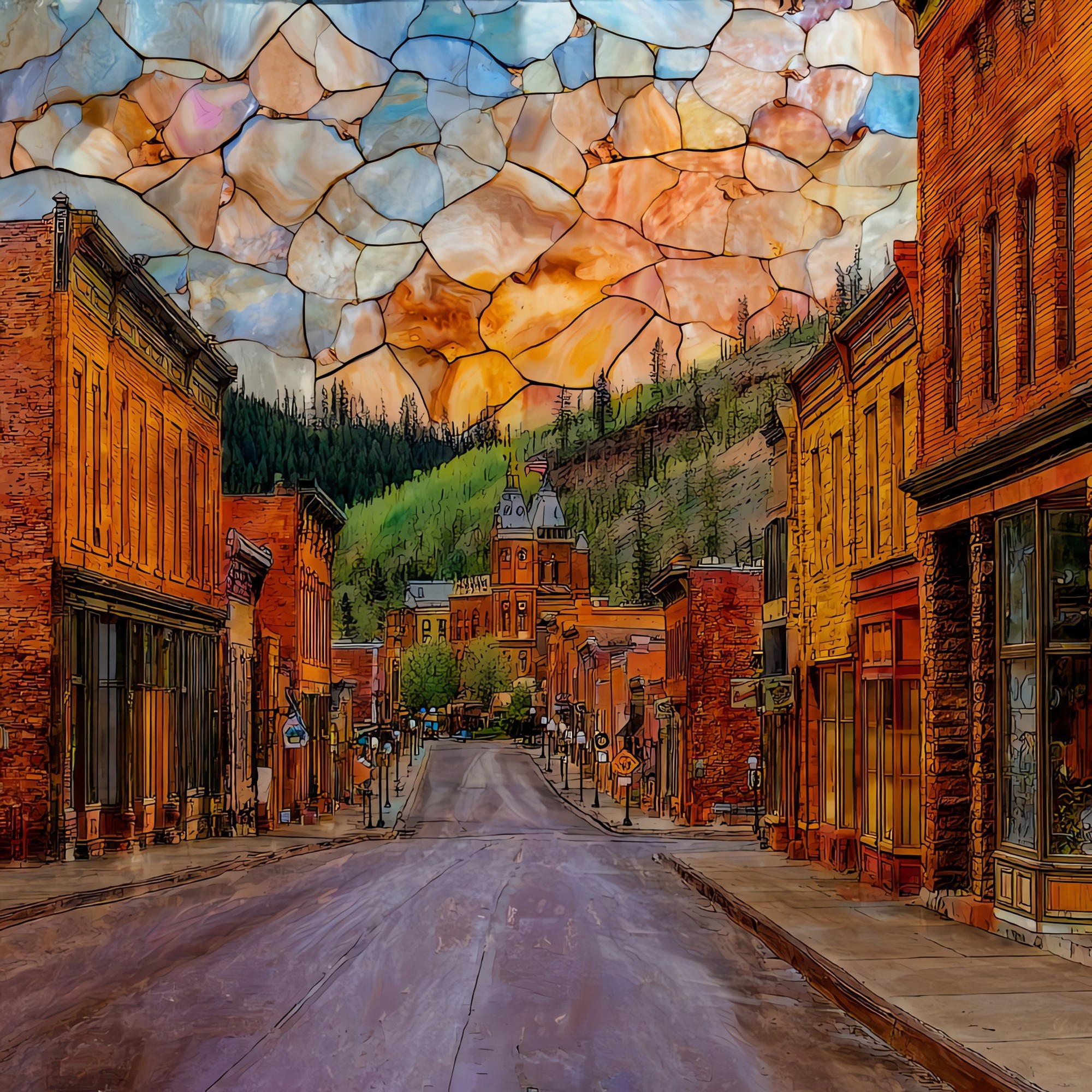
Cripple Creek historic district Front Range Ceramic Art Tile
— — what the boom left in brick, at nine thousand feet.
Not only on a wall.




“A gold-rush town at 9,494 feet, on the southwest flank of Pikes Peak. Most of the streets in the historic district were rebuilt in brick after the wooden camp burned in April 1896. The gold is mostly gone; the Cripple Creek and Victor district produced more than 23 million troy ounces between 1891 and the early 1960s, but the brick stayed. Bennett Avenue still runs the spine of the district. The Imperial Hotel still serves food. The narrow-gauge train still pulls out of the old depot. A quiet town now, where about twelve hundred people live where twenty-five thousand once did.
Cripple Creek historic district Front Range Ceramic Art Tile, on ceramic.
Each tile is finished by hand in our Knoxville studio. Artwork is slowly infused into the ceramic surface under high heat and pressure, and rests beneath a thin glossy finish. The colour lives in the surface, not on top of it.
Pick any four 4-inch tiles — National Parks you've been to, a Smokies set, the four seasons of one place. $ for a set of , cork-backed, ready to live on the table.

Each tile ships in a kraft box, tied with cream ribbon, with a handwritten note from the studio if you'd like to add one.

Three or five different vistas, hung together — a chapter of places you've been, or want to go.
The place, in three passes.
Cripple Creek sits at 9,494 feet on the southwestern flank of Pikes Peak, in Teller County, Colorado, about 45 miles west of Colorado Springs. The historic district covers most of the downtown, including Bennett, Myers, and Carr Avenues with their late-Victorian brick storefronts, and was designated a National Historic Landmark in 1961. The town was platted in 1892 around a gold strike made by cattleman Bob Womack the year before. The Cripple Creek and Victor Mining District went on to produce more than 23 million troy ounces of gold, making it one of the largest gold camps in American history. The Cresson mine south of town still operates.
On the night of April 25, 1896, a fire took most of the wooden mining camp; a second blaze four days later finished the work. The Cripple Creek that rebuilt that summer and autumn was almost entirely brick: the storefronts along Bennett Avenue, the City Hall, the Imperial Hotel that still serves food upstairs, the Old Homestead parlor house preserved as a museum. The brick has held the district's silhouette for more than a century. The buildings sit close to the street the way mining-town buildings do, with second-floor windows that once looked down on twenty-five thousand people and now look down on roughly twelve hundred.
The historic district can be walked in any season, though winter brings deep cold and snow at this elevation; the practical visit window runs from late spring through mid-October. The Cripple Creek and Victor Narrow Gauge Railroad runs short excursions out of the historic depot from late May into October. The Mollie Kathleen Gold Mine offers a 1,000-foot vertical descent into a real shaft on the north edge of town. The Old Homestead House Museum, the Heritage Center, and the Cripple Creek District Museum each open afternoons in summer and on reduced hours otherwise. Limited-stakes gaming, legalised by Colorado voters in 1991, operates inside several of the original brick storefronts on Bennett Avenue.