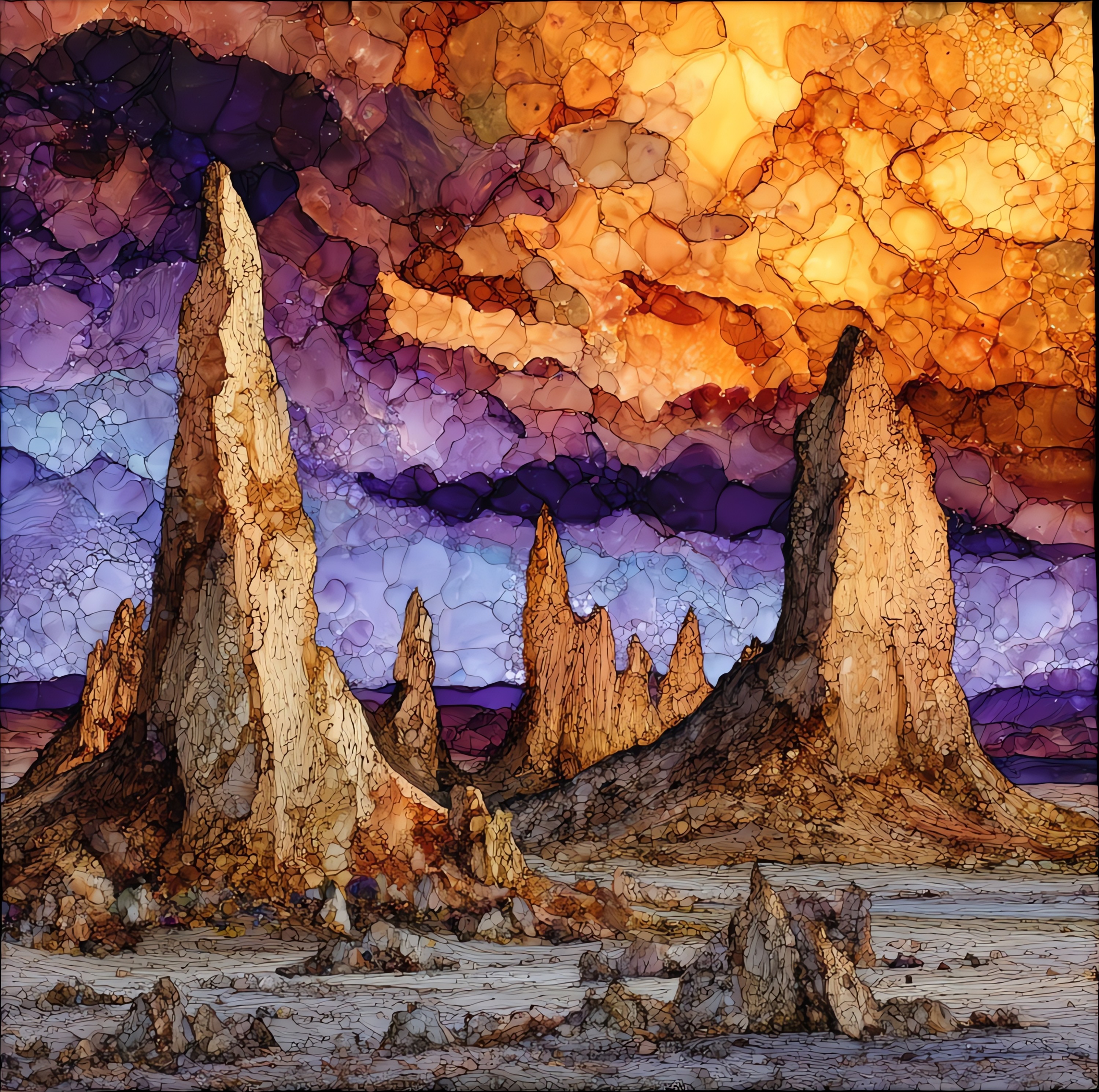
Trona Pinnacles
— — the lake floor that stayed when the water left.
Not only on a wall.





“Five hundred-odd tufa spires rise from the floor of Searles Dry Lake in the northern Mojave. The towers grew underwater between roughly ten and a hundred thousand years ago, when the basin held a deep Pleistocene lake fed by Sierra snowmelt; calcium-carbonate-rich groundwater seeped up through cracks in the lakebed, met the carbonate-rich lake water, and built the spires up around algae-coated vents. The lake dried, the spires stayed. The Bureau of Land Management has held the site since 1968. It still looks lunar enough that film crews come back every few years to use it as a planet that isn't this one.
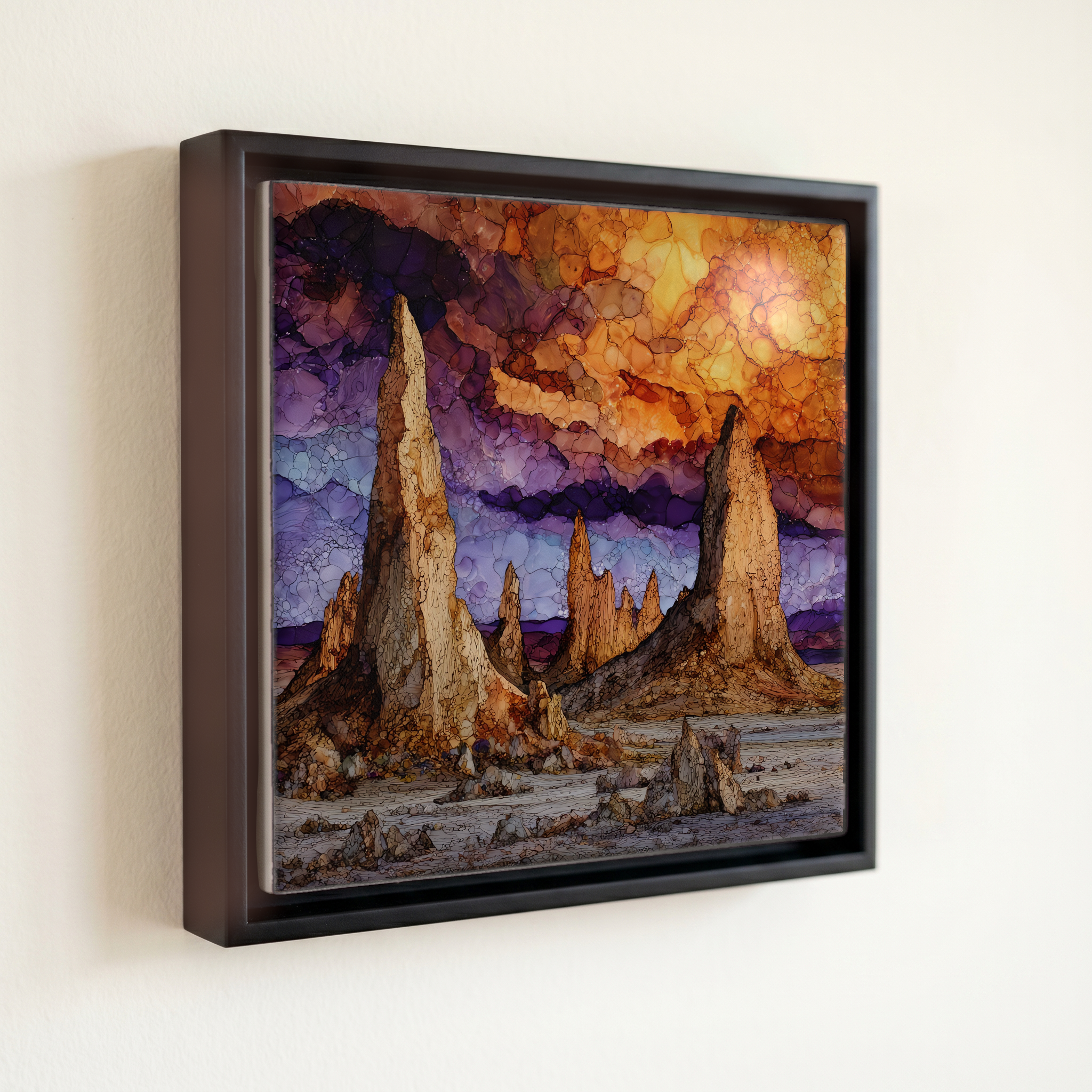
Trona Pinnacles, on ceramic.
Each tile is finished by hand in our Knoxville studio. Artwork is slowly infused into the ceramic surface under high heat and pressure, and rests beneath a thin glossy finish. The colour lives in the surface, not on top of it.
Pick any four 4-inch tiles — National Parks you've been to, a Smokies set, the four seasons of one place. $ for a set of , cork-backed, ready to live on the table.

Each tile ships in a kraft box, tied with cream ribbon, with a handwritten note from the studio if you'd like to add one.

Three or five different vistas, hung together — a chapter of places you've been, or want to go.
The place, in three passes.
The Trona Pinnacles stand on the floor of Searles Dry Lake in San Bernardino County, about twenty miles east of Ridgecrest along the road to Trona. The Bureau of Land Management manages the site, which was designated a National Natural Landmark in 1968 and covers roughly 4,000 acres of dry lakebed at about 1,800 feet of elevation. More than five hundred tufa towers, some over 140 feet tall, rise from the flats in three clusters known as the North, Middle, and South Groups. Access is by Trona Road from US-395, then a graded dirt road, RM194, that runs roughly five miles south to the spires.
The spires are tufa, a porous form of calcium carbonate that grows where calcium-rich groundwater rises into alkaline lake water and the two react at the interface. During the late Pleistocene, Searles Lake held water tens to hundreds of feet deep for long stretches, fed by Sierra Nevada snowmelt that ran down through Owens and China Lakes. The tufa grew up around submerged hot-spring vents on the lakebed, often sheathed in algae that helped fix the carbonate. Geologists group the existing towers into three age sets, the oldest around 100,000 years and the youngest about 10,000. When the lake finally evaporated through the early Holocene, the spires were left standing in the open air.
The site lies about twenty miles east of Ridgecrest along Trona Road, with the turnoff onto graded dirt road RM194 a few miles before the town of Trona. The road runs roughly five miles in and is generally passable for passenger cars when dry; the playa can turn to gumbo after rain and the BLM will close access until it dries out. A short loop drive winds through the South Group. Primitive camping is allowed for up to fourteen days. There are no services, no water, and no shade; bring everything in. The site has stood in for an alien planet in Star Trek V, Lost in Space, and Battlestar Galactica, and the closest motels are in Ridgecrest.