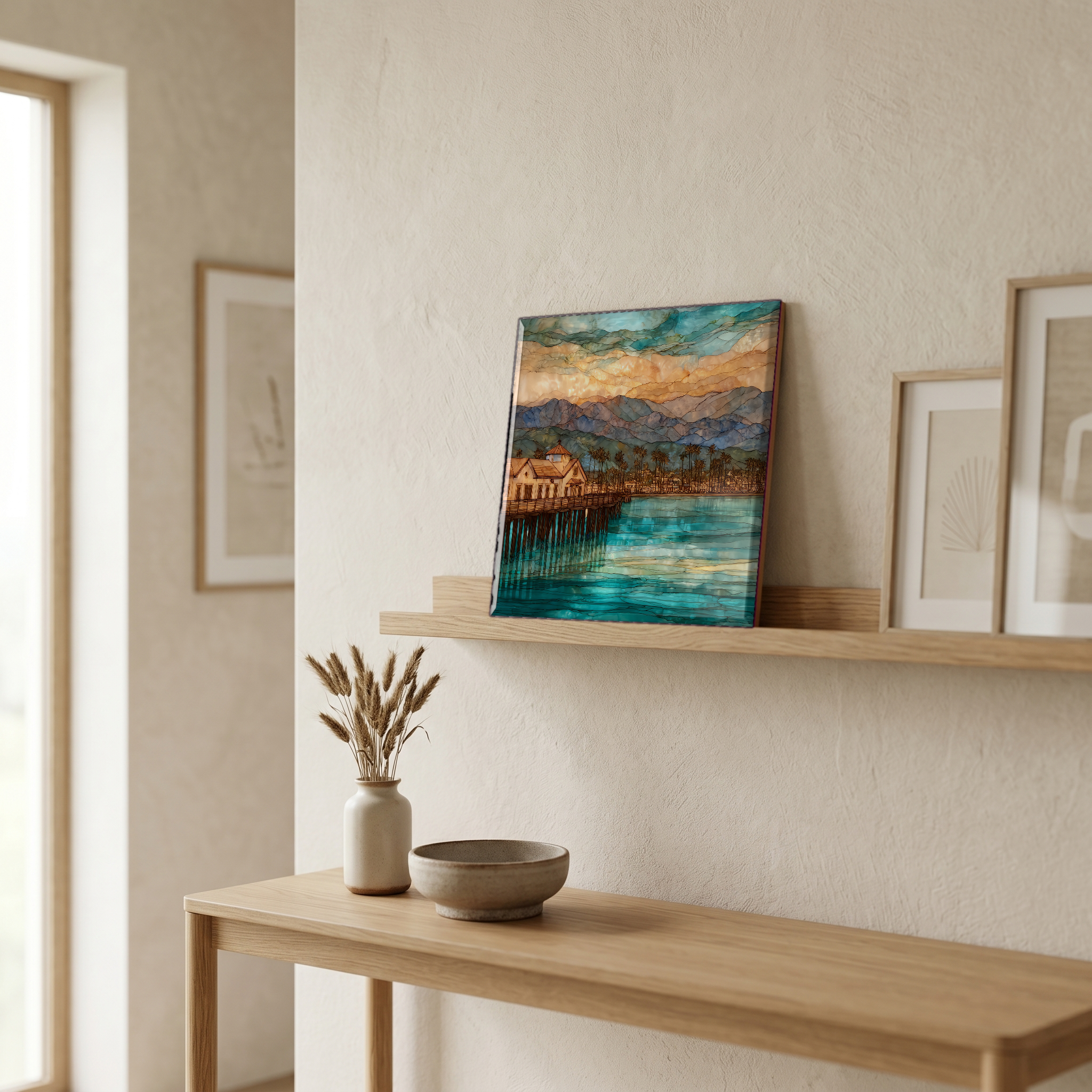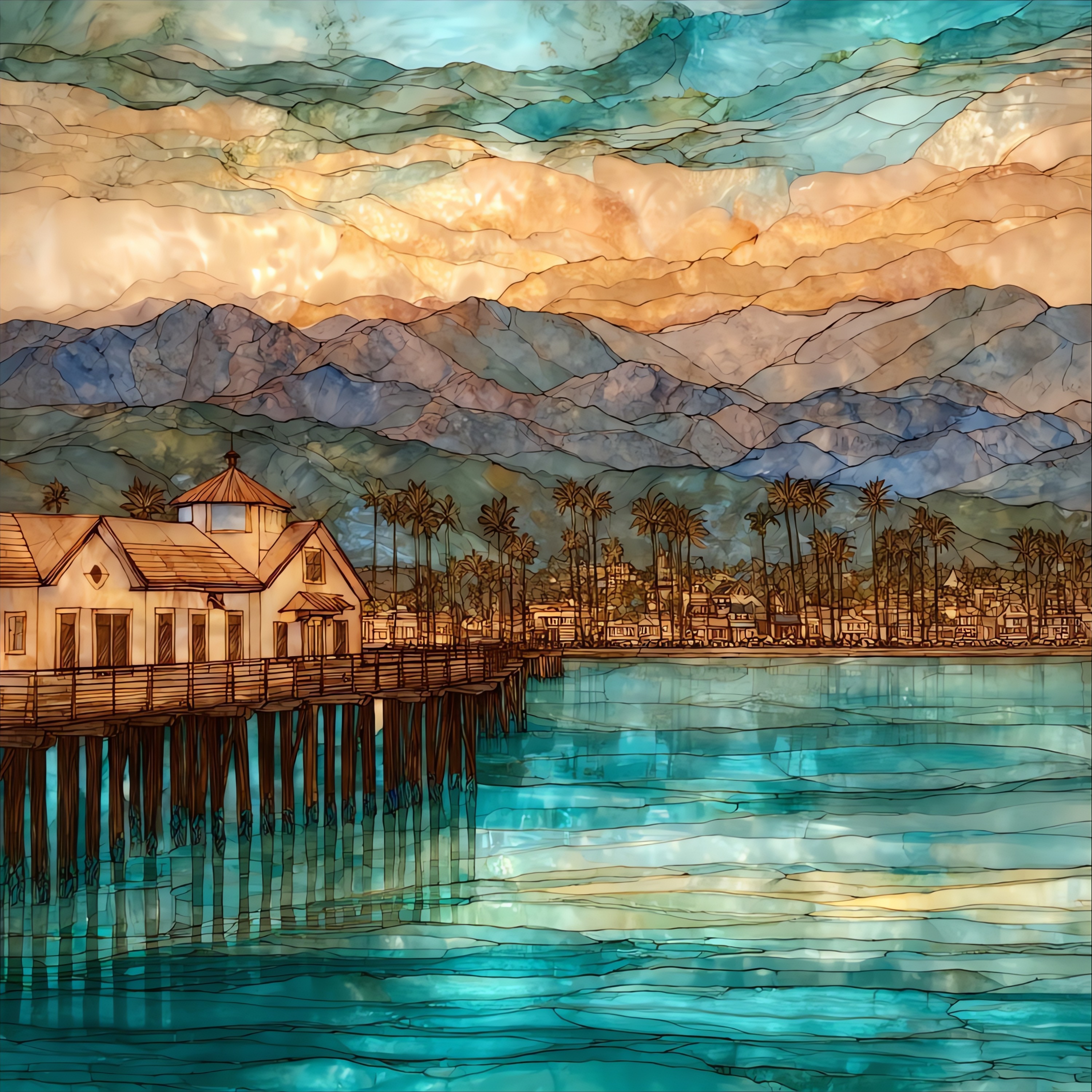
Wender·Vista
Stearns Wharf
shown on ceramic, 12-inch tileCalifornia · United States
at the foot of State Street in Santa Barbara, California

Stearns Wharf

— where State Street ends and the channel begins.

Where it lives

Not only on a wall.

A small tile on the nightstand catching the morning. A larger one above the fire. Yours, wherever you spend the slow hours.
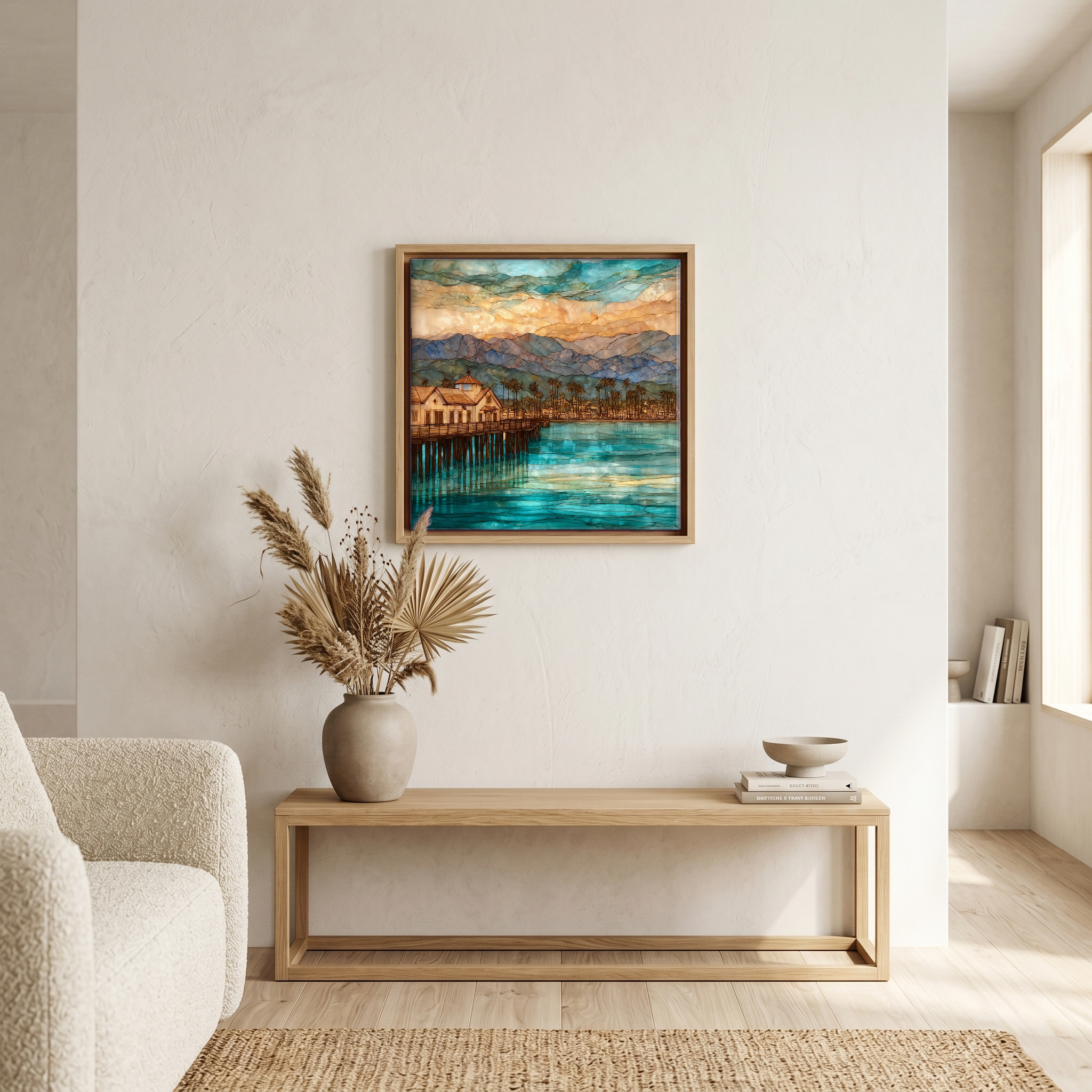
Above the bench, in a warm oak surround.
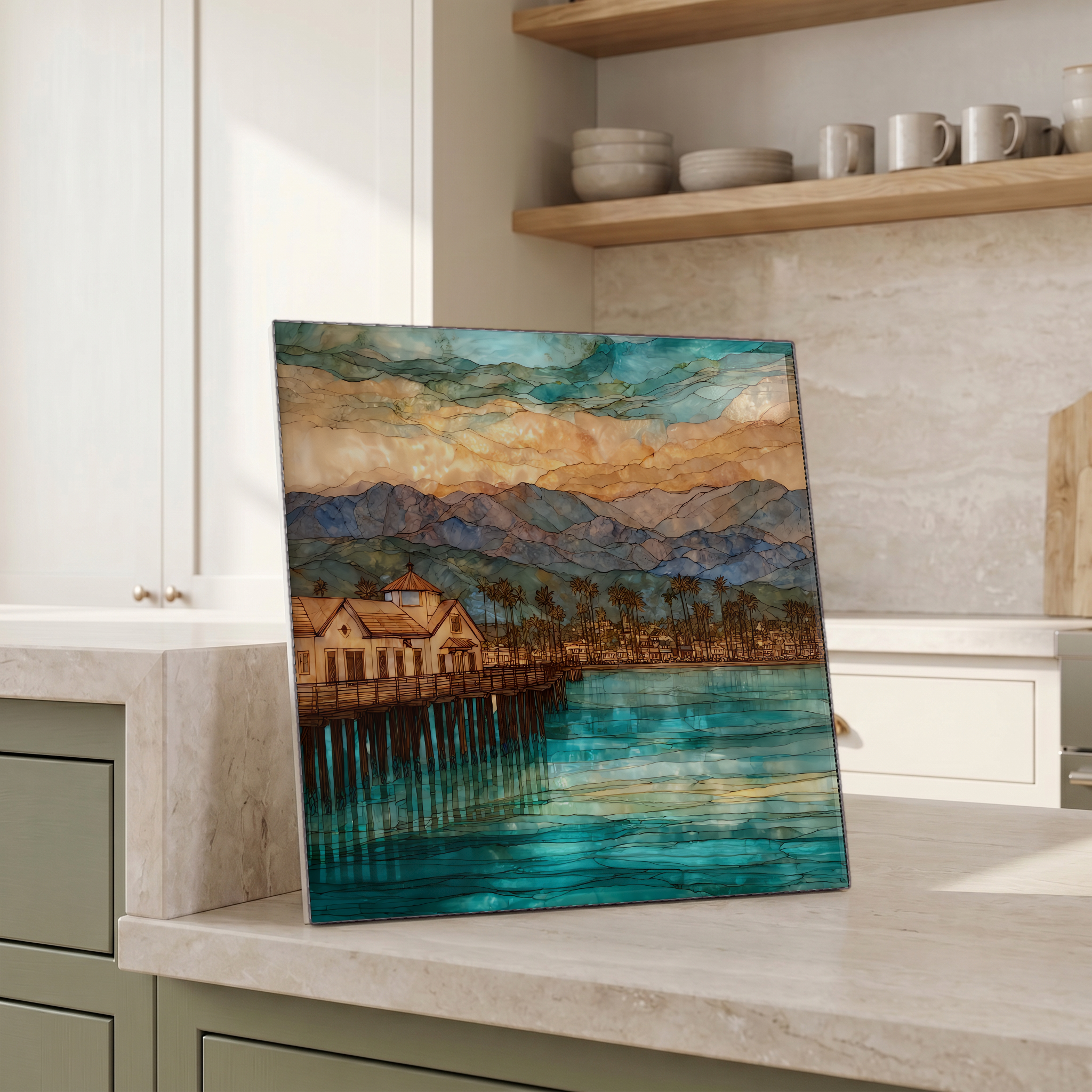
Beside the kettle, propped on the counter.
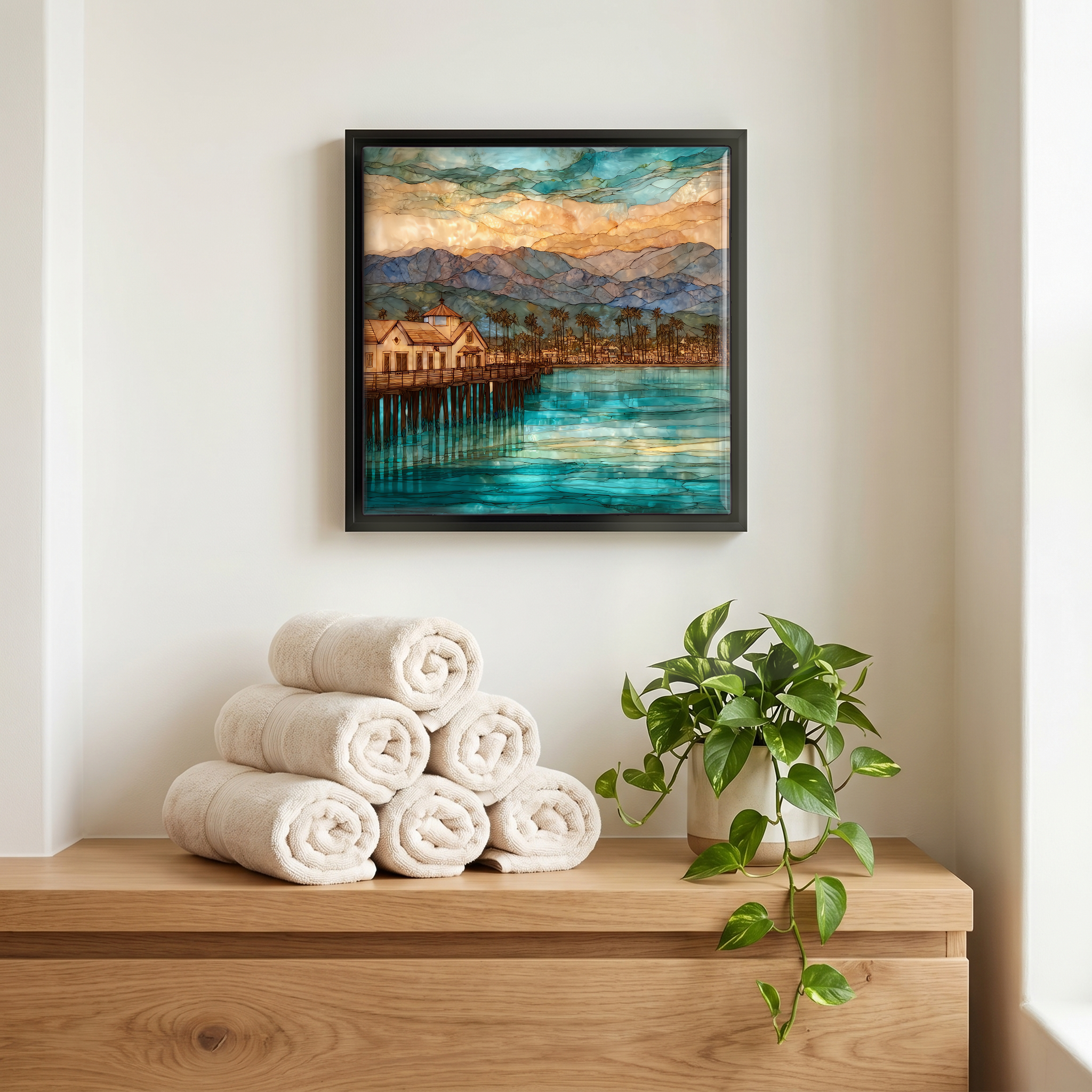
Above the linens, in a slim black surround.
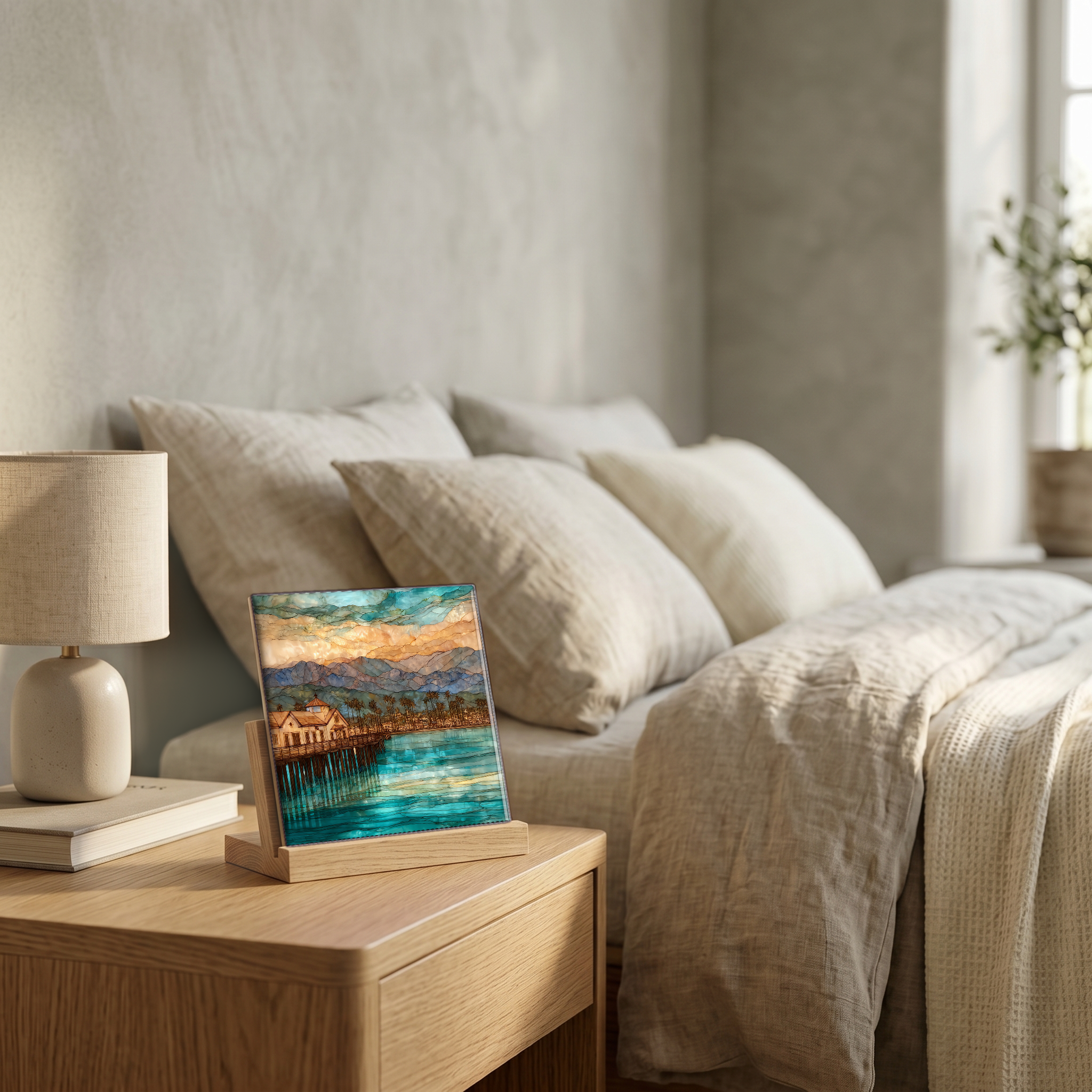
On the nightstand, on a light oak stand.
On a picture ledge, where the light comes in.
a note from the studio

The oldest continuously operating wooden wharf on the California coast, built by John Peck Stearns in 1872 at the foot of State Street in Santa Barbara. It runs roughly 2,300 feet out into the harbour, set on creosoted pilings that have been rebuilt more than once after fire and storm. Cars are still allowed on the deck, which is unusual for a working pier. At the far end the Santa Barbara Museum of Natural History runs a small Sea Center over the water, and a row of restaurants and shops occupies the middle stretch. The light over the channel changes more times in a day than seems fair.
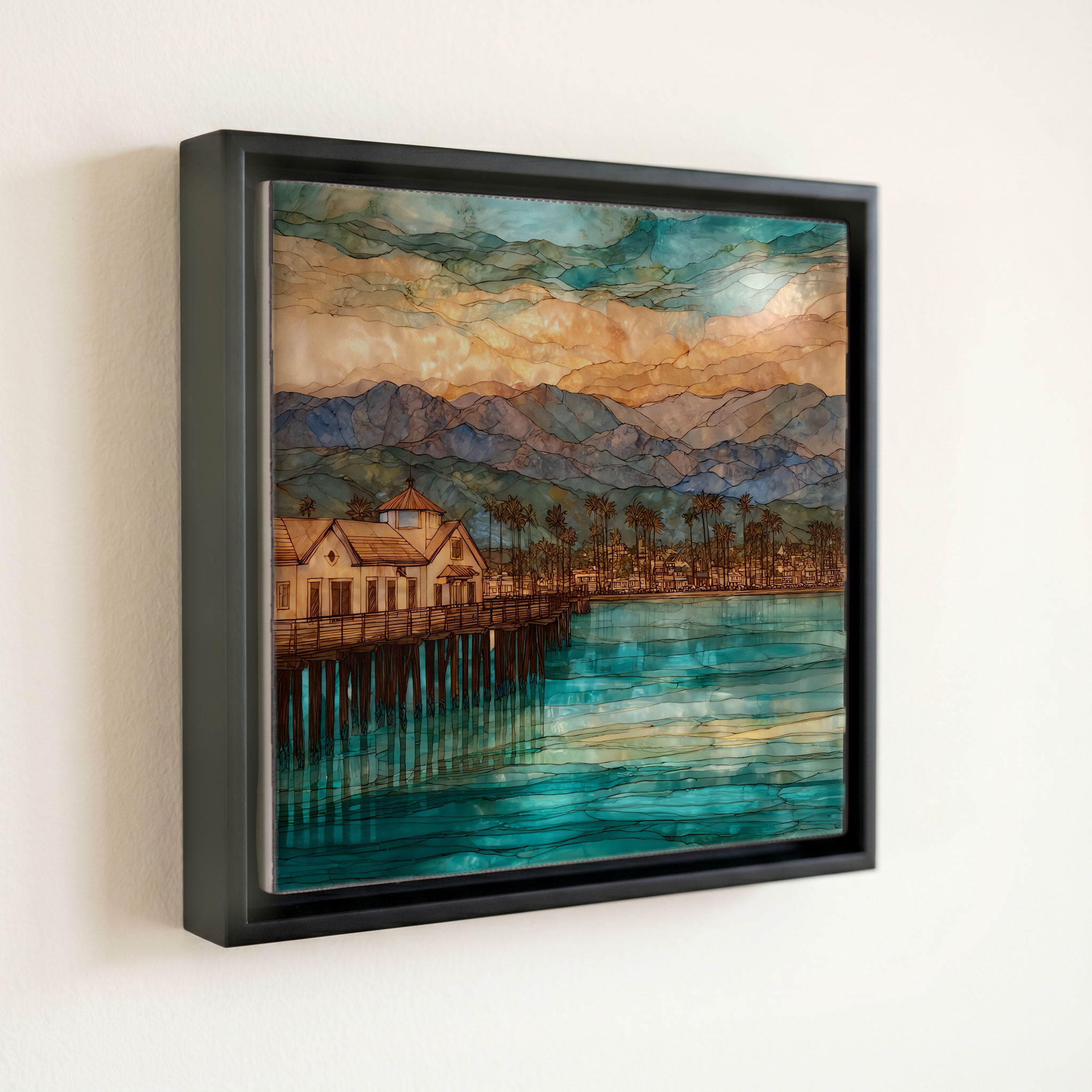
from the studio
shown in a slim black floating frame · 6 × 6 in
— bring it home

Stearns Wharf, on ceramic.

Each tile is finished by hand in our Knoxville studio. Artwork is slowly infused into the ceramic surface under high heat and pressure, and rests beneath a thin glossy finish. The colour lives in the surface, not on top of it.

What kind of piece?
One tile — square or rectangle.
How big?
the popular one — counter, shelf, nightstand
6 × 6 in · 15 cm · 1.6 lb
Surface finish
A clear glossy finish — the artwork reads as if under resin. Ideal for show-pieces and framed wall art.
How it sits
A hidden cleat — sits ¼″ proud of the wall.
$58
Hand-finished and shipped from our studio at the foot of the Smokies. On your wall in about ten days.
size
6 × 6 in
15 cm
weighs
1.6 lb
solid in the hand
surface
ceramic, hand-finished
art rests beneath a thin glossy finish
from
Knoxville, TN
our family studio, at the foot of the Smokies
— start a Coaster Set

Pick any four 4-inch tiles — National Parks you've been to, a Smokies set, the four seasons of one place. $ for a set of , cork-backed, ready to live on the table.
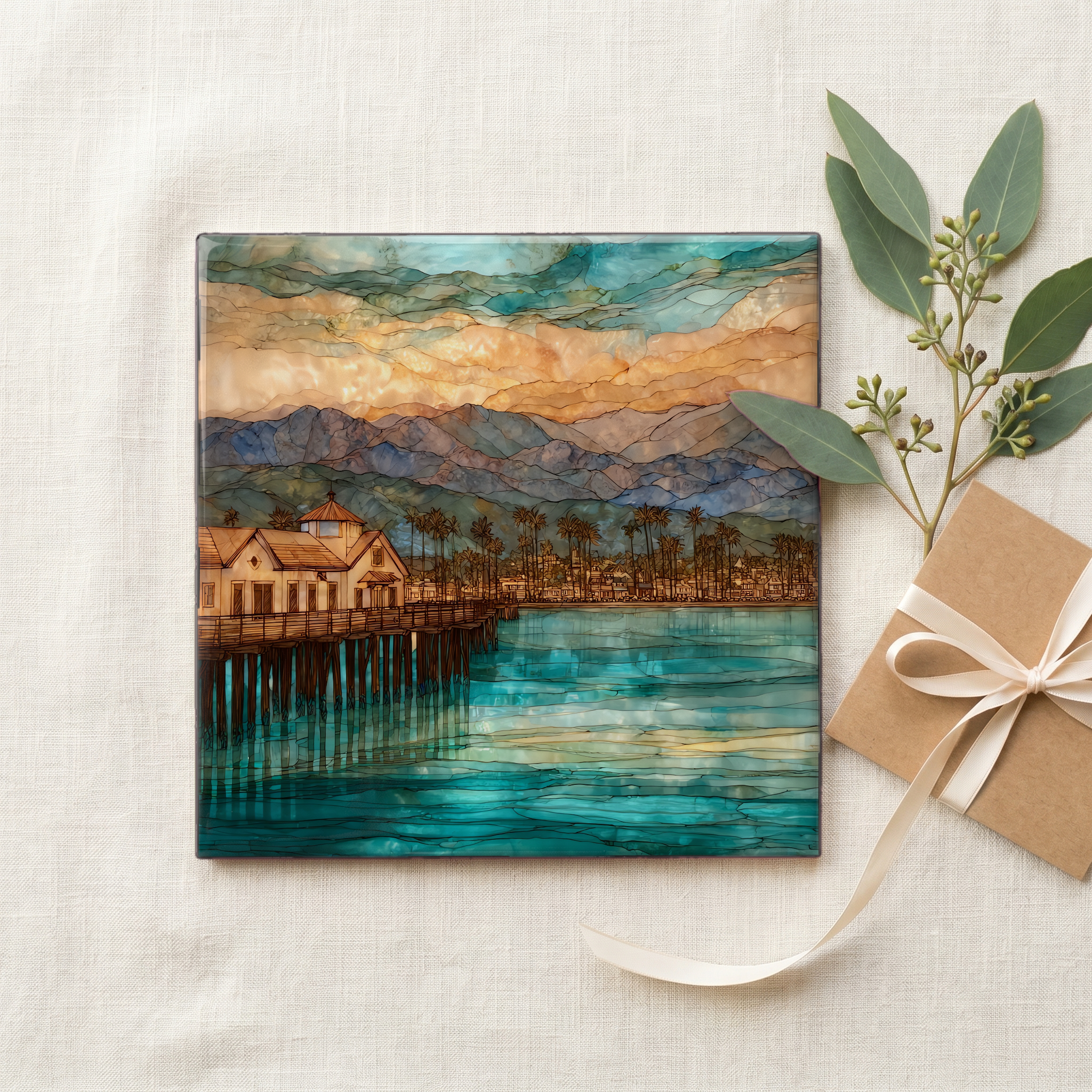
comes gift-ready
comes gift-ready

Each tile ships in a kraft box, tied with cream ribbon, with a handwritten note from the studio if you'd like to add one.
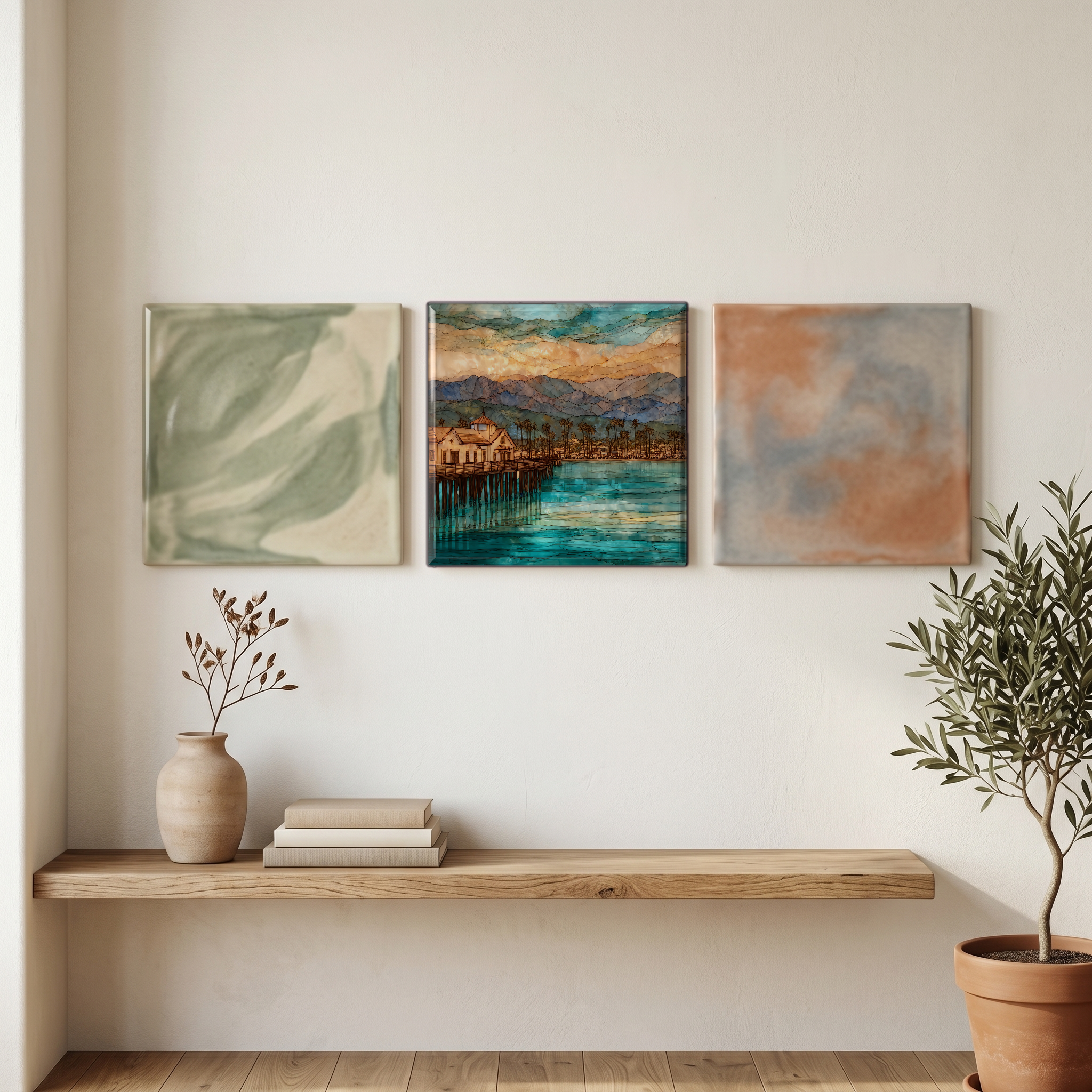
or build a grouping
or build a grouping

Three or five different vistas, hung together — a chapter of places you've been, or want to go.

about Stearns Wharf

The place, in three passes.

A little of what's known, in case you fall down the rabbit hole — or want to go see it yourself.
the place

Stearns Wharf sits at the southern end of State Street in Santa Barbara, California, jutting into the Santa Barbara Channel. The wharf is owned by the City of Santa Barbara and managed by its Waterfront Department, and is one of the few public piers in California that still permits car access along most of its deck. The deck runs about 2,300 feet from the shoreline to the seaward end. The channel itself separates the mainland from the Northern Channel Islands: Anacapa, Santa Cruz, Santa Rosa, and San Miguel, all visible from the wharf on clear afternoons. Whale-watch and harbour-tour boats operate from the slips at the foot of the deck.

the year

The wharf was completed in 1872 by John Peck Stearns, a Massachusetts-born lumberman, and served as the deep-water port for Santa Barbara and the coastal steamer trade for decades. It has burned and been rebuilt more than once, with the most serious fires in 1973 and 1998, each time replaced on its creosoted Douglas-fir pilings. James Cagney and his brothers William and Edward bought the wharf in 1944 and held it until it was returned to the City of Santa Barbara in 1983. It is listed in the National Register of Historic Places. Pelicans still roost on the railings as they did in the old photographs from the 1890s, when the cargo was hides and lumber.

the visit

The wharf is open every day and free to walk. Cars may drive on and park along the deck for a small fee, which is rare among California public piers; the single lane is shared with foot traffic and speeds are kept low. Toward the seaward end is the Santa Barbara Sea Center, a small saltwater aquarium and touch-tank operated by the Santa Barbara Museum of Natural History since 2005, with viewing windows that look directly down into the channel. Restaurants and shops sit along the middle stretch, several of which have operated as concerns for over a century. Sunset is the busiest hour, when the light catches the Santa Ynez foothills behind the city and the channel turns copper.

where
United States · Santa Barbara County, California
elevation
0 m · 0 ft
position
34.4093° N · 119.6857° W
the neighborhood

What's nearby.

A handful of named places within an hour's walk or short drive. Some we've already painted; some we will.
at the lake
State Street
main street
1 km W
Santa Barbara Harbor
harbour
1 km N
Santa Barbara County Courthouse
civic landmark
3 km N
Old Mission Santa Barbara
Spanish mission
2 km E
East Beach
city beach
6 km E
Butterfly Beach
coastal beach
N
Stearns Wharf
State Street
Santa Barbara Harbor
Santa Barbara County Courthouse
Old Mission Santa Barbara
East Beach
Butterfly Beach
common questions

What people ask.

A few questions we get about Stearns Wharf — and about bringing the piece home.
about the place

At the foot of State Street in downtown Santa Barbara, California, on the south coast about 90 miles north of Los Angeles. The wharf runs roughly 2,300 feet into the Santa Barbara Channel, with the Northern Channel Islands visible offshore on clear days.

It was completed in 1872 by John Peck Stearns, making it the oldest continuously operating wooden wharf on the California coast. The pilings have been replaced more than once after storm and fire damage, but the wharf has carried traffic in some form for over 150 years.

Yes. Cars may drive on and park along the deck for a fee, which is rare among California public piers. The single lane is shared with foot traffic; speeds are kept very low. The far end of the wharf is a turnaround.

The Santa Barbara Sea Center is a small saltwater aquarium and touch-tank exhibit operated by the Santa Barbara Museum of Natural History since 2005. It sits at the seaward end of Stearns Wharf, with viewing windows that look directly down into the channel.

Yes, more than once. The most serious fires came in 1973 and 1998, each followed by a substantial rebuild on the original alignment. Lesser repairs have been made after winter storm damage in the years between.

The City of Santa Barbara owns the wharf, through its Waterfront Department. James Cagney and his brothers William and Edward owned it from 1944 through the mid-twentieth century, until it was returned to the City in 1983.

No. Walking on Stearns Wharf is free and the deck is open every day. The fee applies only to vehicles parked along the deck, which is the unusual feature of this particular pier among California public wharves.

about the piece in your home

For someone who knows State Street, the courthouse, and the long view down the channel, a piece of Stearns Wharf carries the city quietly. A Small or Medium in the Glossy finish sits well in a hallway or study, with a handwritten note from the studio.

The Pacific blues, weathered pier-wood greys, and Santa Ynez foothill browns sit well in coastal-modern, California-modern, and Spanish-colonial revival rooms. The painterly treatment also reads as a single colour anchor in a more minimal space with linen and oak.

Yes. The current coastal-modern direction leans into painterly, illustrative work rather than literal photography. The stained-glass treatment of Stearns Wharf carries the place without becoming a postcard, and the channel blue plays well with bone, linen, and pale oak.

Above a sofa, a single Large at 24 inches anchors the wall; a 4-tile Mural at 36 inches fills a longer space. Above a console, the Medium or the smaller 4-tile Mural is the usual call.

Yes. The Dura Satin and Matte finishes are scratch-resistant and made for high-moisture rooms, including showers and full-height backsplashes. The Glossy finish is reserved for show-pieces and framed wall art rather than wet installations.

A microfibre cloth and water. No abrasive pads, no bleach. The colour lives in the surface of the tile and will not fade or scratch off in normal household use.

Yes. Every WenderVista piece is drawn in Wender Studios' own visual language; the painting was made in-house, and the studio holds the original. We do not license third-party art.

if this one stayed with you

A few you might also love.

Hand-picked by the eye that found Sorapis. Same air, same kind of quiet.