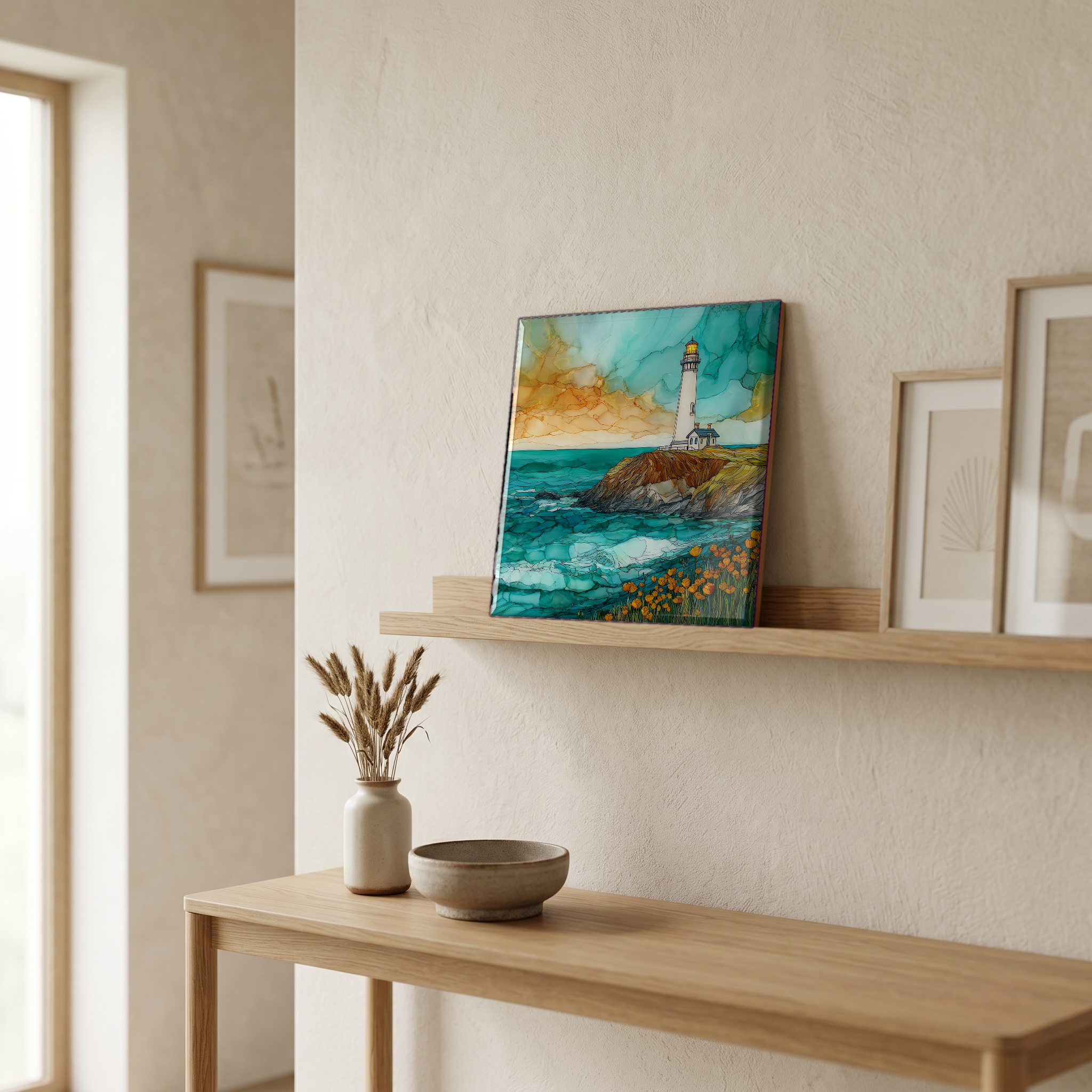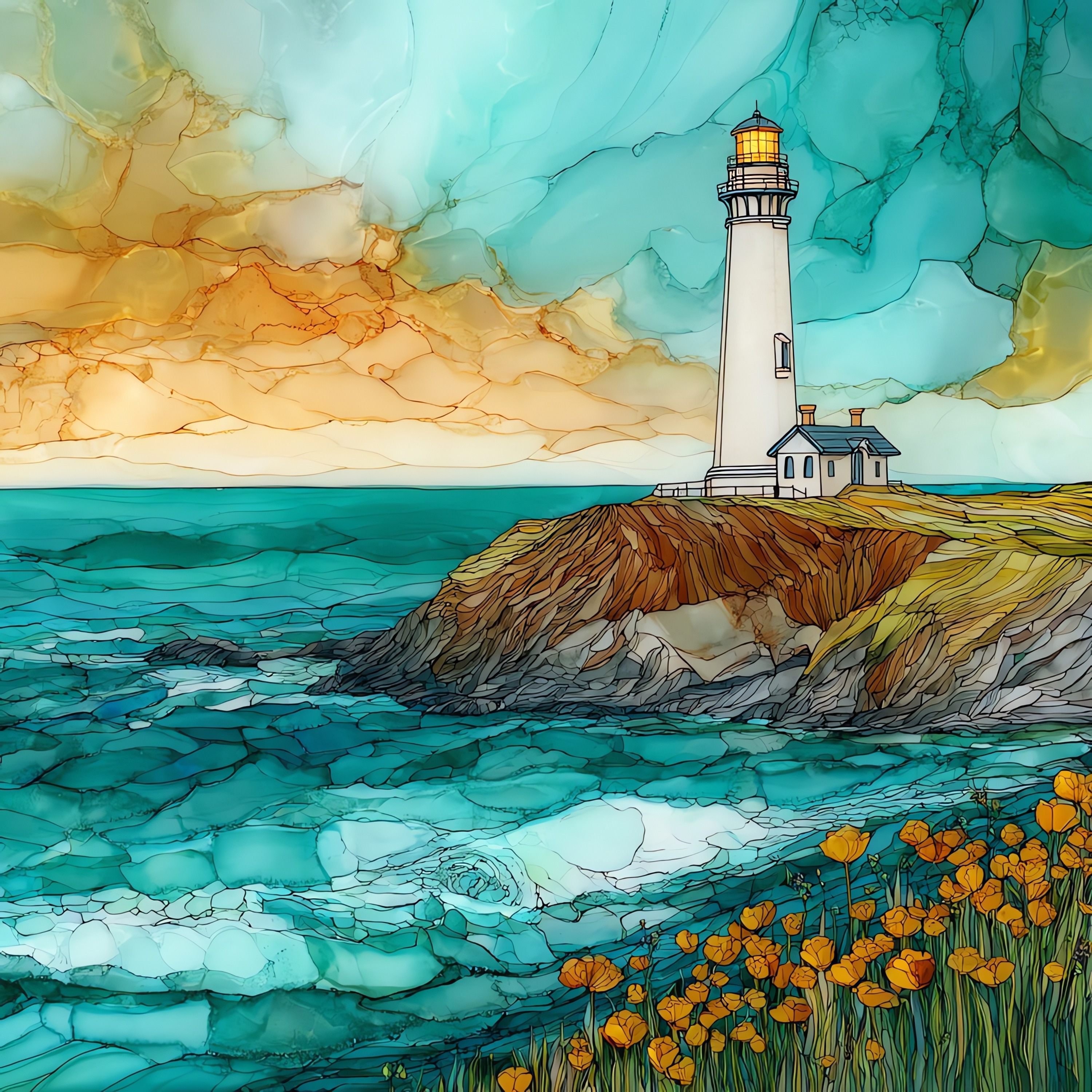
Wender·Vista
Point Arena Lighthouse
shown on ceramic, 12-inch tileCalifornia · United States
on the Mendocino coast, where the San Andreas comes ashore

Point Arena Lighthouse

— the tower the 1906 quake brought down.

Where it lives

Not only on a wall.

A small tile on the nightstand catching the morning. A larger one above the fire. Yours, wherever you spend the slow hours.
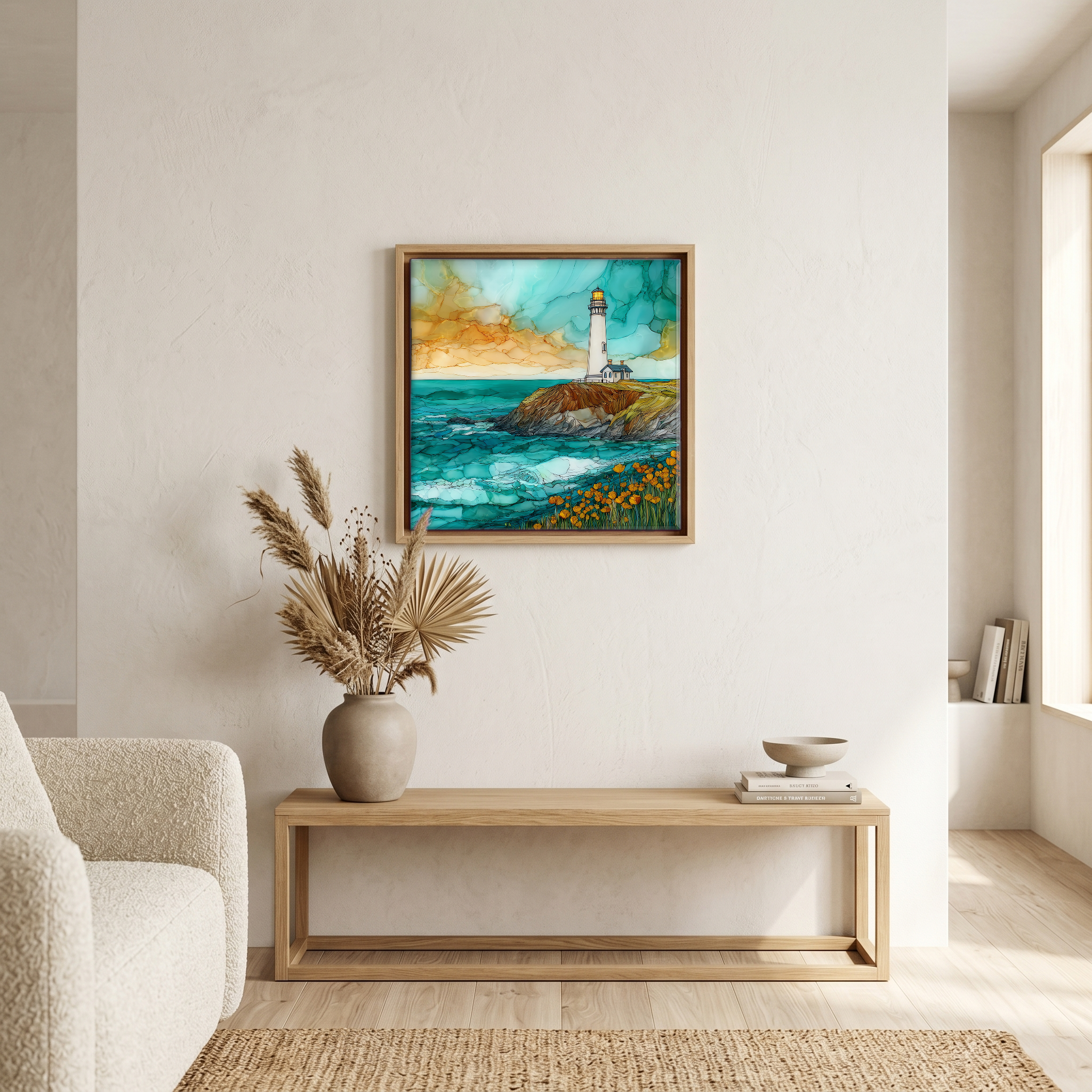
Above the bench, in a warm oak surround.
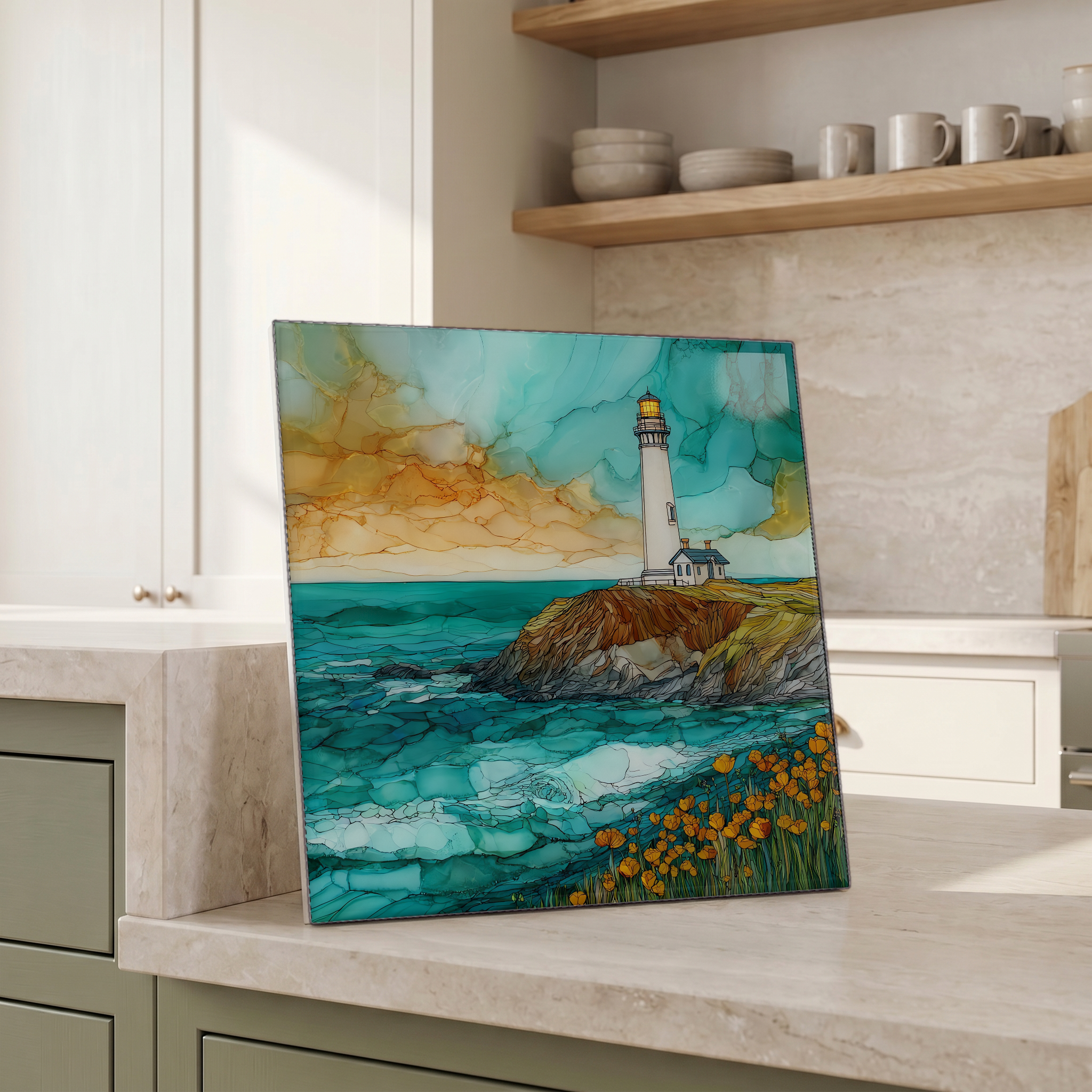
Beside the kettle, propped on the counter.
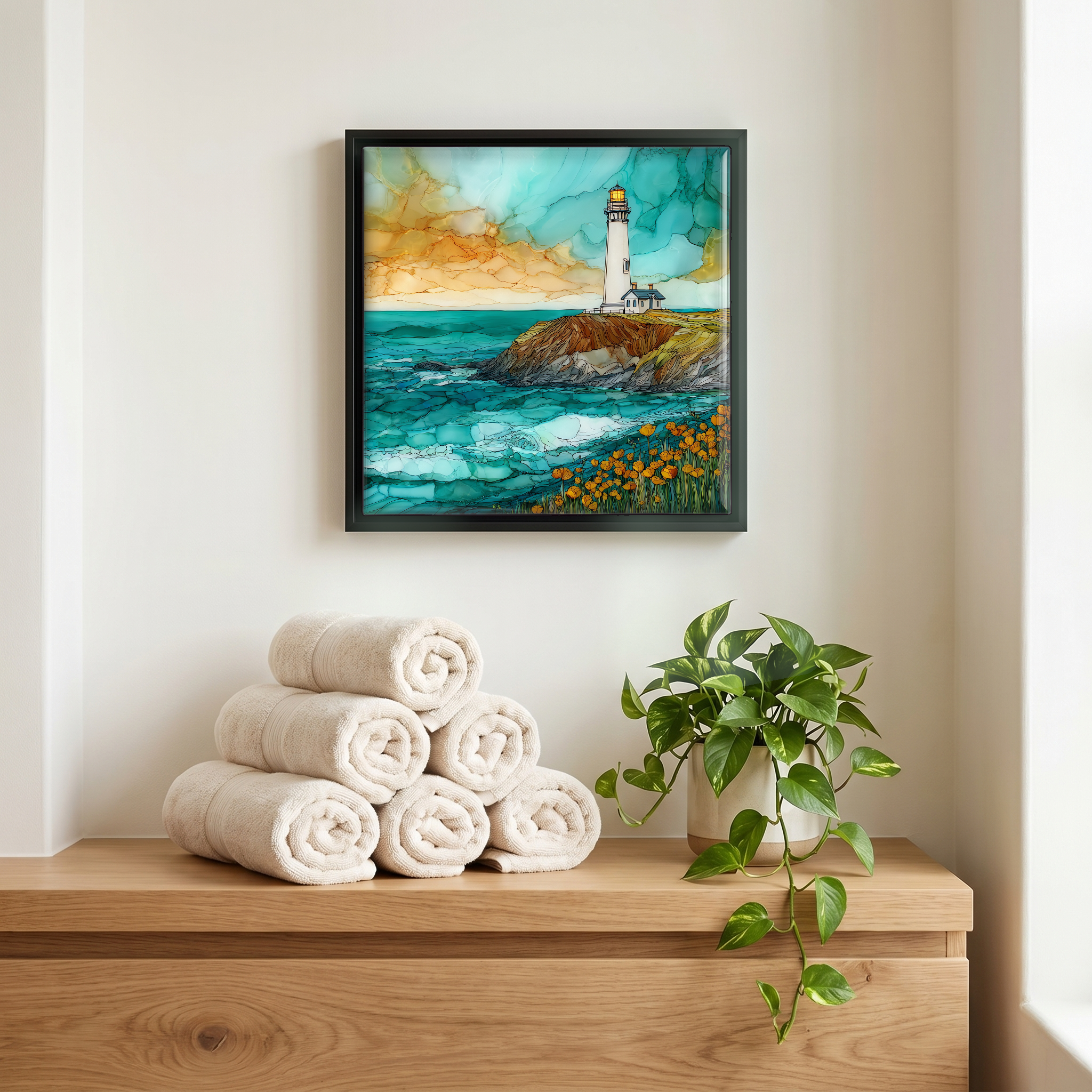
Above the linens, in a slim black surround.
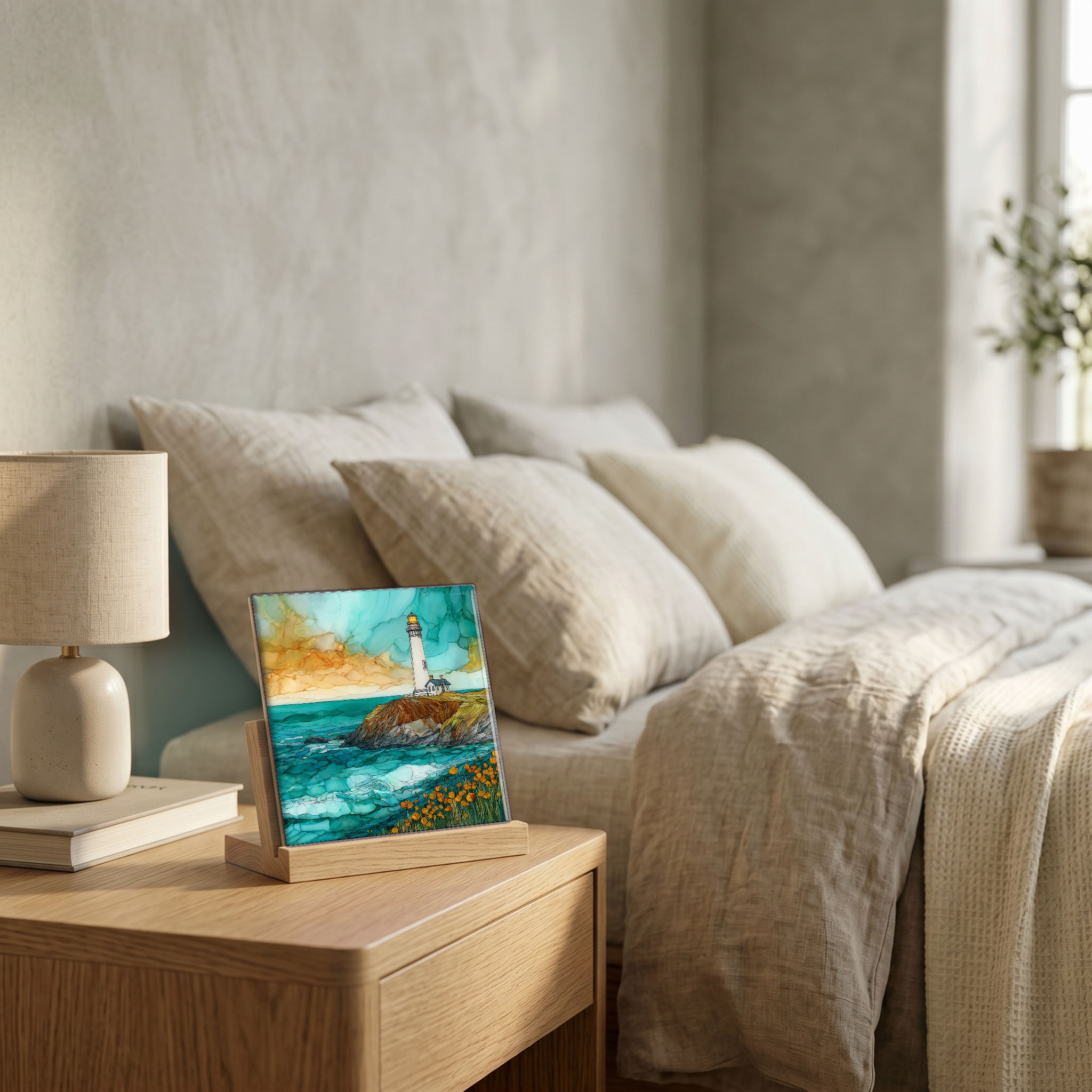
On the nightstand, on a light oak stand.
On a picture ledge, where the light comes in.
a note from the studio

A 115-foot concrete tower on the Mendocino coast of California, standing on a headland just north of where the San Andreas Fault comes ashore at Manchester Beach. The original brick lighthouse, lit in 1870, was destroyed by the 18 April 1906 earthquake — Point Arena was closer to the rupture than San Francisco. The current tower was completed in 1908 as the first steel-reinforced concrete lighthouse in the United States, engineered to withstand the next quake. The first-order Fresnel lens that lit the new tower is now on display in the museum at the base. The light was automated in 1977, and the keepers' cottages have since been let as overnight lodging.
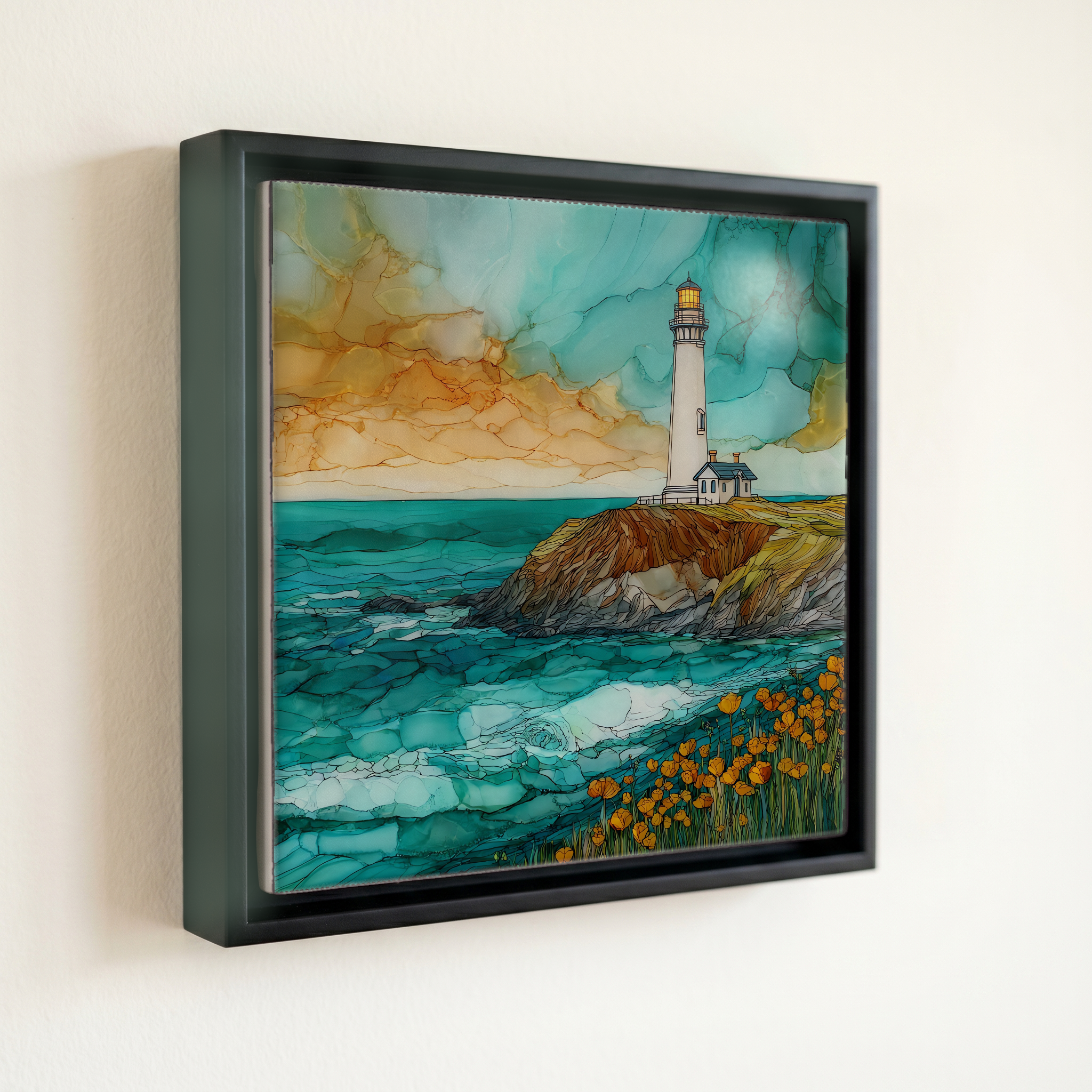
from the studio
shown in a slim black floating frame · 6 × 6 in
— bring it home

Point Arena Lighthouse, on ceramic.

Each tile is finished by hand in our Knoxville studio. Artwork is slowly infused into the ceramic surface under high heat and pressure, and rests beneath a thin glossy finish. The colour lives in the surface, not on top of it.

What kind of piece?
One tile — square or rectangle.
How big?
the popular one — counter, shelf, nightstand
6 × 6 in · 15 cm · 1.6 lb
Surface finish
A clear glossy finish — the artwork reads as if under resin. Ideal for show-pieces and framed wall art.
How it sits
A hidden cleat — sits ¼″ proud of the wall.
$58
Hand-finished and shipped from our studio at the foot of the Smokies. On your wall in about ten days.
size
6 × 6 in
15 cm
weighs
1.6 lb
solid in the hand
surface
ceramic, hand-finished
art rests beneath a thin glossy finish
from
Knoxville, TN
our family studio, at the foot of the Smokies
— start a Coaster Set

Pick any four 4-inch tiles — National Parks you've been to, a Smokies set, the four seasons of one place. $ for a set of , cork-backed, ready to live on the table.

comes gift-ready
comes gift-ready

Each tile ships in a kraft box, tied with cream ribbon, with a handwritten note from the studio if you'd like to add one.
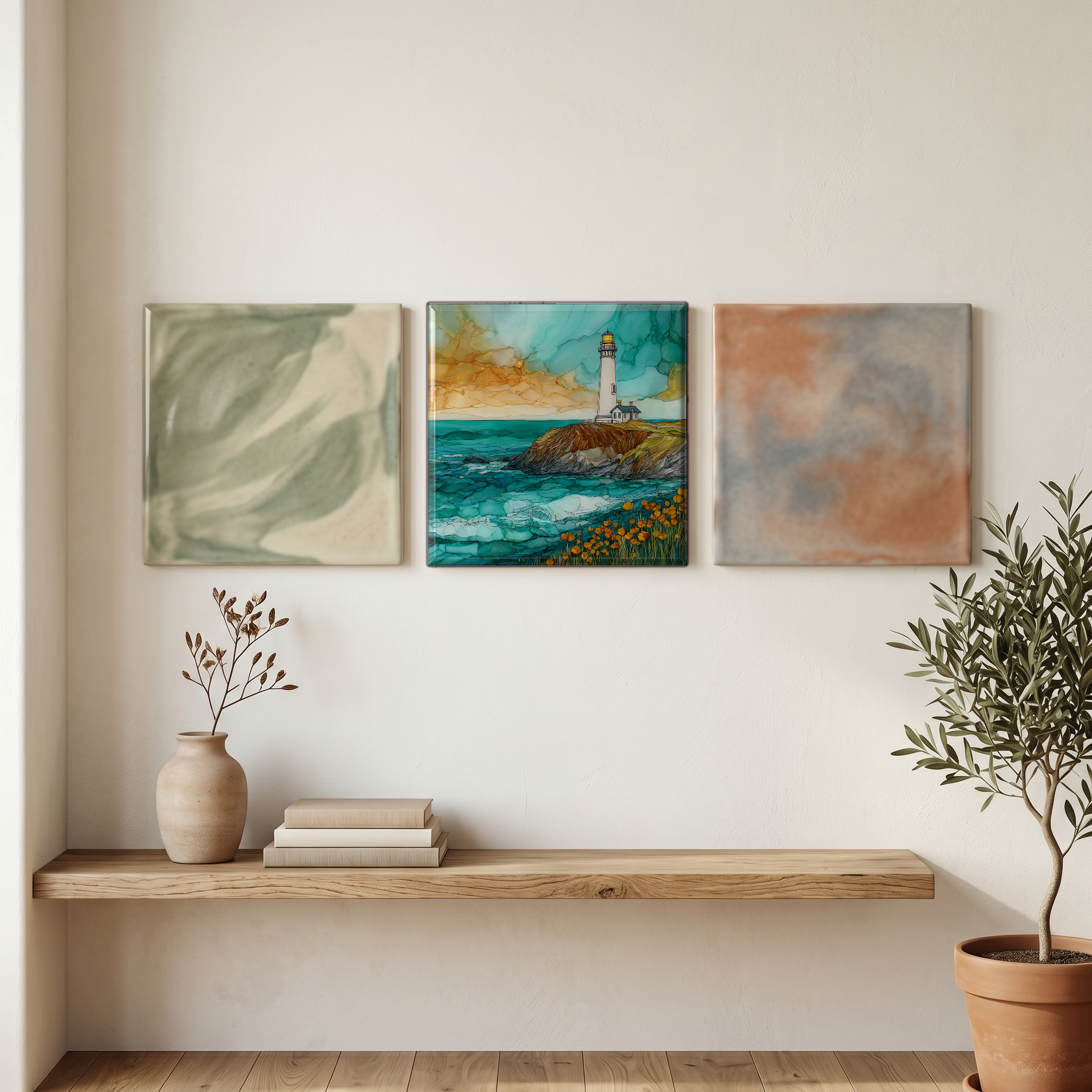
or build a grouping
or build a grouping

Three or five different vistas, hung together — a chapter of places you've been, or want to go.

about Point Arena Lighthouse

The place, in three passes.

A little of what's known, in case you fall down the rabbit hole — or want to go see it yourself.
the place

Point Arena Lighthouse stands on a small headland at the western tip of Mendocino County, California, about 130 road miles north of San Francisco and forty miles south of Mendocino village. The point is one of the westernmost on the California coast and the closest point of the United States mainland to the Hawaiian Islands. The grounds and tower are managed by the Point Arena Lighthouse Keepers, a nonprofit holding a long-term lease from the U.S. Coast Guard. The Bureau of Land Management's Stornetta Public Lands extend the open coast immediately north as part of the California Coastal National Monument.

the stone

The first Point Arena light was lit in 1870, a brick tower 100 feet tall above the Pacific. The 18 April 1906 earthquake brought it down: the San Andreas Fault comes ashore at Manchester Beach about six miles south, putting Point Arena closer to the rupture than San Francisco. The current tower was completed in 1908 as the first steel-reinforced concrete lighthouse in the United States, engineered to withstand the next quake. It stands 115 feet from base to lantern, tied with Pigeon Point Light as the tallest on the U.S. West Coast. The first-order Fresnel lens, manufactured in Paris and shipped around Cape Horn, is now on display in the museum at the base.

the visit

The grounds, museum, and tower are open daily, generally from late morning to mid-afternoon. Visitors can climb the 145-step spiral stair to the gallery deck below the lantern room; the lens room above is closed. The museum at the base of the tower houses the first-order Fresnel lens that lit the 1908 lighthouse from its first night until automation in 1977. Four former keepers' cottages and the assistant keeper's house are rented as overnight lodging on the grounds, with grey whales offshore in winter and harbour seals on the rocks below the cliff. The site is operated by the Point Arena Lighthouse Keepers nonprofit.

where
United States · Mendocino County, California
within
California Coastal National Monument
elevation
18 m · 60 ft
position
38.9550° N · 123.7406° W
the neighborhood

What's nearby.

A handful of named places within an hour's walk or short drive. Some we've already painted; some we will.
3 km S
Point Arena
coastal town
10 km S
Manchester State Beach
state beach
1 km N
Stornetta Public Lands
BLM coastal lands
20 km S
Anchor Bay
coastal community
25 km S
Gualala
coastal town
65 km N
Mendocino
coastal village
50 km S
Sea Ranch
coastal community
N
Point Arena Lighthouse
Point Arena
Manchester State Beach
Stornetta Public Lands
Anchor Bay
Gualala
Mendocino
Sea Ranch
common questions

What people ask.

A few questions we get about Point Arena Lighthouse — and about bringing the piece home.
about the place

Point Arena Lighthouse is on a small headland at the western tip of Mendocino County, California, about 130 road miles north of San Francisco and forty miles south of Mendocino village. The point is among the westernmost on the California coast and the closest point of the mainland United States to the Hawaiian Islands.

The tower stands 115 feet from base to lantern, tied with Pigeon Point Light as the tallest on the U.S. West Coast. The walls are steel-reinforced concrete, four feet thick at the base, and a 145-step cast-iron spiral stair runs up the centre to the gallery deck below the lantern room.

The original brick lighthouse was lit in 1870. It was destroyed by the 18 April 1906 earthquake and rebuilt in 1908 as the first steel-reinforced concrete lighthouse in the United States. The current tower was lit on 25 September 1908 and is still in service as an active aid to navigation.

Very close. The San Andreas Fault comes ashore from the Pacific at Manchester Beach about six miles south of the lighthouse. The 1906 earthquake destroyed the original tower, which is why the 1908 replacement was built of steel-reinforced concrete, the first U.S. lighthouse of that construction.

Yes. Visitors can climb the 145-step cast-iron spiral stair to the gallery deck just below the lantern room. The lens room above is closed to climbing. Admission supports the Point Arena Lighthouse Keepers, the nonprofit that operates the site under a long-term lease from the U.S. Coast Guard.

The first-order Fresnel lens that lit the 1908 tower from its first night until automation in 1977 is displayed in the museum at the base of the lighthouse. It was manufactured in Paris by Henry-Lepaute, shipped around Cape Horn, and held a five-wick oil lamp at its centre before electrification.

Yes. Four former keepers' cottages and the assistant keeper's house on the lighthouse grounds are rented as overnight lodging by the Point Arena Lighthouse Keepers. Grey whales pass offshore in winter and harbour seals haul out on the rocks below the cliff. Booking ahead is usually required.

about the piece in your home

For someone who has driven Highway 1 north through Gualala and Anchor Bay, a piece of Point Arena carries the headland and the long open Pacific. A Small or Medium in the Glossy finish sits well in a hallway or study, with a handwritten note from the studio.

Point Arena is one of the tallest lighthouses on the U.S. West Coast and the first steel-reinforced concrete lighthouse in the country. The artwork holds the tower and the open Pacific rather than the technical detail. The Medium in the Glossy finish reads well alongside other lighthouse pieces.

The Pacific blues, the white tower, and the headland greens read well in coastal-modern, California-modern, and New England rooms. The painterly stained-glass treatment also reads as a single colour anchor in a more minimal space with linen and oak.

Above a sofa, a single Large at 24 inches anchors the wall; a 4-tile Mural at 36 inches fills a longer space. Above a console, the Medium or the smaller 4-tile Mural is the usual call.

Yes. The Dura Satin and Matte finishes are scratch-resistant and made for high-moisture rooms, including showers and full-height backsplashes. The Glossy finish is reserved for show-pieces and framed wall art rather than wet installations.

A microfibre cloth and water. No abrasive pads, no bleach. The colour lives in the surface of the tile and will not fade or scratch off in normal household use.

Yes. Every WenderVista piece is drawn in Wender Studios' own visual language; the painting was made in-house, and the studio holds the original. We do not license third-party art.

if this one stayed with you

A few you might also love.

Hand-picked by the eye that found Sorapis. Same air, same kind of quiet.