
Pacific Grove
— a coast the fog keeps quiet most mornings.
Not only on a wall.





“Pacific Grove sits on the tip of the Monterey Peninsula, between Monterey to the east and Pebble Beach to the south. It was laid out in 1875 as a Methodist seaside retreat, and the small lots and gridded streets still carry that origin. Point Pinos has been lit since 1855, making it the oldest continuously operating lighthouse on the West Coast of the United States. Sea otters work the kelp off Lover's Point most mornings, and tidepools open along the Recreation Trail at low tide. The coast bends north to south here, so winter storms come in sideways and the fog can lift and settle three times in a single afternoon.
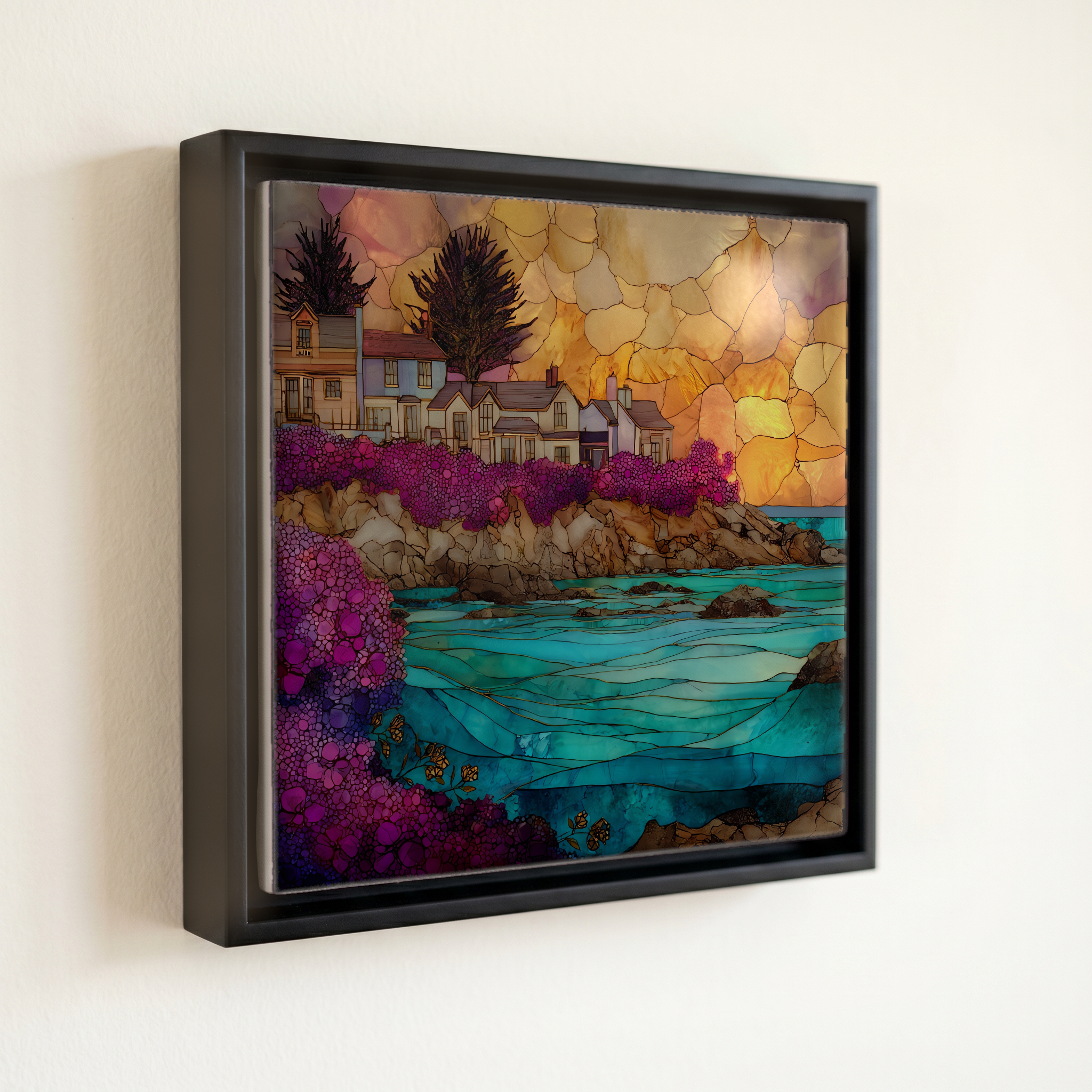
Pacific Grove, on ceramic.
Each tile is finished by hand in our Knoxville studio. Artwork is slowly infused into the ceramic surface under high heat and pressure, and rests beneath a thin glossy finish. The colour lives in the surface, not on top of it.
Pick any four 4-inch tiles — National Parks you've been to, a Smokies set, the four seasons of one place. $ for a set of , cork-backed, ready to live on the table.

Each tile ships in a kraft box, tied with cream ribbon, with a handwritten note from the studio if you'd like to add one.

Three or five different vistas, hung together — a chapter of places you've been, or want to go.
The place, in three passes.
Pacific Grove occupies the southern tip of the Monterey Peninsula in Monterey County, California, with the open Pacific on three sides. The city covers about 2.9 square miles and holds a population of roughly 15,000. It was founded in 1875 as the Pacific Grove Retreat by the Methodist Episcopal Church and ran on dry-town rules until 1969; the original camp lots are still visible in the small footprints of the older houses. The town borders Monterey on the east and the Del Monte Forest of Pebble Beach on the south, with the Asilomar Conference Grounds and Point Pinos along the western coast. The 17-Mile Drive begins at the Asilomar Gate.
The shoreline along Lover's Point, Berwick Park, and Asilomar holds one of the most accessible stretches of the giant kelp forest of Monterey Bay. Sea otters, a keystone species nearly extinct in California by 1900, recovered along this coast through the twentieth century and are now part of the daily view from the Recreation Trail. The Monterey Bay National Marine Sanctuary, designated in 1992, protects more than 6,000 square miles of water from Cambria to Marin and includes the entire Pacific Grove shore. Tidepools open at the low tides along Coral Street and Asilomar State Beach; the rocky substrate carries anemones, hermit crabs, turban snails, and the occasional rust-red sea star.
Point Pinos Lighthouse has guided ships off the western tip of Monterey Bay since 1 February 1855, making it the oldest continuously operating lighthouse on the West Coast. It is a small two-storey Cape Cod structure of local granite, with a third-order Fresnel lens still in place. A mile south, the Asilomar Conference Grounds hold one of Julia Morgan's earliest major commissions; she designed a series of redwood-and-stone YWCA buildings between 1913 and 1928, eleven of which survive on a site now run by California State Parks and listed as a National Historic Landmark. The town's older houses are mostly Queen Anne and Folk Victorian, set on the narrow 25-by-50-foot lots of the original Methodist camp.