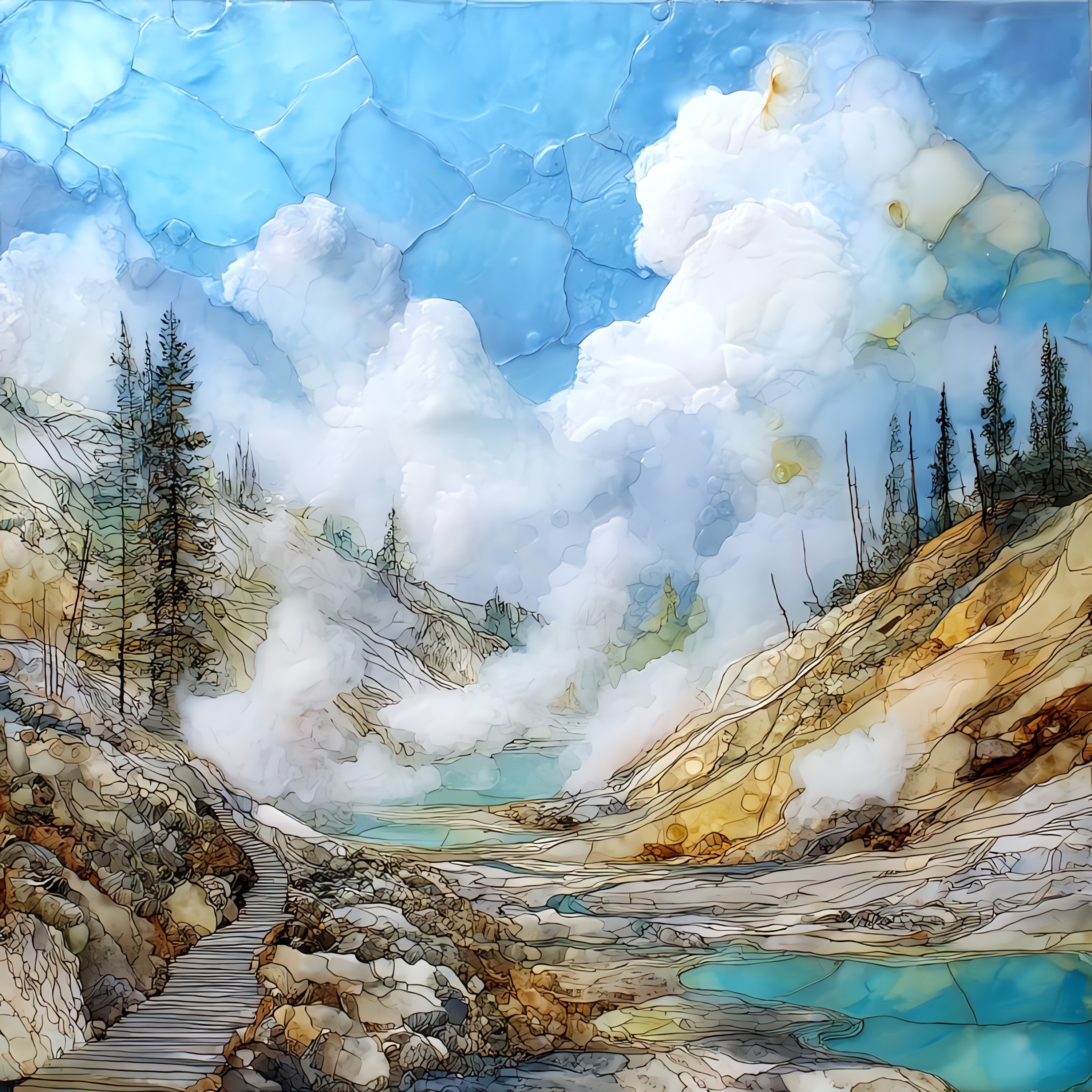
Bumpass Hell
— — the floor of a mountain that hasn't cooled yet.
Not only on a wall.




“Sixteen acres of boiling springs and fumaroles in the high country of Lassen Volcanic National Park, reached by a three-mile trail climbing from Highway 89. The crust is thin in places, and the boardwalk keeps visitors from the same mistake Kendall Bumpass made when he broke through it in 1865 and lost a leg. Steam comes up sulphur-yellow against the ash-grey pools, and Big Boiler, the largest fumarole, runs at temperatures recorded above 320 degrees. Lassen Peak, just north of the basin, last erupted in 1917 and is still classified as active. The road over the park melts open in late June and closes again by October.
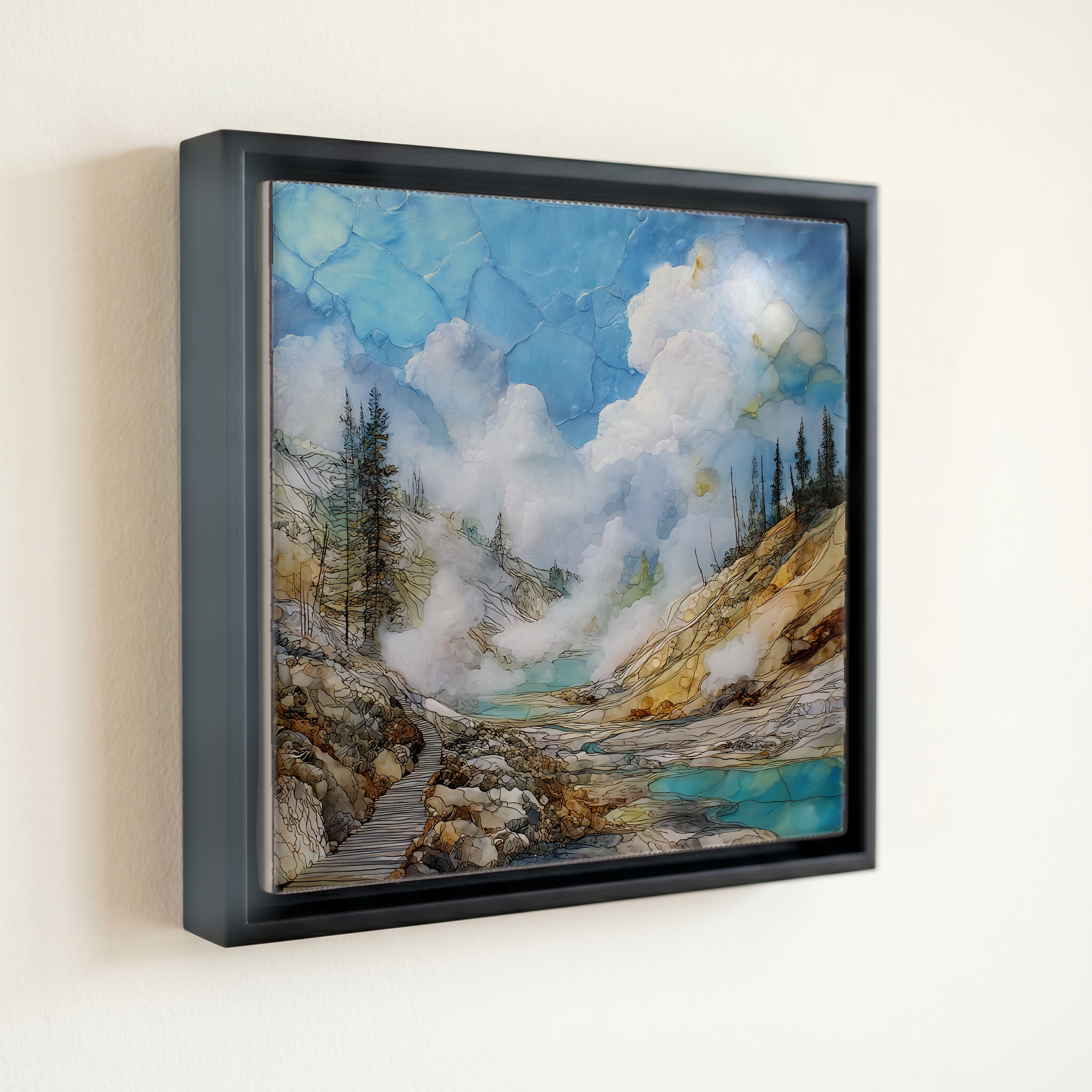
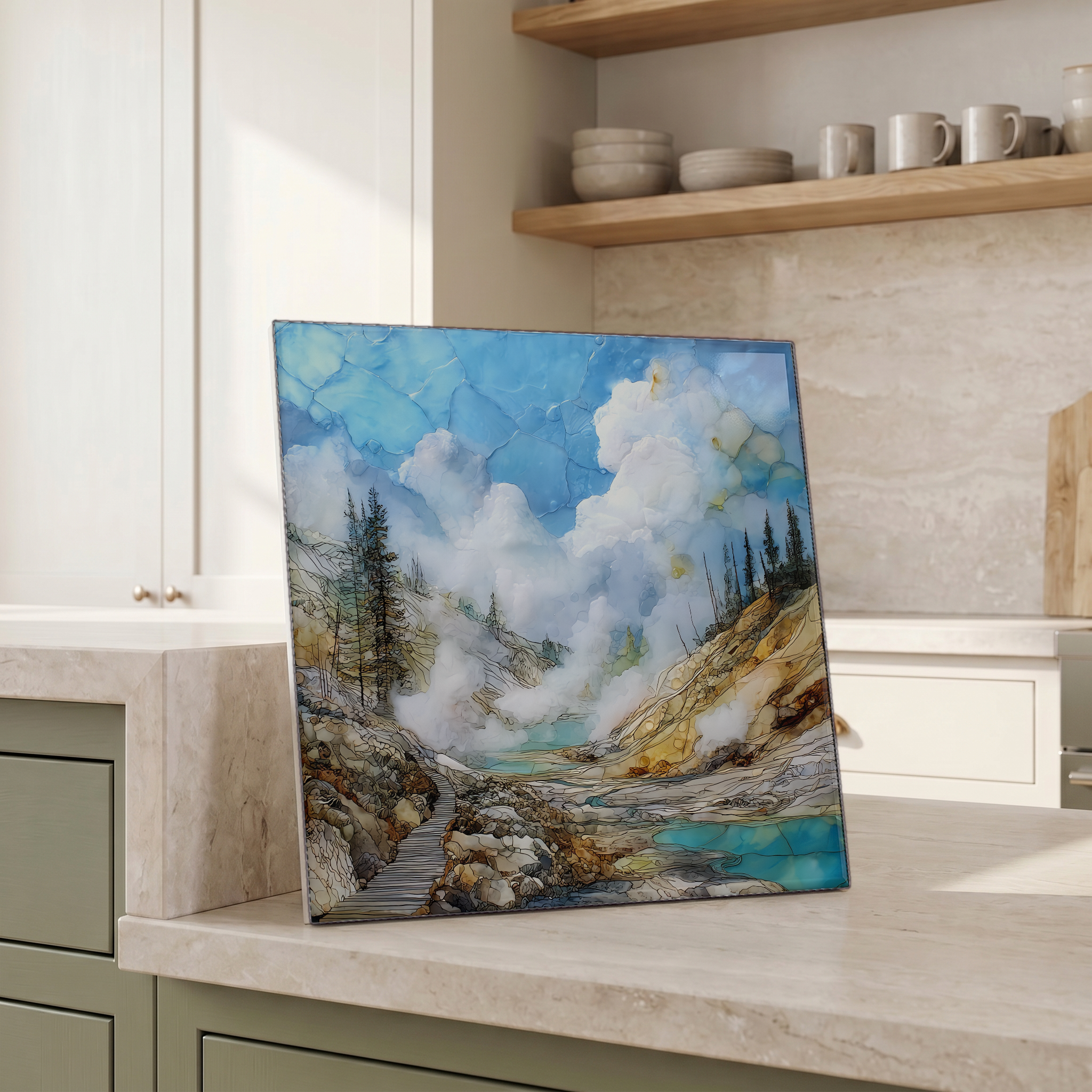
Bumpass Hell, on ceramic.
Each tile is finished by hand in our Knoxville studio. Artwork is slowly infused into the ceramic surface under high heat and pressure, and rests beneath a thin glossy finish. The colour lives in the surface, not on top of it.
Pick any four 4-inch tiles — National Parks you've been to, a Smokies set, the four seasons of one place. $ for a set of , cork-backed, ready to live on the table.

Each tile ships in a kraft box, tied with cream ribbon, with a handwritten note from the studio if you'd like to add one.

Three or five different vistas, hung together — a chapter of places you've been, or want to go.
The place, in three passes.
Bumpass Hell sits at roughly 8,000 feet in the southern section of Lassen Volcanic National Park, in Shasta County, California. It is the largest hydrothermal area in the park, about sixteen acres of fumaroles, mud pots, and superheated springs spread across a basin between Bumpass Mountain and Lake Helen. Access is on foot, three miles round-trip from a trailhead off the park highway between Lake Helen and the Sulphur Works. The basin is named for Kendall Vanhook Bumpass, a hunter and prospector who came across it in 1864 while tracking game and broke through the crust the following year, scalding his leg badly enough to require amputation.
The air at Bumpass Hell carries hydrogen sulphide, the sharp sulphur-match smell that signals a working hydrothermal system. The basin's largest fumarole, Big Boiler, has measured temperatures up to 322 degrees Fahrenheit, hot enough that geologists rank it among the hottest non-eruptive fumaroles on the planet. At 8,000 feet the air also thins, and visitors used to sea-level pressure feel it on the climb out. The acidity in the steam is corrosive, which is why the boardwalks across the basin are replaced on a cycle and why the pools have eaten the rhyolite around them down to the chalky, pale ground the boardwalks now cross.
The park highway that reaches the Bumpass Hell trailhead, State Route 89, is closed by snow for most of the year. The road typically opens in late June and closes again in late October or early November, with the exact dates depending on snowpack. The area around Lake Helen routinely holds twenty feet of snow into May. Inside that window, the trail is at its driest and warmest in August and September; July often has lingering snow on the upper switchbacks. The National Park Service warns visitors to stay on the boardwalks at all times, to keep pets out of the basin entirely, and to leave dogs at home or in vehicles, since hydrogen sulphide concentrations near the pools can reach harmful levels at ground height.