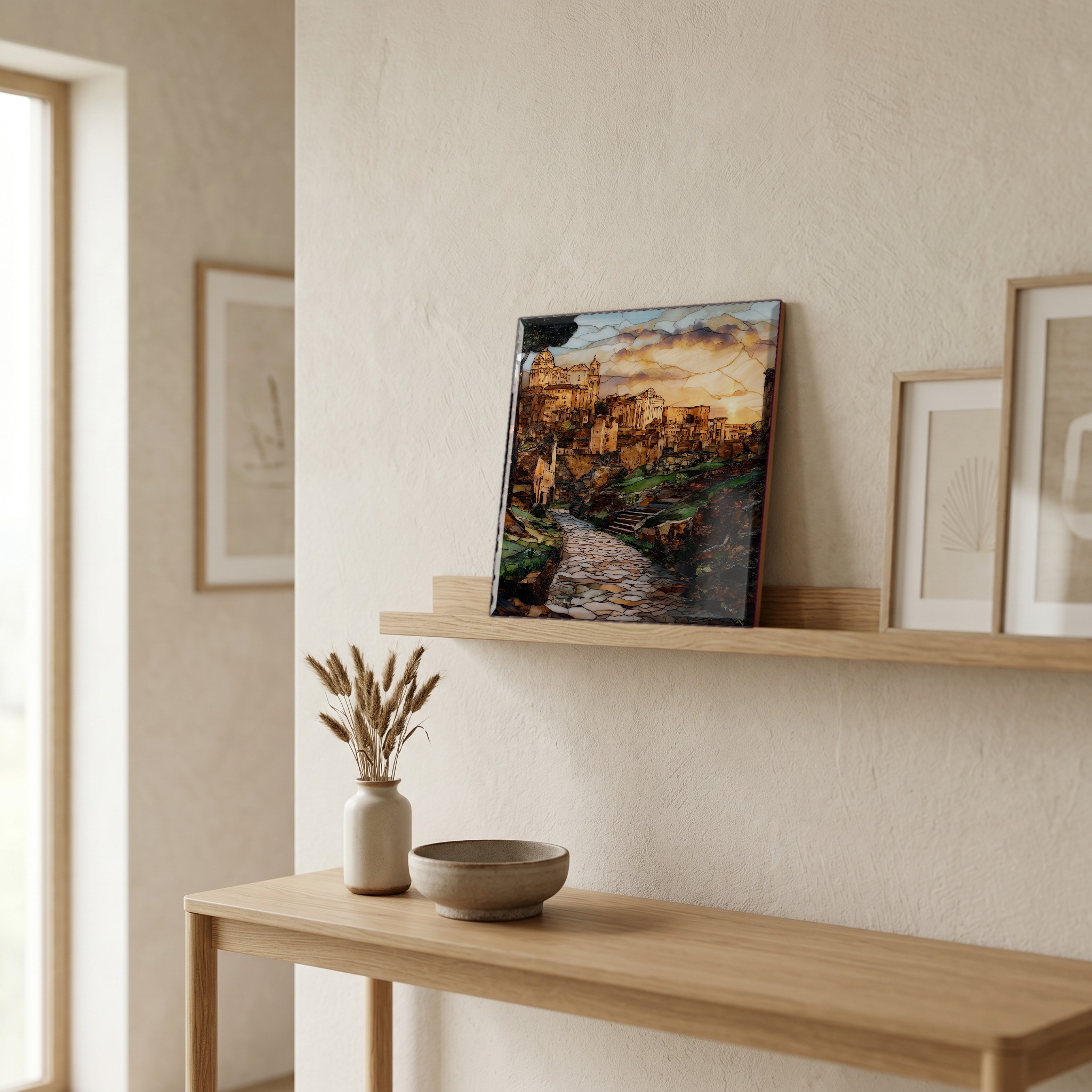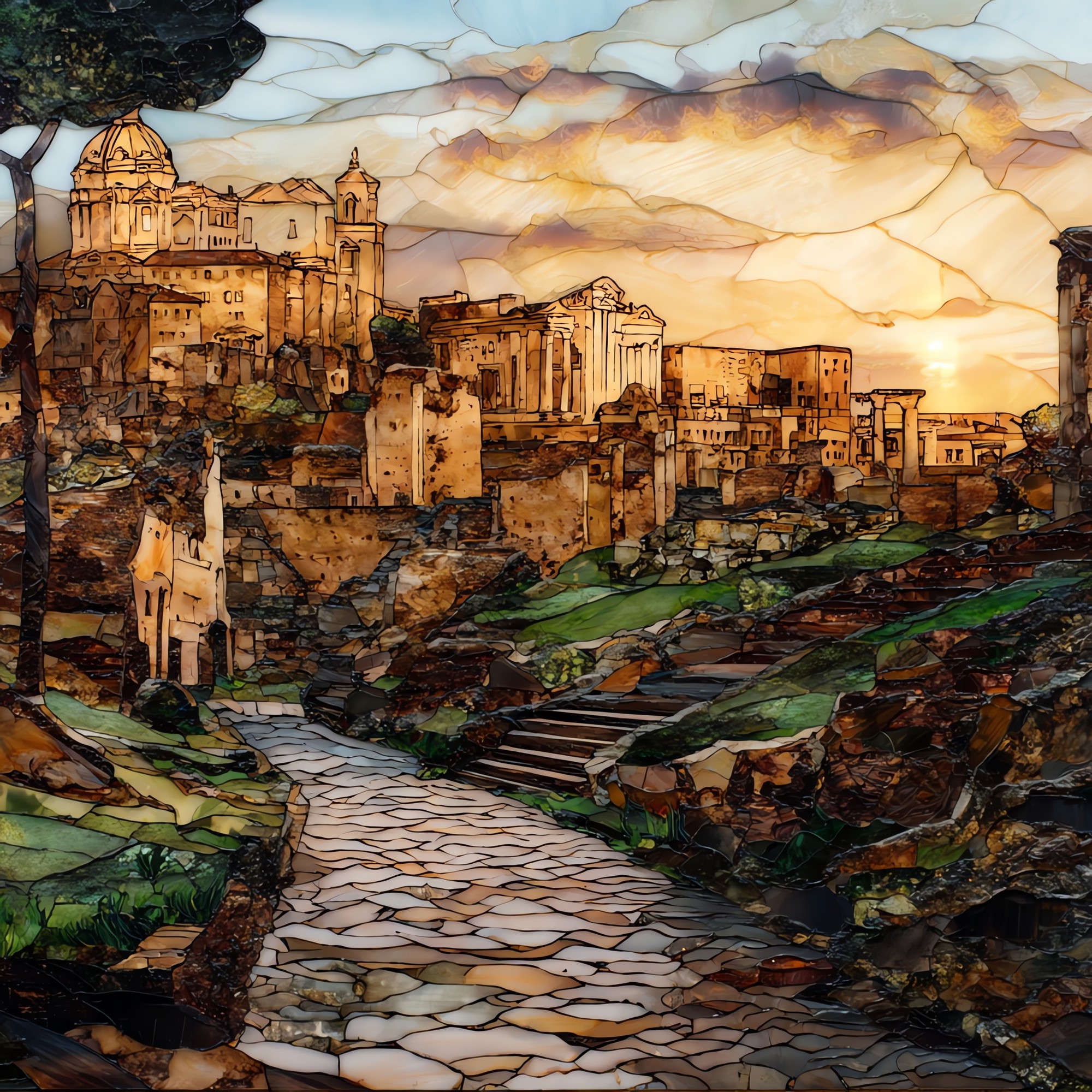
Wender·Vista
Trajan's Market
shown on ceramic, 12-inch tileItaly
on the slope of the Quirinal, above the Imperial Forums

Trajan's Market

the brick the afternoon settles into.

Where it lives

Not only on a wall.

A small tile on the nightstand catching the morning. A larger one above the fire. Yours, wherever you spend the slow hours.
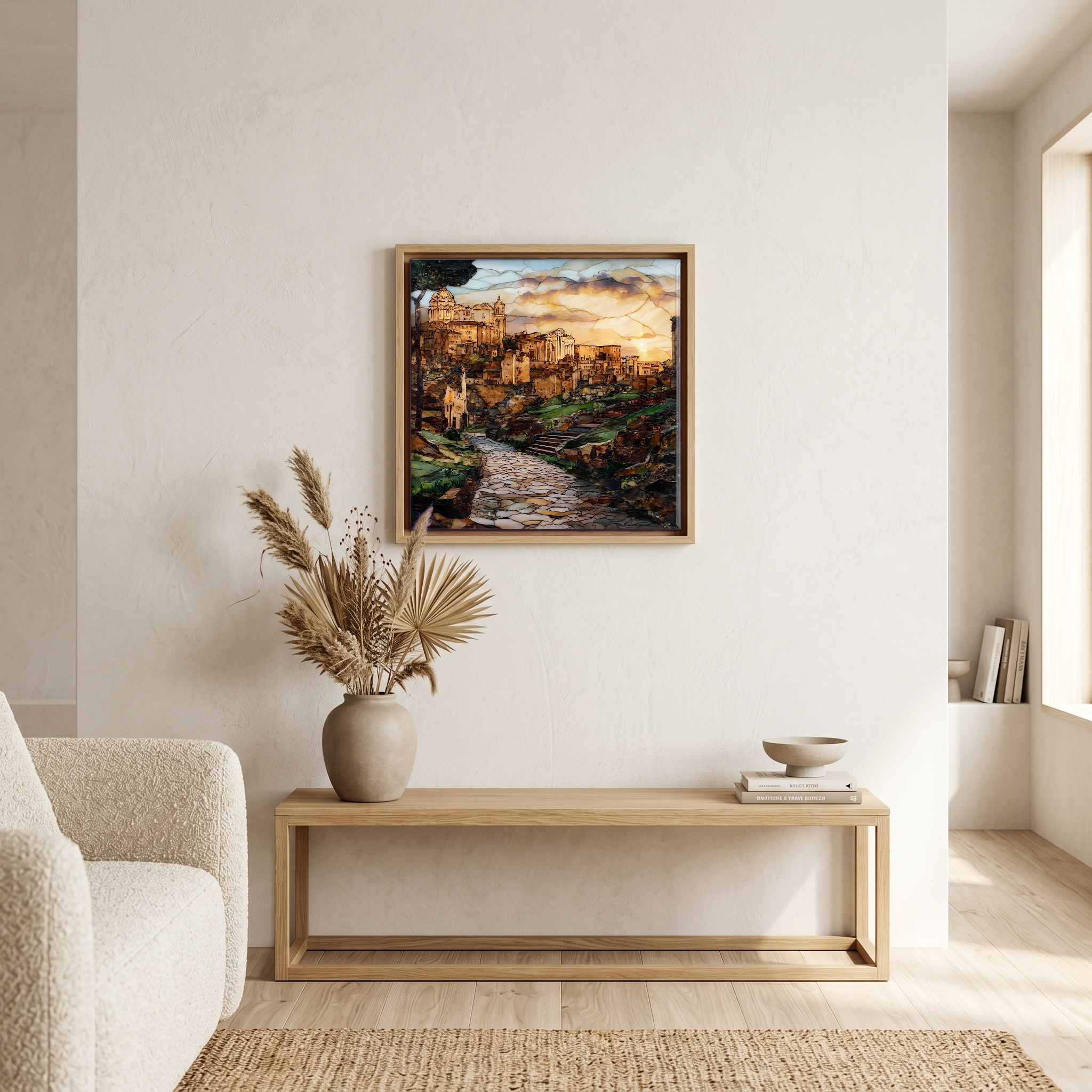
Above the bench, in a warm oak surround.
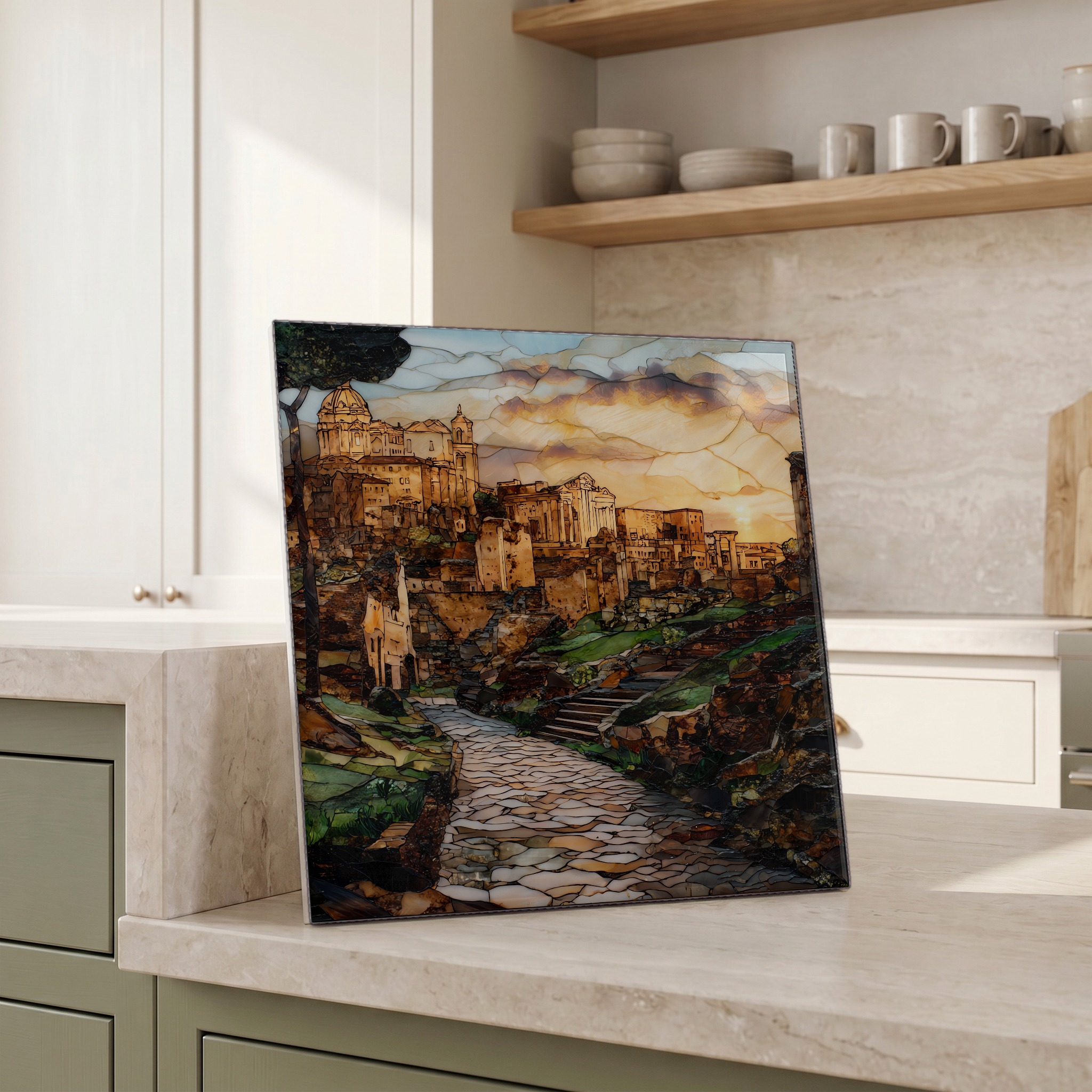
Beside the kettle, propped on the counter.
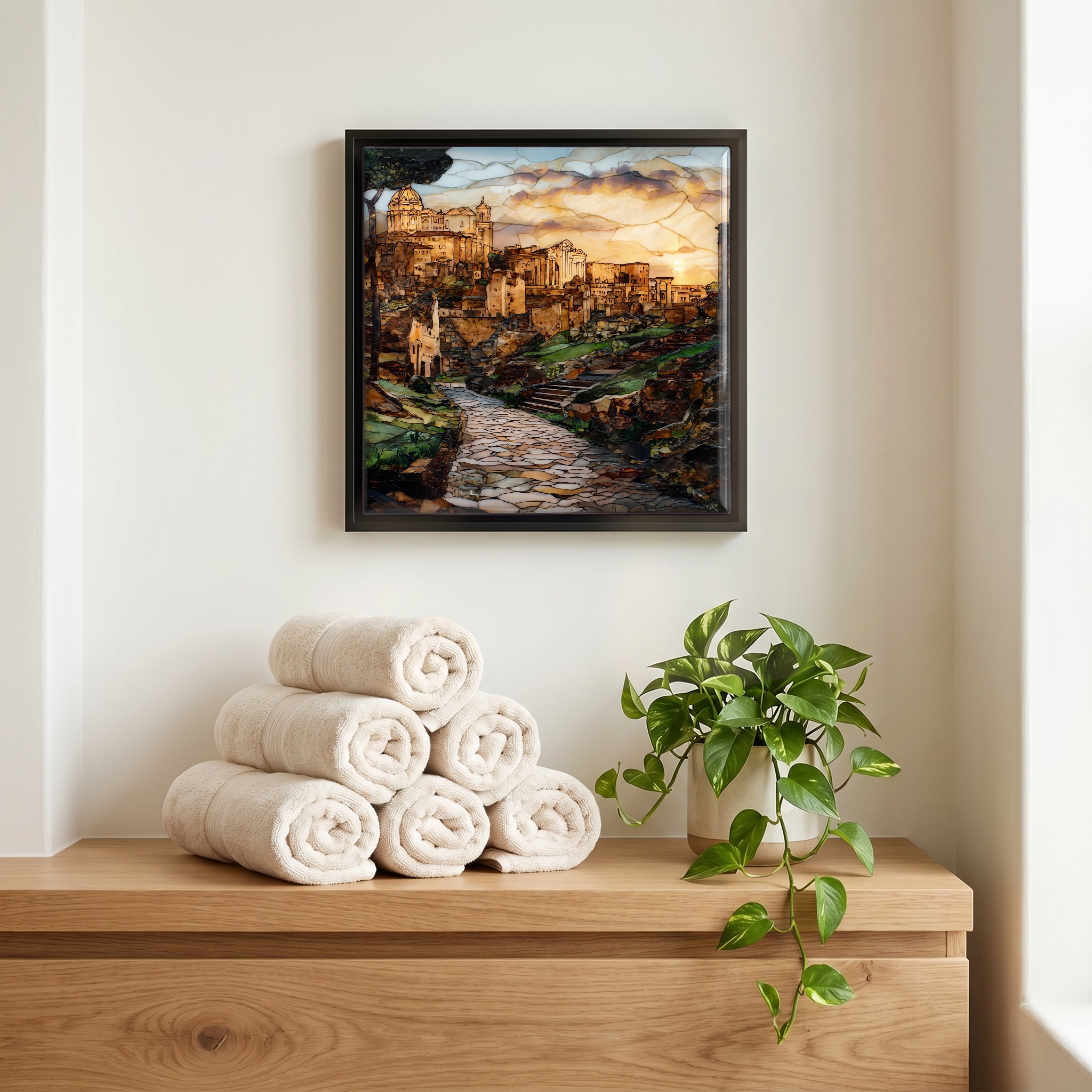
Above the linens, in a slim black surround.
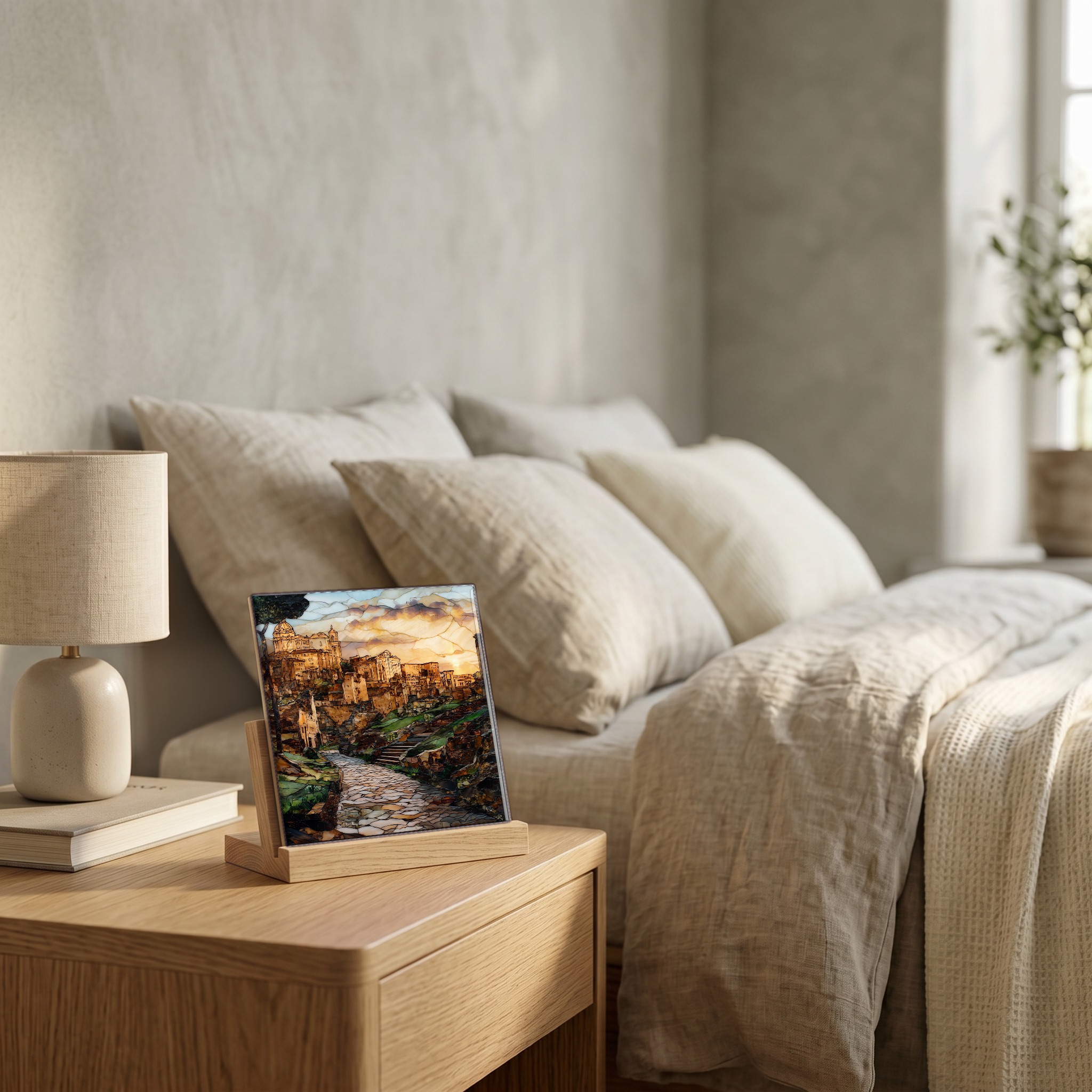
On the nightstand, on a light oak stand.
On a picture ledge, where the light comes in.
a note from the studio

The complex of brick halls and shops Trajan and Apollodorus of Damascus carved into the side of the Quirinal Hill, just after 100 AD. Six terraced levels of tabernae open onto a great curved hemicycle that still defines the silhouette above the Forum. For centuries it has been called the world's oldest shopping mall, though historians now read it more as an administrative quarter that happened to include shops. What survives is the brick, opus latericium, the colour of slow afternoons. The medieval Torre delle Milizie, added a thousand years later, still keeps watch above.
from the studio
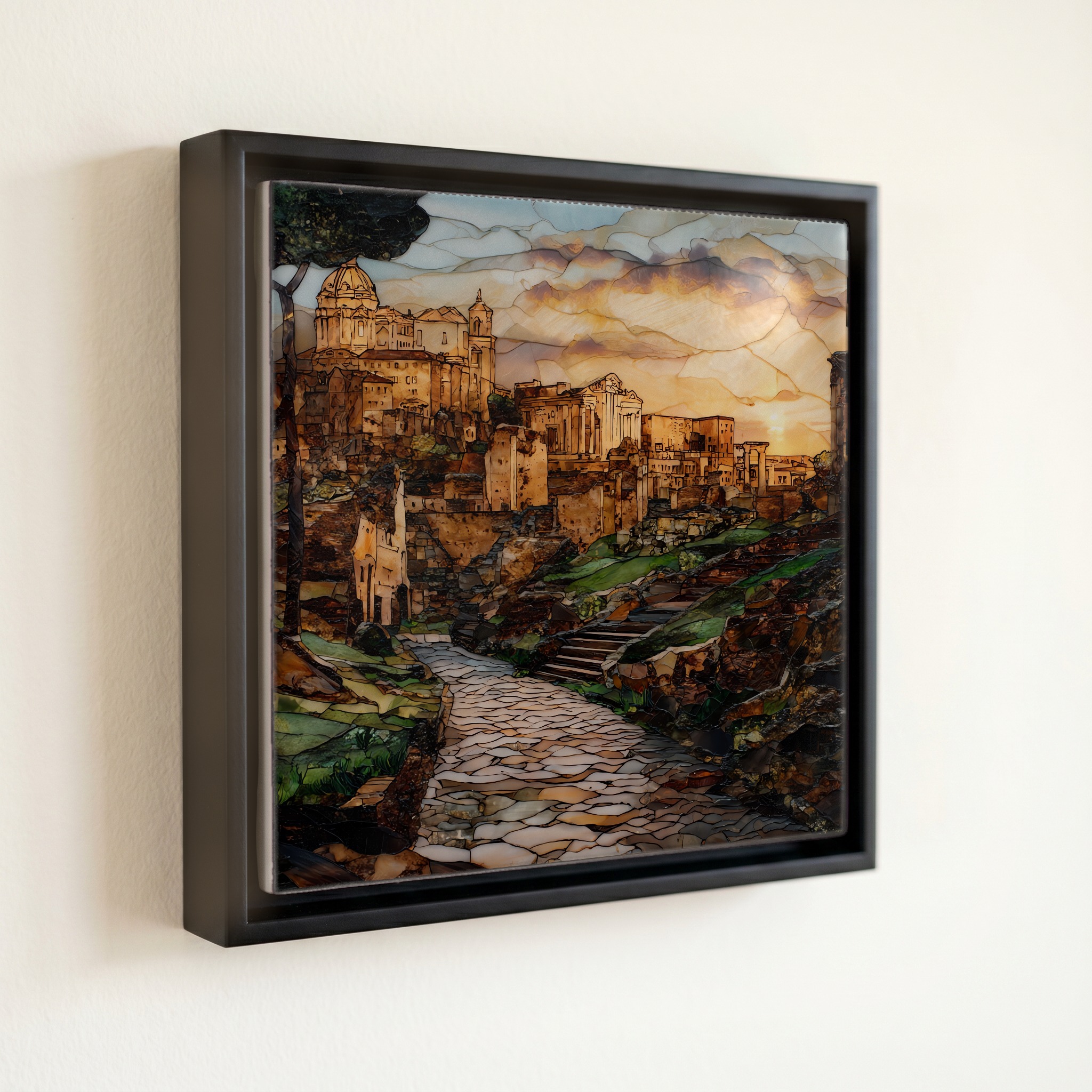
shown in a slim black floating frame · 6 × 6 in
— bring it home

Trajan's Market, on ceramic.

Each tile is finished by hand in our Knoxville studio. Artwork is slowly infused into the ceramic surface under high heat and pressure, and rests beneath a thin glossy finish. The colour lives in the surface, not on top of it.

What kind of piece?
One tile — square or rectangle.
How big?
the popular one — counter, shelf, nightstand
6 × 6 in · 15 cm · 1.6 lb
Surface finish
A clear glossy finish — the artwork reads as if under resin. Ideal for show-pieces and framed wall art.
How it sits
A hidden cleat — sits ¼″ proud of the wall.
$58
Hand-finished and shipped from our studio at the foot of the Smokies. On your wall in about ten days.
size
6 × 6 in
15 cm
weighs
1.6 lb
solid in the hand
surface
ceramic, hand-finished
art rests beneath a thin glossy finish
from
Knoxville, TN
our family studio, at the foot of the Smokies
— start a Coaster Set

Pick any four 4-inch tiles — National Parks you've been to, a Smokies set, the four seasons of one place. $ for a set of , cork-backed, ready to live on the table.
comes gift-ready
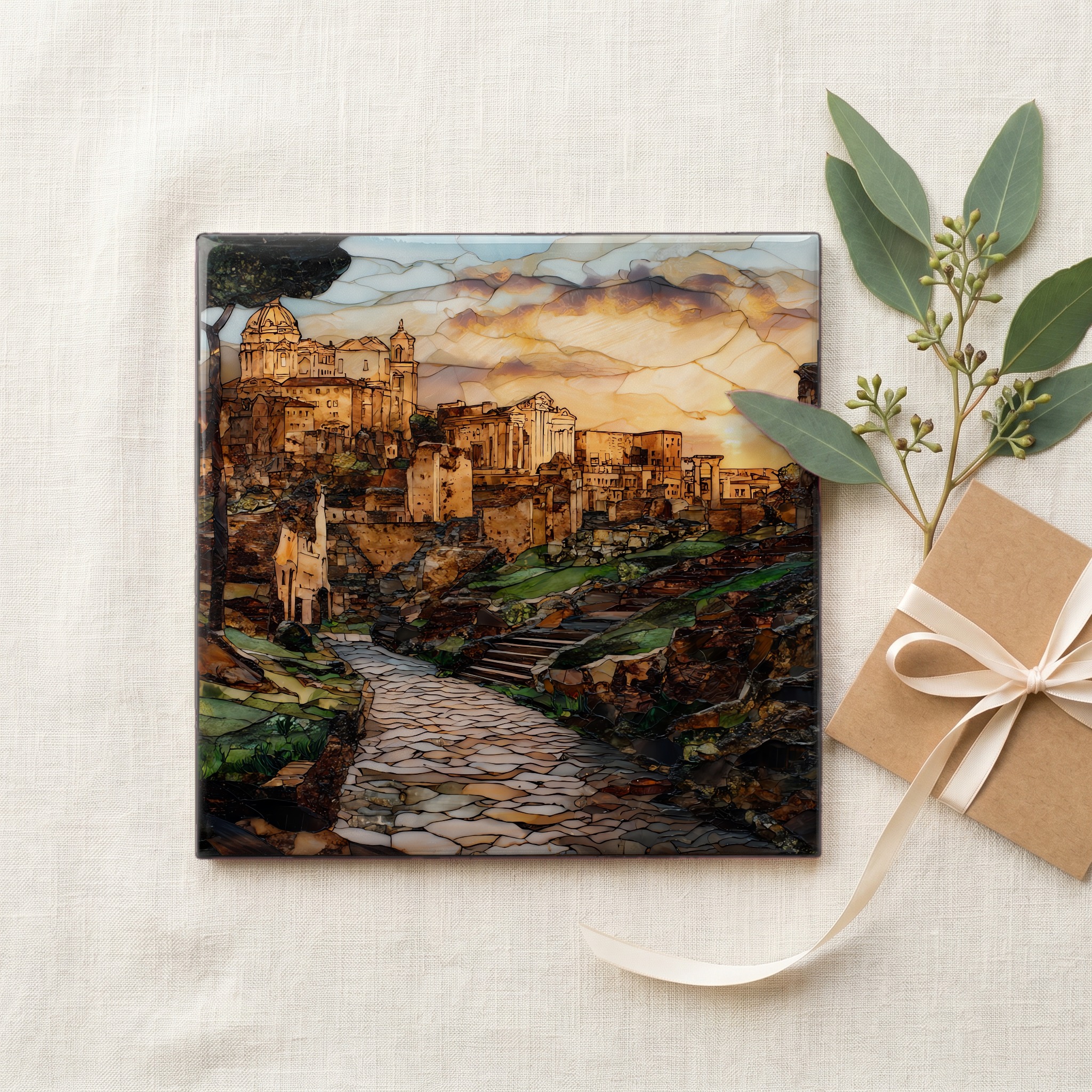
comes gift-ready

Each tile ships in a kraft box, tied with cream ribbon, with a handwritten note from the studio if you'd like to add one.
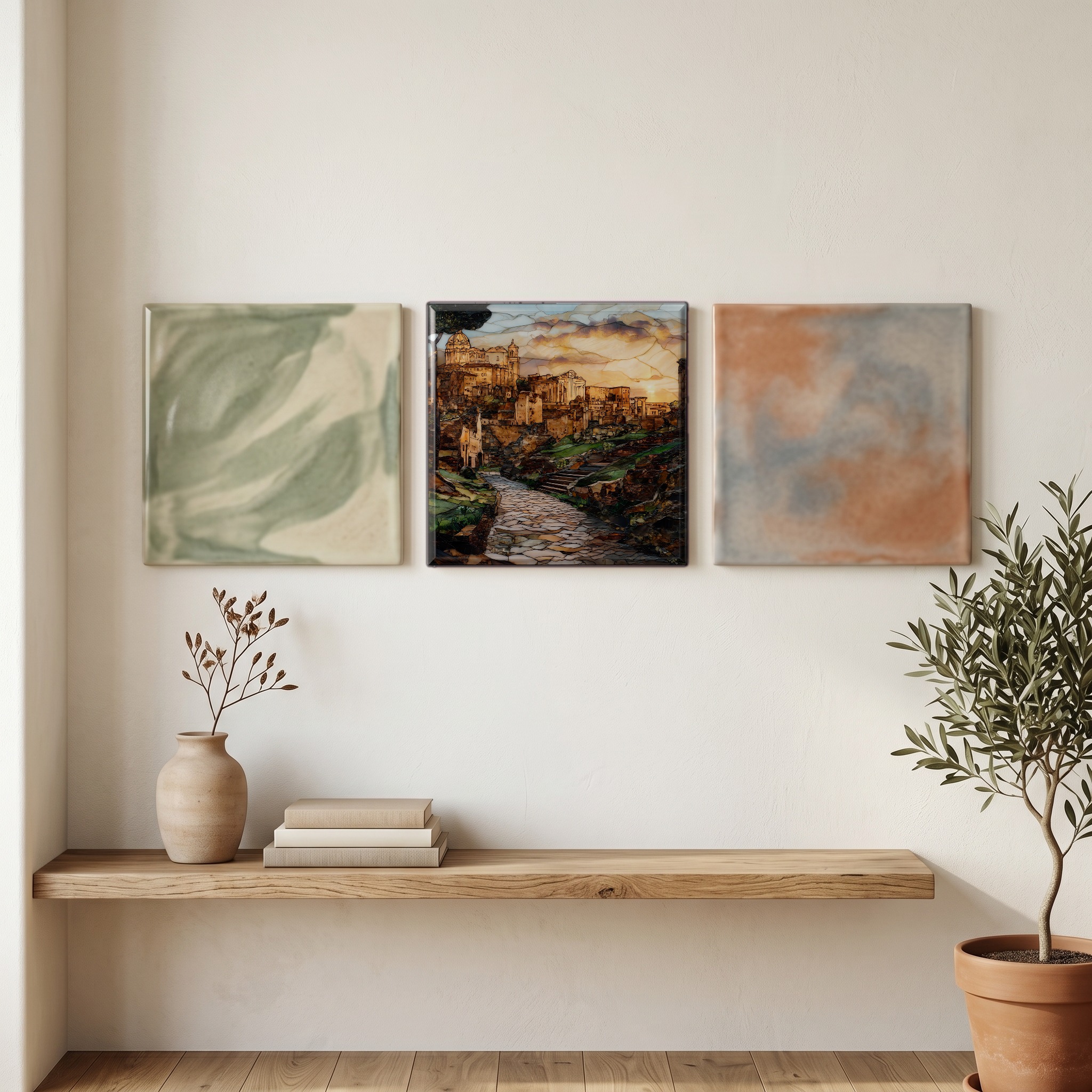
or build a grouping
or build a grouping

Three or five different vistas, hung together — a chapter of places you've been, or want to go.

about Trajan's Market

The place, in three passes.

A little of what's known, in case you fall down the rabbit hole — or want to go see it yourself.
the place

Trajan's Market (Mercati di Traiano) is a multi-level complex of brick halls, vaulted corridors, and small chambers built into the slope of the Quirinal Hill, in the rione of Monti in central Rome. It was completed around 110 AD as part of Emperor Trajan's larger Forum project, the last and largest of the Imperial Fora, designed by the Greek-Syrian architect Apollodorus of Damascus. The complex rises in six terraces above the open square of the Forum and contained more than 150 tabernae arranged around a great curved hemicycle. Today the surviving structure houses the Museo dei Fori Imperiali, entered from Via Quattro Novembre on the Quirinal side.

the stone

The walls are opus latericium, the Roman brick-faced concrete technique perfected in the early second century AD. The clay was worked in commercial brickyards along the Tiber, and stamps from those yards still mark some of the courses, identifying owners, consuls, and the years they were made. The hemicycle's three storeys carry their own weight and the thrust of the hill behind them, which is why so much of the structure survives largely intact after nineteen centuries. The Torre delle Milizie, raised on top of the complex in the early 1200s by the Conti family, leans slightly from the earthquake that struck Rome in 1348 but still stands above the Forum.

the visit

The complex is open daily as the Museo dei Fori Imperiali, with the entrance on Via Quattro Novembre near Piazza Venezia. Standard hours run roughly 9:30 to 19:30, with last entry an hour before closing and reduced hours on December 25 and January 1. The view from the Via Biberatica, the small paved street that runs through the middle terrace, looks out across the columns of Trajan's Forum to the Vittoriano on the far side. The hemicycle is best photographed from the parapet just below the Torre delle Milizie, late in the afternoon when the brick takes on the colour the painters call Roman ochre.

where
Italy · Rome, Lazio
position
41.8958° N · 12.4856° E
the neighborhood

What's nearby.

A handful of named places within an hour's walk or short drive. Some we've already painted; some we will.
0.1 km SW
Trajan's Column
Roman victory column
0.1 km S
Trajan's Forum
Imperial Roman forum
0.3 km SW
Vittoriano
national monument
0.4 km NW
Trevi Fountain
Baroque fountain
0.5 km NE
Quirinal Palace
presidential palace
0.5 km S
Roman Forum
ancient civic plaza
0.7 km SE
Colosseum
Roman amphitheatre
0.8 km W
Pantheon
Roman temple
N
Trajan's Market
Trajan's Column
Trajan's Forum
Vittoriano
Trevi Fountain
Quirinal Palace
Roman Forum
Colosseum
common questions

What people ask.

A few questions we get about Trajan's Market — and about bringing the piece home.
about the place

Trajan's Market is a multi-level complex of brick halls and small rooms built into the Quirinal Hill in Rome, completed around 110 AD. It was part of Emperor Trajan's Forum project, designed by Apollodorus of Damascus, and today houses the Museo dei Fori Imperiali.

It is often called that, but historians now read it more as an administrative complex that included tabernae used variously as shops, offices, and storage. The original purpose was a mix of commerce, archive work, and grain distribution tied to the Forum, not pure retail.

The architect was Apollodorus of Damascus, a Greek-Syrian engineer who also designed Trajan's Forum, Trajan's Column, and a bridge across the Danube during the Dacian Wars. The complex was completed around 110 AD, near the end of Trajan's reign.

The entrance is on Via Quattro Novembre, on the Quirinal Hill side, a short walk from Piazza Venezia. The complex sits directly above the Imperial Forums and is visible from Via dei Fori Imperiali, the street that runs from the Vittoriano to the Colosseum.

The surviving structure preserves more than 150 small rooms, called tabernae, arranged over six terraced levels. They open onto vaulted corridors and the great curved hemicycle that defines the building's silhouette from the Forum below.

The Torre delle Milizie is a medieval fortified tower built on top of the complex in the early 1200s by the Conti family, later held by the Caetani. It leans slightly from the earthquake of 1348 but still stands above the museum today.

The museum at Trajan's Market is open daily, generally 9:30 to 19:30, with last entry an hour before closing. Hours shift seasonally and are reduced on December 25 and January 1; the Sovrintendenza Capitolina publishes the current schedule on the official site.

about the piece in your home

It's been a meaningful gift for our customers with ties to the city. Trajan's Market sits at the visual centre of Imperial Rome, just above the Forum and the Column, and most Rome-lovers know the curve of its hemicycle by sight. A Medium with a handwritten note from the studio carries well; a Large works as a centrepiece.

The piece sits naturally in Italian-villa, Mediterranean-modern, and warm Maximalist interiors. The terracotta-and-amber palette reads at home with antique books, leather, burnished brass, and rooms built around old-stone or plaster-wall finishes.

Yes. The Italian-villa interior, terracotta tile and plaster walls and antique wood, has had a sustained run in design press since 2023, and the warm Roman brick palette of this piece anchors a wall in that vocabulary without leaning kitsch.

A single Large works above a console table or a love seat. For a full-size sofa, the 4-tile Mural is the right scale; for a long media wall or hallway, the 9-tile Mural reads as a single architectural panel.

Yes, with the Dura Satin or Matte finish. Both are scratch-resistant and built for vertical installation in humid rooms. The Glossy finish is for framed wall pieces and show pieces away from direct water contact.

A soft microfibre cloth and warm water are enough. Avoid abrasive sponges, bleach, and acidic cleaners. The colour lives in the ceramic surface beneath a thin glossy finish and stays true with gentle care.

Yes. Every WenderVista piece is made in our Knoxville studio. Reid Wender chooses each place and oversees the work; we don't license art from third parties and we don't reprint stock images.

if this one stayed with you

A few you might also love.

Hand-picked by the eye that found Sorapis. Same air, same kind of quiet.
— a collection

The Italian Dolomites,
painted slow.

The valleys between Cortina and Val Gardena, the tarns you walk an hour to see, the towers that turn the colour of a banked fire just before dark. Wander the collection by valley, by season, or follow the path Reid walked.

Tre Cime
Braies
Misurina
Sorapis
Cinque Torri
Sassolungo
Marmolada