Wender·Vista
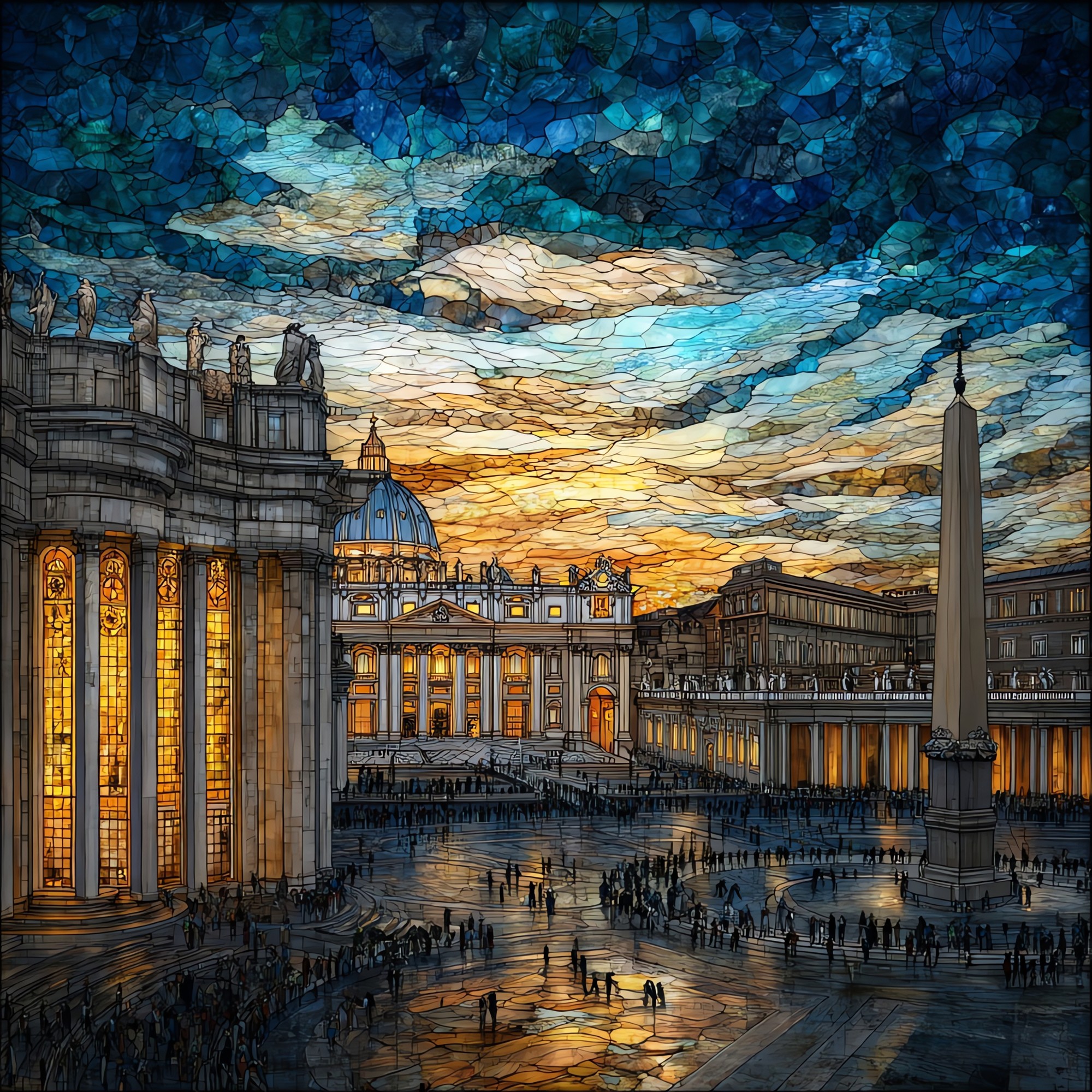
St Peter's Square
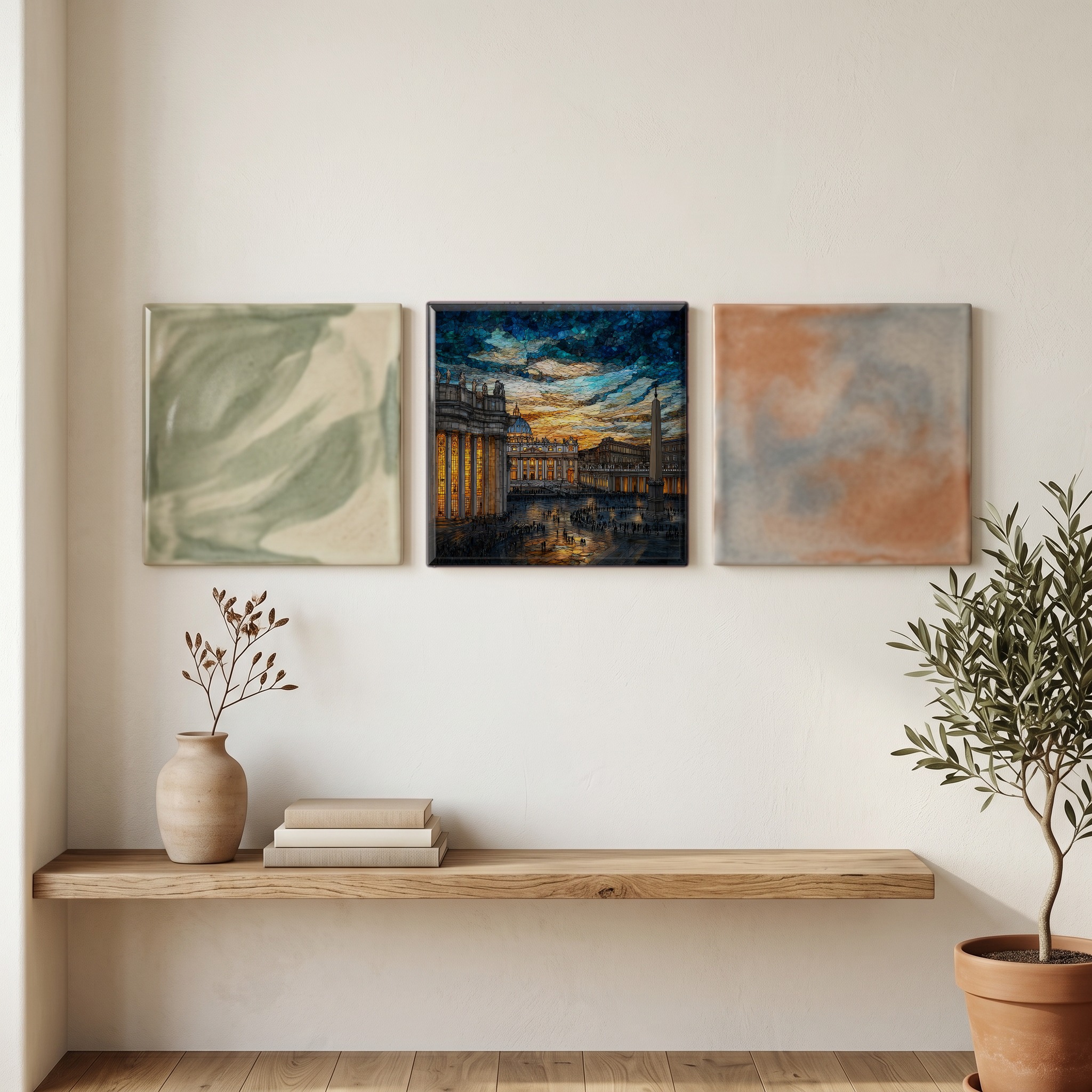
shown on ceramic, 12-inch tileItaly
across the Tiber from old Rome, inside Vatican City

St Peter's Square

the stone arms held open for four centuries.

Where it lives

Not only on a wall.

A small tile on the nightstand catching the morning. A larger one above the fire. Yours, wherever you spend the slow hours.
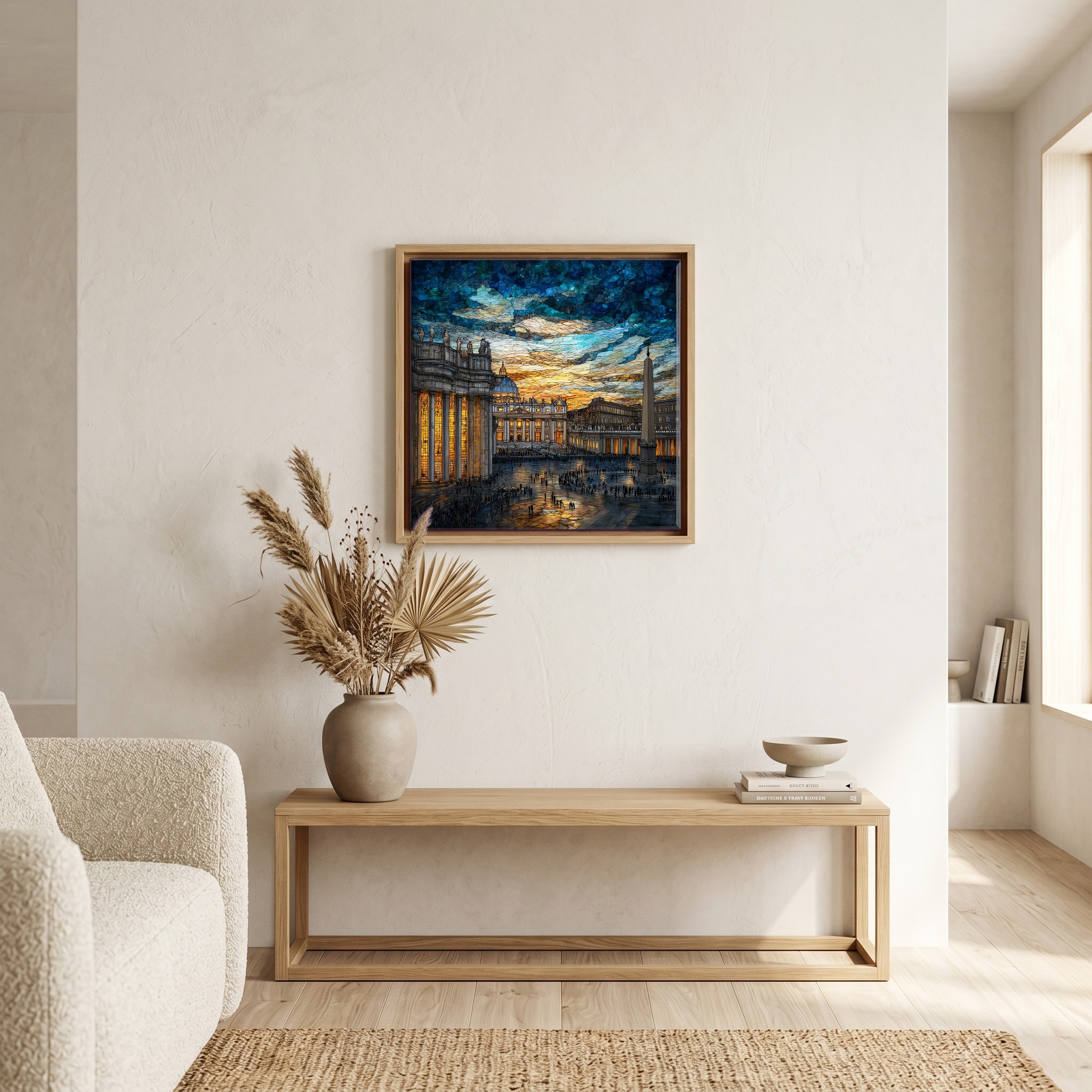
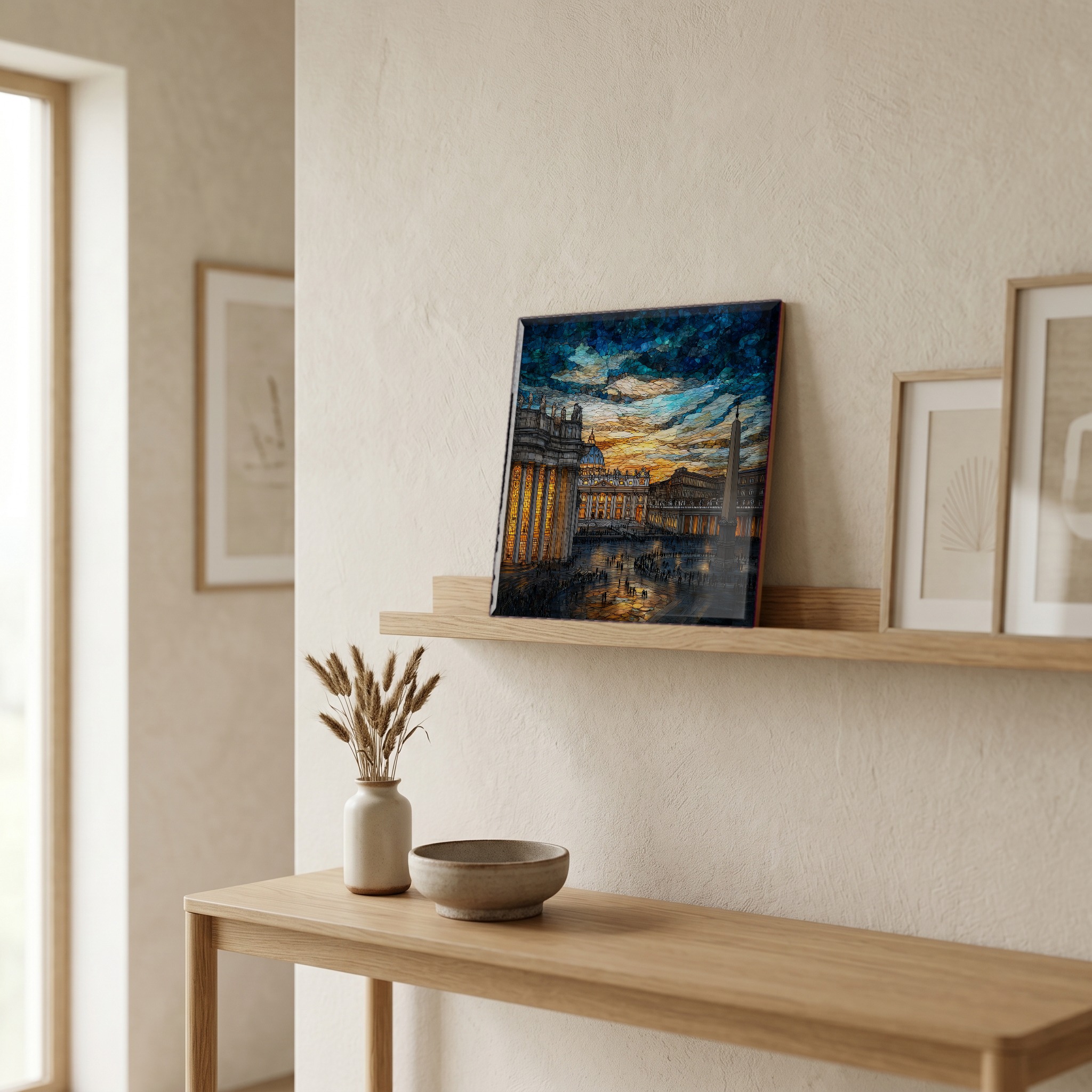
Above the bench, in a warm oak surround.
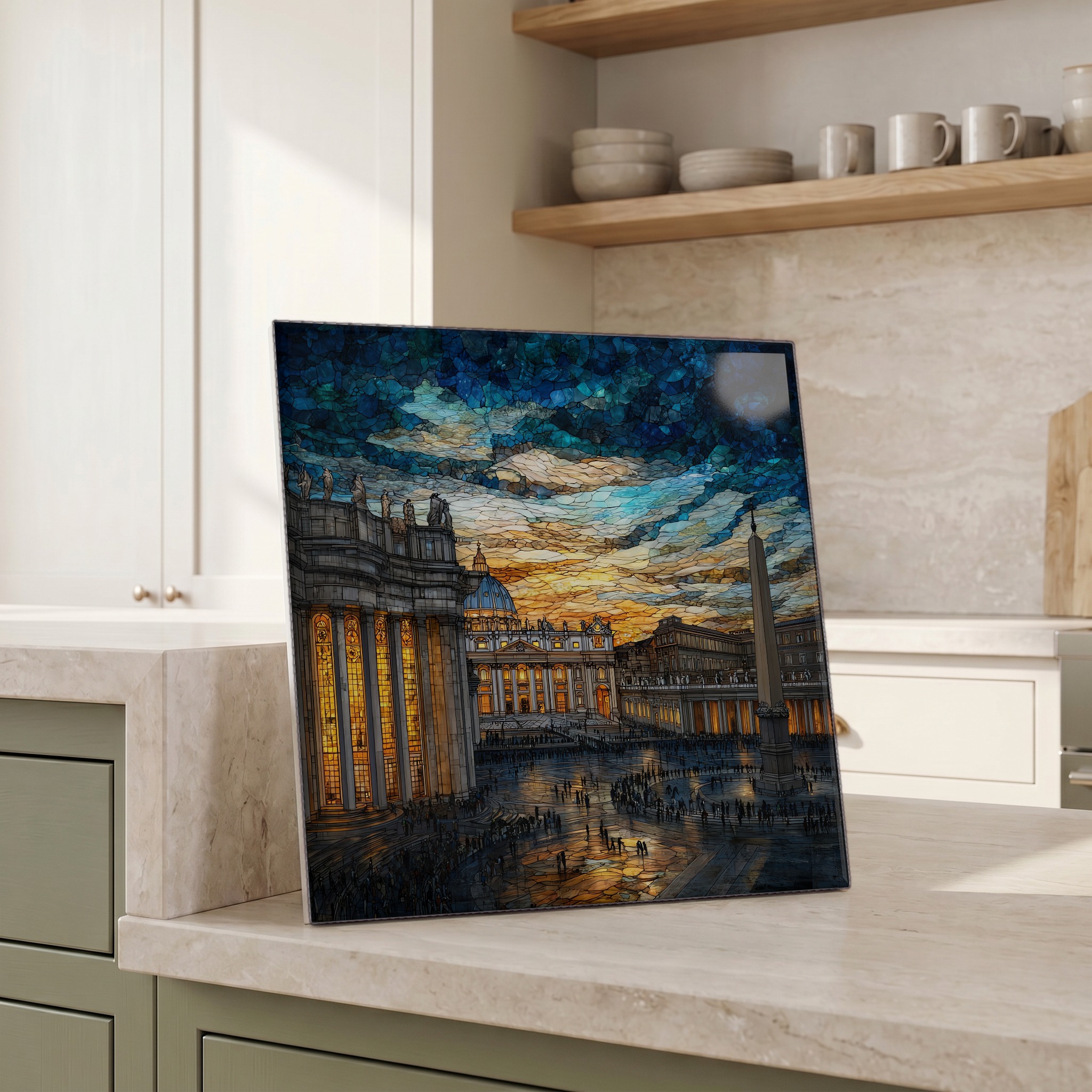
Beside the kettle, propped on the counter.
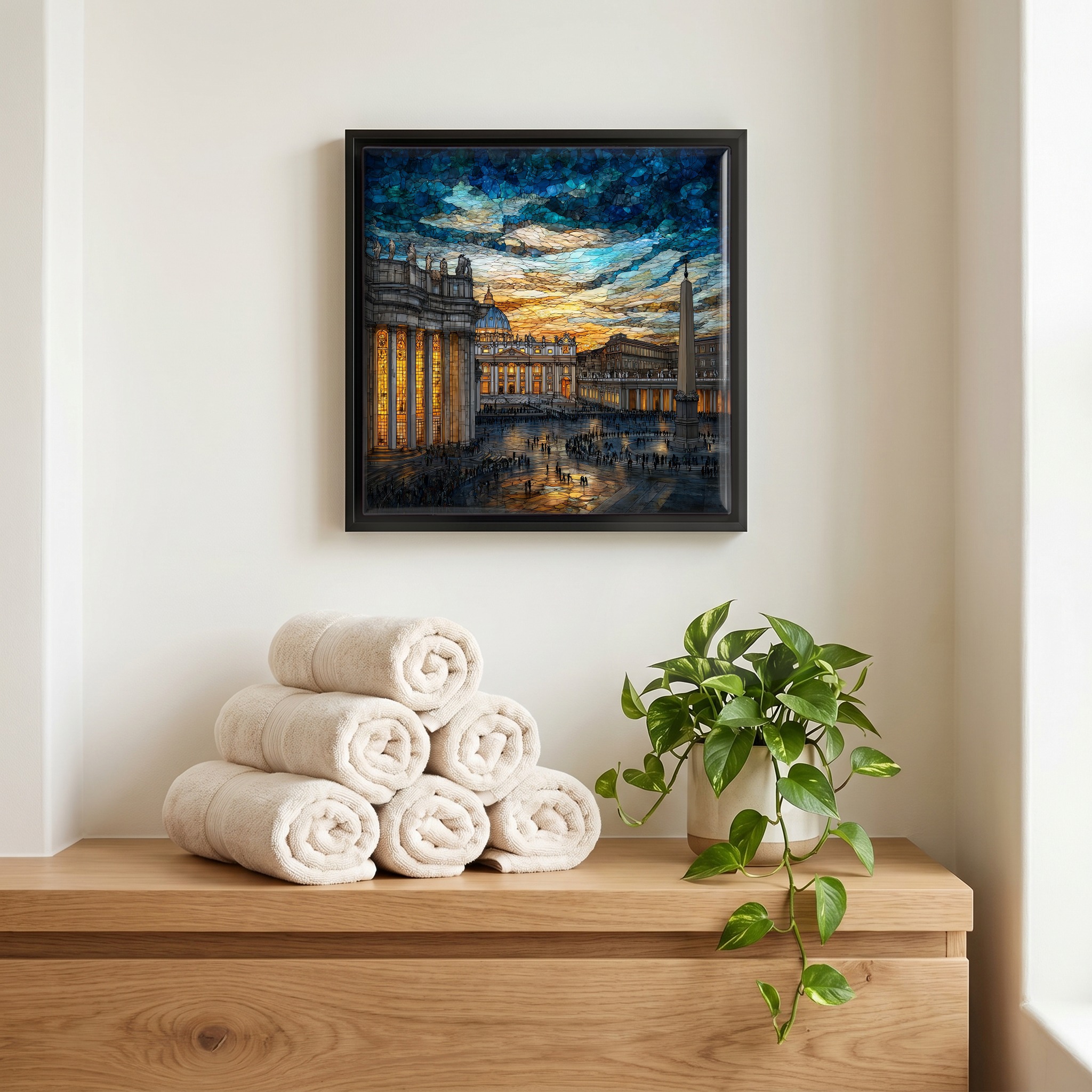
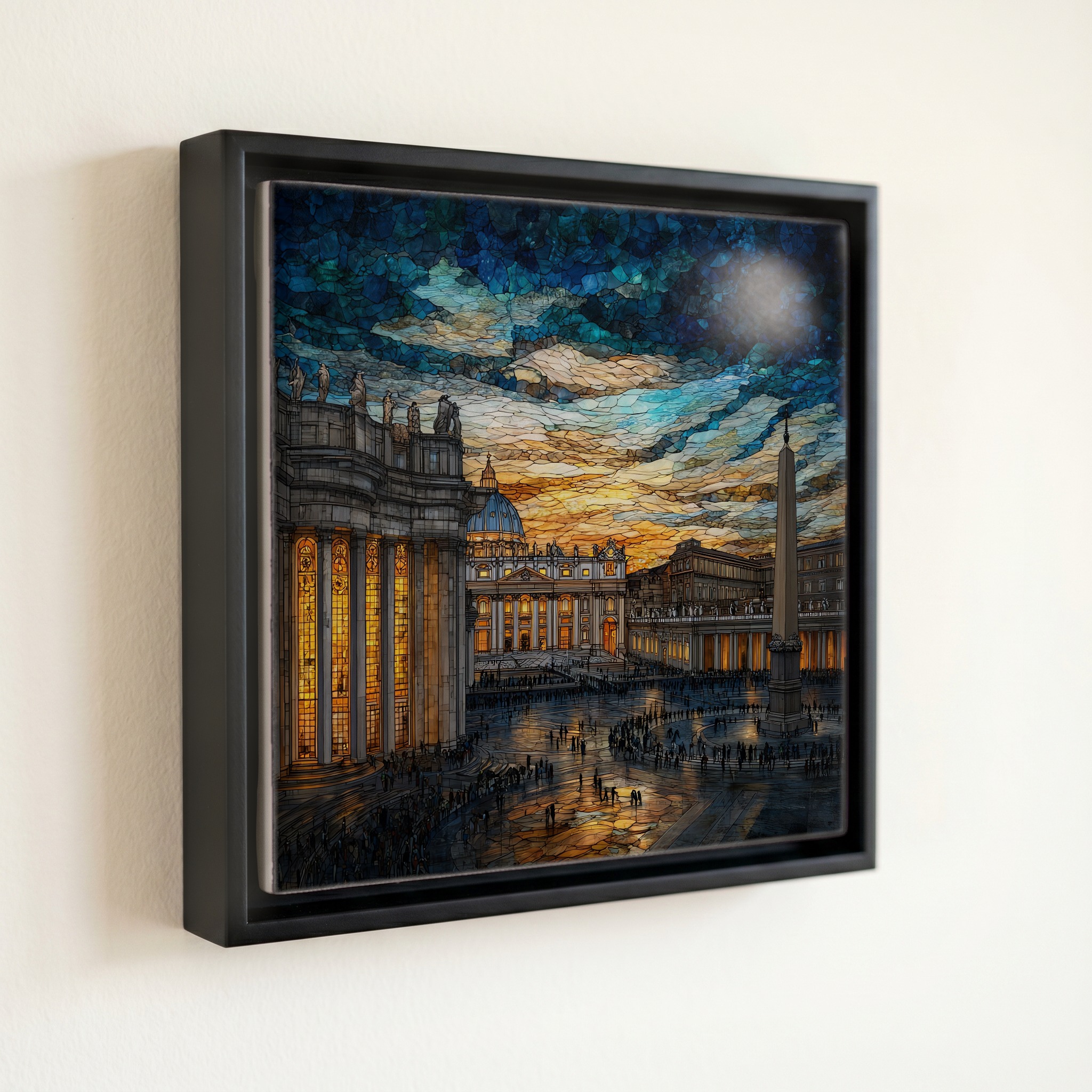
Above the linens, in a slim black surround.
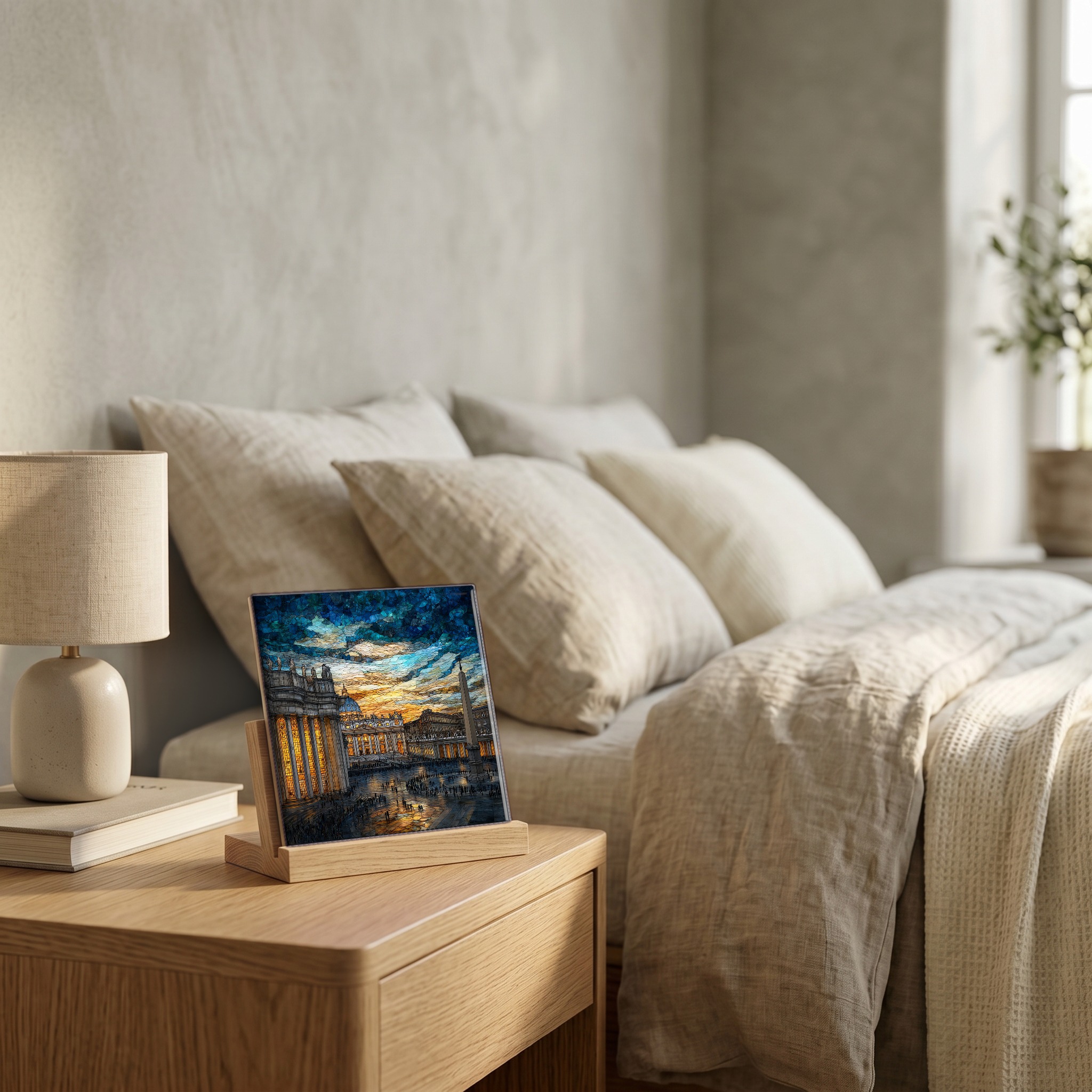
On the nightstand, on a light oak stand.
On a picture ledge, where the light comes in.
a note from the studio

Bernini's colonnade opens like two arms around an oval of pale stone. At the centre, an Egyptian obelisk that watched Caligula's chariots in 37 AD waits between two fountains for a blessing or a funeral. The square fills with the kind of silence only a vast open space can hold, then breaks with the bells, then fills again. On most Wednesdays the chairs come out and the square becomes a parish meeting for the world. By evening the colonnade is mostly shadow and the obelisk casts a line clear across the stones.
from the studio
shown in a slim black floating frame · 6 × 6 in
— bring it home

St Peter's Square, on ceramic.

Each tile is finished by hand in our Knoxville studio. Artwork is slowly infused into the ceramic surface under high heat and pressure, and rests beneath a thin glossy finish. The colour lives in the surface, not on top of it.

What kind of piece?
One tile — square or rectangle.
How big?
the popular one — counter, shelf, nightstand
6 × 6 in · 15 cm · 1.6 lb
Surface finish
A clear glossy finish — the artwork reads as if under resin. Ideal for show-pieces and framed wall art.
How it sits
A hidden cleat — sits ¼″ proud of the wall.
$58
Hand-finished and shipped from our studio at the foot of the Smokies. On your wall in about ten days.
size
6 × 6 in
15 cm
weighs
1.6 lb
solid in the hand
surface
ceramic, hand-finished
art rests beneath a thin glossy finish
from
Knoxville, TN
our family studio, at the foot of the Smokies
— start a Coaster Set

Pick any four 4-inch tiles — National Parks you've been to, a Smokies set, the four seasons of one place. $ for a set of , cork-backed, ready to live on the table.
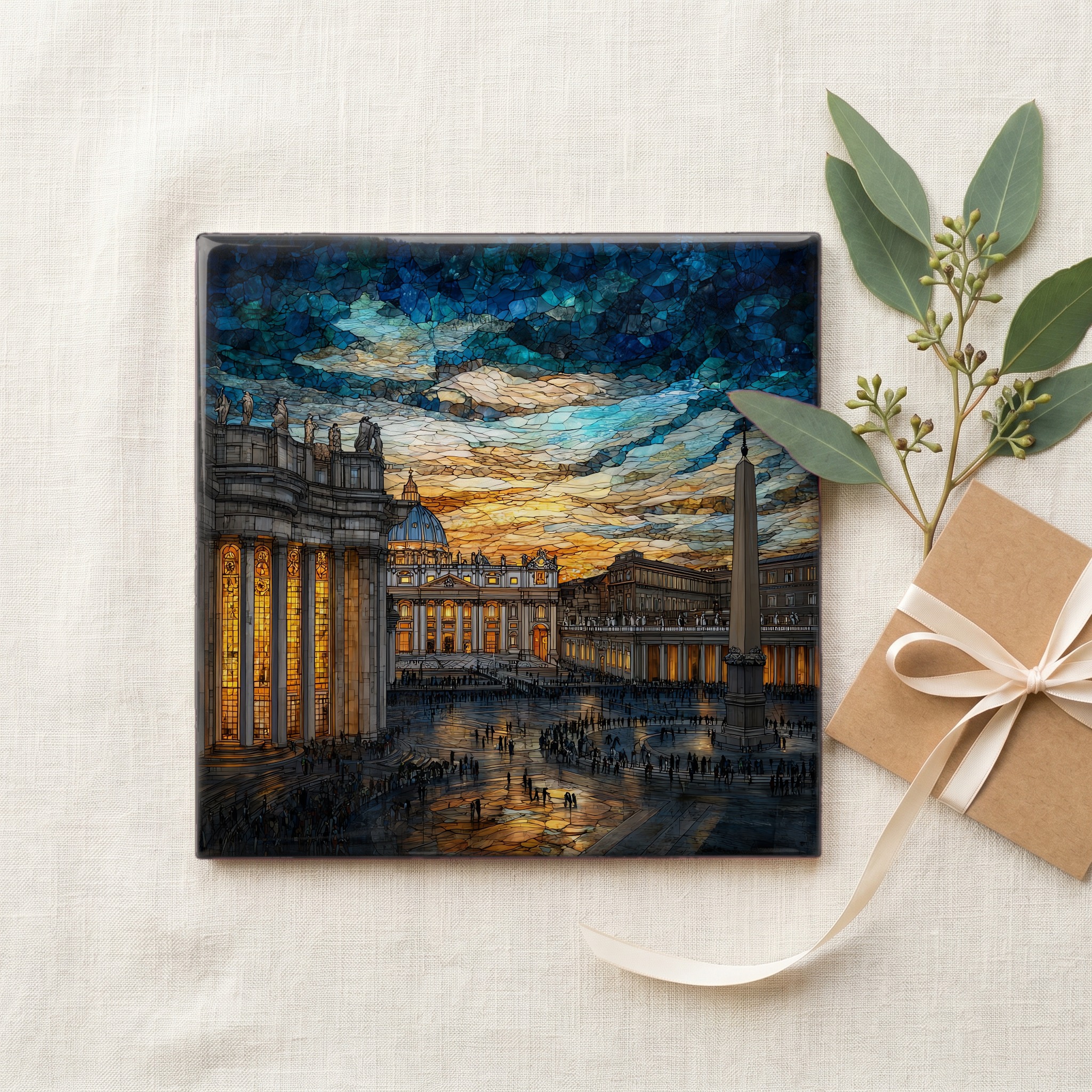
comes gift-ready
comes gift-ready

Each tile ships in a kraft box, tied with cream ribbon, with a handwritten note from the studio if you'd like to add one.
or build a grouping
or build a grouping

Three or five different vistas, hung together — a chapter of places you've been, or want to go.

about St Peter's Square

The place, in three passes.

A little of what's known, in case you fall down the rabbit hole — or want to go see it yourself.
the place

St Peter's Square lies at the eastern edge of Vatican City, the 49-hectare sovereign state enclaved within Rome that became independent under the Lateran Treaty of 1929. The square is bounded on the west by St Peter's Basilica and on the other three sides by Gian Lorenzo Bernini's colonnade, begun in 1656 for Pope Alexander VII and largely complete by 1667. The oval measures roughly 320 metres along its long axis and 240 metres across at the widest point. It is reached on foot from Via della Conciliazione, the broad avenue carved through the Borgo neighbourhood beginning in 1936 and opened for the Holy Year of 1950.

the stone

Bernini's colonnade is cut from travertine quarried at Tivoli, the same stone the Romans used for the Colosseum. Four rows of Doric columns curve around the square, 284 in total, with 88 pilasters and 140 statues of saints crowning the entablature. The columns were placed so that from one of two marble disks set into the pavement, the four rows align as a single colonnade. At the centre stands the obelisk Caligula brought from Heliopolis in 37 AD for his circus on the Vatican Hill. Pope Sixtus V had it moved to this spot in 1586. The engineering feat by Domenico Fontana took 900 men and four months.

the visit

The square is open to the public around the clock and free to enter, with security screening at the colonnade openings and bags checked. Papal general audiences are held in the square on most Wednesday mornings, weather permitting, and require a free ticket from the Prefecture of the Papal Household. The Angelus blessing is given from the apostolic apartment window at noon on most Sundays. Major liturgies for Christmas, Easter, canonisations and papal funerals can fill the square and spill east down Via della Conciliazione. The basilica entrance is to the right of the colonnade after security; the Vatican Museums sit on the north side of the city-state, a separate ticketed visit.

where
Italy · Vatican City, Rome
position
41.9022° N · 12.4568° E
the neighborhood

What's nearby.

A handful of named places within an hour's walk or short drive. Some we've already painted; some we will.
0.1 km W
St Peter's Basilica
basilica
0.6 km N
Vatican Museums
museum complex
0.5 km N
Sistine Chapel
chapel
0.7 km E
Castel Sant'Angelo
fortress· on a tile
0.8 km E
Ponte Sant'Angelo
Roman bridge
1.3 km E
Piazza Navona
Baroque square
1.5 km E
Pantheon
Roman temple
N
St Peter's Square
St Peter's Basilica
Vatican Museums
Sistine Chapel
Castel Sant'Angelo
Ponte Sant'Angelo
Piazza Navona
Pantheon
common questions

What people ask.

A few questions we get about St Peter's Square — and about bringing the piece home.
about the place

St Peter's Square lies at the eastern edge of Vatican City, the sovereign city-state enclaved within Rome. The basilica closes its western side; Via della Conciliazione runs east from the colonnade openings across the Tiber toward the historic centre of the Italian capital.

Geographically it sits inside Rome, but politically it belongs to Vatican City, the sovereign state established by the Lateran Treaty of 1929. The square is the public entry point from the Italian capital into the territory of the Holy See.

Gian Lorenzo Bernini designed the square between 1656 and 1667 for Pope Alexander VII. The two semicircular colonnades were intended to read as the maternal arms of the Church drawn open from the basilica. Bernini chose Doric columns for their austerity against the more decorative basilica facade by Carlo Maderno.

A red granite Egyptian obelisk roughly 25.5 metres tall, brought from Heliopolis by Caligula in 37 AD for his circus on the Vatican Hill. Pope Sixtus V had it moved to the centre of the square in 1586. It is uninscribed and topped with a bronze cross holding a relic of the True Cross.

The oval measures roughly 320 metres along its long axis and 240 metres across at its widest point. The Vatican estimates the square holds around 300,000 people for an open-air Mass, with overflow spilling east along Via della Conciliazione during major liturgies.

Most Wednesday mornings for the general audience, weather permitting, and most Sundays at noon for the Angelus blessing given from the apostolic apartment window. Christmas Eve Mass, the Easter Urbi et Orbi, canonisations and papal funerals also draw the Pope into the square.

284 travertine columns in four concentric rows, with 88 pilasters at the openings and 140 statues of saints along the top entablature. Two marble disks in the pavement mark the focal points from which all four rows align as a single column.

about the piece in your home

Yes. It is a frequent choice for our customers gifting Catholic friends or family who have walked through the colonnade. The piece carries the geometry of the square, Bernini's curve, the obelisk, the basilica's dome, into a kitchen, hallway, or office. A Small or Medium with a handwritten note from the studio travels well.

Yes. St Peter's Square is one of the most recognised images in Roman Catholic life, bound to canonisations, papal blessings, and the universal Church. A Medium reads as a serious, lasting gift for confirmation or ordination. A Coaster Set is a graceful, smaller token for a parish staff or a returning pilgrim.

The luminous jewel tones over travertine and shadow suit rooms with depth and warmth rather than cool minimalism. It sits well in Old-World European and heritage-traditional interiors, Grandmillennial spaces with oil paintings and dark wood, and warm eclectic rooms that already mix antiques with framed art.

Yes. The warm, heritage-leaning maximalism replacing cool grey minimalism favours saturated, story-rich wall pieces of this kind. It also fits the European-heritage and Grandmillennial looks, where framed art with a strong sense of place anchors the room above a console, sofa, or reading chair.

Above a sofa, a single Large reads from across the room, while a four-tile Mural fills a wider wall with more presence. Above a console or in a hallway, a Medium or a four-tile Mural holds the space without crowding. For a feature wall that meets the scale of the colonnade, a nine-tile Mural.

Yes. For kitchens, bathrooms, showers, and backsplashes, choose the Dura Satin or Matte finish rather than Glossy. Both are scratch-resistant and built for steam and splashes. The colour lives in the ceramic surface, so it holds up to daily wear and ordinary cleaning.

A soft microfibre cloth and warm water. The colour is slowly infused into the ceramic surface under high heat and pressure and sits beneath a thin glossy finish, so there is nothing on top to wipe away. Skip abrasive pads and ammonia-based cleaners.

Yes. Every WenderVista piece is created by Reid Wender and hand-finished in our Knoxville, Tennessee studio. The work is not licensed from stock libraries, and each place in the atlas is interpreted in our own stained-glass visual language.

if this one stayed with you

A few you might also love.

Hand-picked by the eye that found Sorapis. Same air, same kind of quiet.
— a collection

The Italian Dolomites,
painted slow.

The valleys between Cortina and Val Gardena, the tarns you walk an hour to see, the towers that turn the colour of a banked fire just before dark. Wander the collection by valley, by season, or follow the path Reid walked.

Tre Cime
Braies
Misurina
Sorapis
Cinque Torri
Sassolungo
Marmolada