Wender·Vista
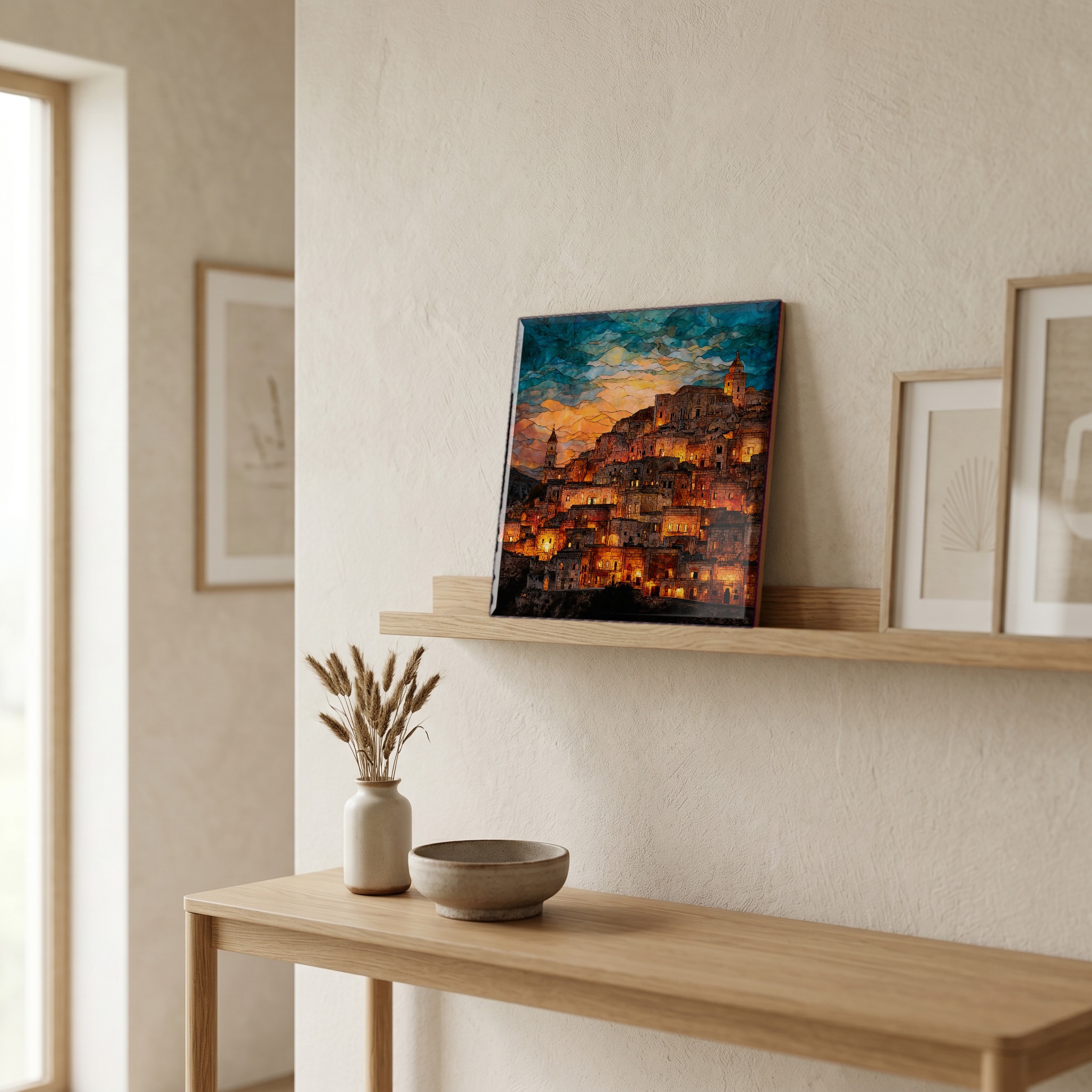
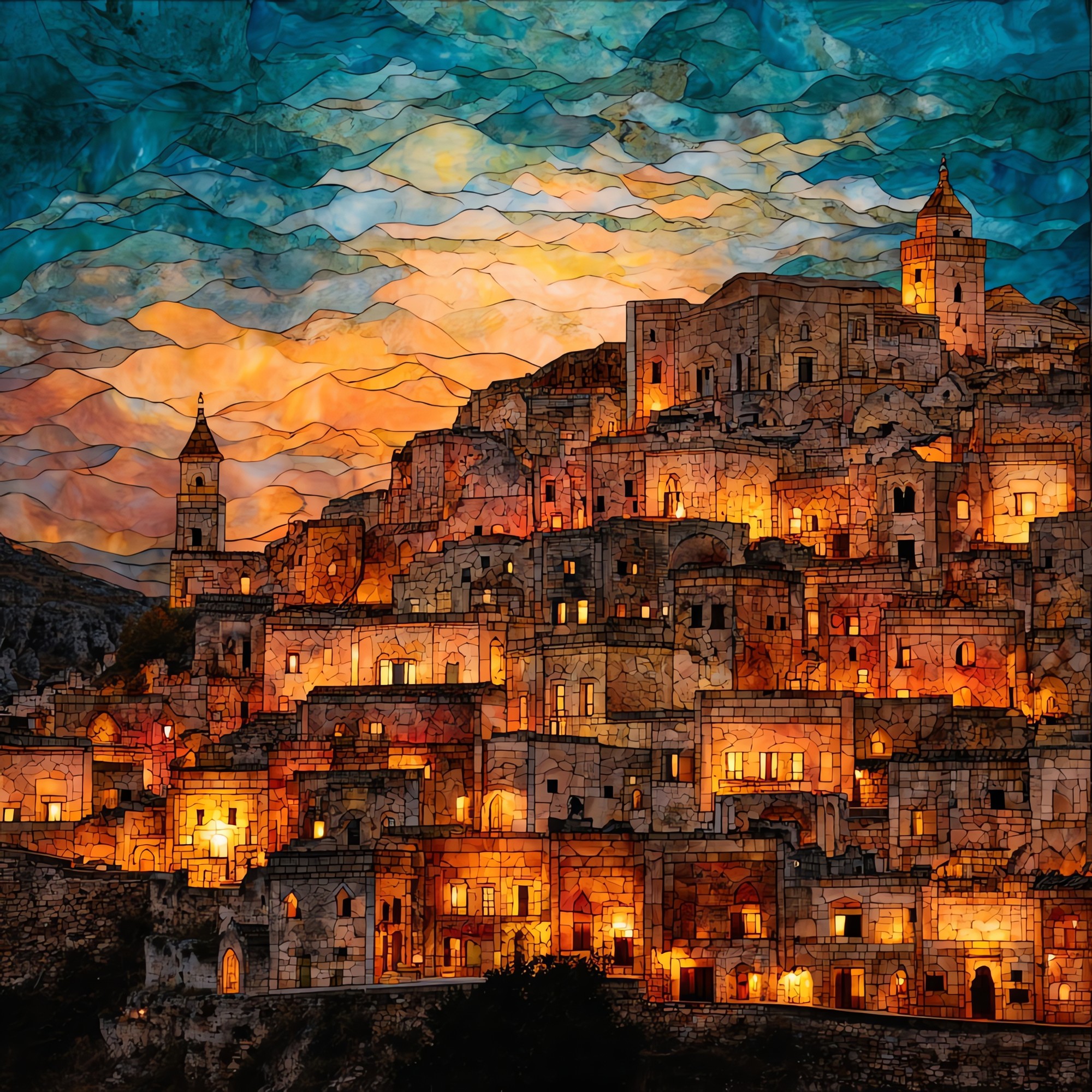
Sassi di Matera
shown on ceramic, 12-inch tileItaly
in the south of Italy, an hour from the Adriatic

Sassi di Matera

a hillside that turns to lamplight.

Where it lives

Not only on a wall.

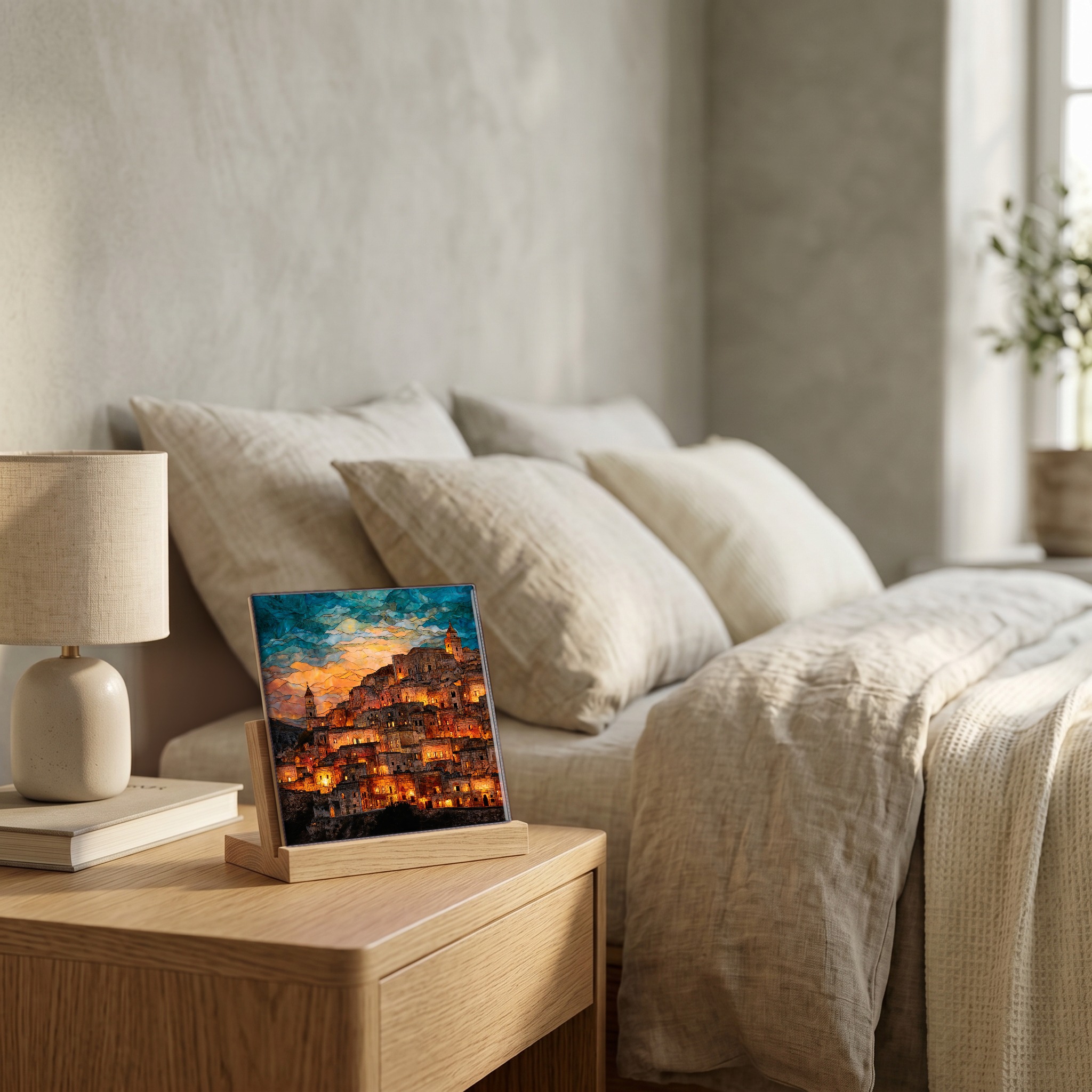
A small tile on the nightstand catching the morning. A larger one above the fire. Yours, wherever you spend the slow hours.
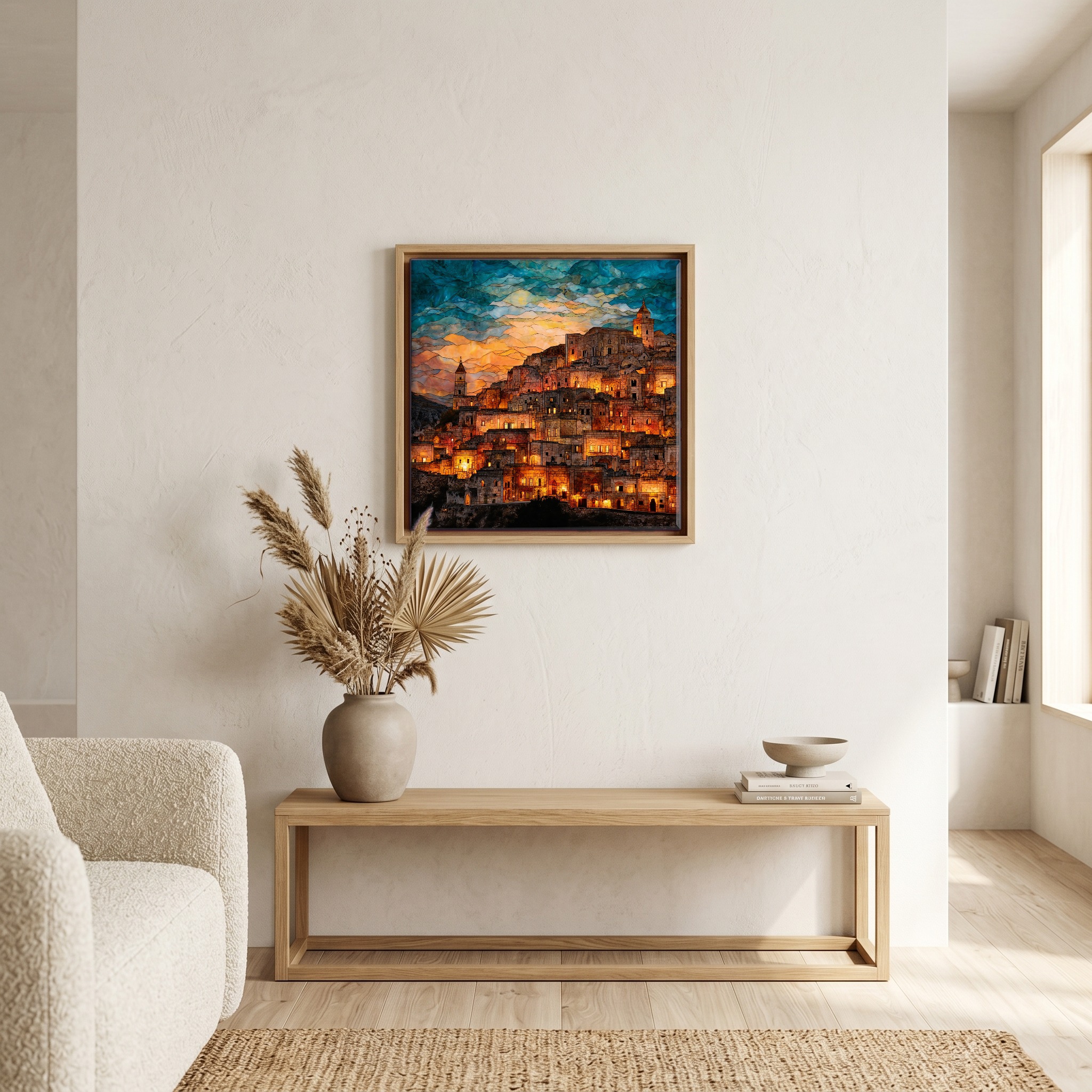
Above the bench, in a warm oak surround.
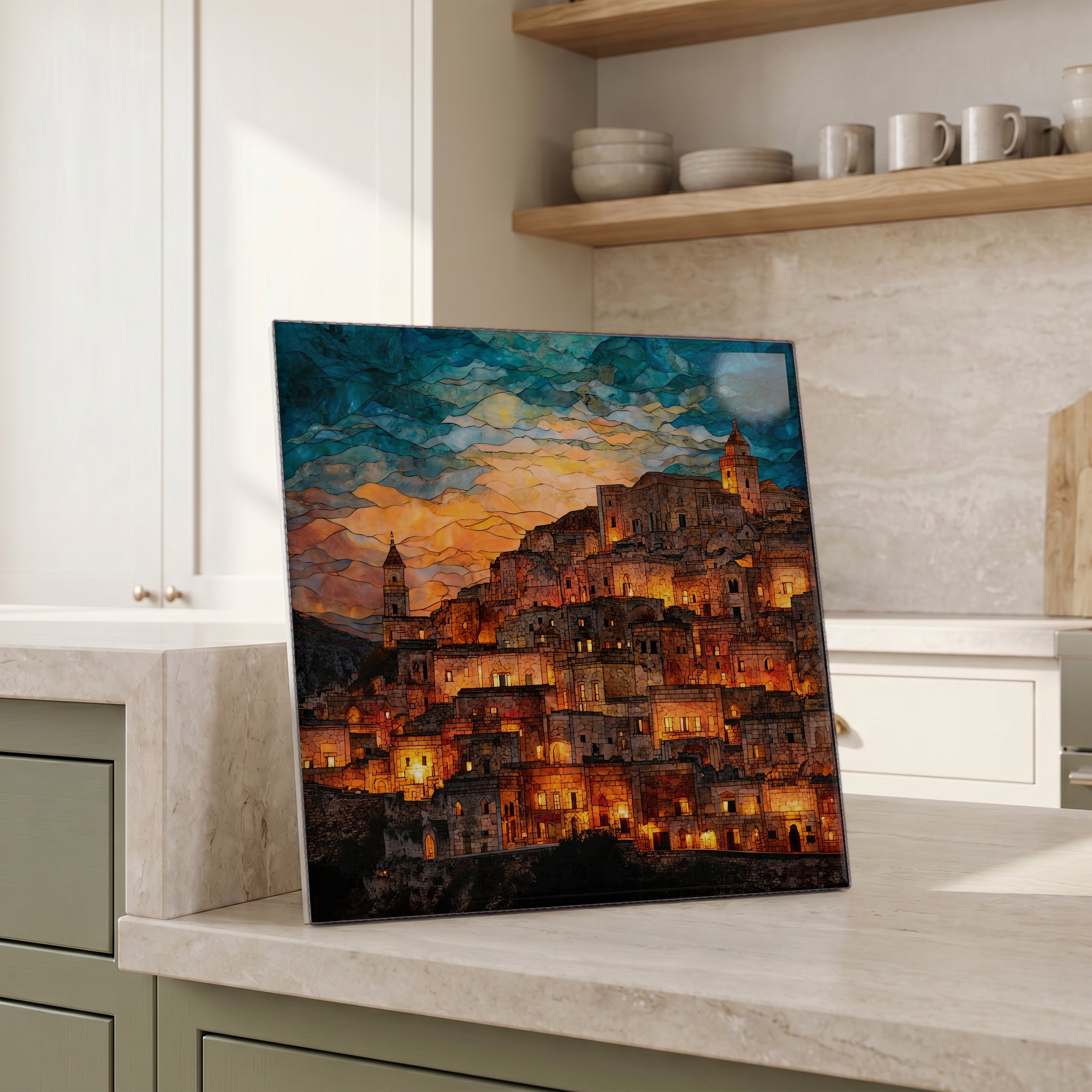
Beside the kettle, propped on the counter.
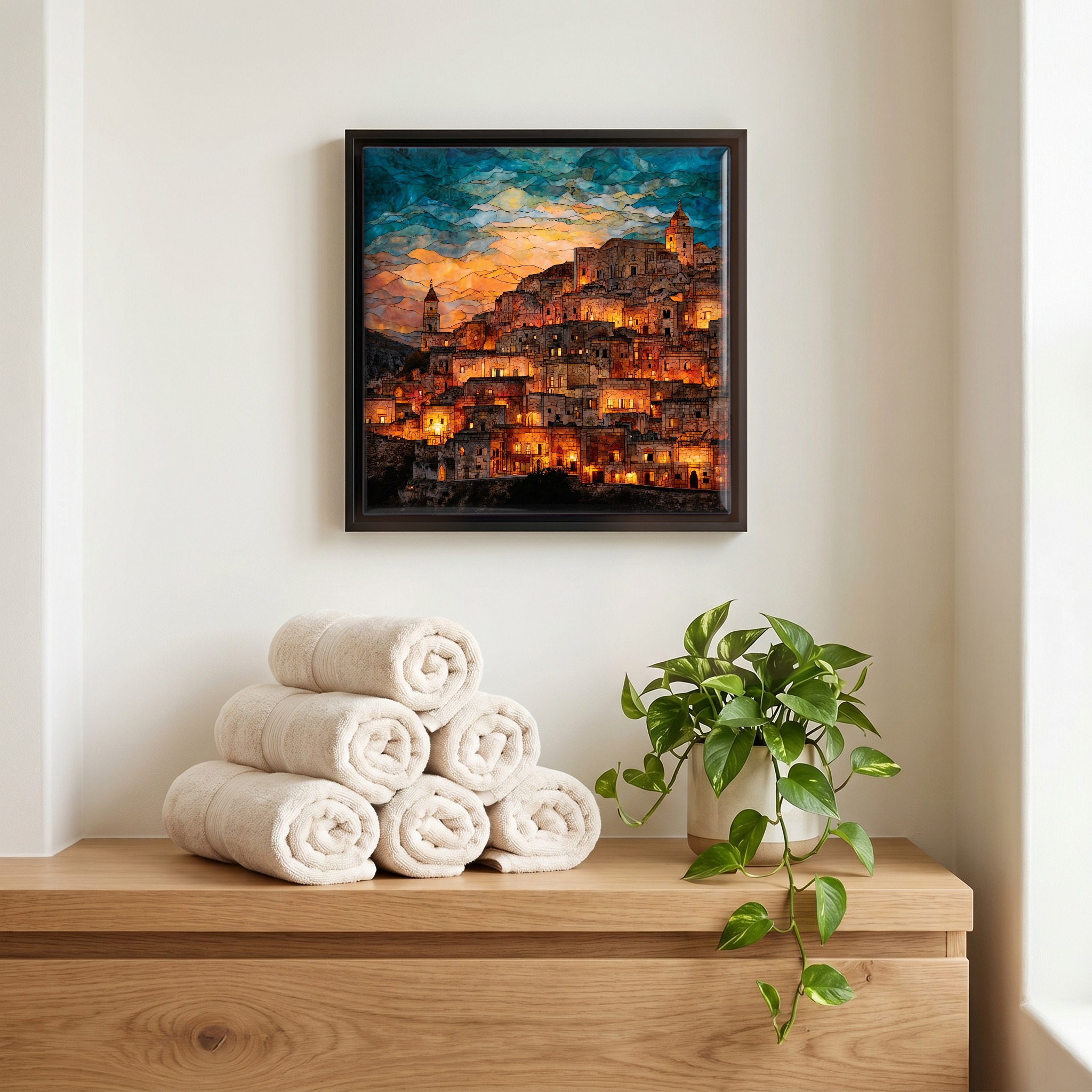
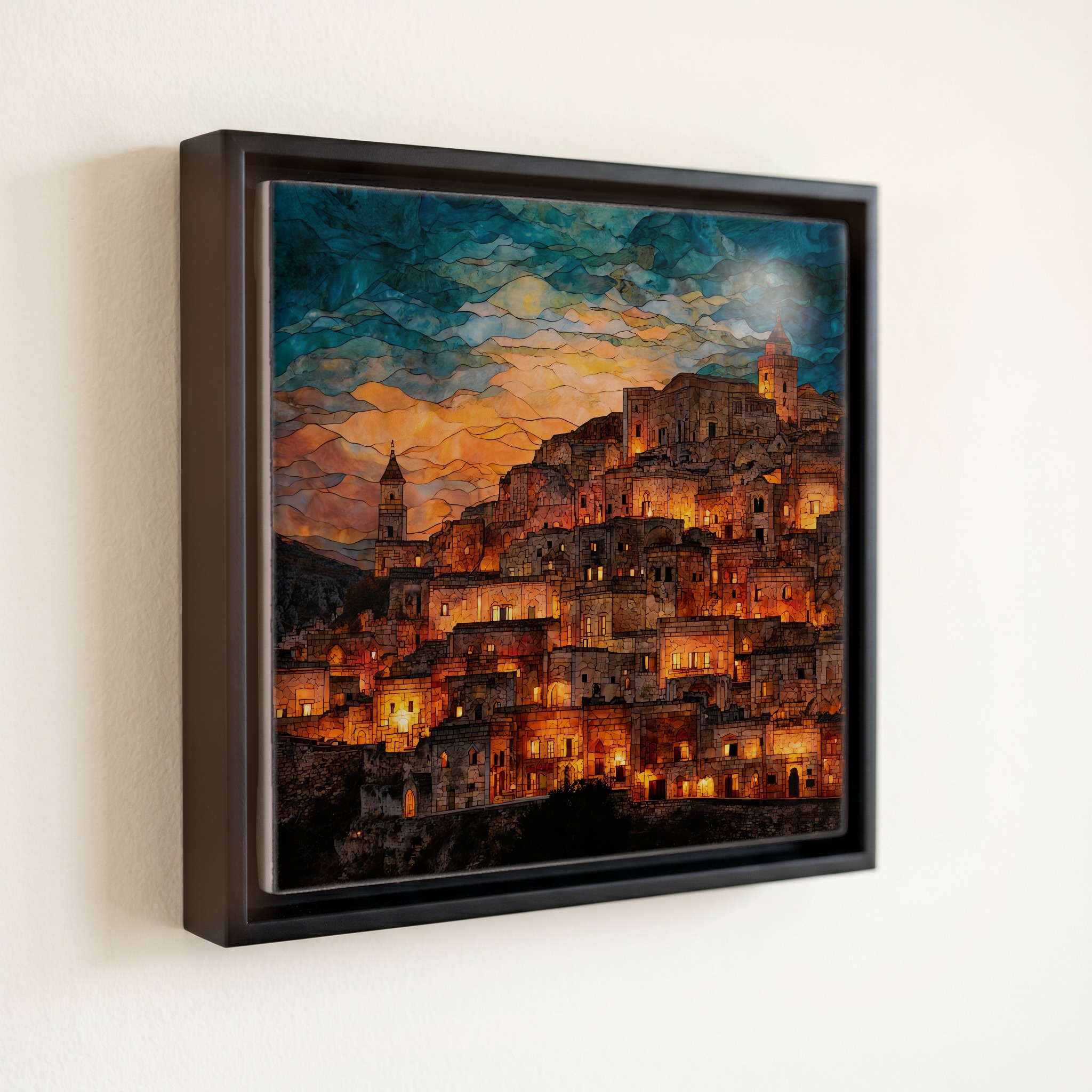
Above the linens, in a slim black surround.
On the nightstand, on a light oak stand.
On a picture ledge, where the light comes in.
a note from the studio

Two districts carved into the soft limestone above the Gravina ravine. Sasso Caveoso to the south, Sasso Barisano to the north, with the cathedral on the ridge between them. Some of the dwellings were occupied without interruption from the Paleolithic until the 1950s, one of the longest unbroken records of human settlement anywhere. The town emptied for a few decades, then came back. At dusk the whole hillside warms to the colour of a banked fire, lamp by lamp by lamp.
from the studio
shown in a slim black floating frame · 6 × 6 in
— bring it home

Sassi di Matera, on ceramic.

Each tile is finished by hand in our Knoxville studio. Artwork is slowly infused into the ceramic surface under high heat and pressure, and rests beneath a thin glossy finish. The colour lives in the surface, not on top of it.

What kind of piece?
One tile — square or rectangle.
How big?
the popular one — counter, shelf, nightstand
6 × 6 in · 15 cm · 1.6 lb
Surface finish
A clear glossy finish — the artwork reads as if under resin. Ideal for show-pieces and framed wall art.
How it sits
A hidden cleat — sits ¼″ proud of the wall.
$58
Hand-finished and shipped from our studio at the foot of the Smokies. On your wall in about ten days.
size
6 × 6 in
15 cm
weighs
1.6 lb
solid in the hand
surface
ceramic, hand-finished
art rests beneath a thin glossy finish
from
Knoxville, TN
our family studio, at the foot of the Smokies
— start a Coaster Set

Pick any four 4-inch tiles — National Parks you've been to, a Smokies set, the four seasons of one place. $ for a set of , cork-backed, ready to live on the table.
comes gift-ready
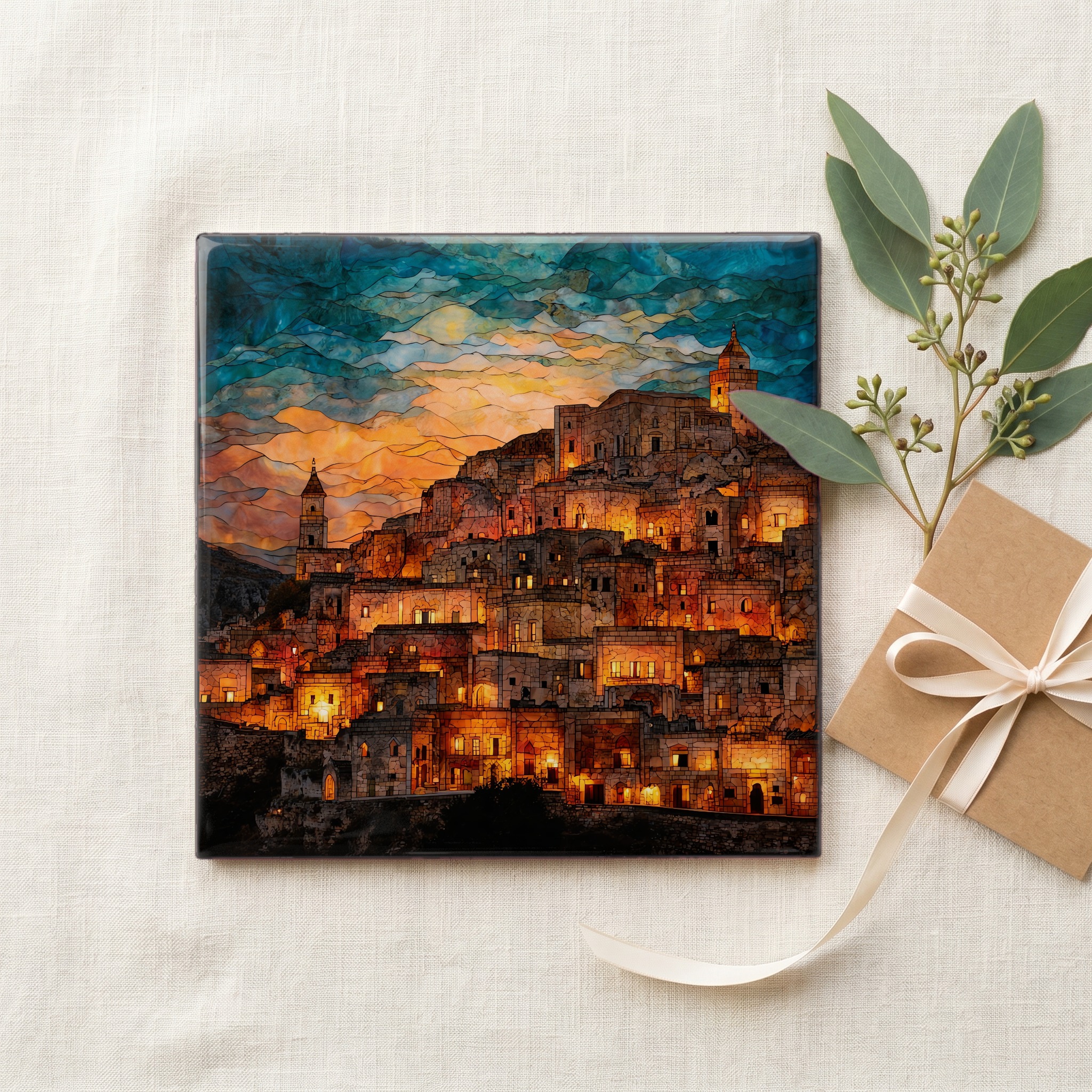
comes gift-ready

Each tile ships in a kraft box, tied with cream ribbon, with a handwritten note from the studio if you'd like to add one.
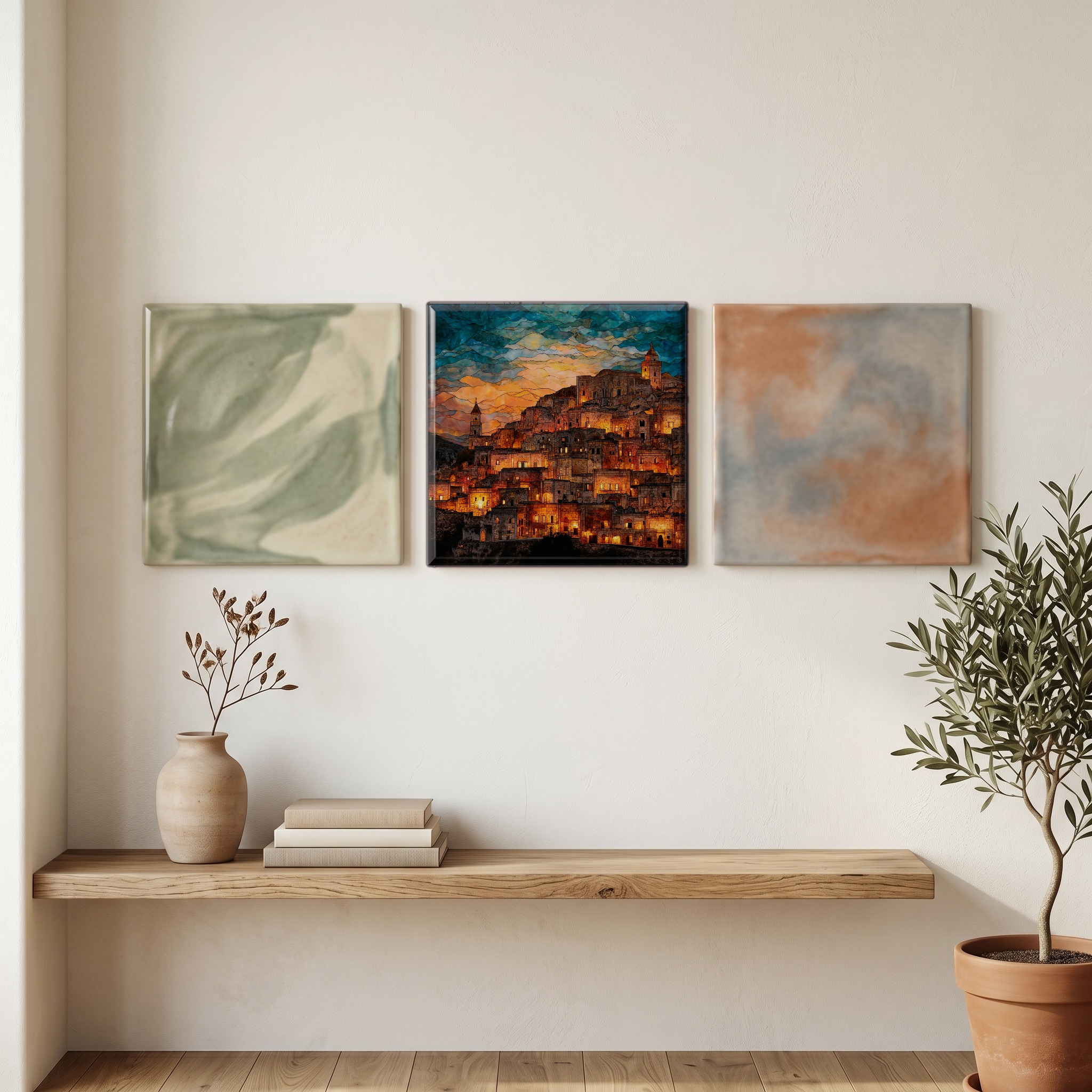
or build a grouping
or build a grouping

Three or five different vistas, hung together — a chapter of places you've been, or want to go.

about Sassi di Matera

The place, in three passes.

A little of what's known, in case you fall down the rabbit hole — or want to go see it yourself.
the place

The Sassi are two cave-dwelling districts carved into a limestone ridge above the Gravina di Matera river canyon, in the city of Matera in the Basilicata region of southern Italy. Sasso Caveoso lies to the south and Sasso Barisano to the north; the medieval Cattedrale di Matera, completed in 1270, sits on the Civita ridge that separates them. Across the ravine is the Parco della Murgia Materana, a regional park of roughly 8,000 hectares that holds more than 150 rock-cut churches dating from the eighth to the thirteenth century. The site was inscribed as a UNESCO World Heritage Site in 1993, and Matera served as a European Capital of Culture in 2019.

the stone

The stone is calcarenite, a soft honey-coloured marine limestone the locals call tufa, easily carved and hardening on exposure to air. Settlement here goes back tens of thousands of years; some scholars argue the Paleolithic-era caves make this one of the longest continuously inhabited sites on earth. The houses were not built on the rock so much as dug into it: cisterns, dovecotes, and entire churches share walls with the cliffside. Over 150 rupestrian churches survive in the Sassi and the Murgia across the ravine, several still bearing Byzantine frescoes from before the Norman conquest. The same stone built the 1270 Cattedrale di Matera on the Civita ridge above.

the visit

The Sassi are open and walkable in any season, with no admission to the districts themselves; individual cave churches such as Santa Maria de Idris and the Convicinio di Sant'Antonio charge small entry fees. The 1950s were a turning point: after Carlo Levi's 1945 book Christ Stopped at Eboli drew national attention to the poverty here, the Italian government relocated roughly 15,000 residents out of the caves between 1952 and the late 1960s. The Sassi sat largely abandoned until restoration began in the 1980s. Many of the cave dwellings have since been converted into hotels, restaurants, and small museums, and Matera served as the backdrop for The Passion of the Christ in 2004 and No Time to Die in 2021.

where
Italy · Matera, Basilicata
within
Parco della Murgia Materana
position
40.6664° N · 16.6088° E
the neighborhood

What's nearby.

A handful of named places within an hour's walk or short drive. Some we've already painted; some we will.
at the lake
Cattedrale di Matera
medieval cathedral
1 km E
Parco della Murgia Materana
rupestrian-church park
14 km W
Cripta del Peccato Originale
frescoed cave church
18 km NW
Altamura
cathedral town
N
Sassi di Matera
Cattedrale di Matera
Parco della Murgia Materana
Cripta del Peccato Originale
Altamura
common questions

What people ask.

A few questions we get about Sassi di Matera — and about bringing the piece home.
about the place

Matera is a city in the Basilicata region of southern Italy, roughly 65 kilometres inland from the Adriatic coast and just west of the Apulian border. The historic Sassi districts sit above the Gravina di Matera ravine on a limestone plateau called the Murgia.

Some of the rock-cut dwellings show evidence of human occupation going back to the Paleolithic period, making Matera one of the longest continuously inhabited settlements in the world. The visible architecture spans roughly nine thousand years, from prehistoric caves to the medieval Cattedrale di Matera completed in 1270.

Sassi is Italian for stones. The name refers to the two districts of rock-cut houses, churches, and cisterns carved directly into the soft calcarenite limestone of the ravine wall: Sasso Caveoso on the south side and Sasso Barisano on the north.

Writer Carlo Levi's 1945 book Christ Stopped at Eboli drew national attention to extreme rural poverty in Basilicata, and Prime Minister Alcide De Gasperi called the Sassi the shame of Italy. The government relocated roughly 15,000 residents to new housing between 1952 and the late 1960s.

Yes. The Sassi and the rupestrian churches of the Park of the Murgia Materana were inscribed on the UNESCO World Heritage List in 1993, recognised as an outstanding example of a vernacular human settlement carved into the landscape. Matera was also a European Capital of Culture in 2019.

Mel Gibson's The Passion of the Christ in 2004 used the Sassi extensively, as did the opening sequence of the James Bond film No Time to Die in 2021. Matera has stood in for ancient Jerusalem in several biblical films because the limestone architecture closely resembles the old city.

Yes. The Sassi themselves and the Parco della Murgia Materana across the ravine contain more than 150 rupestrian churches dating from the eighth to thirteenth centuries. Several, including Santa Maria de Idris and the Convicinio di Sant'Antonio, are open to visitors for a small entry fee.

about the piece in your home

It tends to find its way home with people who have walked the Sassi at dusk and remember the light. Anyone who has stayed in one of the cave hotels, or sat down to orecchiette in a restaurant cut into the rock, recognises the warmth in the work. A Small or Medium with a handwritten note from the studio carries well.

The honey-and-amber palette sits comfortably in Mediterranean-modern interiors, in earth-toned Wabi-Sabi rooms, and against the limewashed plaster walls that have come back in slow-living and Italian-rustic design. The piece reads warm rather than bright, so it pairs well with brass, terracotta, and unfinished wood.

The stone-and-lamplight palette aligns with the Italian Country movement and the broader Mediterranean revival in interior design through 2025 and 2026. It also reads at home in slow-living and Wabi-Sabi rooms, where the texture of old materials is part of the appeal.

The Large, at 16 by 16 inches, sits well above a console table or a reading chair. Above a full sofa we generally suggest a 4-tile Mural at 32 by 32 inches or a 9-tile Mural at 48 by 48 inches, which lets the ravine geometry of the Sassi extend properly across the wall.

Yes. The Dura Satin and Matte finishes are scratch-resistant and built for vertical installation in wet rooms: kitchen backsplashes, shower walls, powder-room accent walls. The Glossy finish is meant for framed wall art and dry rooms. The ceramic itself is unaffected by humidity in either case.

A soft microfibre cloth and clean water are enough. For kitchen or bathroom installations, a mild non-abrasive household cleaner is fine. The colour lives in the ceramic surface beneath the finish, so it will not lift, fade, or scratch off with ordinary cleaning.

Yes. Every WenderVista piece is original to our studio in Knoxville, Tennessee. No licensing, no stock imagery, no reproductions of someone else's work. Reid Wender chooses each place, and the visual language is consistent across the full atlas of vistas.

if this one stayed with you

A few you might also love.

Hand-picked by the eye that found Sorapis. Same air, same kind of quiet.
— a collection

The Italian Dolomites,
painted slow.

The valleys between Cortina and Val Gardena, the tarns you walk an hour to see, the towers that turn the colour of a banked fire just before dark. Wander the collection by valley, by season, or follow the path Reid walked.

Tre Cime
Braies
Misurina
Sorapis
Cinque Torri
Sassolungo
Marmolada