Wender·Vista
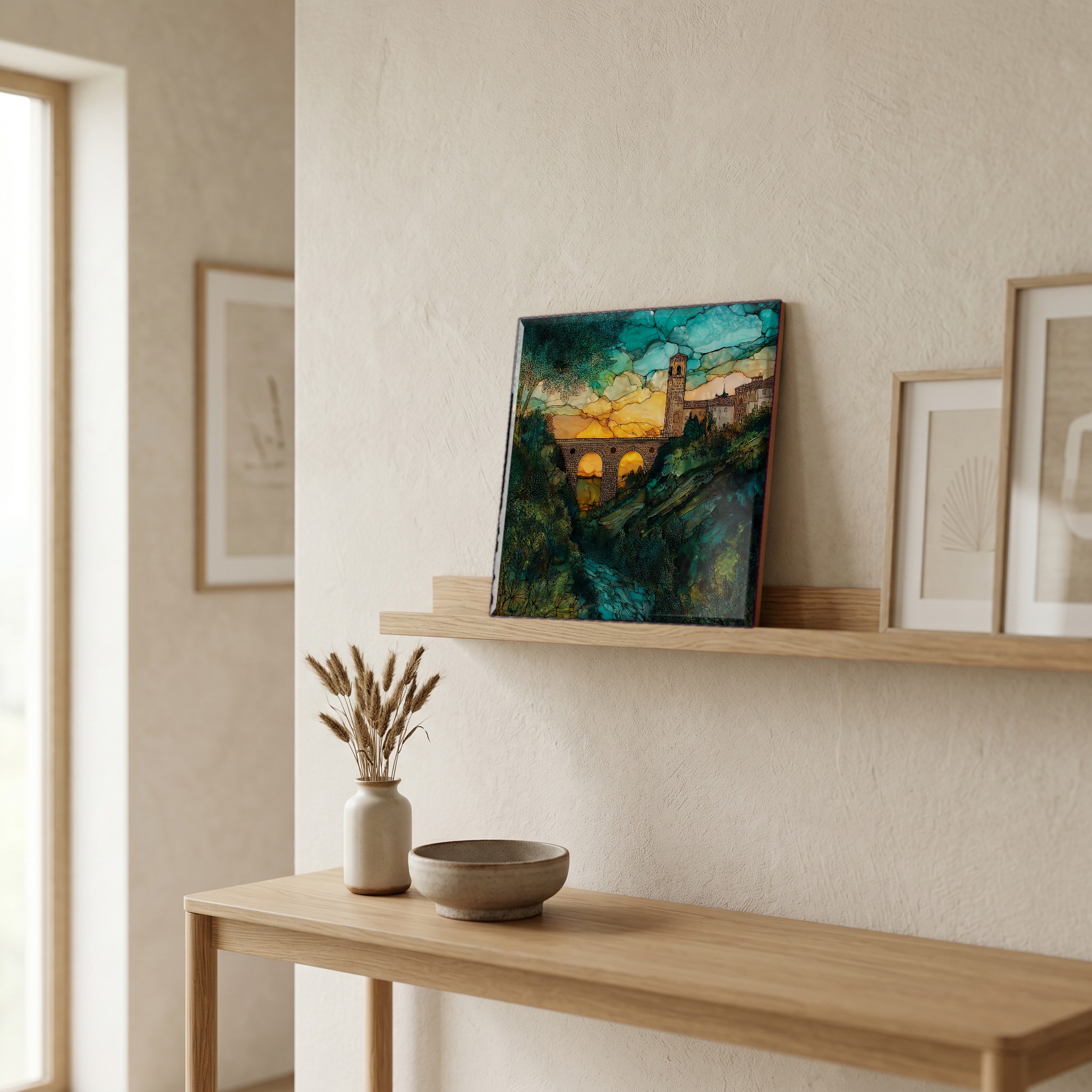
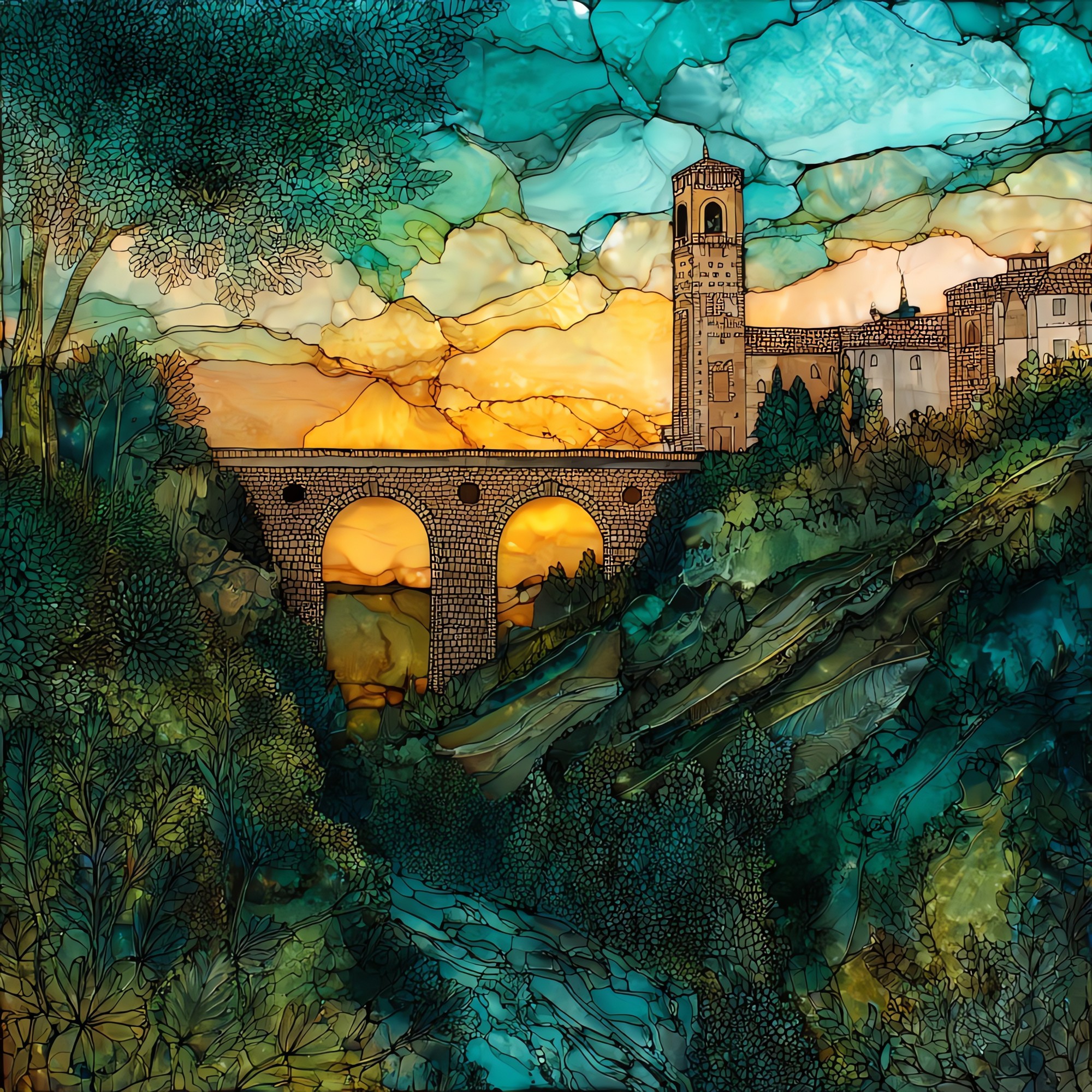
Ponte delle Torri
shown on ceramic, 12-inch tileItaly
in the hills of Umbria, above the Tessino gorge

Ponte delle Torri

the green falls away, and the stone keeps crossing.

Where it lives

Not only on a wall.

A small tile on the nightstand catching the morning. A larger one above the fire. Yours, wherever you spend the slow hours.
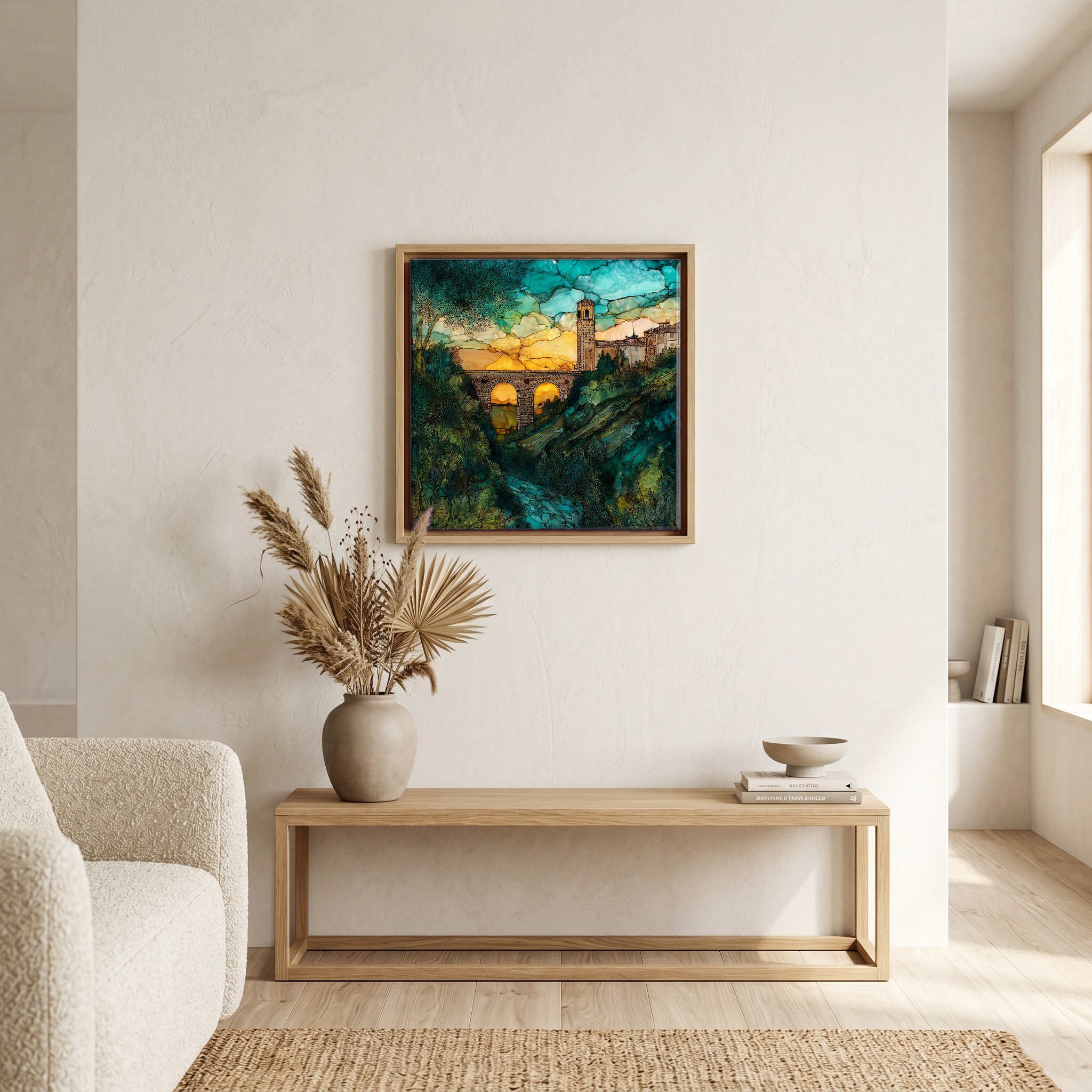
Above the bench, in a warm oak surround.
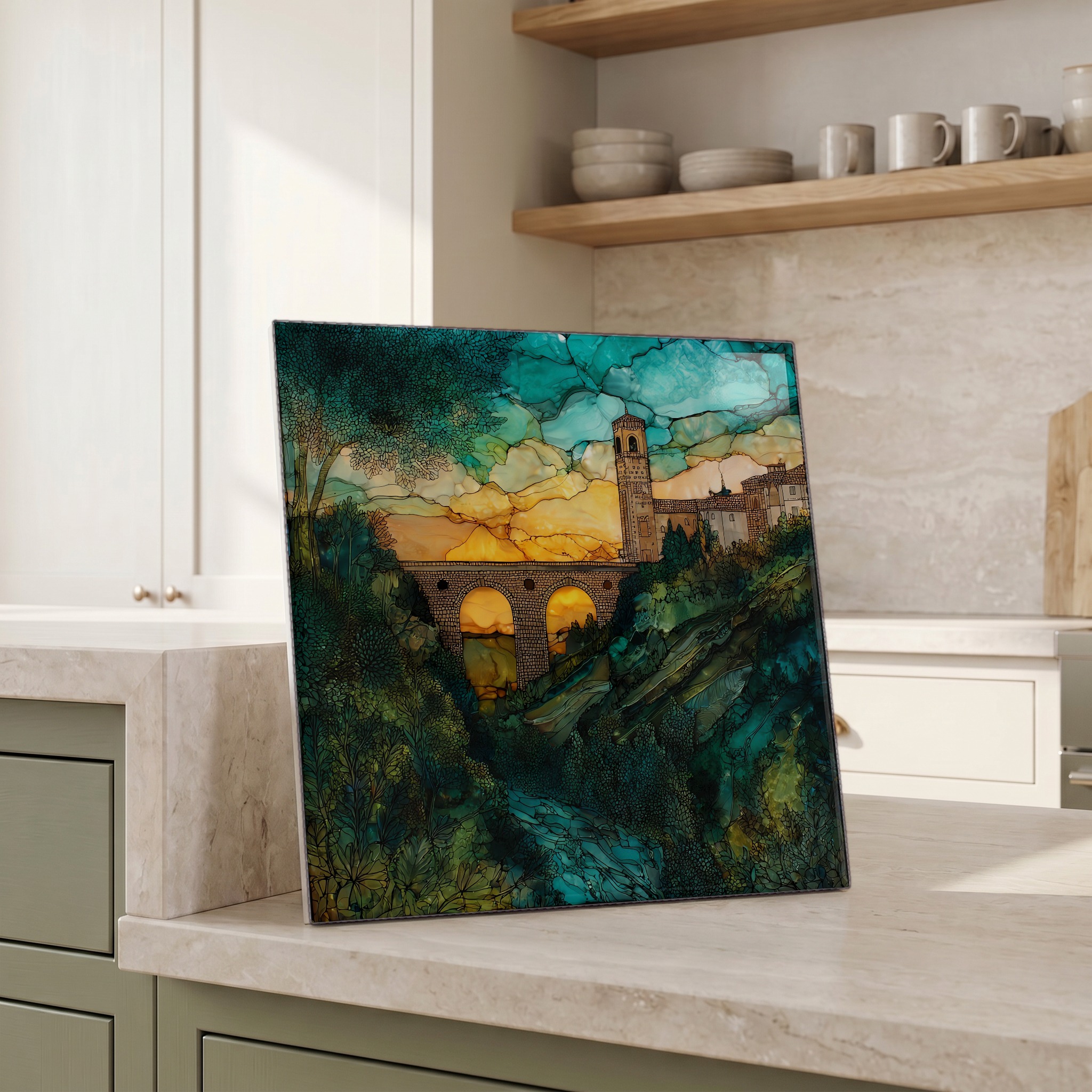
Beside the kettle, propped on the counter.
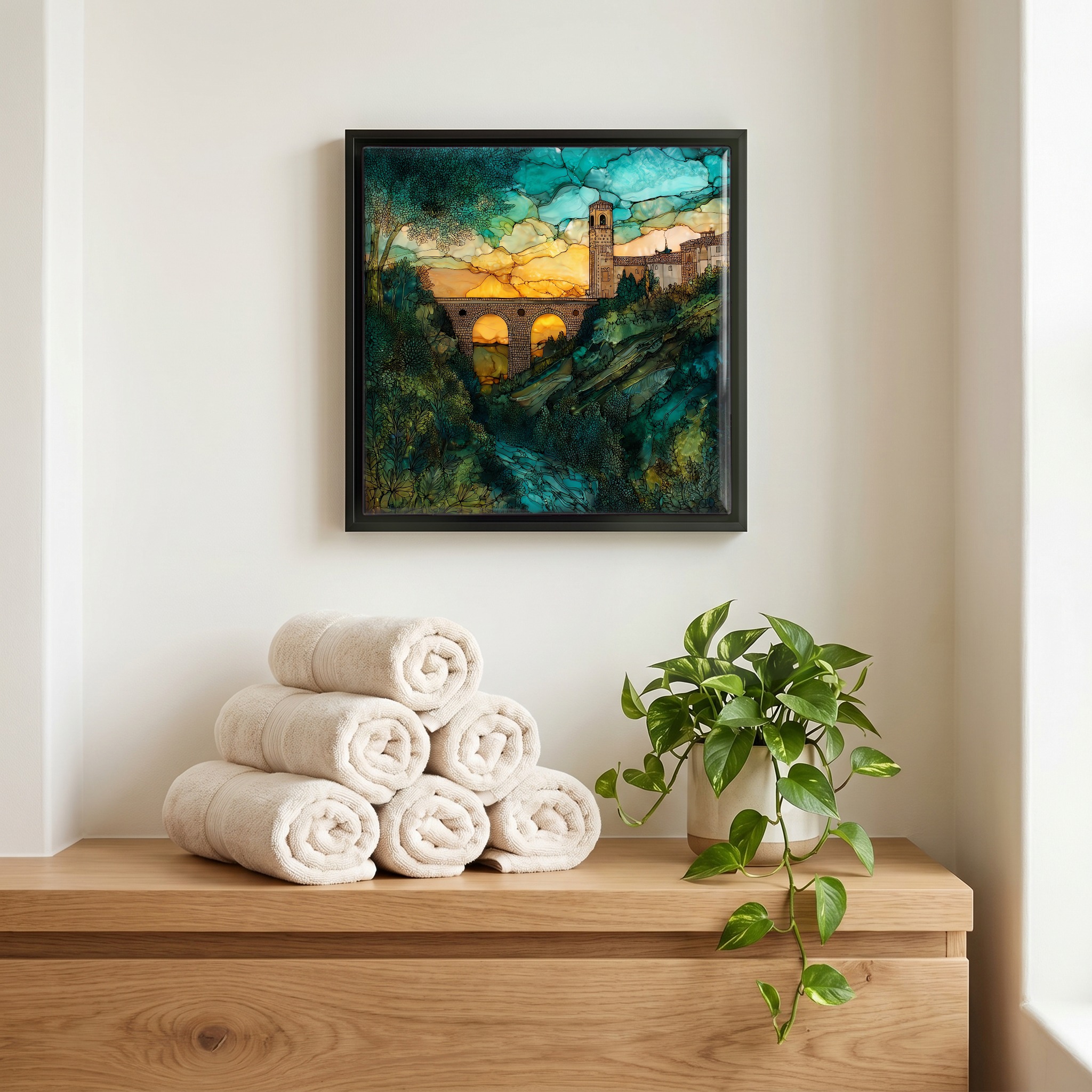
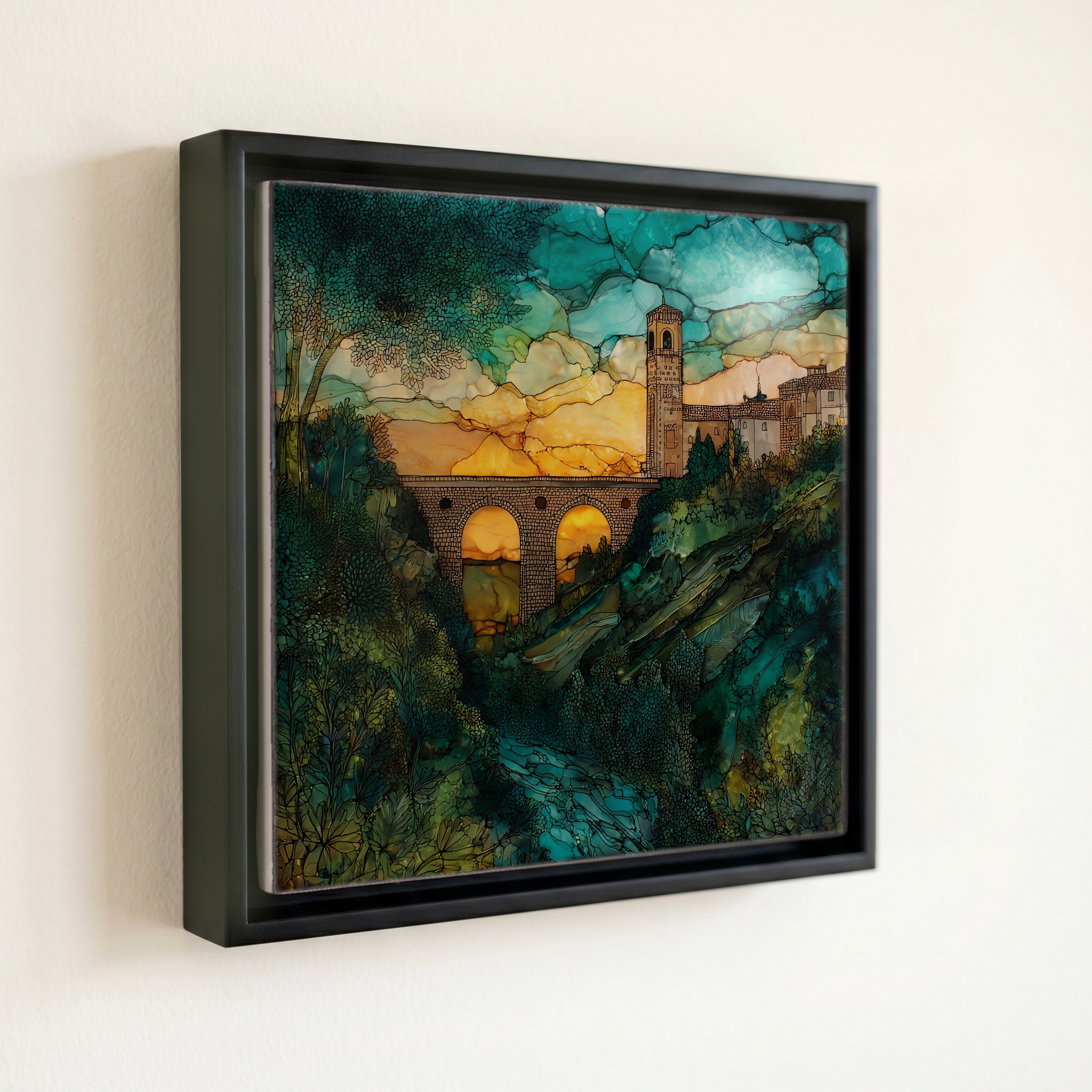
Above the linens, in a slim black surround.
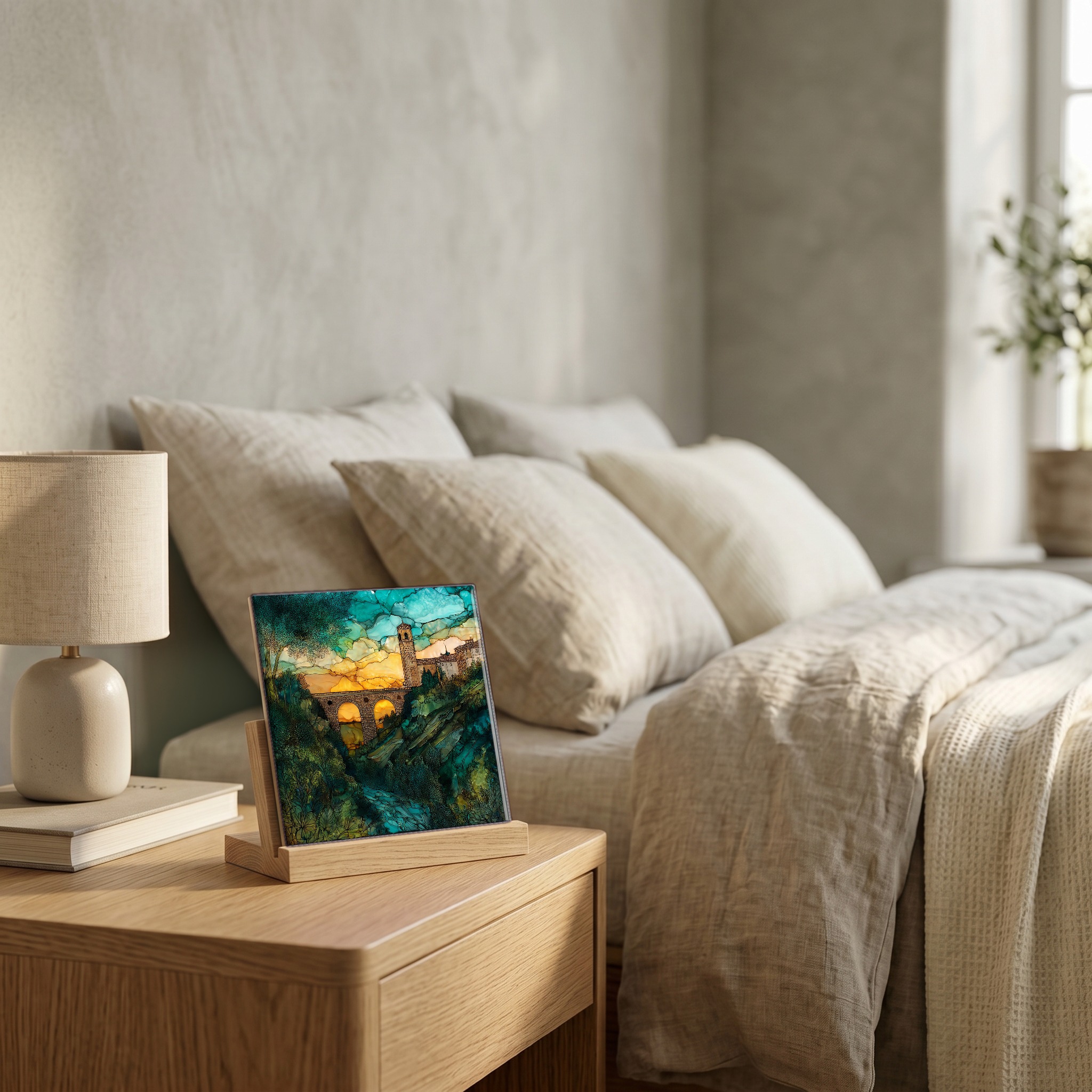
On the nightstand, on a light oak stand.
On a picture ledge, where the light comes in.
a note from the studio

A fourteenth-century aqueduct that became a road into the woods. It crosses the Tessino gorge on nine arches of pale stone, joining the old fortress on Sant'Elia hill to the wooded mountain of Monteluco on the far side. Goethe walked across it in 1786 and wrote it down; Turner sketched it from the road to Rome. For eight years after the 2016 earthquakes the bridge stayed shut, then opened again at the end of 2024. Now it carries walkers, cyclists, and dogs, all of them slowing somewhere near the middle, where the green is farthest down.
from the studio
shown in a slim black floating frame · 6 × 6 in
— bring it home

Ponte delle Torri, on ceramic.

Each tile is finished by hand in our Knoxville studio. Artwork is slowly infused into the ceramic surface under high heat and pressure, and rests beneath a thin glossy finish. The colour lives in the surface, not on top of it.

What kind of piece?
One tile — square or rectangle.
How big?
the popular one — counter, shelf, nightstand
6 × 6 in · 15 cm · 1.6 lb
Surface finish
A clear glossy finish — the artwork reads as if under resin. Ideal for show-pieces and framed wall art.
How it sits
A hidden cleat — sits ¼″ proud of the wall.
$58
Hand-finished and shipped from our studio at the foot of the Smokies. On your wall in about ten days.
size
6 × 6 in
15 cm
weighs
1.6 lb
solid in the hand
surface
ceramic, hand-finished
art rests beneath a thin glossy finish
from
Knoxville, TN
our family studio, at the foot of the Smokies
— start a Coaster Set

Pick any four 4-inch tiles — National Parks you've been to, a Smokies set, the four seasons of one place. $ for a set of , cork-backed, ready to live on the table.
comes gift-ready
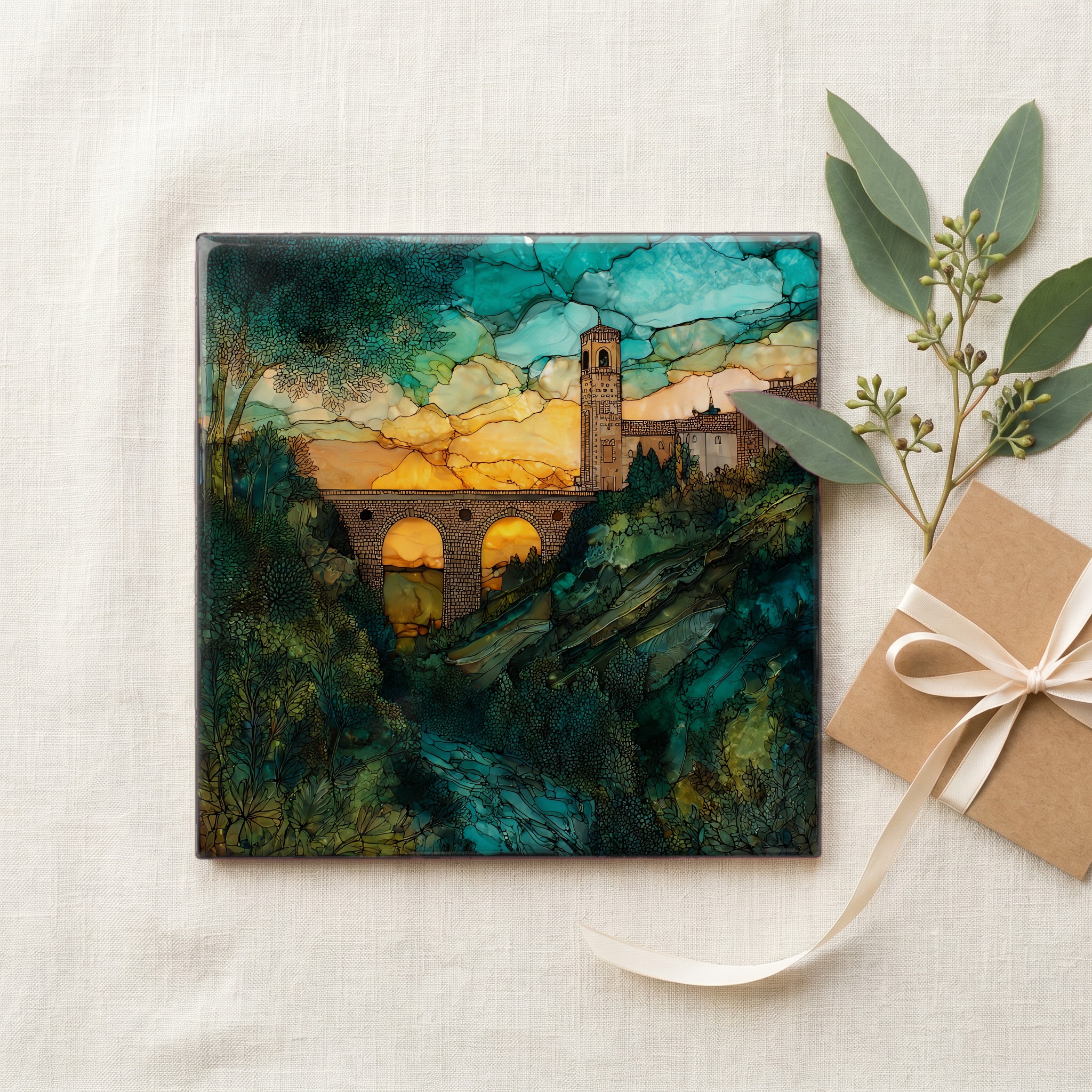
comes gift-ready

Each tile ships in a kraft box, tied with cream ribbon, with a handwritten note from the studio if you'd like to add one.
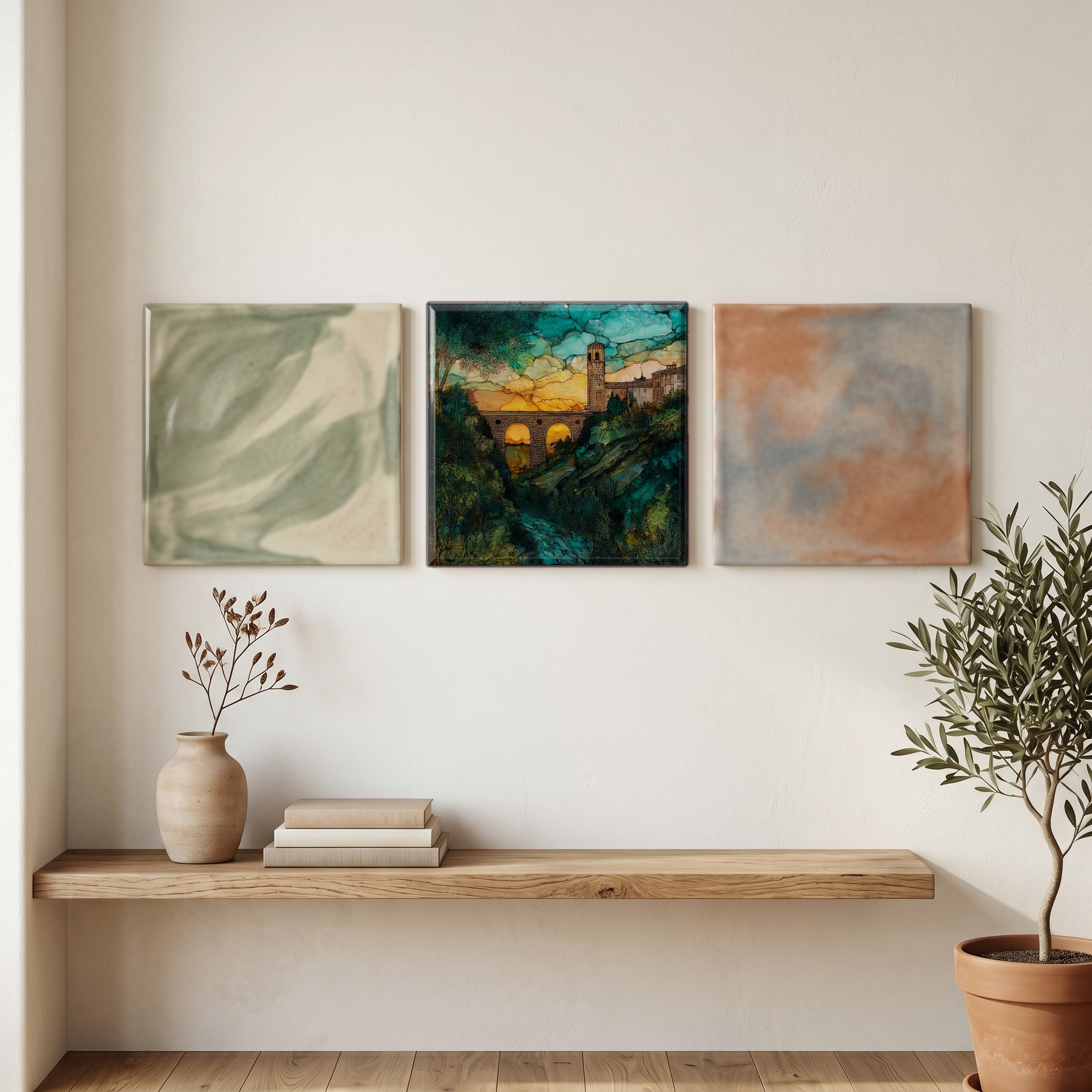
or build a grouping
or build a grouping

Three or five different vistas, hung together — a chapter of places you've been, or want to go.

about Ponte delle Torri

The place, in three passes.

A little of what's known, in case you fall down the rabbit hole — or want to go see it yourself.
the place

Ponte delle Torri stands at the southeastern edge of Spoleto, a hill town in the Umbria region of central Italy, north of Rome. The walkway runs roughly 230 metres across the Tessino gorge, close to 80 metres above the valley floor, linking the Rocca Albornoziana, the fortress on Sant'Elia hill, to the wooded slope of Monteluco opposite. The structure most likely follows the line of an earlier Roman aqueduct; its present form is attributed to Matteo di Giovannello, called Gattapone, working under Cardinal Egidio Albornoz after 1363. From the Monteluco side, the Giro dei Condotti footpath traces the old water conduits back toward the town.

the stone

The bridge reads as two structures at once: an aqueduct that carried water from the Cortaccione and Valcieca springs into Spoleto, and a parapeted walkway laid over the conduit so people could cross on foot. Its piers are massive, some roughly ten by twelve metres at the base, tapering as they rise to the nine arches that carry the deck nearly 80 metres above the torrent. The towers anchoring each end, the Rocca on the city side and the Fortilizio dei Mulini opposite, gave the bridge its name. Goethe, crossing in 1786, counted the arches at ten and set them down in his Italian Journey; the stone, built largely of local limestone, has moved little in the six centuries since.

the visit

After the central-Italy earthquakes of August 2016, Spoleto closed the bridge to foot traffic and kept it shut while engineers assessed the damage. Restoration ran on roughly 1.2 million euros of Ministry of Culture funding, managed through the Regional Direction of Umbrian Museums, and the walkway reopened at the end of 2024. It now stands open around the clock, with no admission fee, to walkers, cyclists, and people with dogs. The Giro dei Condotti, the path that descends along the old conduits below, gives the view most photographers want: the full span of arches against the green of the Monteluco woods. Spring and autumn are the easier seasons to walk it.

— informed by Adagio Umbro, Umbria Tourism
where
Italy · Spoleto, Province of Perugia, Umbria
position
42.7331° N · 12.7436° E
the neighborhood

What's nearby.

A handful of named places within an hour's walk or short drive. Some we've already painted; some we will.
0.1 km W
Rocca Albornoziana
fortress
0.4 km E
Fortilizio dei Mulini
medieval fort
2 km E
Monteluco
sacred wood
0.7 km NW
Duomo di Spoleto
cathedral
13 km N
Fonti del Clitunno
springs
N
Ponte delle Torri
Rocca Albornoziana
Fortilizio dei Mulini
Monteluco
Duomo di Spoleto
Fonti del Clitunno
common questions

What people ask.

A few questions we get about Ponte delle Torri — and about bringing the piece home.
about the place

It is a medieval bridge-aqueduct about 230 metres long and nearly 80 metres high, crossing the Tessino gorge in Spoleto, Umbria. It links the Rocca Albornoziana fortress to the wooded mountain of Monteluco and once carried water into the town.

Its present form dates to the late fourteenth century and is attributed to the architect Matteo di Giovannello, known as Gattapone, working under Cardinal Egidio Albornoz after 1363. It most likely follows the line of an earlier Roman aqueduct.

The name comes from the two fortified structures at its ends: the Rocca Albornoziana on Sant'Elia hill above the city, and the Fortilizio dei Mulini on the Monteluco side. Their towers gave the Bridge of Towers its name.

The bridge runs roughly 230 metres across the Tessino gorge and stands close to 80 metres above the valley floor, carried on nine stone arches. When Goethe crossed in 1786 he counted ten and wrote it down.

Yes. Closed after the 2016 central-Italy earthquakes, it reopened at the end of 2024 following restoration funded by the Ministry of Culture. It is now open around the clock with no admission fee to walkers, cyclists, and people with dogs.

Yes. The German poet Johann Wolfgang von Goethe crossed the bridge in 1786 and described it in his Italian Journey, noting its arches striding across the valley in stone. The English painter J. M. W. Turner later sketched it from the road to Rome.

The wooded mountain of Monteluco, long held sacred, first as a Roman grove protected by an ancient law and later home to Franciscan hermitages. From there the Giro dei Condotti footpath descends along the bridge's old water conduits.

about the piece in your home

It has carried meaning for customers connected to the region. The Ponte delle Torri is one of the defining images of Spoleto, known to anyone who has walked it or grown up beneath it. A Small or Medium with a note from the studio travels well.

The deep stone tones and the green of the gorge sit easily in Mountain-modern, warm Mediterranean, and Jewel-tone rooms. It holds a wall of its own and pairs with natural wood, brass, and unbleached linen.

It fits the current pull toward heritage architecture and earthy, stone-and-foliage palettes. The piece reads as collected rather than decorated, which lets it sit in both warm minimalist and layered maximalist rooms.

Above a sofa, most rooms want a single Large or a four-tile Mural for presence. Above a console or in a hallway, a Medium or a nine-tile Mural arrangement holds the space without crowding it.

Yes. For a backsplash, a shower wall, or any damp or steamy spot, order the Dura Satin or Matte finish rather than Glossy. Both are scratch-resistant and made for vertical installation in wet rooms.

A soft microfibre cloth and a little water. The colour is infused into the ceramic surface and sits beneath a thin protective finish, so there is no print layer on top to wear away. Skip abrasive pads and harsh solvents.

Yes. Every WenderVista piece is created in-house in Knoxville, Tennessee, in the studio's own stained-glass and ink visual language. There is no licensing and no stock imagery; each place is rendered and hand-finished by the studio.

if this one stayed with you

A few you might also love.

Hand-picked by the eye that found Sorapis. Same air, same kind of quiet.
— a collection

The Italian Dolomites,
painted slow.

The valleys between Cortina and Val Gardena, the tarns you walk an hour to see, the towers that turn the colour of a banked fire just before dark. Wander the collection by valley, by season, or follow the path Reid walked.

Tre Cime
Braies
Misurina
Sorapis
Cinque Torri
Sassolungo
Marmolada