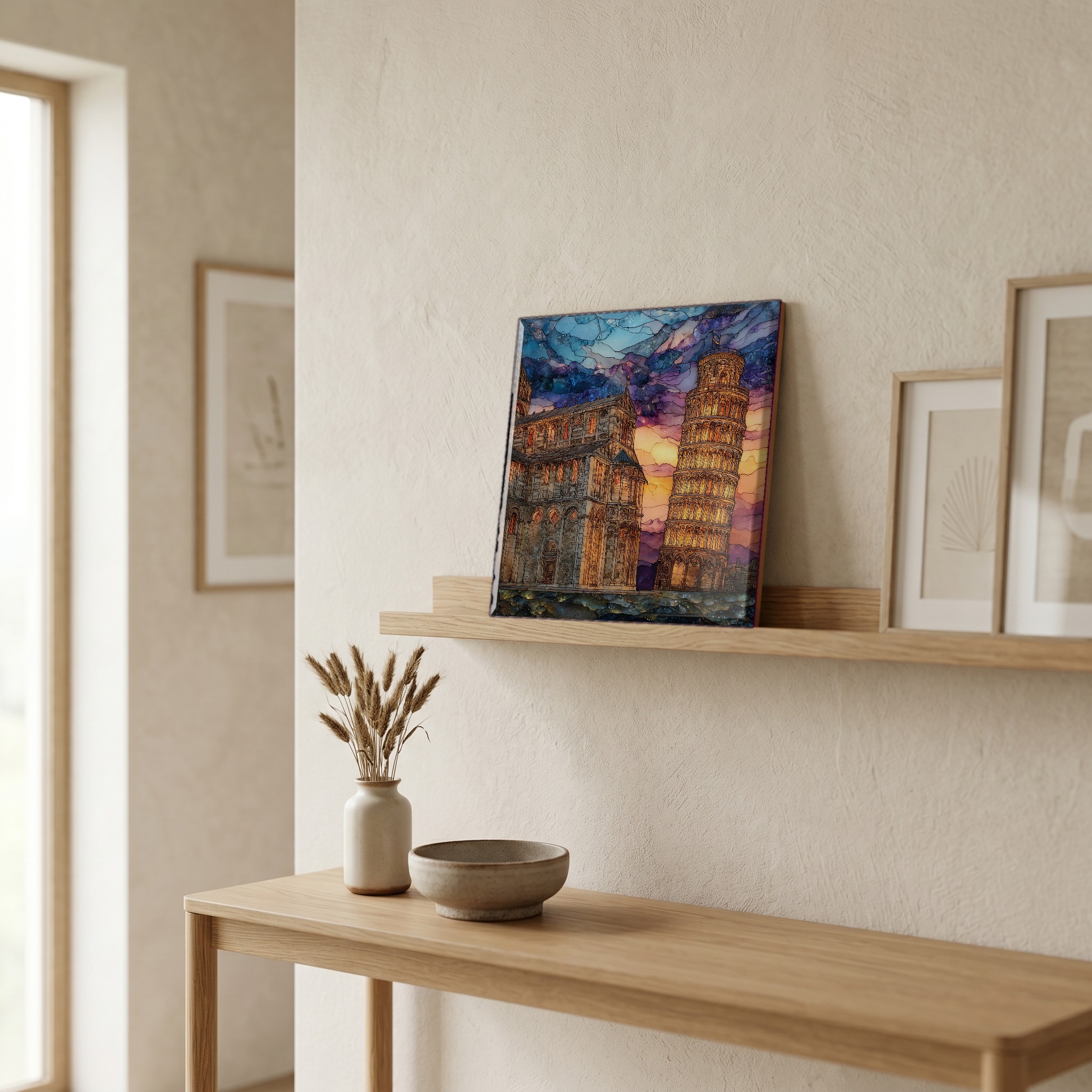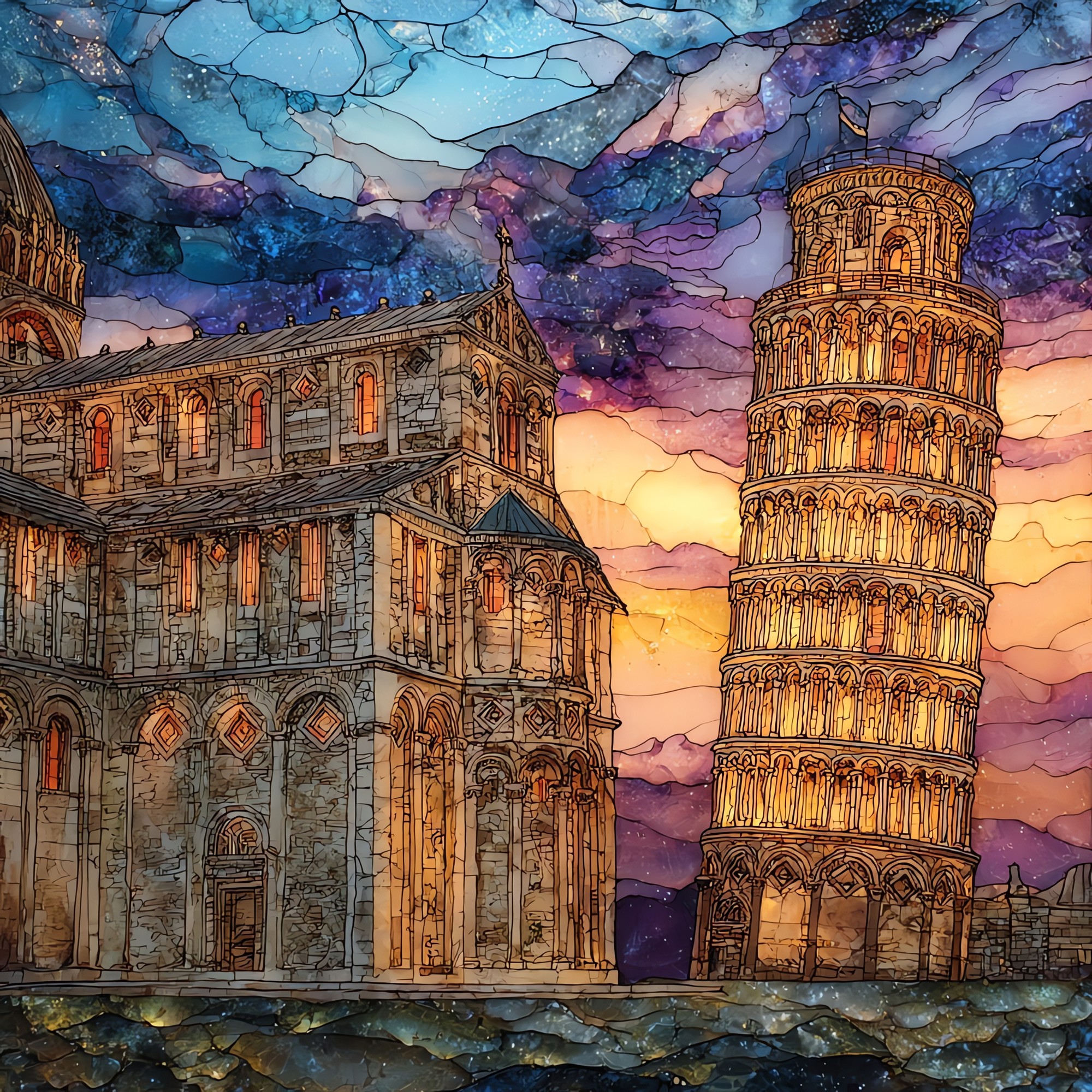
Wender·Vista
Leaning Tower of Pisa
shown on ceramic, 12-inch tileItaly
in the Square of Miracles, in Tuscany

Leaning Tower of Pisa

a fall that never finishes.

Where it lives

Not only on a wall.

A small tile on the nightstand catching the morning. A larger one above the fire. Yours, wherever you spend the slow hours.
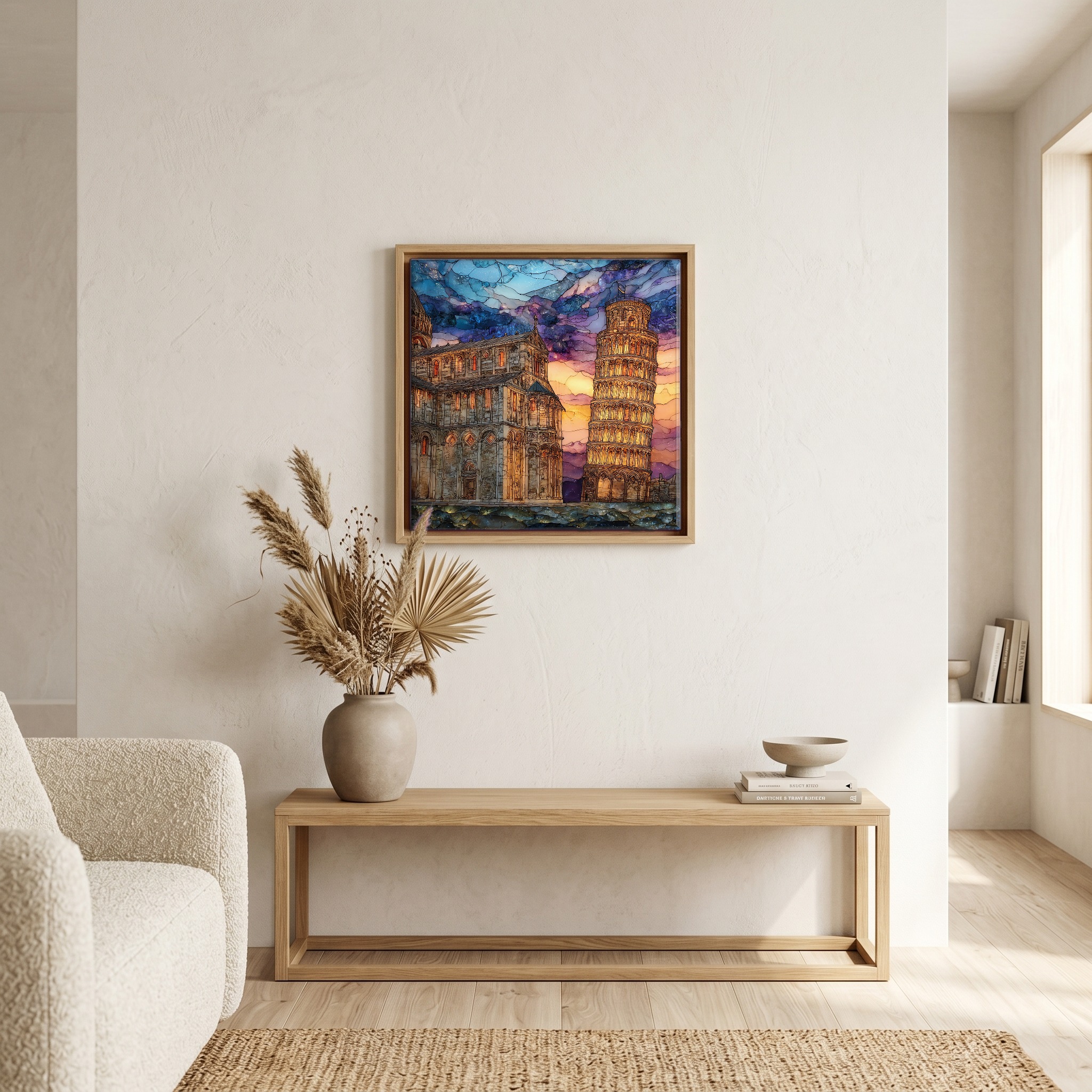
Above the bench, in a warm oak surround.
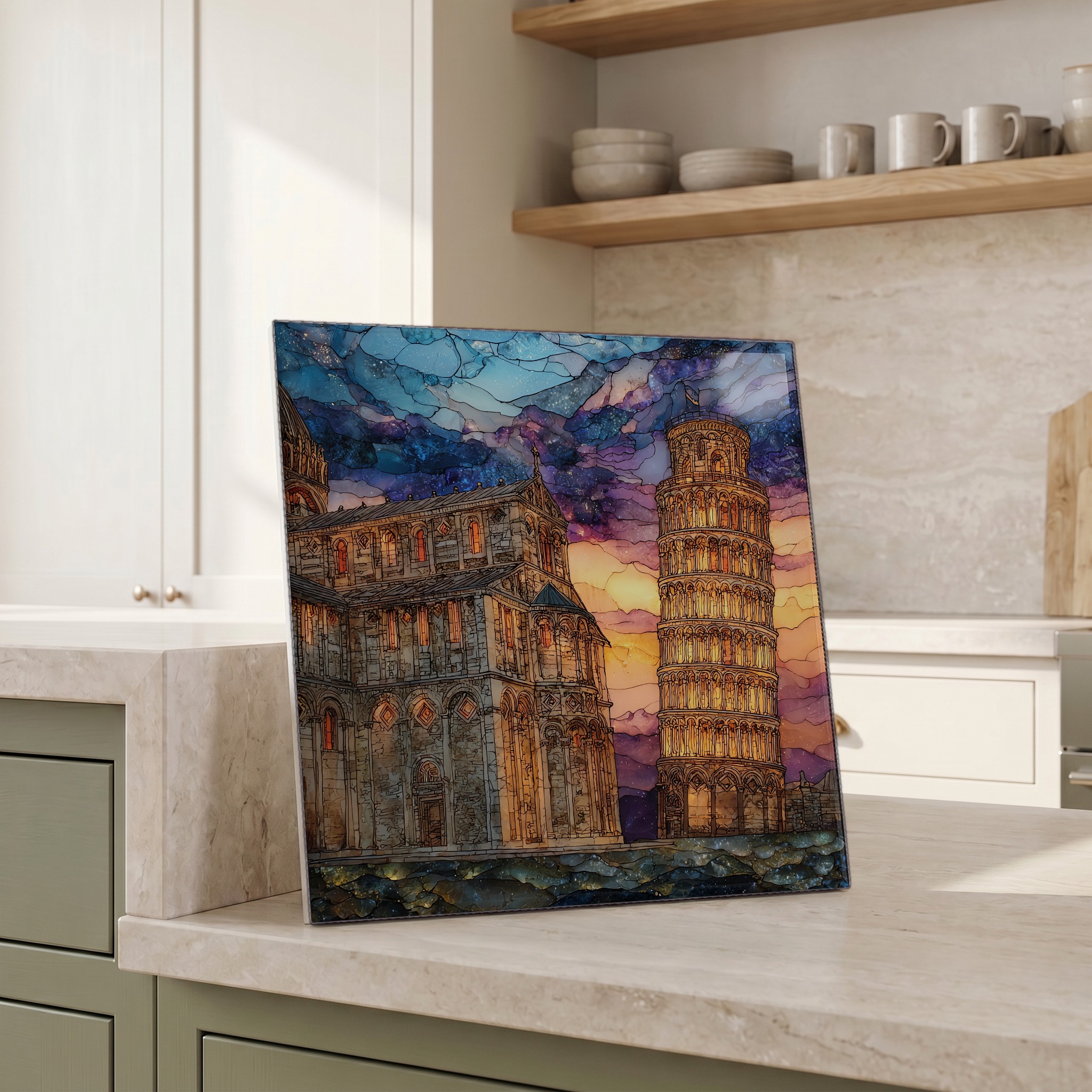
Beside the kettle, propped on the counter.
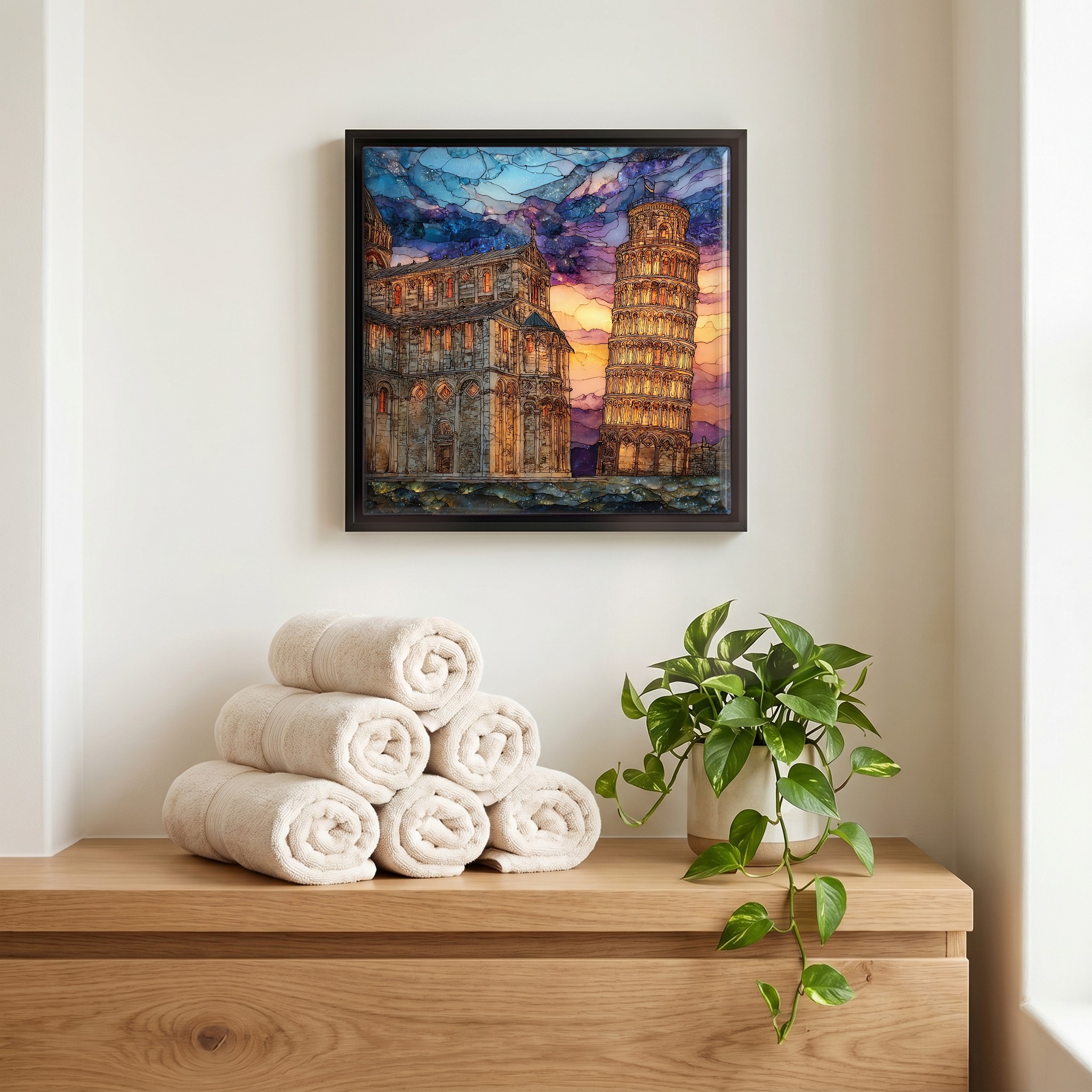
Above the linens, in a slim black surround.
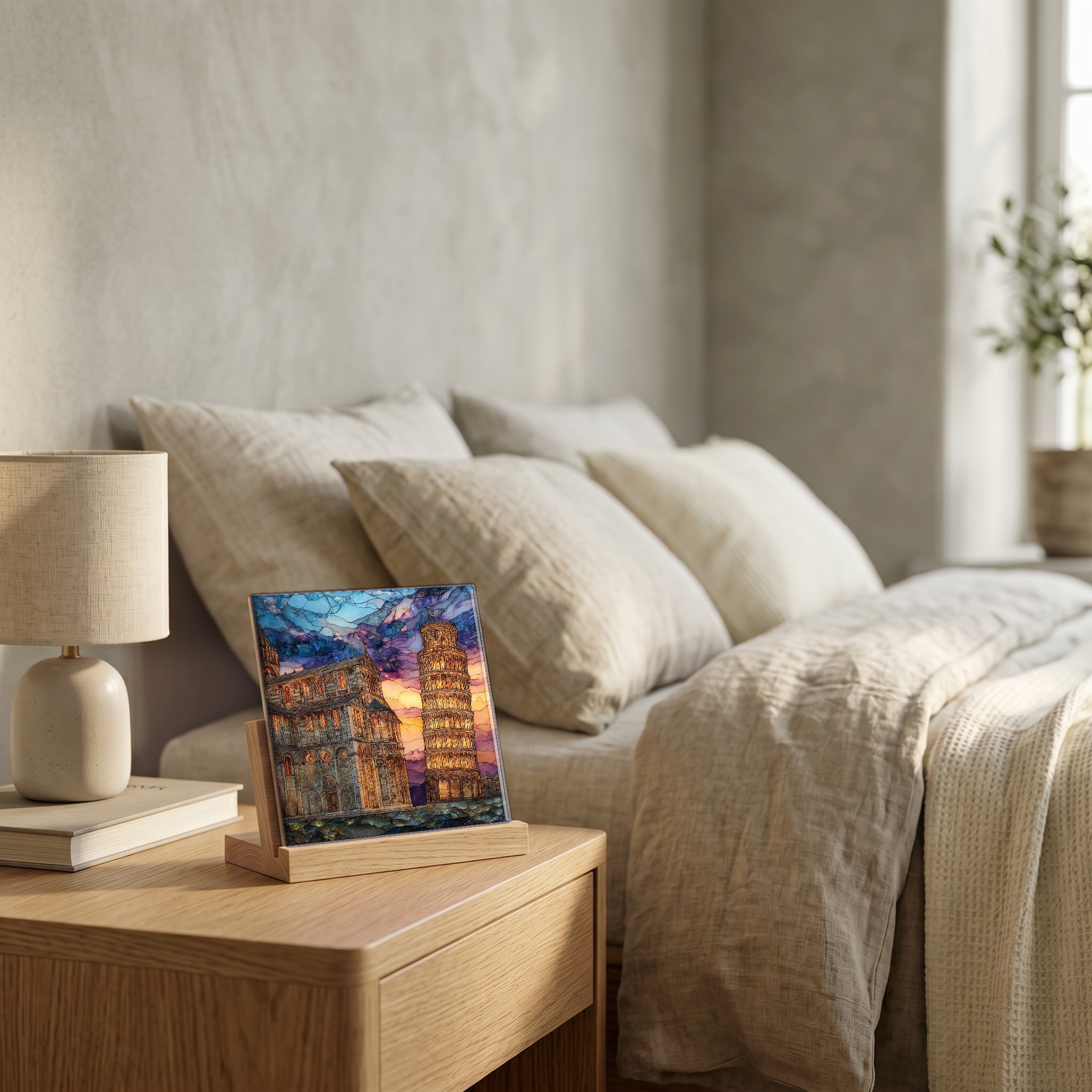
On the nightstand, on a light oak stand.
On a picture ledge, where the light comes in.
a note from the studio

Every photograph of Pisa is the same photograph: someone in the foreground, palm out, holding it up. The tower has been falling since 1178, when the third storey rose on ground too soft to hold its weight. The builders kept going, curving the upper floors to chase the vertical, and the lean only deepened. Eight centuries later it still stands, caught now at just under four degrees after engineers spent a decade easing it back. It is the bell tower of the cathedral beside it. Almost nobody comes for the cathedral.
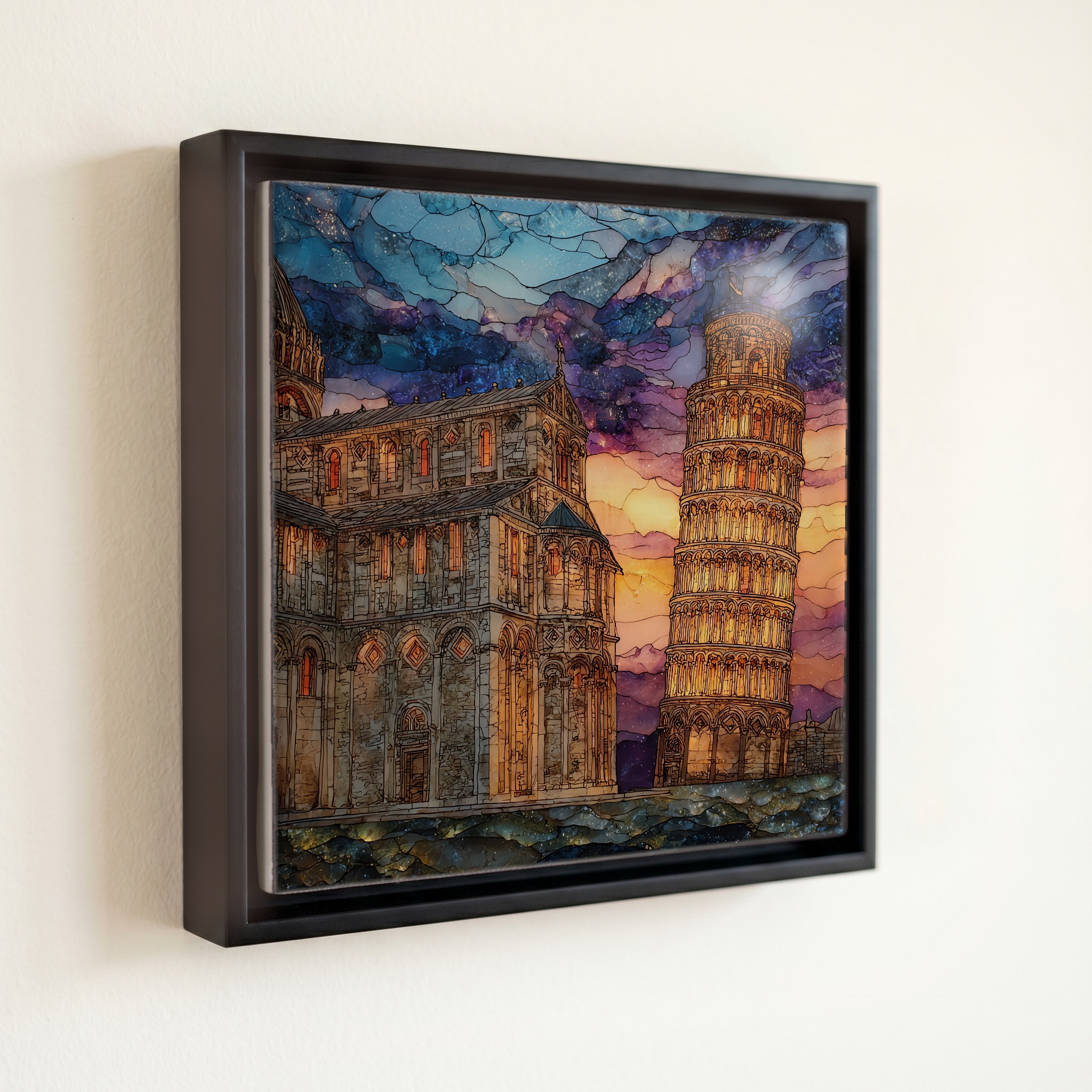
from the studio
shown in a slim black floating frame · 6 × 6 in
— bring it home

Leaning Tower of Pisa, on ceramic.

Each tile is finished by hand in our Knoxville studio. Artwork is slowly infused into the ceramic surface under high heat and pressure, and rests beneath a thin glossy finish. The colour lives in the surface, not on top of it.

What kind of piece?
One tile — square or rectangle.
How big?
the popular one — counter, shelf, nightstand
6 × 6 in · 15 cm · 1.6 lb
Surface finish
A clear glossy finish — the artwork reads as if under resin. Ideal for show-pieces and framed wall art.
How it sits
A hidden cleat — sits ¼″ proud of the wall.
$58
Hand-finished and shipped from our studio at the foot of the Smokies. On your wall in about ten days.
size
6 × 6 in
15 cm
weighs
1.6 lb
solid in the hand
surface
ceramic, hand-finished
art rests beneath a thin glossy finish
from
Knoxville, TN
our family studio, at the foot of the Smokies
— start a Coaster Set

Pick any four 4-inch tiles — National Parks you've been to, a Smokies set, the four seasons of one place. $ for a set of , cork-backed, ready to live on the table.
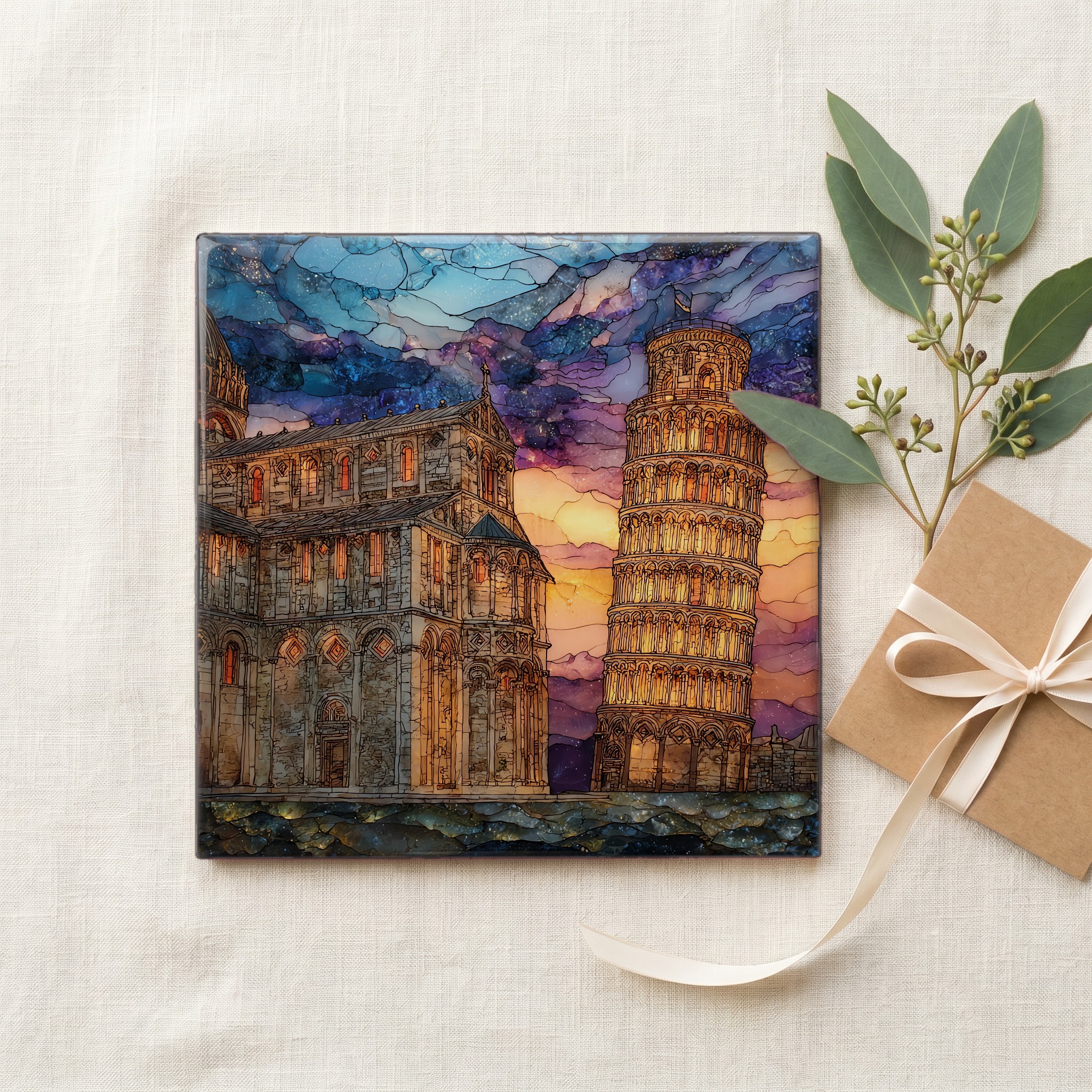
comes gift-ready
comes gift-ready

Each tile ships in a kraft box, tied with cream ribbon, with a handwritten note from the studio if you'd like to add one.
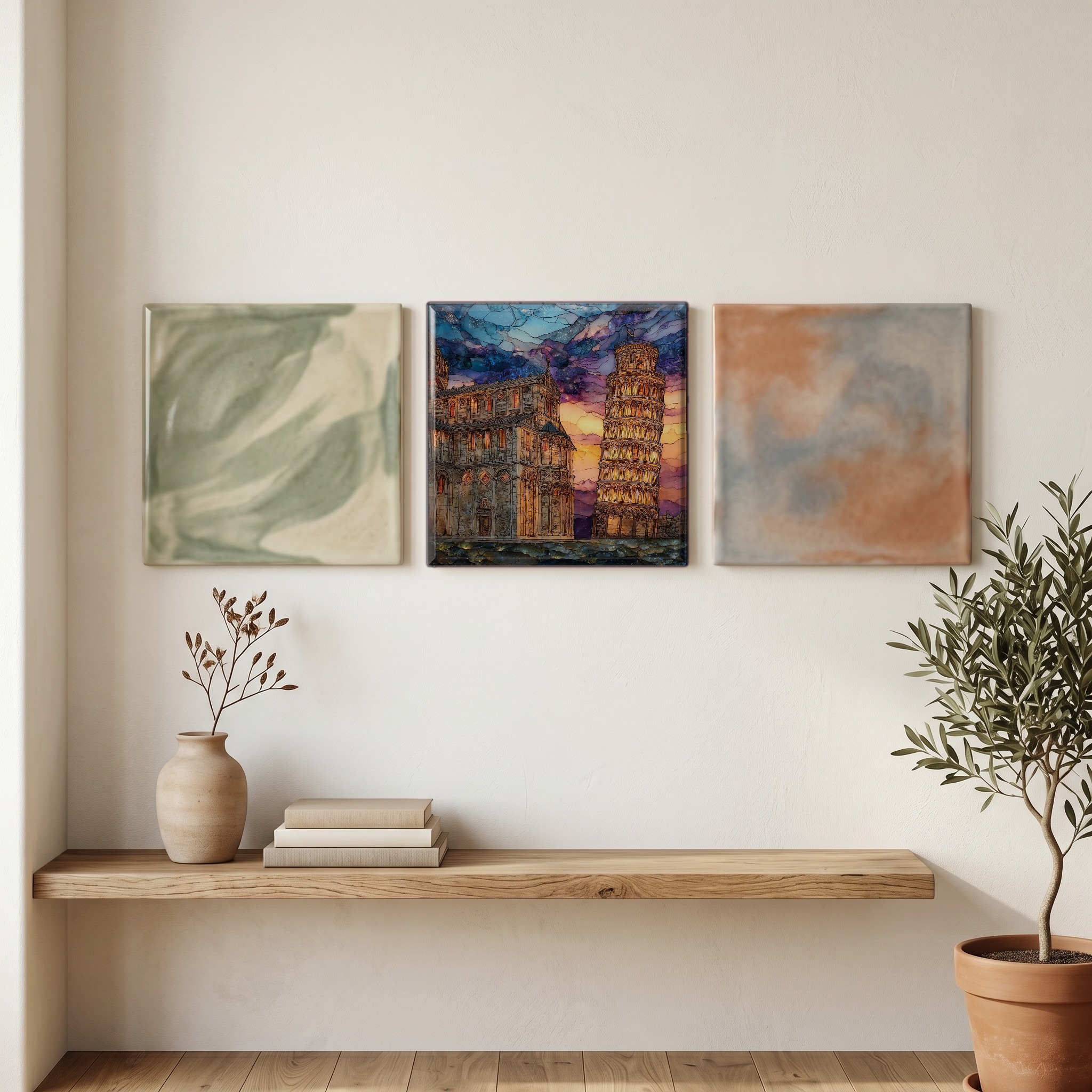
or build a grouping
or build a grouping

Three or five different vistas, hung together — a chapter of places you've been, or want to go.

about Leaning Tower of Pisa

The place, in three passes.

A little of what's known, in case you fall down the rabbit hole — or want to go see it yourself.
the place

The tower stands on the Piazza dei Miracoli, the walled cathedral green at the northern edge of Pisa, in Tuscany. It is the free-standing campanile, or bell tower, of Pisa Cathedral, and shares the green with the cathedral, the round Baptistery, and the Camposanto cemetery. The four monuments were inscribed together as a UNESCO World Heritage Site in 1987. Pisa sits about a kilometre north of the Arno, roughly an hour west of Florence by train, near the Ligurian coast. The tower rises 56 metres on its high side, eight storeys of white and grey marble, reached by 296 steps spiralling inside the hollow drum.

— informed by Wikipedia, UNESCO
the stone

The lean is a construction error that never stopped moving. Work began in 1173, and by the time the third storey went up around 1178 the tower was already tilting, its three-metre foundation set in soft subsoil of clay, fine sand, and shells that compressed unevenly under the weight. Building halted for nearly a century during Pisa's wars, which may be the only reason it still stands: the ground had time to settle. Later builders curved the upper storeys back toward vertical, so the tower bends faintly along its height. By 1990 the tilt reached 5.5 degrees and the structure was closed as unsafe.

— informed by Britannica, Wikipedia
the visit

Engineers stabilised the tower between 1993 and 2001, siphoning soil from the high side until the lean eased from 5.5 to about 3.97 degrees, a correction of some 44 centimetres. In 2008 they declared it stable for at least two hundred years and reopened the climb. Visitors book a timed ticket to climb the 296 steps; bags are not allowed inside, and children under eight cannot go up. Most people, though, never climb. They stop on the lawn of the Square of Miracles to pose with a palm raised, pretending to hold the tower upright. The cathedral and Baptistery are separate tickets.

— informed by Britannica, Wikipedia
where
Italy · Pisa, Tuscany
within
Piazza dei Miracoli
position
43.7230° N · 10.3964° E
the neighborhood

What's nearby.

A handful of named places within an hour's walk or short drive. Some we've already painted; some we will.
at the lake
Pisa Cathedral
Romanesque cathedral
at the lake
Pisa Baptistery
Romanesque baptistery
at the lake
Camposanto Monumentale
monumental cemetery
1 km S
Arno River
river
1 km SE
Piazza dei Cavalieri
civic square
N
Leaning Tower of Pisa
Pisa Cathedral
Pisa Baptistery
Camposanto Monumentale
Arno River
Piazza dei Cavalieri
common questions

What people ask.

A few questions we get about Leaning Tower of Pisa — and about bringing the piece home.
about the place

The ground beneath it is too soft to bear its weight. The three-metre foundation sits on clay, fine sand, and shells that compressed unevenly, and the tower began tilting around 1178, when only three of its eight storeys had been built.

About 3.97 degrees. It reached 5.5 degrees by 1990, but an engineering project between 1993 and 2001 siphoned soil from the high side and eased it back by roughly 44 centimetres. In 2008 it was declared stable for at least two hundred years.

It rises 55.86 metres on the low side and 56.67 metres on the high side, with 296 steps spiralling inside the hollow marble drum to the bell chamber at the top.

About 199 years. Work began in 1173 and finished around 1372, interrupted twice by wars involving Pisa. The long pauses let the soft ground settle, which is part of why the tower survived.

Yes. It is the free-standing bell tower, or campanile, of Pisa Cathedral, set apart on the Piazza dei Miracoli alongside the cathedral, the Baptistery, and the Camposanto cemetery. The four were named a UNESCO World Heritage Site in 1987.

The story says Galileo Galilei dropped two balls of different mass from the tower to show they fall at the same rate. Most historians treat it as a legend with no firm evidence, though Galileo did teach at the University of Pisa.

Yes, with a timed ticket. The climb is 296 steps, bags must be left in storage, and children under eight are not permitted. The tower reopened to climbers in 2001 after its stabilisation work.

about the piece in your home

It has been a meaningful gift for travellers who have stood on the Square of Miracles and for anyone with ties to Tuscany. A Small or Medium with a handwritten note from the studio carries the place well. The Keepsake suits a desk or shelf.

The stained-glass and ink palette, warm marble tones broken by deep colour, sits well in Mediterranean-modern, jewel-tone Maximalist, and warm Minimalist rooms. It reads as art rather than a souvenir, so it holds its own beside books and framed prints.

Yes. The piece works as an anchor in a mixed gallery wall, where its single strong subject and saturated colour hold the eye among photographs and smaller prints. Two tiles of paired Italian places balance each other well.

Above a standard sofa, a single Large holds the wall on its own; for a wider wall, a four-tile Mural; above a large sectional, a nine-tile Mural. Over a console or in a hallway, the Medium sits well at eye level.

Yes. For a backsplash, a shower, or any damp or vertical spot, order the Dura Satin or Matte finish, which is scratch-resistant and soft-sheened. The glossy finish suits framed wall pieces and show shelves.

A soft microfibre cloth and water. The colour is infused into the ceramic surface beneath a thin protective finish, so it will not fade or rub off, and no sprays or polishes are needed.

Yes. Every WenderVista piece is created in-house by the studio, with no licensed or stock imagery. Each place is rendered once, in the studio's stained-glass and ink language, then hand-finished in Knoxville, Tennessee.

if this one stayed with you

A few you might also love.

Hand-picked by the eye that found Sorapis. Same air, same kind of quiet.
— a collection

The Italian Dolomites,
painted slow.

The valleys between Cortina and Val Gardena, the tarns you walk an hour to see, the towers that turn the colour of a banked fire just before dark. Wander the collection by valley, by season, or follow the path Reid walked.

Tre Cime
Braies
Misurina
Sorapis
Cinque Torri
Sassolungo
Marmolada