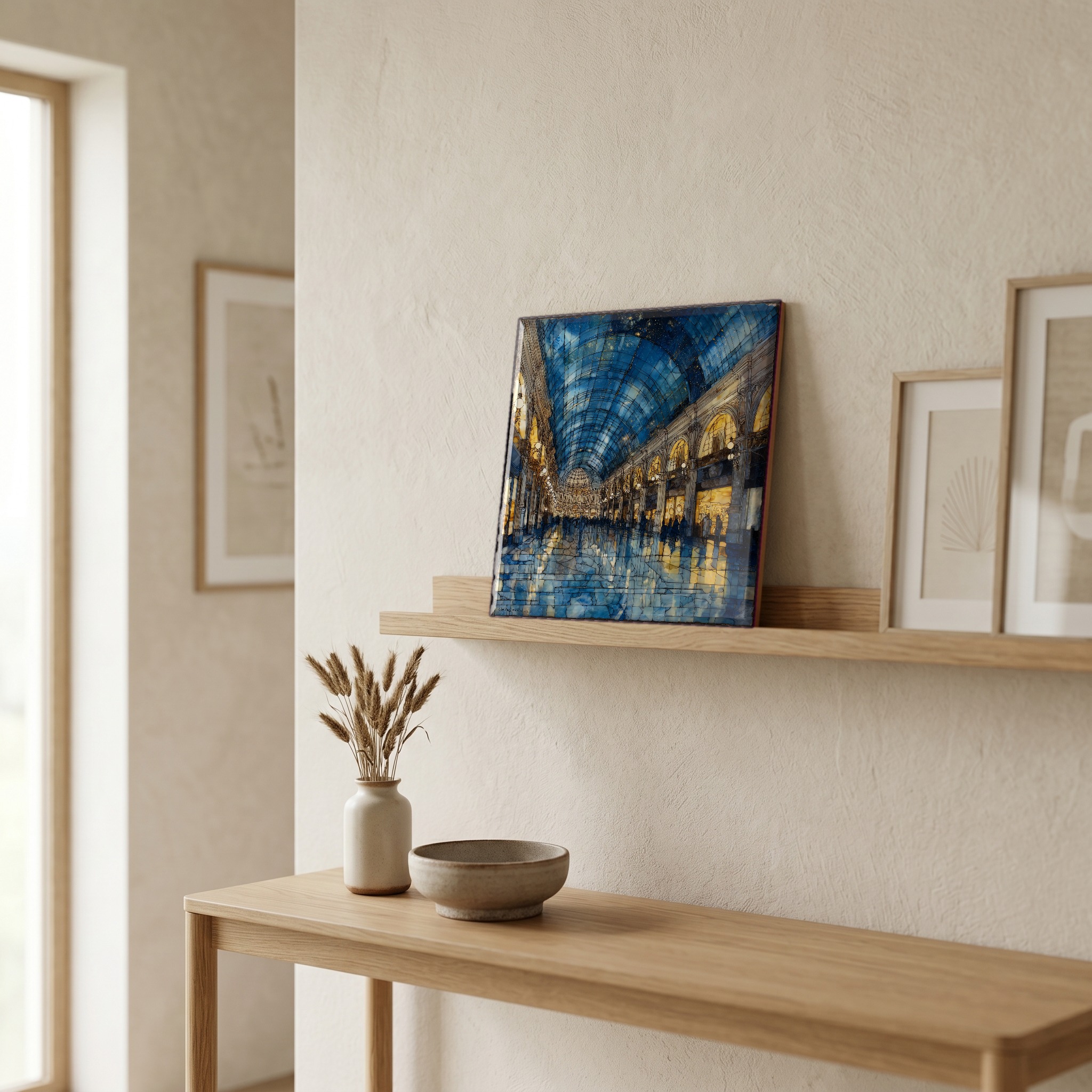
Wender·Vista
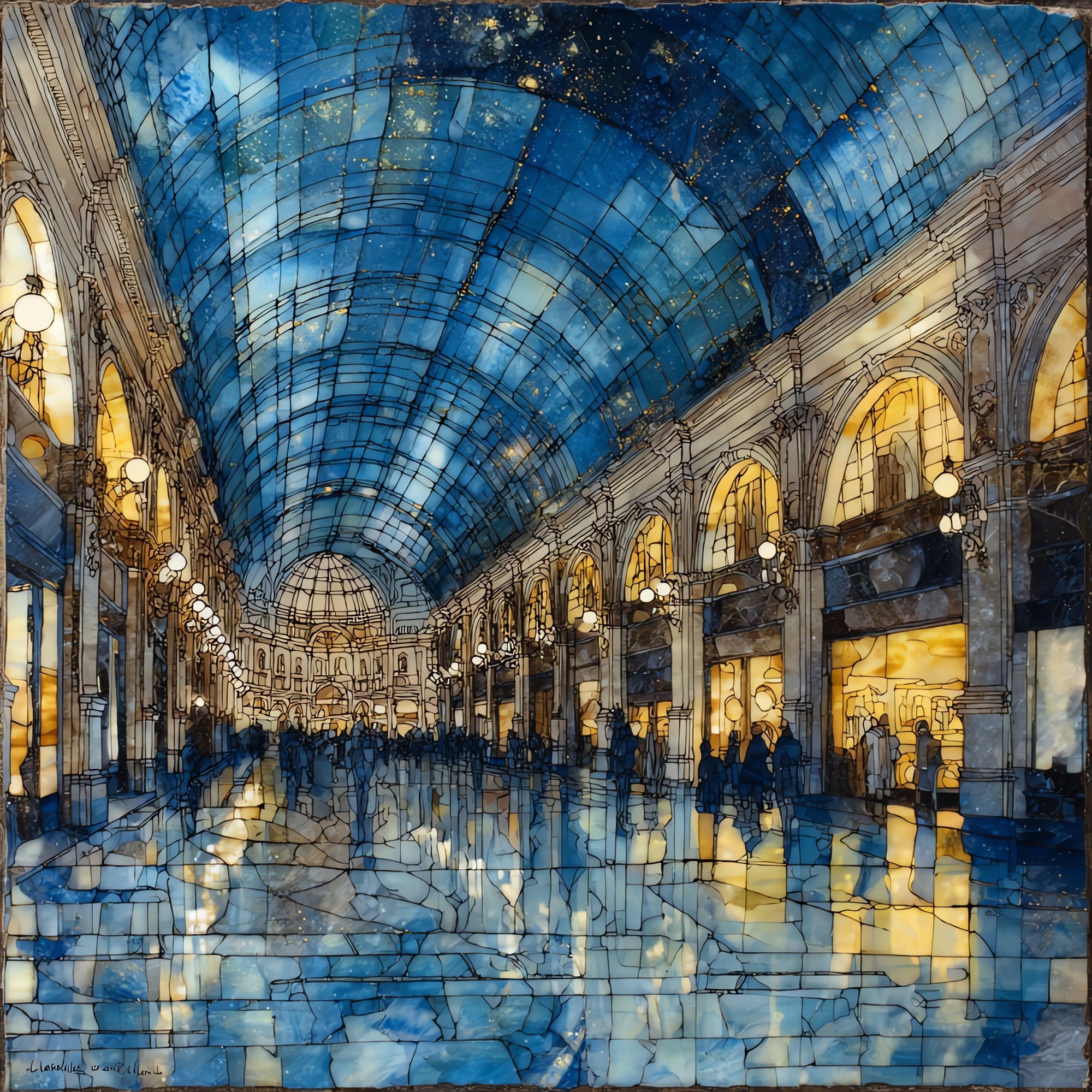
Galleria Vittorio Emanuele II
shown on ceramic, 12-inch tileItaly
in Milan, between the Duomo and La Scala

Galleria Vittorio Emanuele II

the light a glass roof leaves on marble.

Where it lives

Not only on a wall.

A small tile on the nightstand catching the morning. A larger one above the fire. Yours, wherever you spend the slow hours.
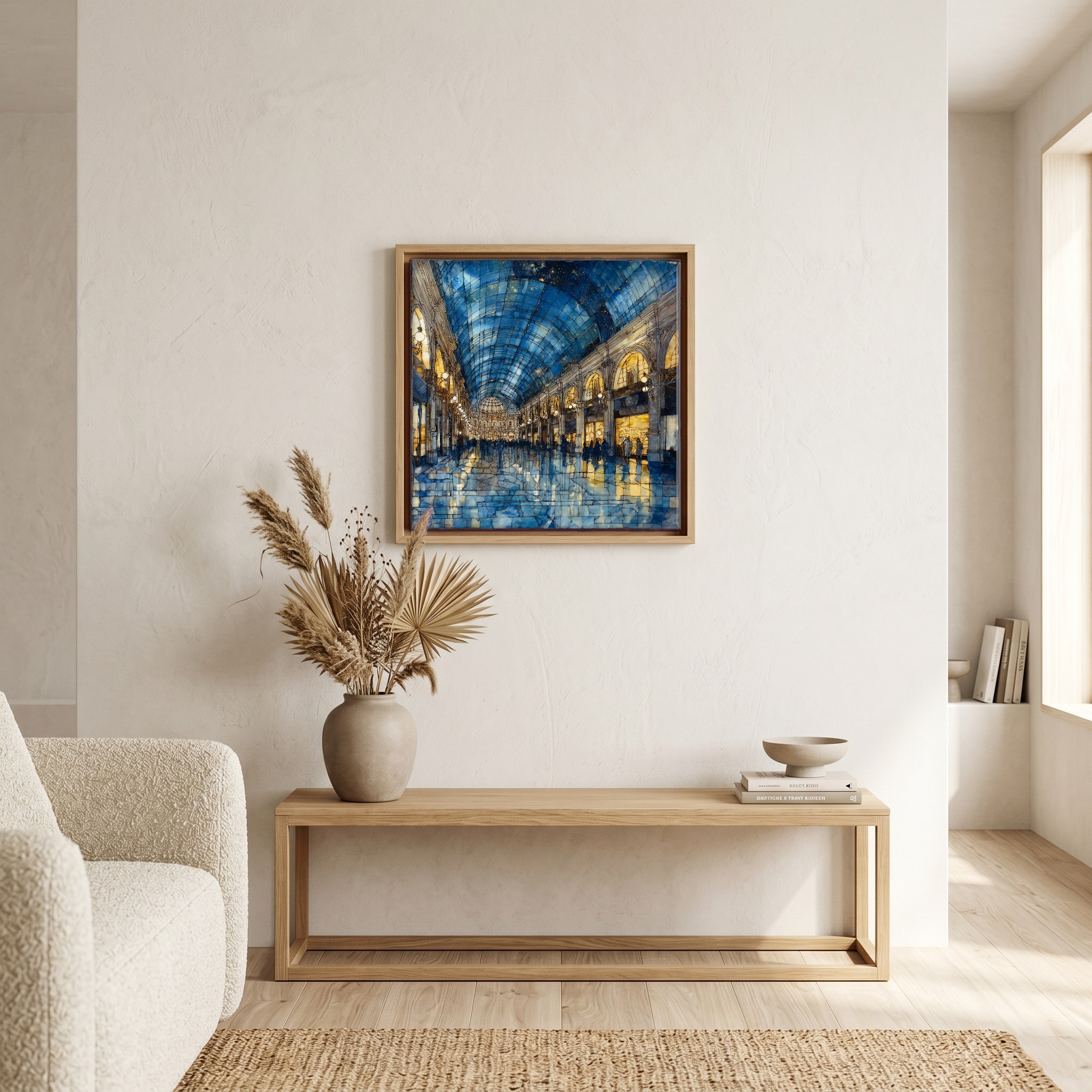
Above the bench, in a warm oak surround.
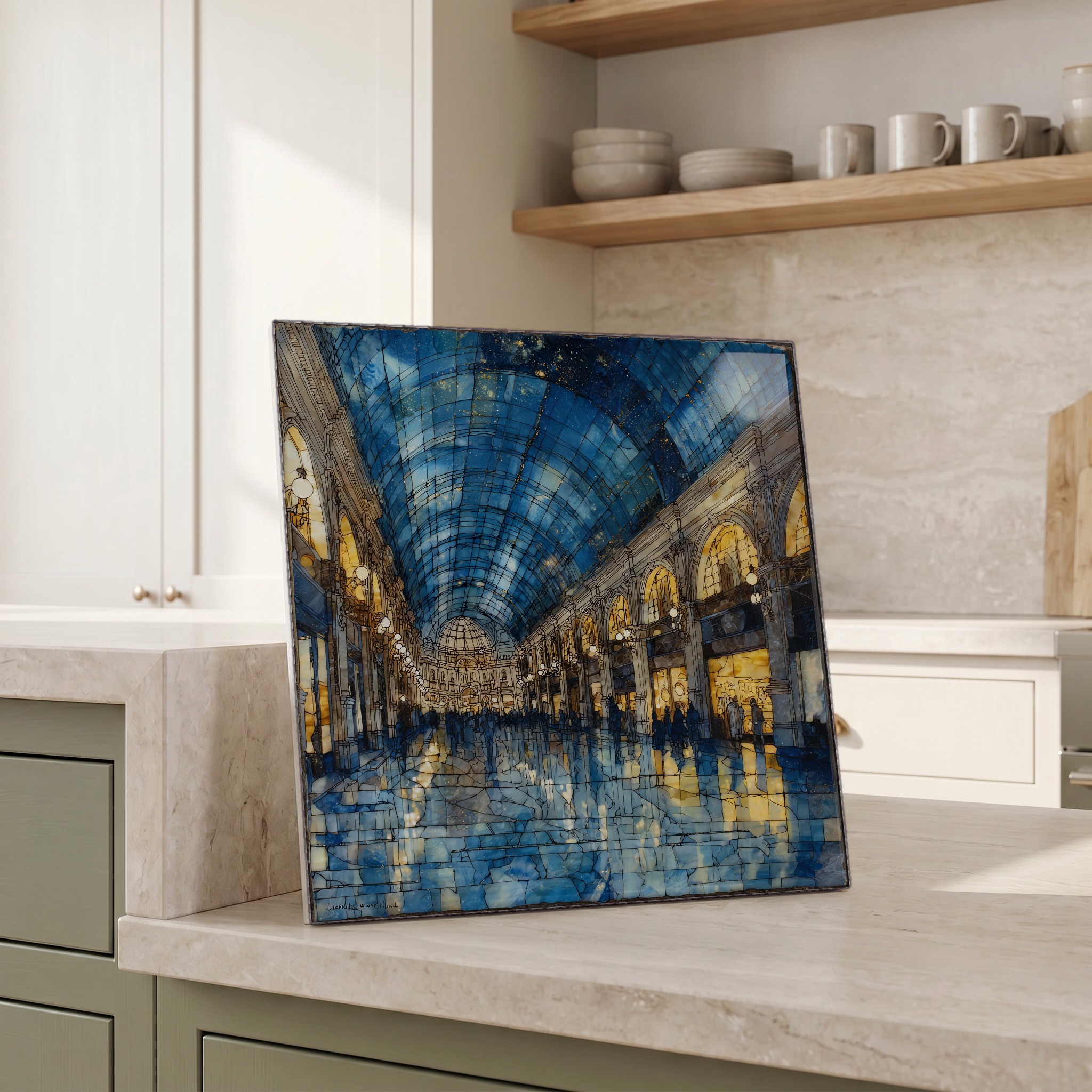
Beside the kettle, propped on the counter.
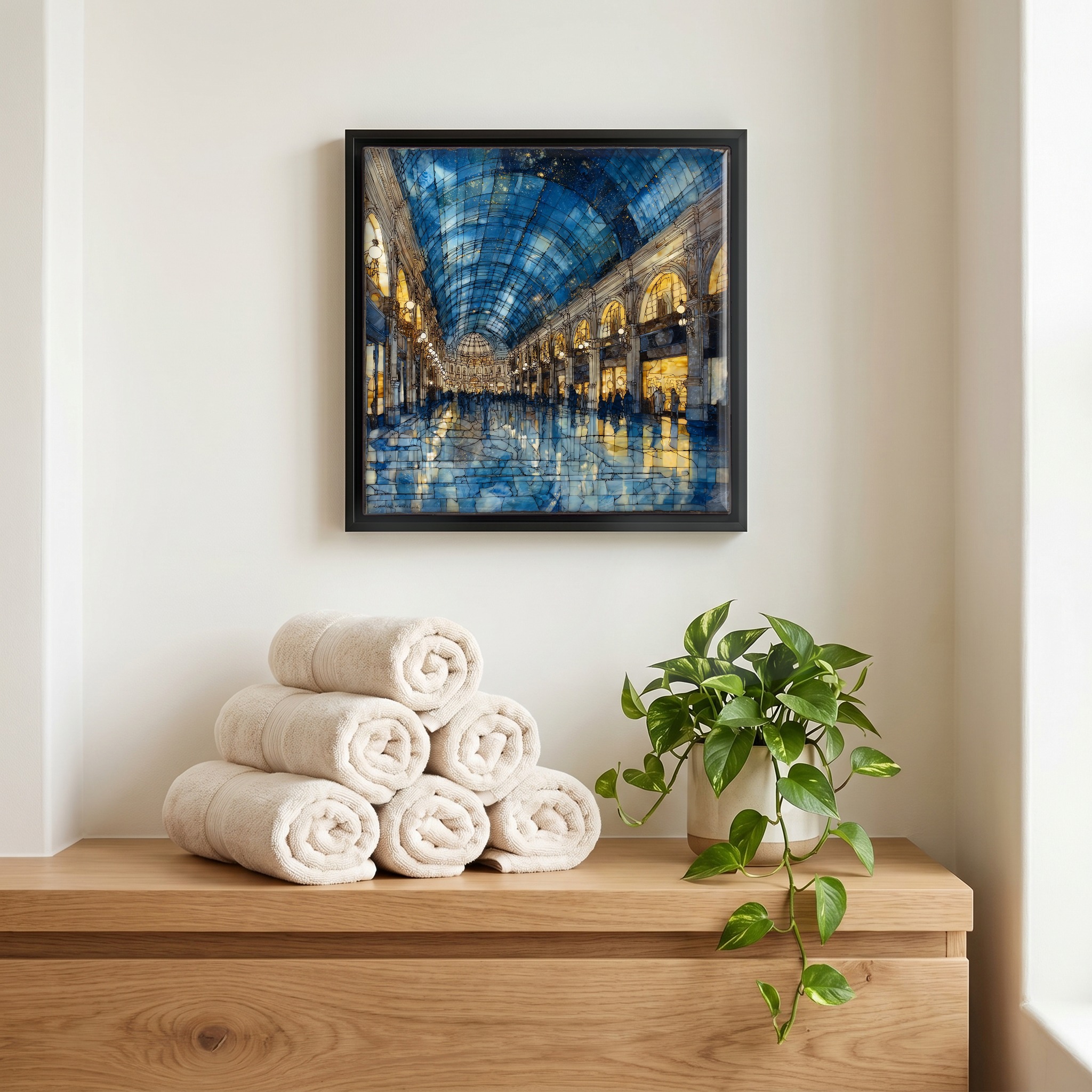
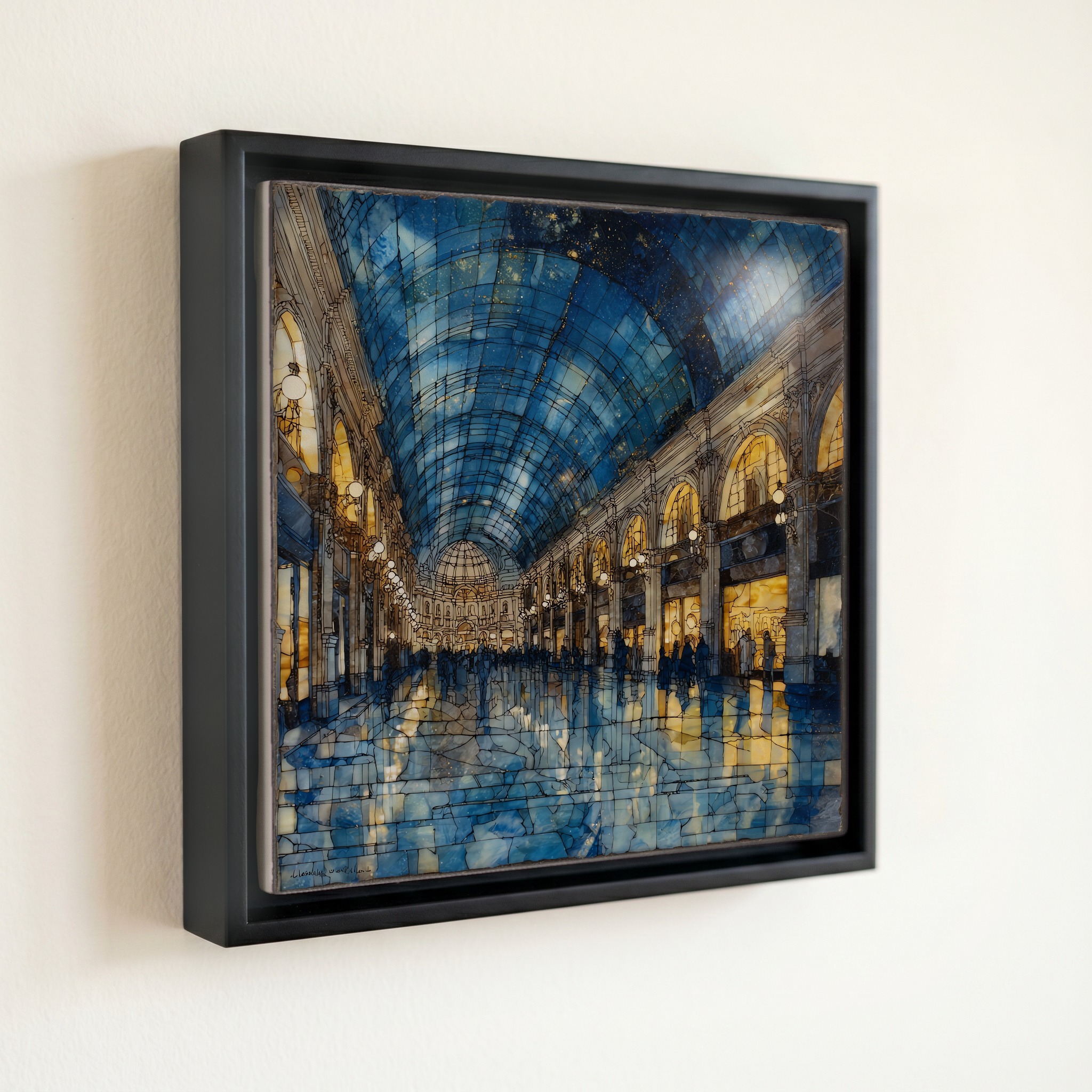
Above the linens, in a slim black surround.
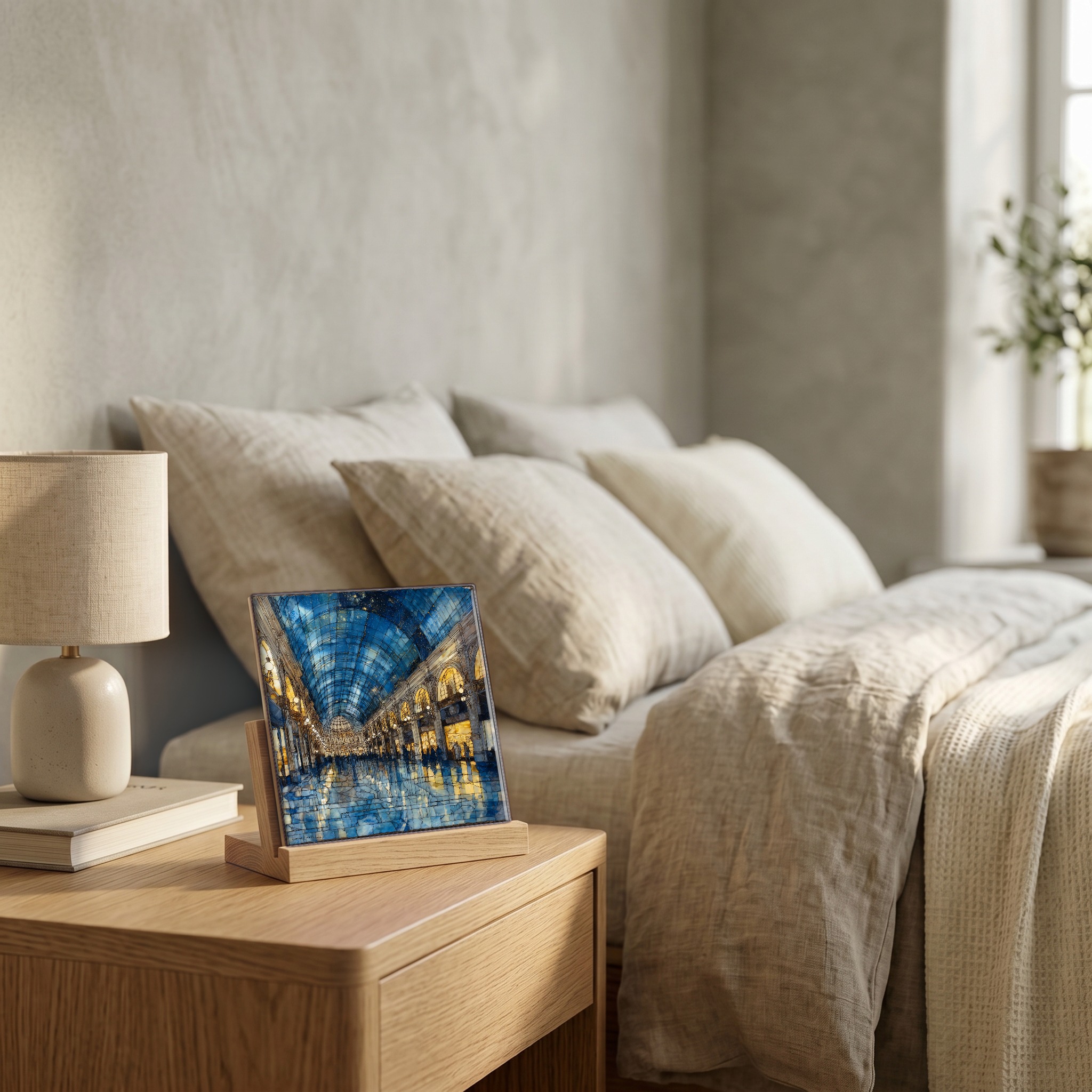
On the nightstand, on a light oak stand.
On a picture ledge, where the light comes in.
a note from the studio

Milan's covered street, opened in 1877. A cross of glass and iron between the Duomo and La Scala, designed by Giuseppe Mengoni. The Milanese call it il salotto di Milano, the city's drawing room. People come for Prada's original storefront, for Camparino's bar, for the bull mosaic on the floor everyone spins on for luck. Most days the light comes down through the octagonal dome and lands on marble nobody has time to look at. The Milanese walk through without looking up. Visitors stop in the middle and try to take the whole ceiling in one photograph.
from the studio
shown in a slim black floating frame · 6 × 6 in
— bring it home

Galleria Vittorio Emanuele II, on ceramic.

Each tile is finished by hand in our Knoxville studio. Artwork is slowly infused into the ceramic surface under high heat and pressure, and rests beneath a thin glossy finish. The colour lives in the surface, not on top of it.

What kind of piece?
One tile — square or rectangle.
How big?
the popular one — counter, shelf, nightstand
6 × 6 in · 15 cm · 1.6 lb
Surface finish
A clear glossy finish — the artwork reads as if under resin. Ideal for show-pieces and framed wall art.
How it sits
A hidden cleat — sits ¼″ proud of the wall.
$58
Hand-finished and shipped from our studio at the foot of the Smokies. On your wall in about ten days.
size
6 × 6 in
15 cm
weighs
1.6 lb
solid in the hand
surface
ceramic, hand-finished
art rests beneath a thin glossy finish
from
Knoxville, TN
our family studio, at the foot of the Smokies
— start a Coaster Set

Pick any four 4-inch tiles — National Parks you've been to, a Smokies set, the four seasons of one place. $ for a set of , cork-backed, ready to live on the table.
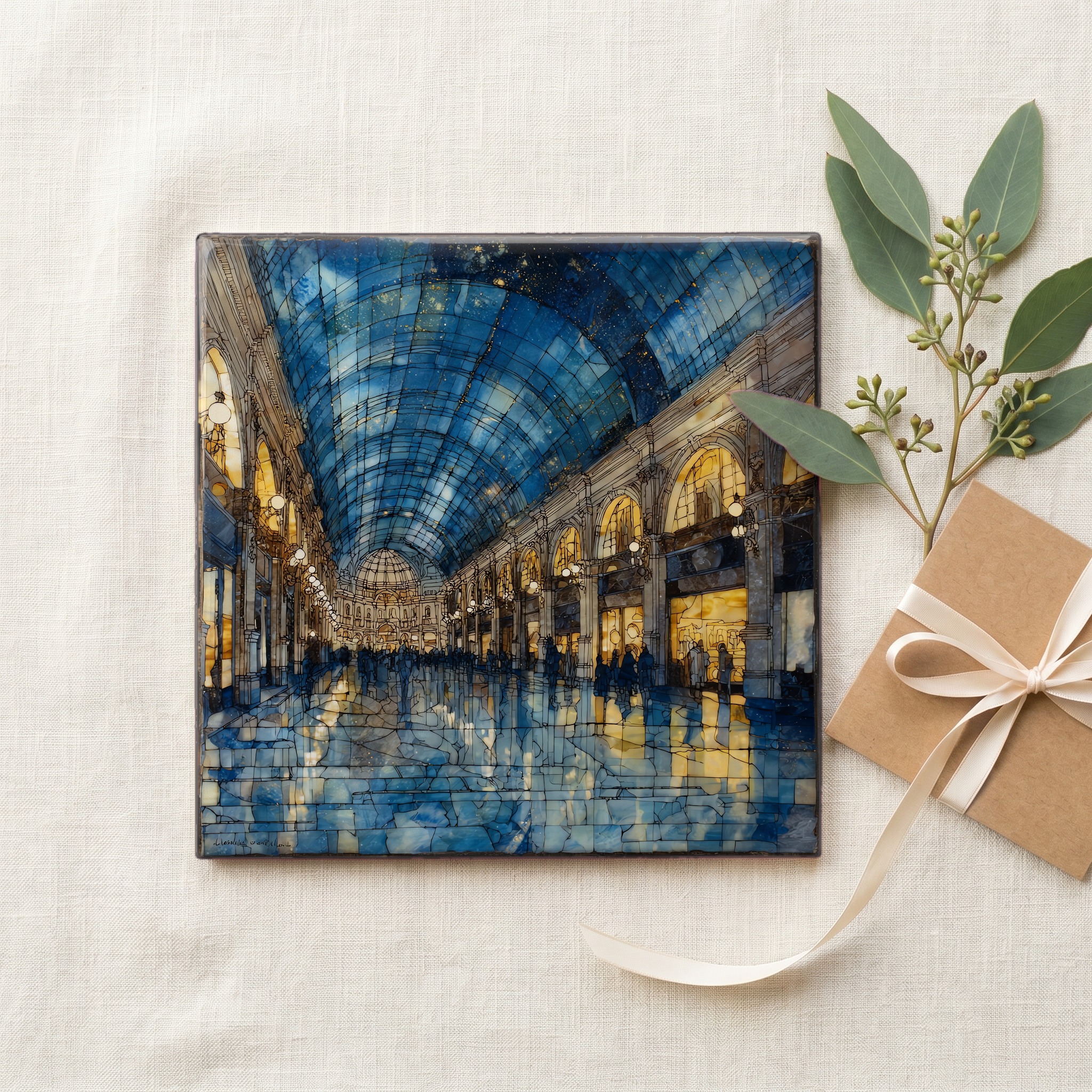
comes gift-ready
comes gift-ready

Each tile ships in a kraft box, tied with cream ribbon, with a handwritten note from the studio if you'd like to add one.
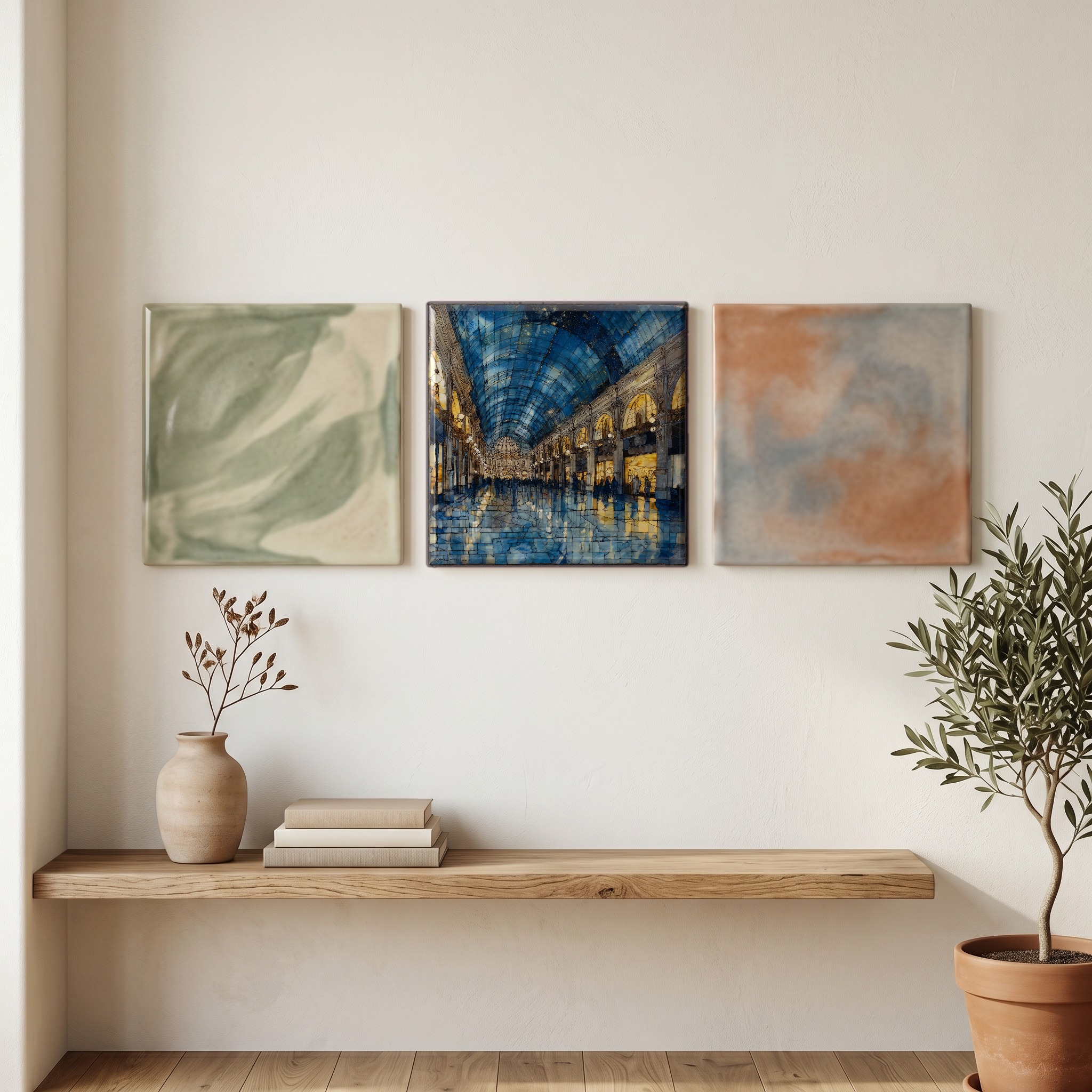
or build a grouping
or build a grouping

Three or five different vistas, hung together — a chapter of places you've been, or want to go.

about Galleria Vittorio Emanuele II

The place, in three passes.

A little of what's known, in case you fall down the rabbit hole — or want to go see it yourself.
the place

The Galleria Vittorio Emanuele II is a covered double-arcade in central Milan, opened in 1877 and named for the first king of unified Italy. It runs in a cross plan between Piazza del Duomo and Piazza della Scala, linking the cathedral and the opera house, the longer arm stretching roughly 196 metres beneath an iron-and-glass roof. The four arms meet under a glass dome at the central octagon. The architect was Giuseppe Mengoni, who won the design competition in 1861 and died in a fall from the scaffolding on 30 December 1877. The building is widely cited as the prototype for the covered shopping galleries of nineteenth-century Europe, including the Galleria Umberto I in Naples. Milanese call it il salotto di Milano, the city's drawing room.

— informed by Wikipedia, YesMilano
the light

The arcade's roof is an iron-and-glass canopy completed between 1865 and 1877, with a central dome rising above an octagonal piazza where the four arms meet. At the time of its opening it was among the largest glass-roofed public interiors in Europe. Daylight enters through the dome and the four barrel-vaulted arms and falls on a floor of polychrome marble and mosaic. The central panels carry the coats of arms of Italy's four former capital cities: Turin's bull, Florence's lily, Rome's she-wolf, and Milan's red cross. The four lunettes under the dome carry allegorical frescoes of the four continents Europeans recognised in the 1870s. On bright afternoons the dome's iron ribs cast their octagonal pattern across the marble floor below.

— informed by Wikipedia
the visit

The Galleria is a public passageway, open day and night, with no admission fee. The shops, cafés, and restaurants set their own hours. Prada's first store, opened in 1913, still occupies its original corner. Camparino, the historic bar associated with the rise of Campari and the modern aperitivo, has held its place at the Piazza del Duomo entrance since 1915. The most photographed spot on the floor is the bull mosaic of Turin, where a tradition of spinning on the heel inside the bull's groin is said to bring luck or a return to Milan. The mosaic is restored periodically and visitors are now asked to step around it. A rooftop walkway over the glass roof, the Highline Galleria, opened in October 2015 with timed tickets.

— informed by Wikipedia, Highline Galleria
where
Italy · Milan, Lombardy
position
45.4656° N · 9.1900° E
the neighborhood

What's nearby.

A handful of named places within an hour's walk or short drive. Some we've already painted; some we will.
at the lake
Duomo di Milano
Gothic cathedral
at the lake
Teatro alla Scala
opera house
at the lake
Piazza dei Mercanti
medieval square
1 km N
Pinacoteca di Brera
art museum
1 km NW
Castello Sforzesco
Renaissance castle
770 km S
Galleria Umberto I
sister arcade· on a tile
N
Galleria Vittorio Emanuele II
Duomo di Milano
Teatro alla Scala
Piazza dei Mercanti
Pinacoteca di Brera
Castello Sforzesco
Galleria Umberto I
common questions

What people ask.

A few questions we get about Galleria Vittorio Emanuele II — and about bringing the piece home.
about the place

It stands in central Milan, between Piazza del Duomo and Piazza della Scala. The southern entrance faces the cathedral; the northern entrance opens onto the square of Teatro alla Scala. It is a free public passageway in the Centro Storico.

The architect Giuseppe Mengoni won the design competition in 1861. Construction ran from 1865 to 1877. Mengoni fell to his death from the scaffolding on 30 December 1877, days before the building was fully completed. The arcade is named for Vittorio Emanuele II, the first king of a unified Italy.

The Milanese nickname il salotto di Milano dates from the late nineteenth century. The covered arcade became the city's social centre, a place to meet, walk, take coffee, and be seen sheltered from the weather. The historic Camparino bar and Biffi restaurant still anchor that role.

The central octagon's marble floor carries the coats of arms of Italy's four former capital cities. The bull represents Turin. A tradition holds that spinning on the heel inside a depression worn into the bull figure brings luck or a return to Milan. Repeated wear has required several restorations.

The arcade houses Prada's original 1913 store, Louis Vuitton, Versace, and Borsalino, along with Camparino bar (1915), Biffi, and Savini restaurant. Above them are the suites of the Seven Stars Galleria, one of the few hotels in the world whose rooms open directly onto a public arcade.

Yes. The arcade is a public passageway, free to enter, open day and night. Individual shops, cafés, and restaurants keep their own hours. The rooftop walkway above the glass dome, the Highline Galleria, runs on timed tickets.

The Highline Galleria is a guided rooftop walkway opened in October 2015 that runs along the glass-and-iron roof of the arcade. It offers an unusual view across the cathedral, the central octagon, and the spire of the Madonnina above the Duomo. Tickets are timed.

about the piece in your home

It works well for customers with Milan ties. The Galleria is one of the city's most loved gathering places, the room locals walk through to reach almost anything in Centro Storico. A Small or Medium with a handwritten note carries well for a former resident, a fashion-design student, or anyone who has spent an afternoon at Camparino.

Our treatment of the Galleria carries stained-glass blues, ironwork blacks, and warm marble cream. It sits well in Italianate Maximalist rooms, Continental-classical interiors, and rooms leaning Art Nouveau. It also reads against deeper jewel-tone walls in a study or library.

It pairs with the Milanese-modern direction that combines deep wood, brass, and stained-glass colour against pale walls. That look has returned to Italian shelter magazines over the last several seasons. The piece also reads well in Art Deco revival rooms and Italian Liberty-inspired interiors.

Above a standard sofa or console, a single Large reads as a focal piece without crowding the wall. For larger living rooms or above a long banquette, a four-tile Mural carries the architecture better. For a statement wall, a nine-tile Mural lets the cross-arms and the dome breathe across the width.

Yes, on the Dura Satin or Matte finish. The colour is slowly infused into the ceramic surface under high heat and pressure and lives beneath a non-glaring sheen that resists humidity and steam. The Galleria's marble-and-iron palette reads well above a powder-room console or in an Italian-leaning kitchen.

A soft microfibre cloth and warm water are enough. For stubborn marks, add a drop of mild dish soap. Avoid abrasive sponges, bleach, and ammonia-based cleaners, which can dull the finish over time. The colour will not lift; it lives within the ceramic surface.

Yes. Reid Wender is the curator and the eye behind every WenderVista piece. The artwork is original to our studio in Knoxville, Tennessee, and is not licensed from any third party. Each piece is hand-finished in our studio.

if this one stayed with you

A few you might also love.

Hand-picked by the eye that found Sorapis. Same air, same kind of quiet.
— a collection

The Italian Dolomites,
painted slow.

The valleys between Cortina and Val Gardena, the tarns you walk an hour to see, the towers that turn the colour of a banked fire just before dark. Wander the collection by valley, by season, or follow the path Reid walked.

Tre Cime
Braies
Misurina
Sorapis
Cinque Torri
Sassolungo
Marmolada