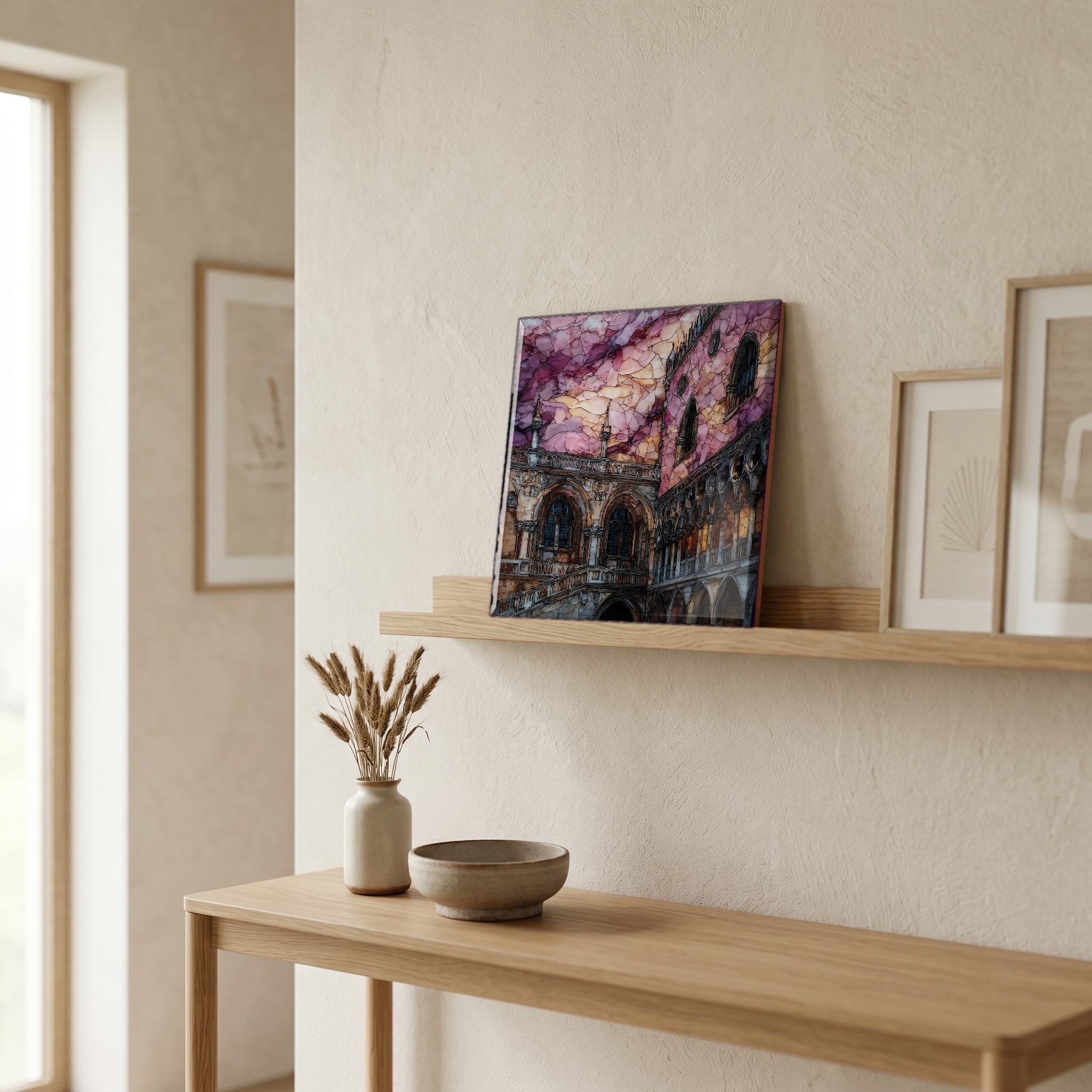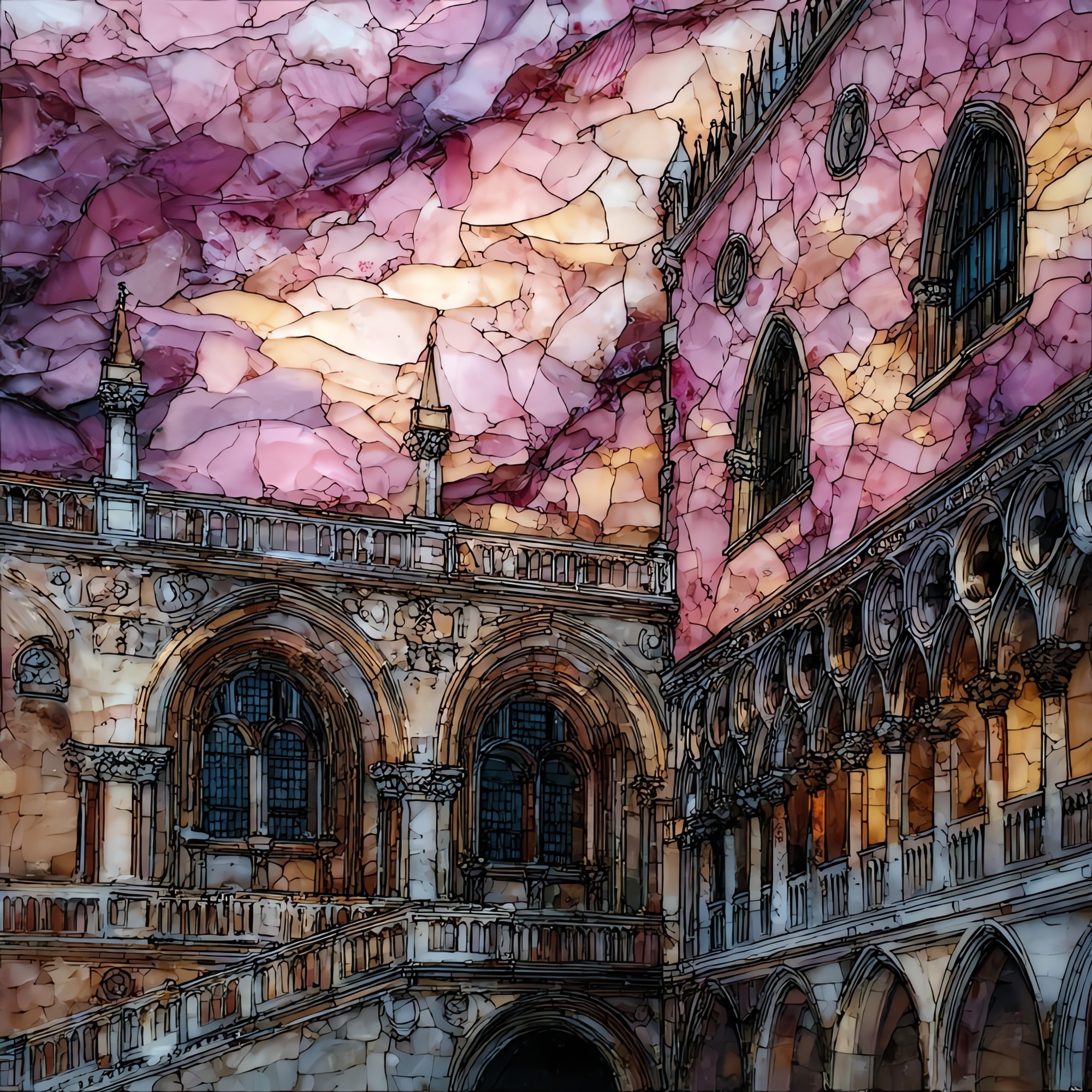
Wender·Vista
Doge's Palace
shown on ceramic, 12-inch tileItaly
on the lagoon at the south end of St. Mark's Square

Doge's Palace

— pink marble lace above the water.

Where it lives

Not only on a wall.

A small tile on the nightstand catching the morning. A larger one above the fire. Yours, wherever you spend the slow hours.
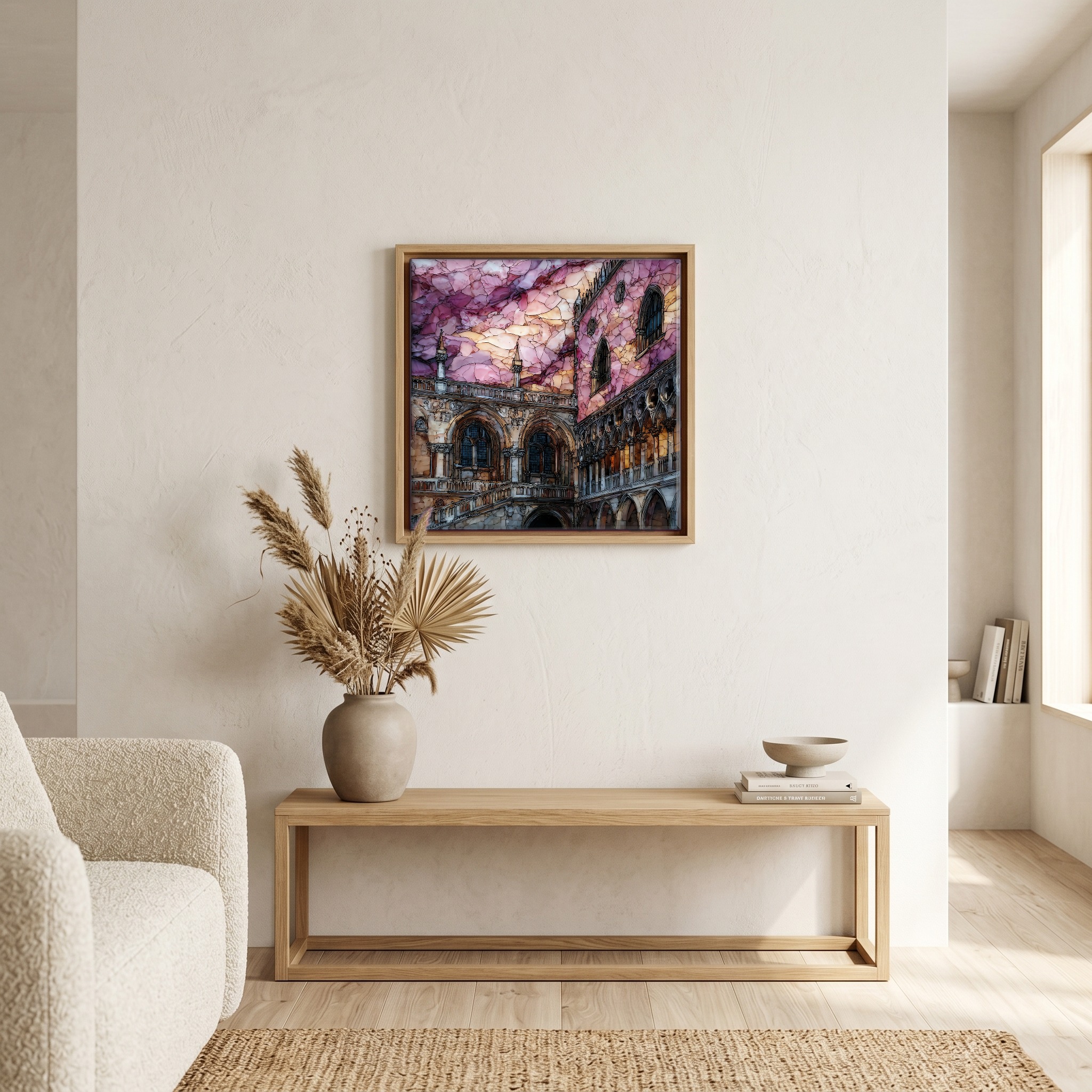
Above the bench, in a warm oak surround.
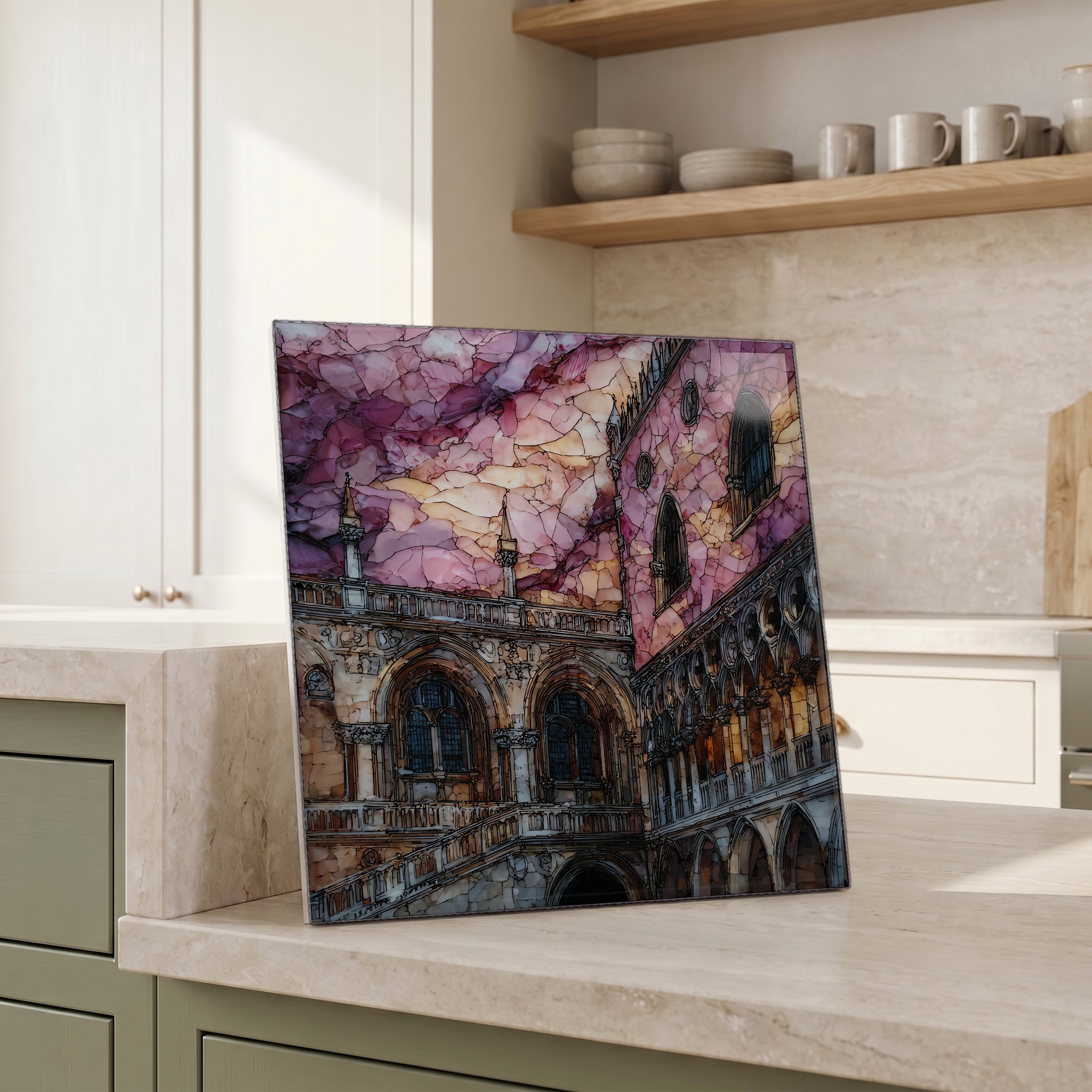
Beside the kettle, propped on the counter.
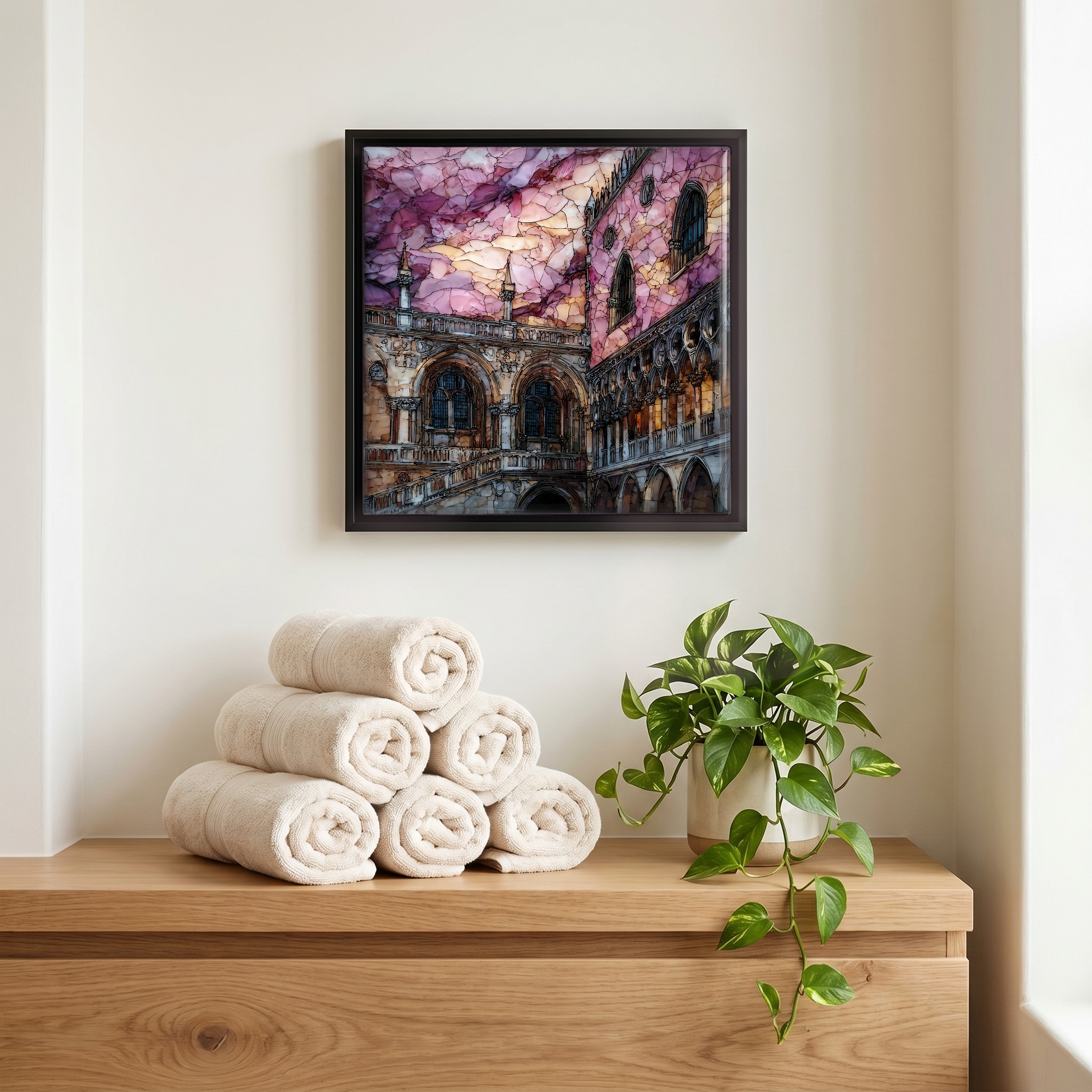
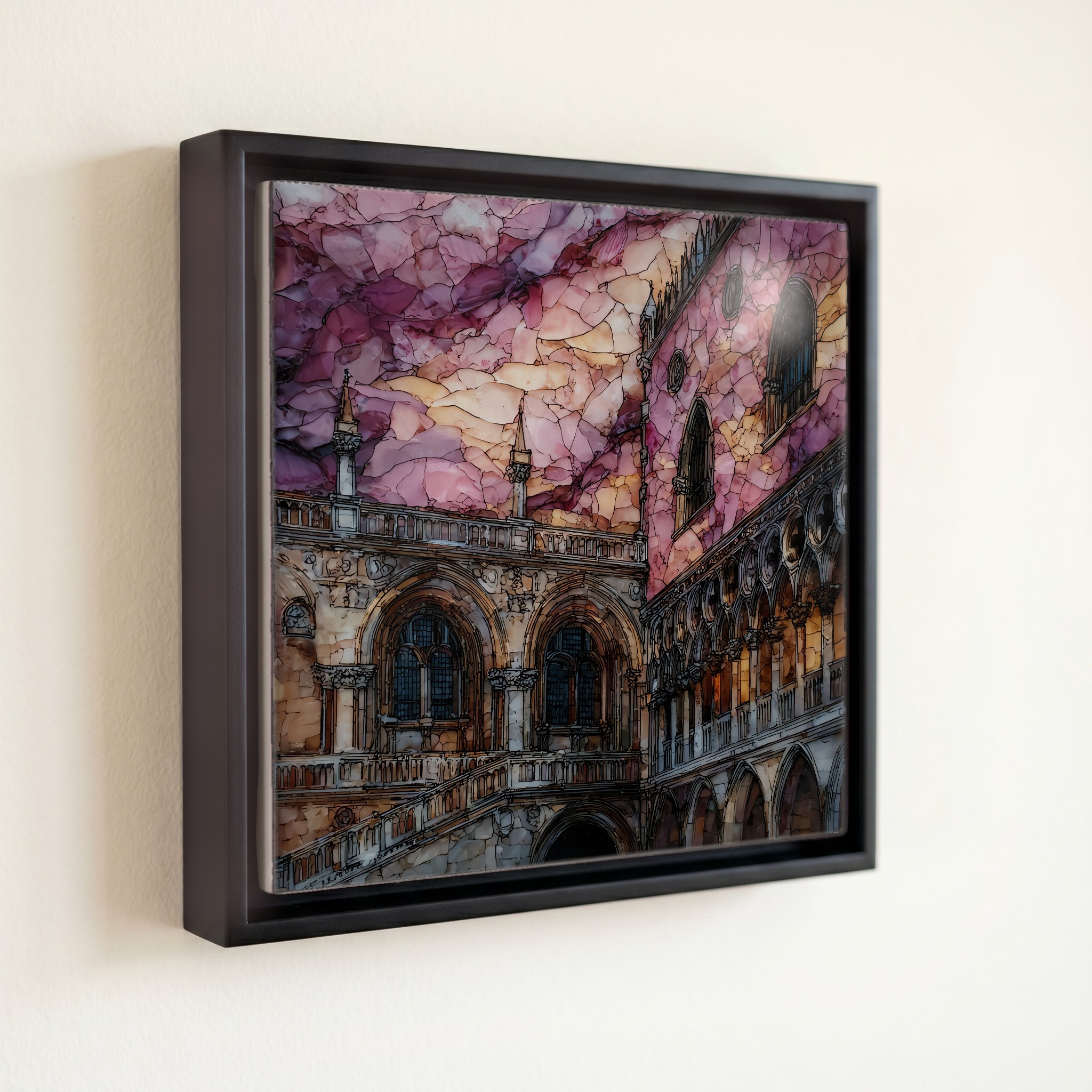
Above the linens, in a slim black surround.
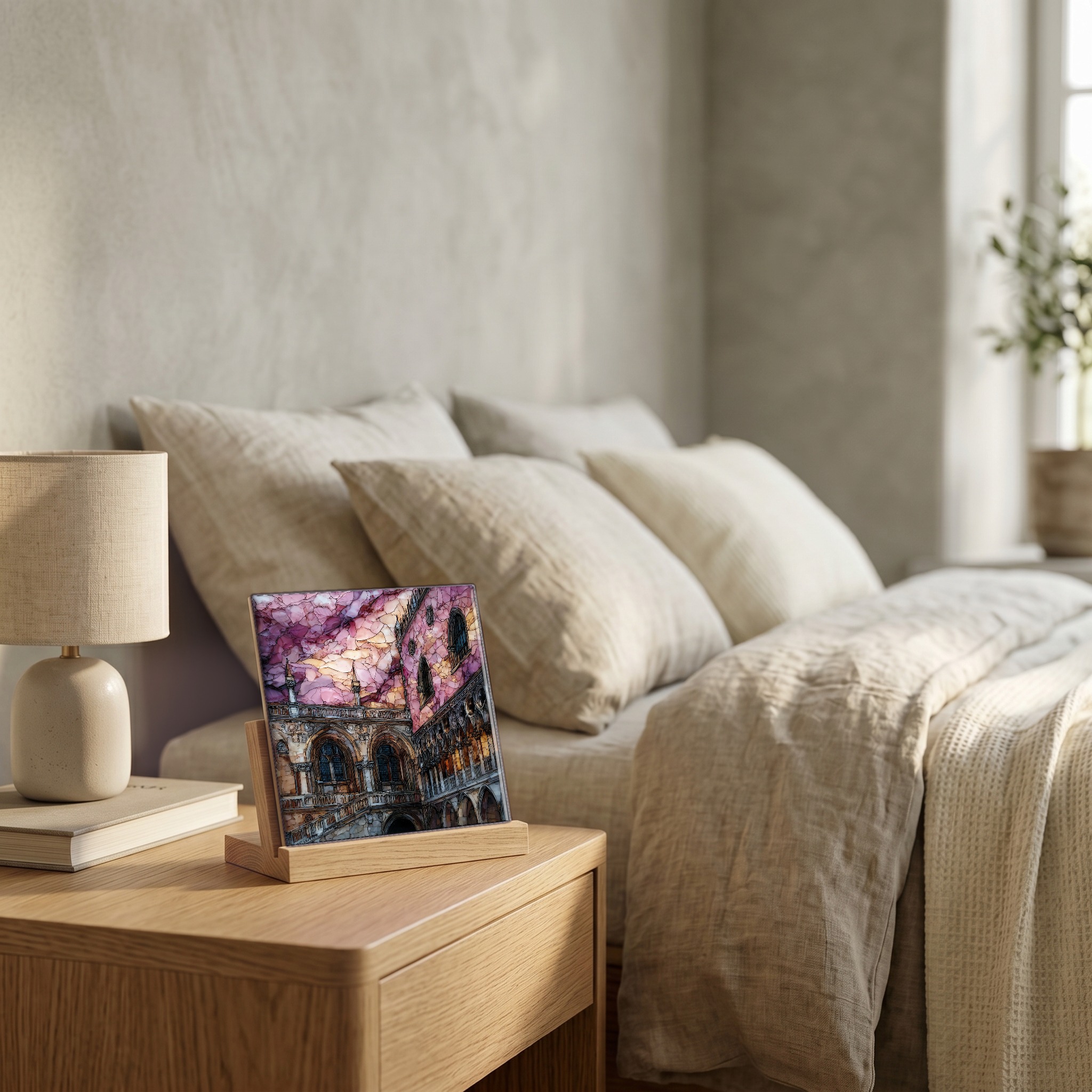
On the nightstand, on a light oak stand.
On a picture ledge, where the light comes in.
a note from the studio

The seat of the Venetian Republic for a thousand years, set on the edge of the lagoon at the south end of Piazza San Marco. Pink Verona marble laid in diamond patterns above white Istrian stone arcades. The lower colonnade carries the upper gallery the way lace carries a hem. From across the basin at San Giorgio Maggiore the whole facade reads as a single pink-and-white wall the water keeps returning to. Inside, Tintoretto's Paradise still covers a wall the length of a tennis court. The Bridge of Sighs runs from the back rooms across the canal to the old prisons. Most mornings the line forms before the gates open.
from the studio
shown in a slim black floating frame · 6 × 6 in
— bring it home

Doge's Palace, on ceramic.

Each tile is finished by hand in our Knoxville studio. Artwork is slowly infused into the ceramic surface under high heat and pressure, and rests beneath a thin glossy finish. The colour lives in the surface, not on top of it.

What kind of piece?
One tile — square or rectangle.
How big?
the popular one — counter, shelf, nightstand
6 × 6 in · 15 cm · 1.6 lb
Surface finish
A clear glossy finish — the artwork reads as if under resin. Ideal for show-pieces and framed wall art.
How it sits
A hidden cleat — sits ¼″ proud of the wall.
$58
Hand-finished and shipped from our studio at the foot of the Smokies. On your wall in about ten days.
size
6 × 6 in
15 cm
weighs
1.6 lb
solid in the hand
surface
ceramic, hand-finished
art rests beneath a thin glossy finish
from
Knoxville, TN
our family studio, at the foot of the Smokies
— start a Coaster Set

Pick any four 4-inch tiles — National Parks you've been to, a Smokies set, the four seasons of one place. $ for a set of , cork-backed, ready to live on the table.
comes gift-ready
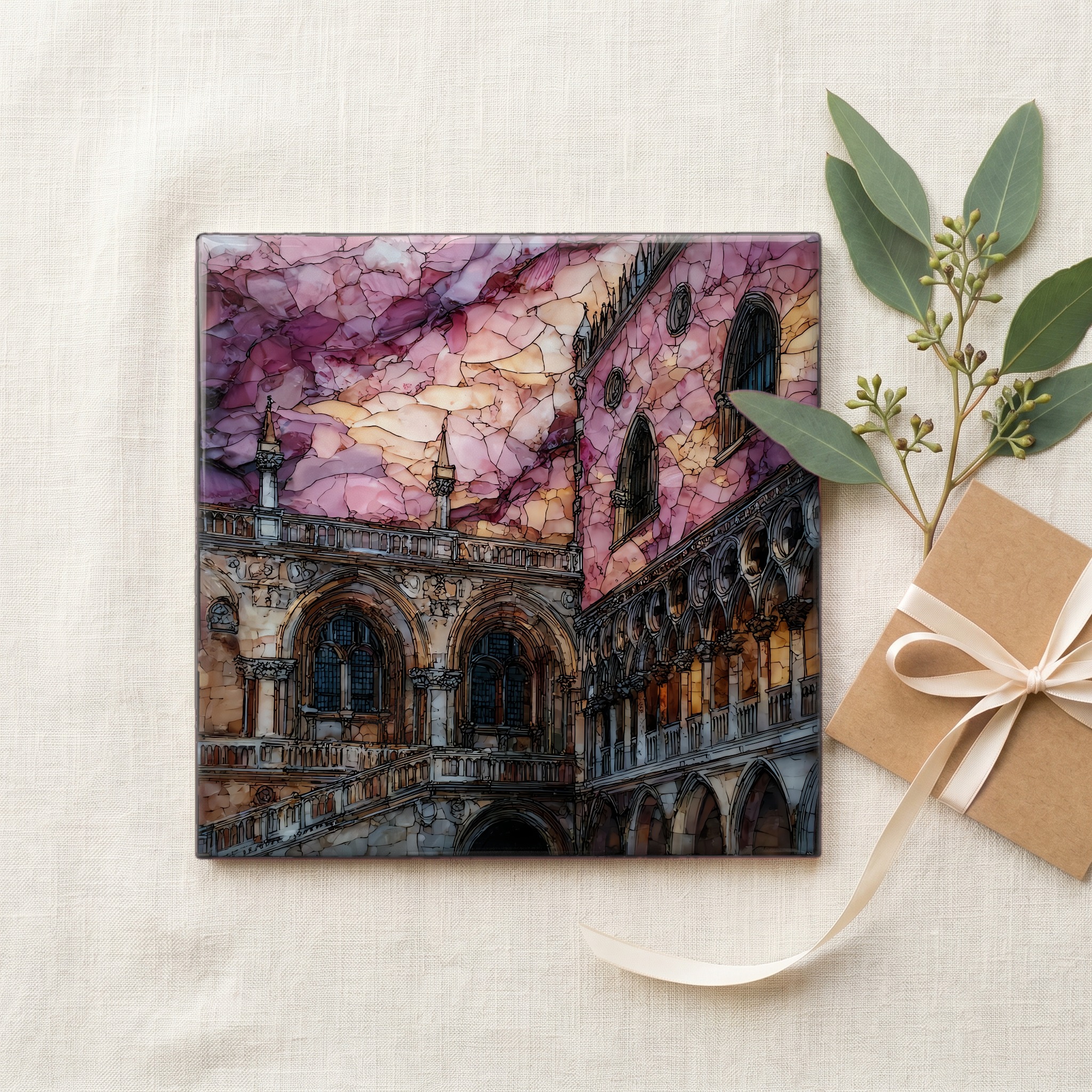
comes gift-ready

Each tile ships in a kraft box, tied with cream ribbon, with a handwritten note from the studio if you'd like to add one.
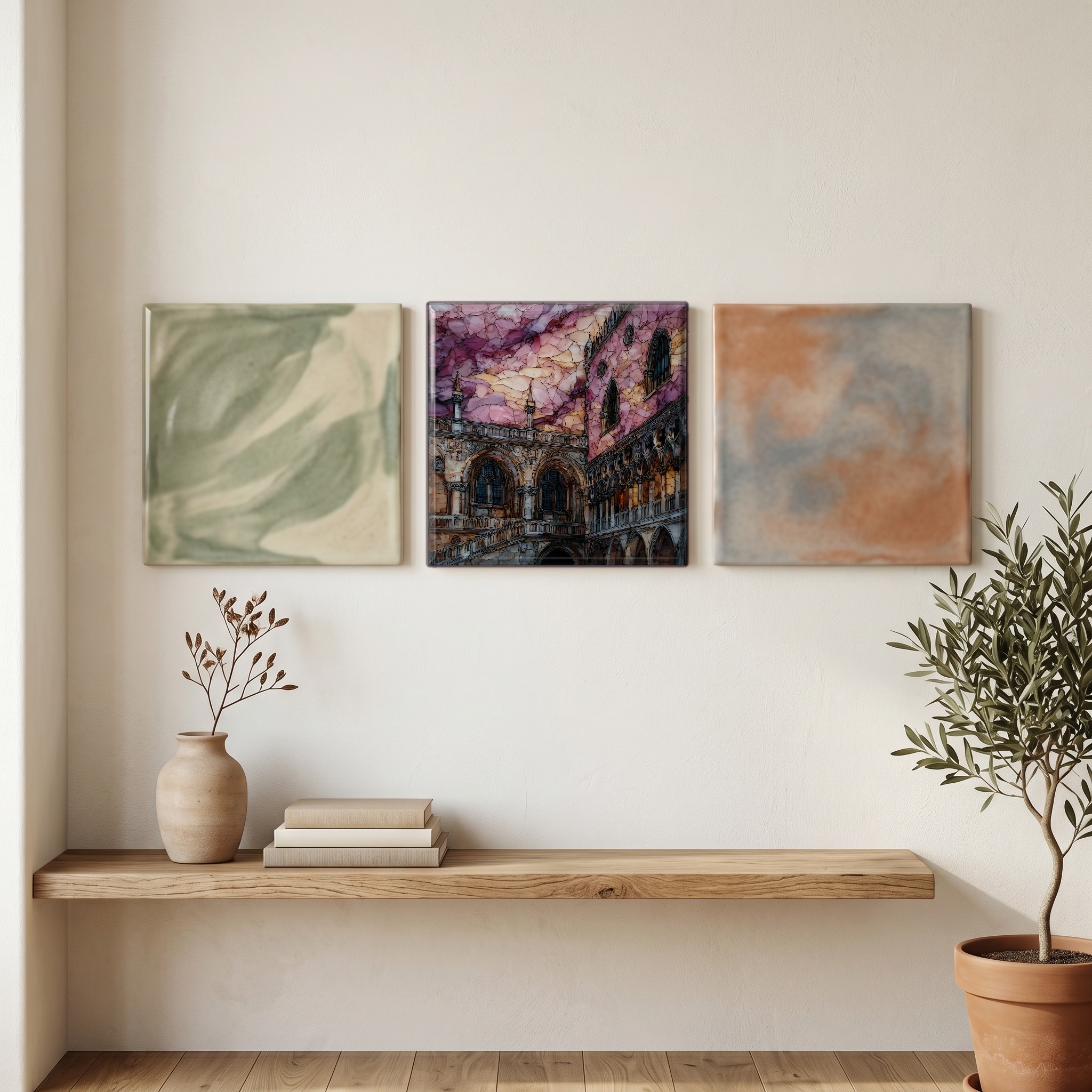
or build a grouping
or build a grouping

Three or five different vistas, hung together — a chapter of places you've been, or want to go.

about Doge's Palace

The place, in three passes.

A little of what's known, in case you fall down the rabbit hole — or want to go see it yourself.
the place

Palazzo Ducale stands at the south end of Piazza San Marco in Venice, the seat of the Doge and the government of the Venetian Republic from the ninth century until 1797. The present Gothic building took its current shape between 1340 and the early fifteenth century, replacing two earlier palaces lost to fire. The facade fronts the Bacino di San Marco, the basin of water that opens to the Adriatic past San Giorgio Maggiore. The palace is part of the Civic Museums of Venice and shares the UNESCO designation 'Venice and its Lagoon,' inscribed in 1987. The principal entrance for visitors is the Porta del Frumento on the lagoon side; the ceremonial Porta della Carta opens onto the piazzetta.

— informed by Wikipedia, UNESCO
the stone

The lower two storeys are an open arcade of white Istrian limestone, with thirty-six pointed arches at ground level supporting seventy-one quatrefoiled arches above, all cut from the coastal stone that frames most of Venice. Above the arcades, the upper wall is faced in Verona marble laid as alternating pink and cream lozenges, a diamond pattern that became the palace's signature. The corner sculptures are attributed to fourteenth- and fifteenth-century Venetian sculptors including the Bon family, who also carved the ceremonial Porta della Carta finished in 1442. The effect is structurally inverted: the heavy wall sits on the light arcade. John Ruskin took this as evidence that Venice trusted the eye over the engineer. The pink stone reads warmest in the hour after sunrise.

the visit

The palace opens daily from 9:00 to 19:00 in high season and 9:00 to 18:00 from November through March, with last entry one hour before closing. Admission is sold as part of the St Mark's Square Museums combined ticket, which also covers the Museo Correr and the Museo Archeologico. The Itinerari Segreti tour, by separate reservation, leads visitors through the administrative offices, the Piombi attic prisons where Casanova was held in 1755, and the inquisitors' chamber. The standard route from the Great Council Hall crosses the Bridge of Sighs, built by Antonio Contin in 1600, into the Prigioni Nuove on the far side of the Rio di Palazzo. Lines are shortest before 10:00 and after 16:00.

where
Italy · Venice, Veneto
position
45.4337° N · 12.3403° E
the neighborhood

What's nearby.

A handful of named places within an hour's walk or short drive. Some we've already painted; some we will.
at the lake
St Mark's Basilica
Byzantine basilica
at the lake
St Mark's Campanile
campanile
at the lake
Bridge of Sighs
enclosed bridge
at the lake
San Giorgio Maggiore
Palladian church
1 km NW
Rialto Bridge
stone arch bridge
1 km W
Santa Maria della Salute
Baroque basilica
7 km NE
Burano
lagoon fishing village
N
Doge's Palace
St Mark's Basilica
St Mark's Campanile
Bridge of Sighs
San Giorgio Maggiore
Rialto Bridge
Santa Maria della Salute
Burano
common questions

What people ask.

A few questions we get about Doge's Palace — and about bringing the piece home.
about the place

Palazzo Ducale stands at the south end of Piazza San Marco in Venice, Italy, facing the Bacino di San Marco basin. It sits between St Mark's Basilica and the lagoon, with the ceremonial Porta della Carta opening onto the piazzetta and the visitors' Porta del Frumento on the waterfront.

It was the seat of the Venetian Republic for nearly a thousand years, housing the Doge's residence, the Great Council, the Senate, the Council of Ten, and the courts. After the fall of the Republic in 1797 it ceased to function as a government building, and opened as a museum in 1923 under the Civic Museums of Venice.

The upper walls are faced with Verona marble laid in alternating pink and cream lozenges, quarried from the Lessini hills north of the city. The lower arcades are white Istrian limestone, the same coastal stone used across Venice. The diamond pattern is the palace's signature.

The current Gothic palace took shape between 1340 and the early 1400s, replacing two earlier palaces destroyed by fire. The ceremonial Porta della Carta was finished by Giovanni and Bartolomeo Bon in 1442. The Bridge of Sighs to the new prisons across the canal was completed in 1600, designed by Antonio Contin.

Yes. The palace is open daily as part of the St Mark's Square Museums combined ticket, which also covers the Museo Correr and Museo Archeologico. The standard route covers the Doge's apartments, the Great Council Hall with Tintoretto's Paradise, and crosses the Bridge of Sighs into the old prisons. The Itinerari Segreti tour requires separate booking.

The Ponte dei Sospiri is an enclosed limestone bridge connecting Doge's Palace to the Prigioni Nuove across the Rio di Palazzo, completed in 1600. The name comes from a nineteenth-century romantic notion that prisoners sighed at their last view of the lagoon through its small barred windows.

It is part of the UNESCO World Heritage Site 'Venice and its Lagoon,' inscribed in 1987. The inscription covers the historic centre of Venice along with its surrounding lagoon islands, a 70,176-hectare area recognised for its urban relationship with the water.

about the piece in your home

It carries well for people with ties to Venice: returning visitors, students who studied there, anyone whose honeymoon or family roots run through the city. The pink-and-white marble of Palazzo Ducale is the face of Venice in a way the canals are not. A Small or Medium with a handwritten studio note travels well.

The piece reads naturally in Old-World European, Italianate, and warm Maximalist interiors, where the pink and cream tones echo wall colours and gilt frames. It also holds its own in Modern Italian rooms with brass and travertine, and in transitional spaces that want one richly coloured anchor against neutral walls.

Yes. The current return to layered, colour-rich Old-World European and Italianate interiors places this piece in the conversation. Pink Verona marble, gilt-framed art, and jewel-tone colour are core notes of the look. Designers cite it as a counter to the cool minimalism of the 2010s.

For a standard sofa, the Large tile holds the wall on its own at the right scale. Above a longer console or behind a dining sideboard, a four-tile Mural carries further. For a feature wall behind a bed or in an entry, the nine-tile Mural gives the full pink-and-white facade.

Yes. For a bathroom, kitchen, or any humid or splash-prone space, choose the Dura Satin or Matte finish. Both are scratch-resistant and stand up to steam and cleaning. The Glossy finish is for framed wall pieces in dry rooms.

Microfibre cloth and clean water. For stubborn marks, a drop of mild dish soap in the water is fine. No abrasive pads, no bleach, no glass cleaner. The colour lives beneath the finish and keeps its depth when the surface is left undisturbed.

Yes. Every piece in the WenderVista atlas is original to the studio. Reid Wender chooses each place, and each is hand-finished in our Knoxville workshop. There is no licensing or third-party stock. The eye of the studio is the only one that decides what enters the line.

if this one stayed with you

A few you might also love.

Hand-picked by the eye that found Sorapis. Same air, same kind of quiet.
— a collection

The Italian Dolomites,
painted slow.

The valleys between Cortina and Val Gardena, the tarns you walk an hour to see, the towers that turn the colour of a banked fire just before dark. Wander the collection by valley, by season, or follow the path Reid walked.

Tre Cime
Braies
Misurina
Sorapis
Cinque Torri
Sassolungo
Marmolada