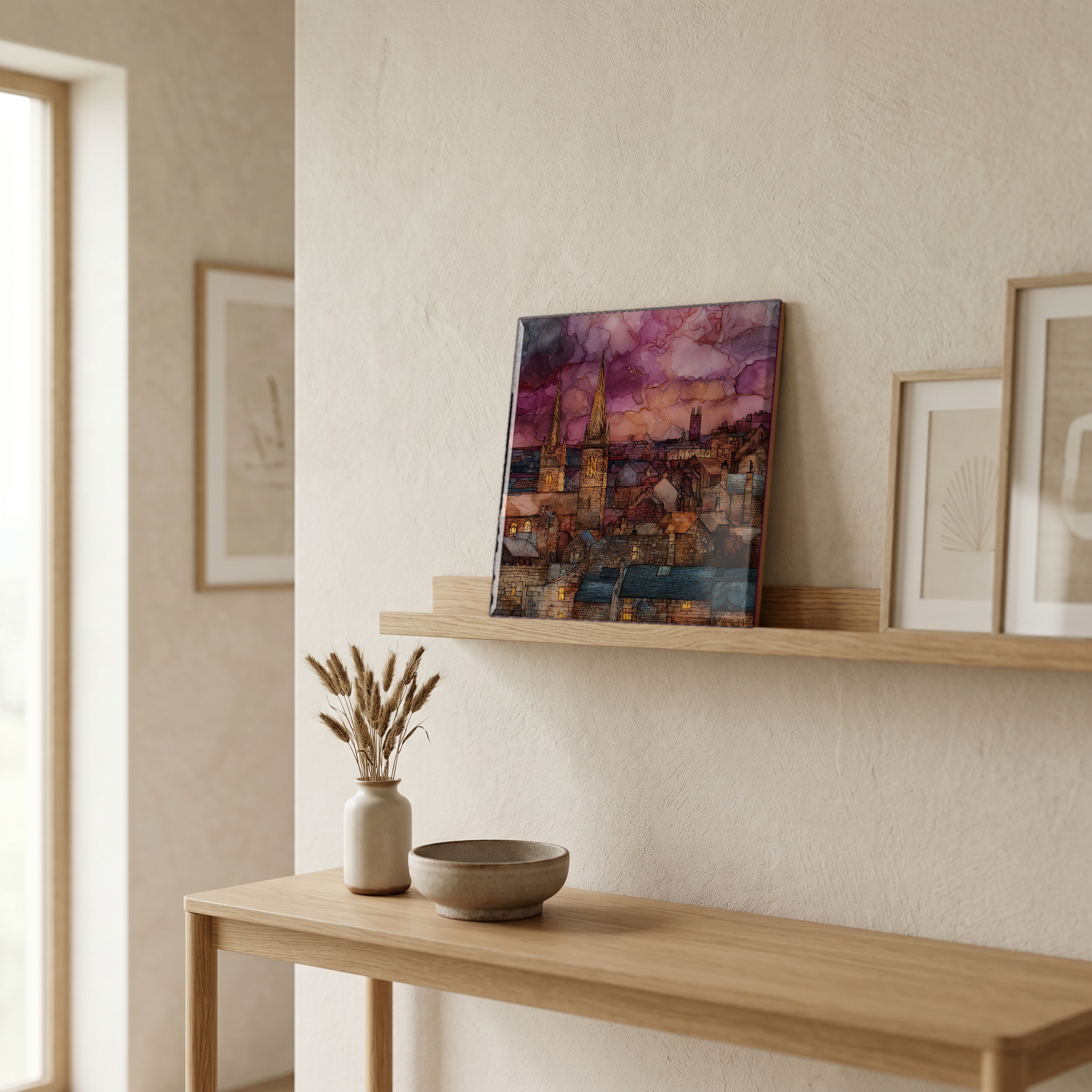
Wender·Vista
Walled City of Derry
shown on ceramic, 12-inch tileIreland
above the river Foyle, near Ireland's north coast

Walled City of Derry

— a circle the centuries kept.

Where it lives

Not only on a wall.

A small tile on the nightstand catching the morning. A larger one above the fire. Yours, wherever you spend the slow hours.
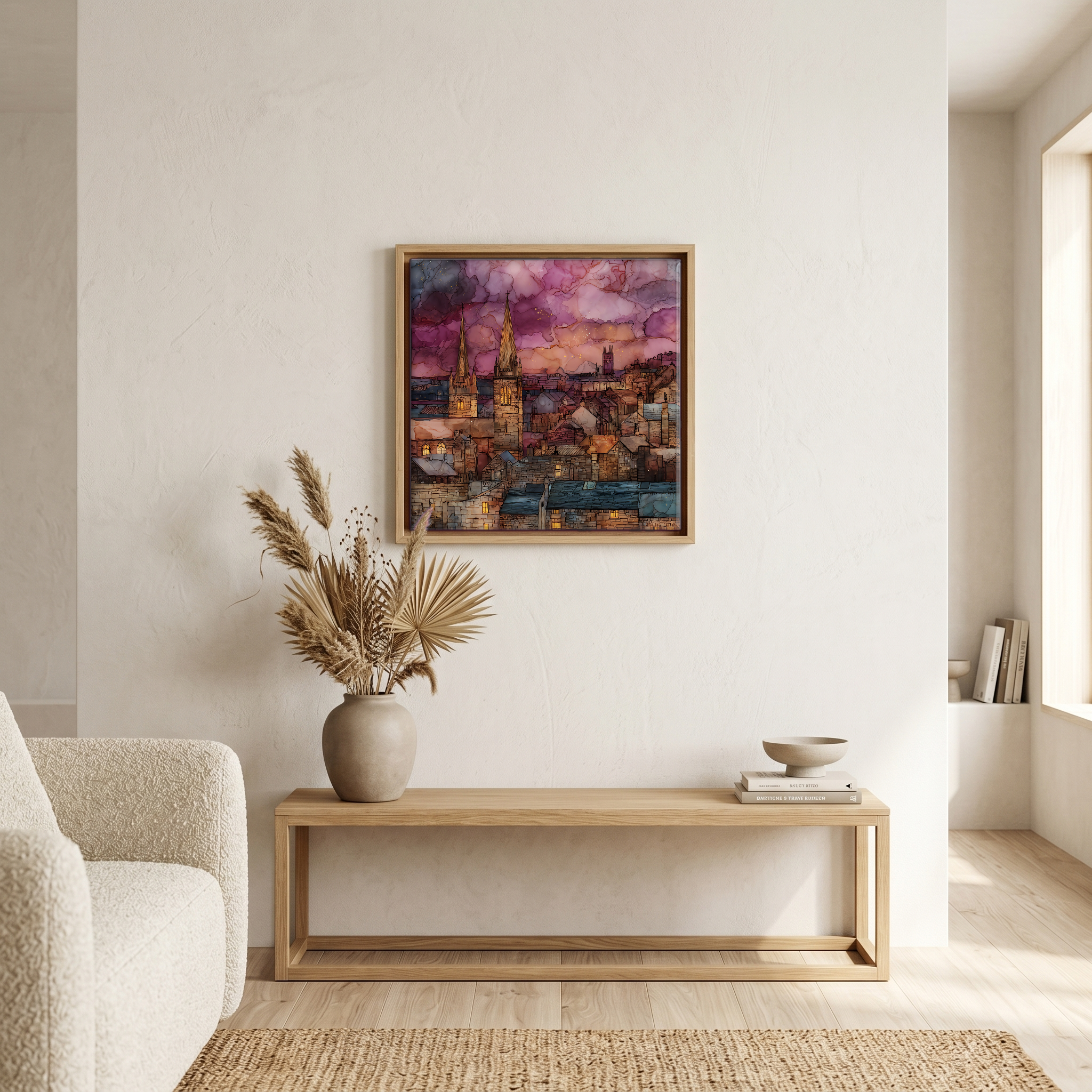
Above the bench, in a warm oak surround.
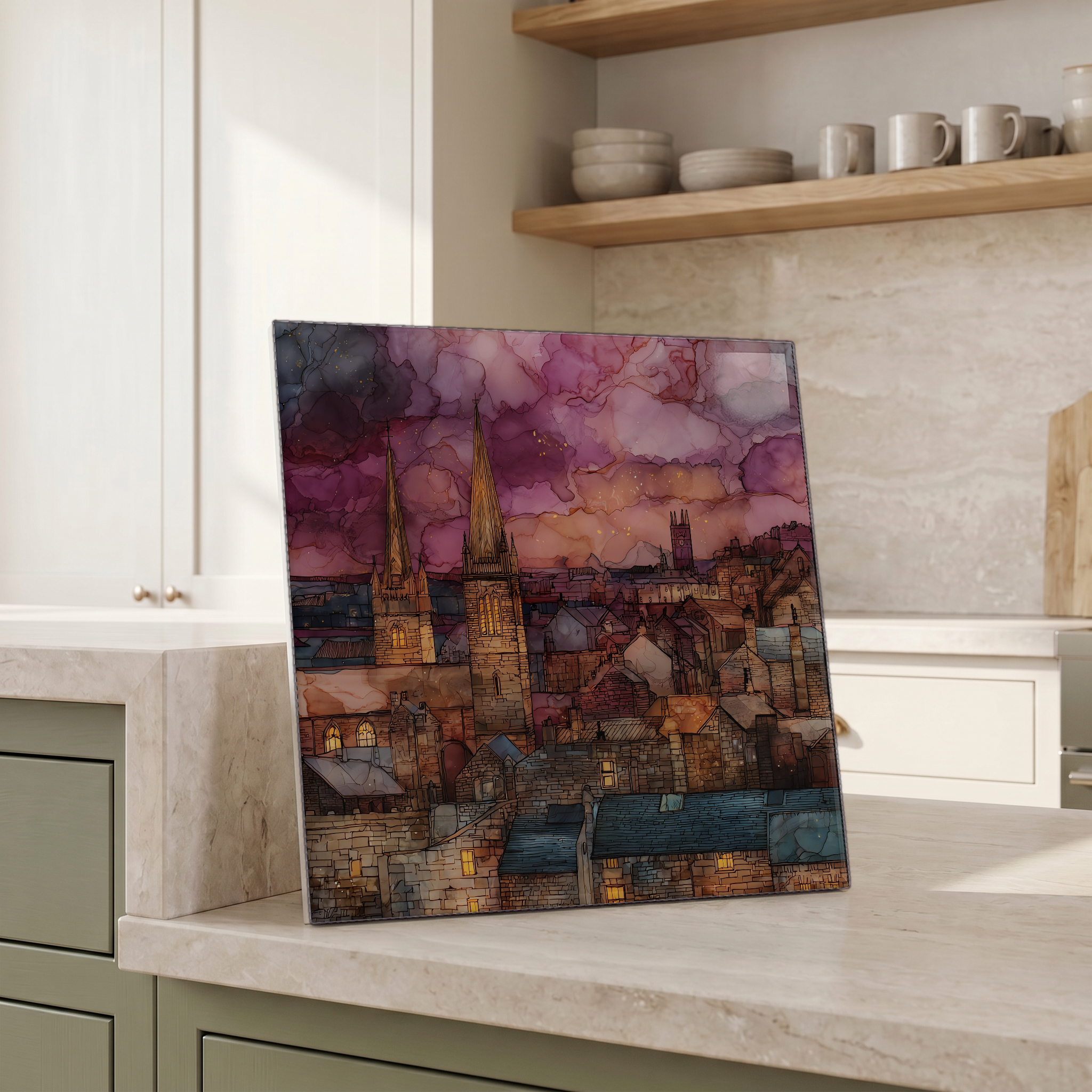
Beside the kettle, propped on the counter.
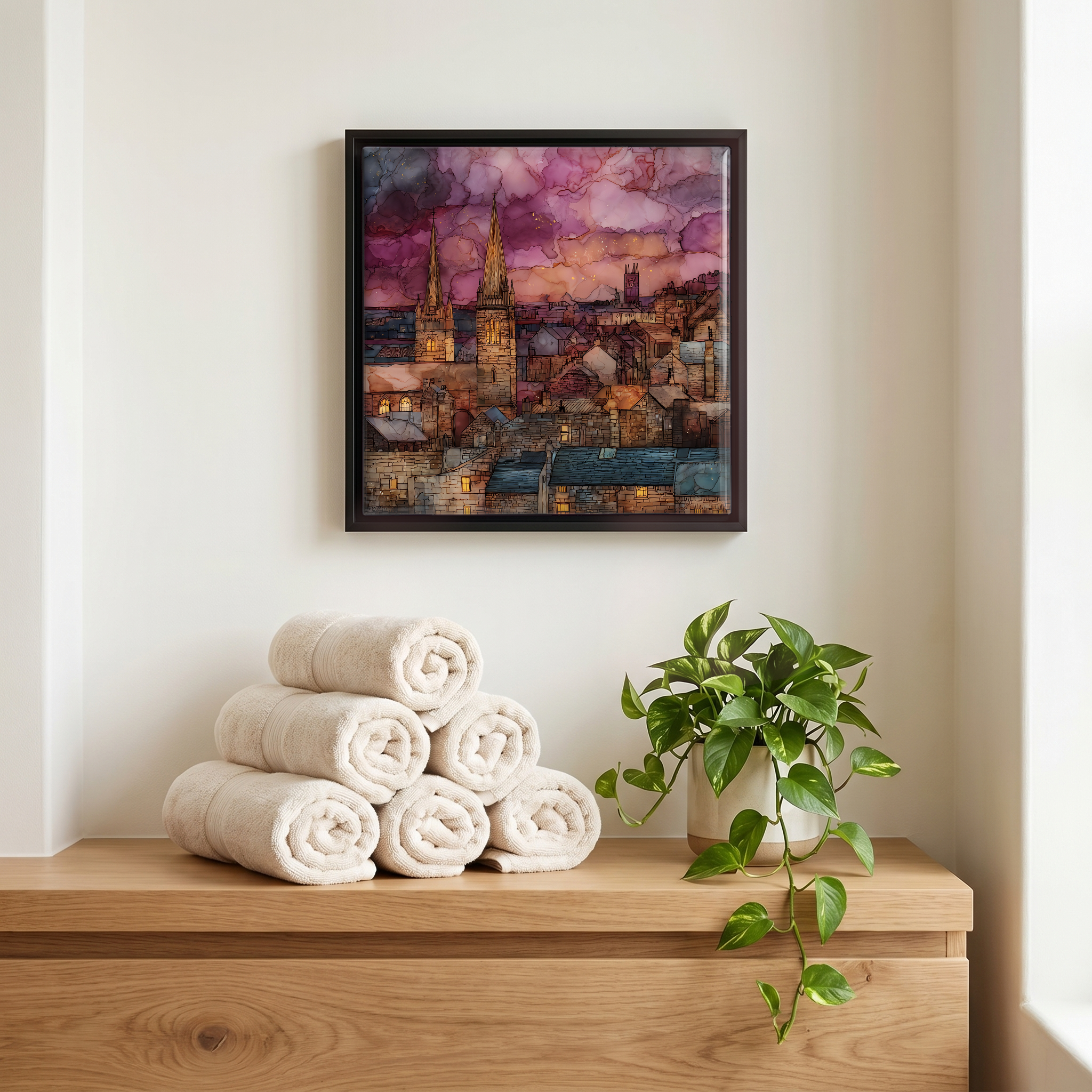
Above the linens, in a slim black surround.
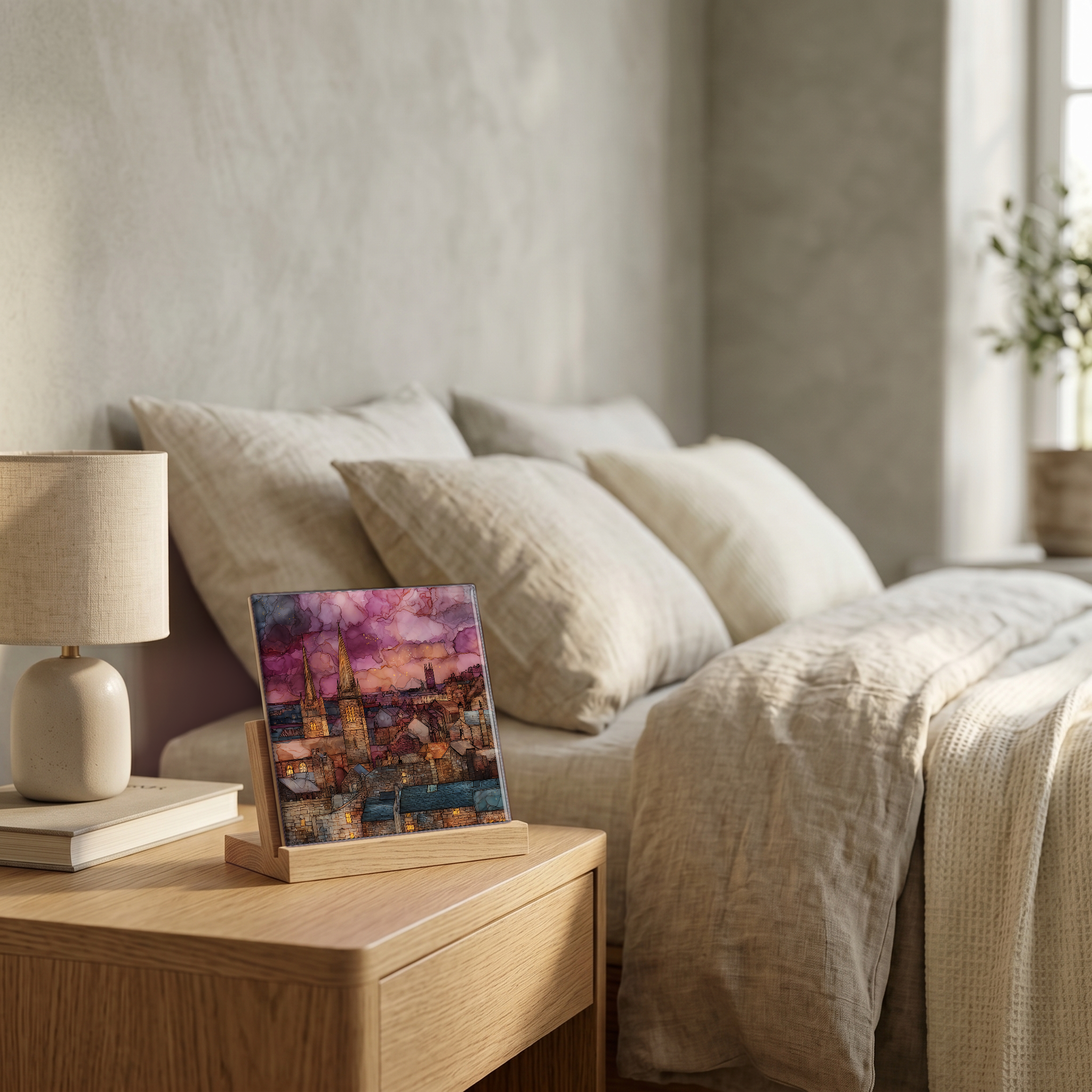
On the nightstand, on a light oak stand.
On a picture ledge, where the light comes in.
a note from the studio

Walls about a mile long, built between 1613 and 1618, the only completely intact city walls in Ireland. They have never been breached: not in the 105-day siege of 1689, not in centuries since. Today you walk them for free, the whole circuit in twenty minutes if you don't stop, an hour if you do. Below the parapet the Bogside spreads out, and the Foyle bends north towards the Atlantic. The city goes by two names. The walls have one shape, and have kept it.
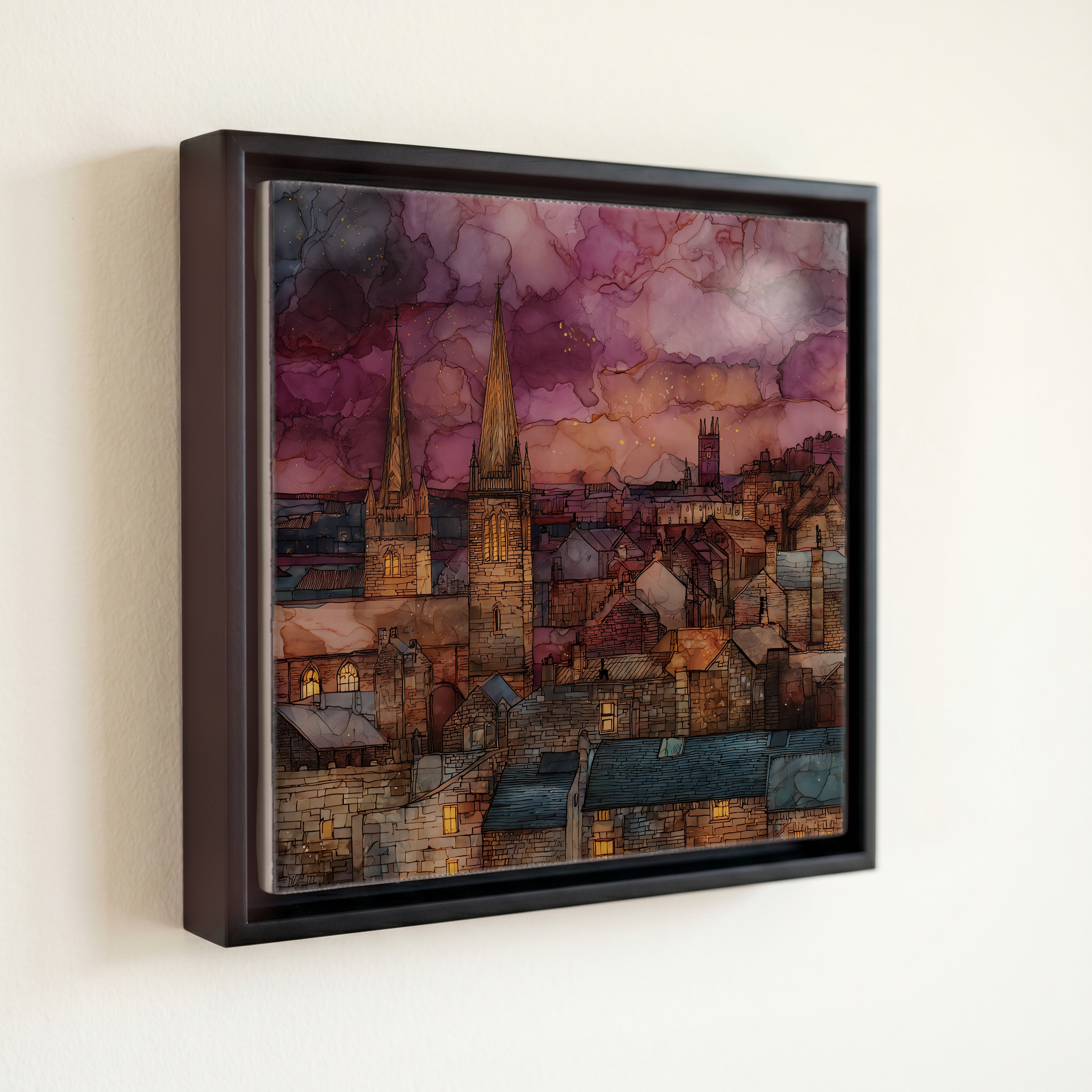
from the studio
shown in a slim black floating frame · 6 × 6 in
— bring it home

Walled City of Derry, on ceramic.

Each tile is finished by hand in our Knoxville studio. Artwork is slowly infused into the ceramic surface under high heat and pressure, and rests beneath a thin glossy finish. The colour lives in the surface, not on top of it.

What kind of piece?
One tile — square or rectangle.
How big?
the popular one — counter, shelf, nightstand
6 × 6 in · 15 cm · 1.6 lb
Surface finish
A clear glossy finish — the artwork reads as if under resin. Ideal for show-pieces and framed wall art.
How it sits
A hidden cleat — sits ¼″ proud of the wall.
$58
Hand-finished and shipped from our studio at the foot of the Smokies. On your wall in about ten days.
size
6 × 6 in
15 cm
weighs
1.6 lb
solid in the hand
surface
ceramic, hand-finished
art rests beneath a thin glossy finish
from
Knoxville, TN
our family studio, at the foot of the Smokies
— start a Coaster Set

Pick any four 4-inch tiles — National Parks you've been to, a Smokies set, the four seasons of one place. $ for a set of , cork-backed, ready to live on the table.

comes gift-ready
comes gift-ready

Each tile ships in a kraft box, tied with cream ribbon, with a handwritten note from the studio if you'd like to add one.
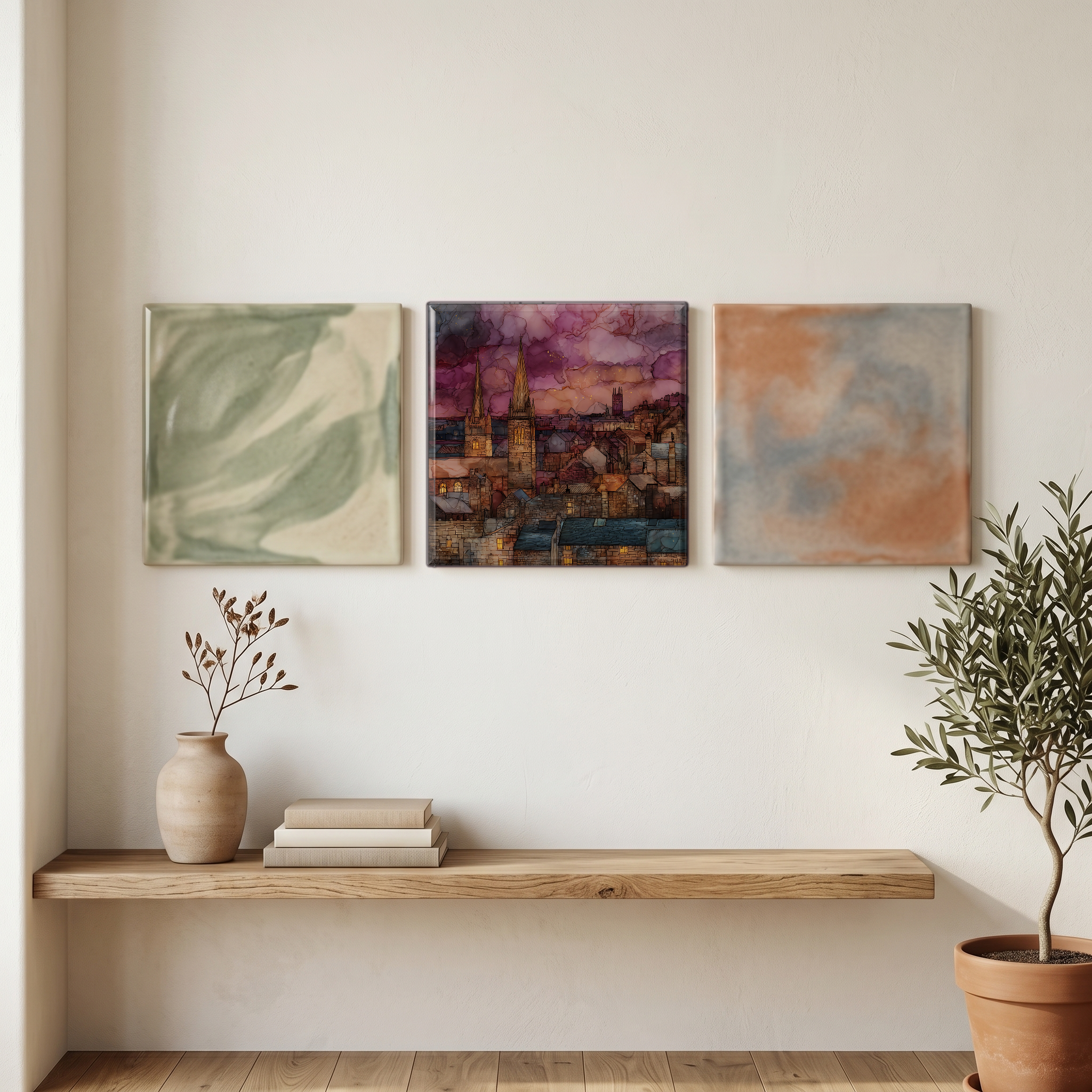
or build a grouping
or build a grouping

Three or five different vistas, hung together — a chapter of places you've been, or want to go.

about Walled City of Derry

The place, in three passes.

A little of what's known, in case you fall down the rabbit hole — or want to go see it yourself.
the place

The Walled City of Derry sits on a hill above the river Foyle in the north-west of Northern Ireland, about three miles inland from where the Foyle meets Lough Foyle and the Atlantic. The walls enclose the original plantation town in a near-complete circuit about 1.5 km long, with seven gates and the central Diamond square. They were built between 1613 and 1618 by The Honourable The Irish Society, a London consortium chartered under King James I as part of the Plantation of Ulster. Today the walls are a UK state-care monument, and the only fully intact walled circuit on the island of Ireland.

the stone

The walls run for about 1.5 km, varying between 4 and 10 metres in height and up to 9 metres in thickness at the base, built of local stone with a wide walking parapet on top. Four original gates (Bishop's, Ferryquay, Butcher's, and Shipquay) were cut through in the seventeenth century. Three more (Magazine, Castle, and New Gate) were added in the eighteenth and nineteenth as traffic and military needs changed. The bastions still carry their original Williamite-era cannon, including Roaring Meg, which fired from the Double Bastion during the siege of 1689. Maintained continuously for four centuries, the walls are a UK state-care monument and one of the few completely intact urban defensive circuits in Western Europe.

— informed by Wikipedia
the visit

The walls are open every day, free of charge, with no ticket and no opening hours: you climb up at any one of the seven gates and walk. The full circuit is just under a mile and takes about twenty minutes at a steady pace, an hour if you stop for the views: over the Bogside and the People's Gallery murals to the west, over the Diamond and St. Columb's Cathedral inside, over the river Foyle and the Peace Bridge to the east. The Discover Northern Ireland tourist board recommends the loop in any weather; Atlantic winds make winter walks bracing. The Tower Museum at Union Hall Place, just inside Magazine Gate, holds the city's archaeological collection.

where
United Kingdom · Derry, County Londonderry, Northern Ireland
position
54.9966° N · 7.3217° W
the neighborhood

What's nearby.

A handful of named places within an hour's walk or short drive. Some we've already painted; some we will.
0.2 km S
St. Columb's Cathedral
Anglican cathedral
0.3 km NE
The Guildhall
civic hall
0.3 km NW
Bogside
historic neighborhood
0.4 km NW
Free Derry Corner
civil rights mural
0.5 km E
Peace Bridge
pedestrian bridge
10 km SW
Grianan of Aileach
early medieval ring fort
N
Walled City of Derry
St. Columb's Cathedral
The Guildhall
Bogside
Free Derry Corner
Peace Bridge
Grianan of Aileach
common questions

What people ask.

A few questions we get about Walled City of Derry — and about bringing the piece home.
about the place

The walls enclose the old centre of Derry in the north-west of Northern Ireland, on a hill above the river Foyle about three miles inland from the Atlantic. The town lies about 110 km (70 mi) north-west of Belfast.

The walls were built between 1613 and 1618 by The Honourable The Irish Society, a London consortium chartered under King James I as part of the Plantation of Ulster. They are the most complete city walls of their period in the British Isles.

Because the walls were never breached. The walls' most severe test came in the siege of 1688 to 1689, when Jacobite forces under King James II besieged the city for 105 days. The defenders held; the walls held; the nickname stuck.

The full circuit is about 1.5 km (just under a mile) and takes about twenty minutes at a steady pace, or an hour with stops. The walking surface is on top of the wall, with steps up at each of the seven gates.

No. Access to the walls is free, with no ticket and no opening hours. You climb up at any one of the seven gates and walk. The Tower Museum inside Magazine Gate is a paid ticket for the city's archaeological collection.

The four original gates from the 1613-1618 construction are Bishop's Gate, Ferryquay Gate, Butcher's Gate, and Shipquay Gate. Three later gates were added: Magazine Gate, Castle Gate, and New Gate. Each gives access up to the parapet walk.

The walled city was renamed Londonderry in 1613 by royal charter when the Plantation of Ulster placed it under the London livery companies. Many residents and the local council use Derry; the UK government and the Church of Ireland use Londonderry. Both are correct.

about the piece in your home

The walls are one of the most-loved landmarks in Northern Ireland, and for diaspora families they are often the first place a relative shows visitors. A Small or Medium tile with a handwritten note from the studio carries that connection well.

The stained-glass blues and warm stone tones of the artwork sit comfortably in Celtic-modern, traditional Irish-pub-aesthetic, and library-style interiors. The deep palette also works as a single statement piece in a minimalist room where most of the wall is otherwise bare.

The Voynich palette and the architectural subject sit naturally in the heritage-modern direction many readers and slow-room collectors are choosing right now. Paired with leather, walnut, dark green walls, and brass hardware, a Medium or Large finds its place at eye level over a reading chair.

Above a sofa, a single Large hangs proportionately for most standard three-seater couches. For longer sectionals, a 4-tile Mural carries the wall. Above a console table or hallway runner, a Medium or a 4-tile Mural anchors the space.

Yes, in our Dura Satin or Matte finish, which is scratch-resistant and built for moisture-prone vertical installations. The colour is slowly infused into the ceramic surface under high heat and pressure, so steam and splashes do not affect it.

A soft microfibre cloth and warm water are enough for routine cleaning. For tougher marks, add a small amount of mild dish soap. Avoid abrasive sponges and ammonia-based glass cleaners, which can dull the thin glossy finish over time.

Yes. Every WenderVista piece is original to the studio, painted by Reid Wender's eye and slowly infused into the ceramic surface under high heat and pressure. The work is not licensed from any other source.

if this one stayed with you

A few you might also love.

Hand-picked by the eye that found Sorapis. Same air, same kind of quiet.