Wender·Vista
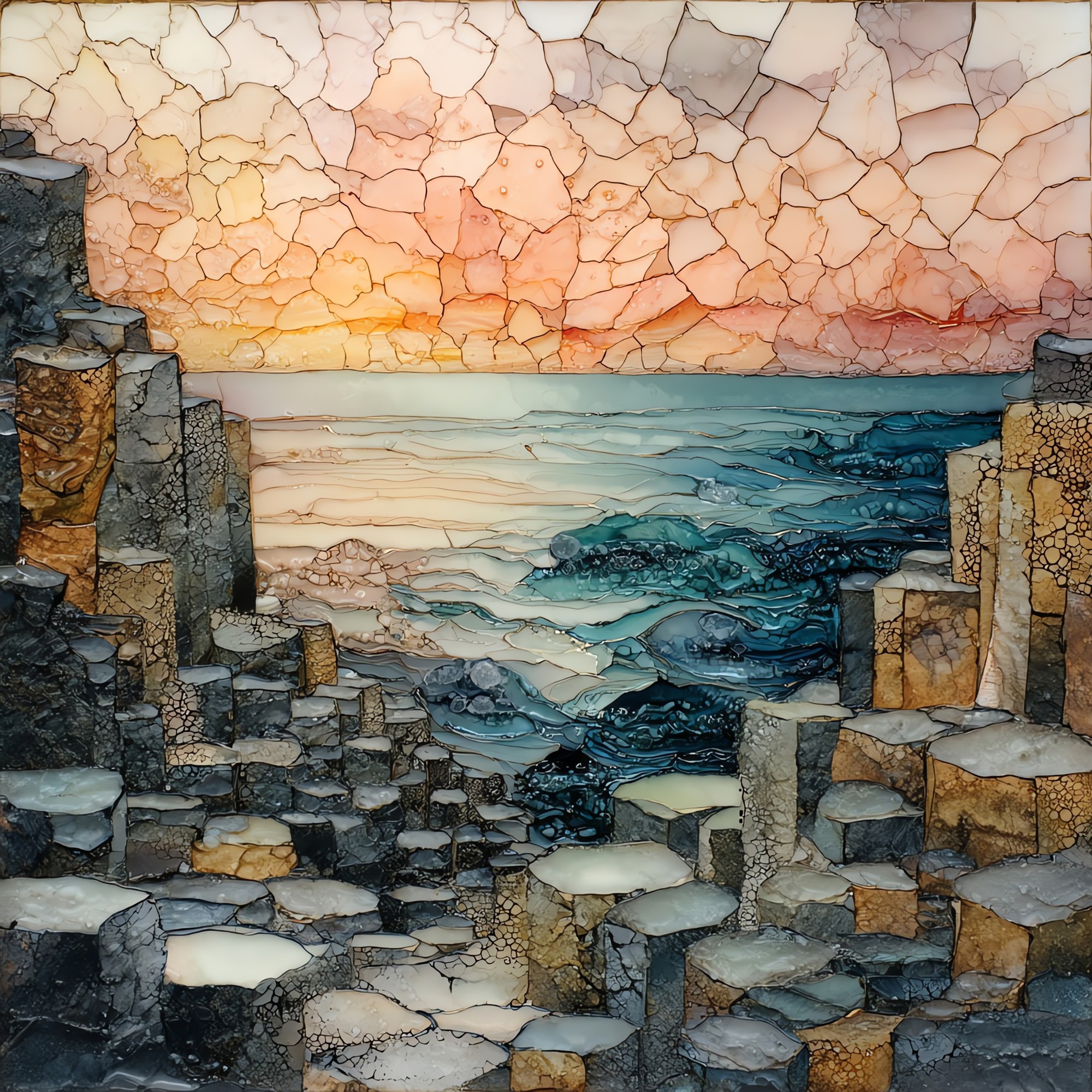
Giant's Causeway
shown on ceramic, 12-inch tileIreland
on the Causeway Coast, north of Bushmills

Giant's Causeway

— the morning the tide steps back from the stones.

Where it lives

Not only on a wall.

A small tile on the nightstand catching the morning. A larger one above the fire. Yours, wherever you spend the slow hours.
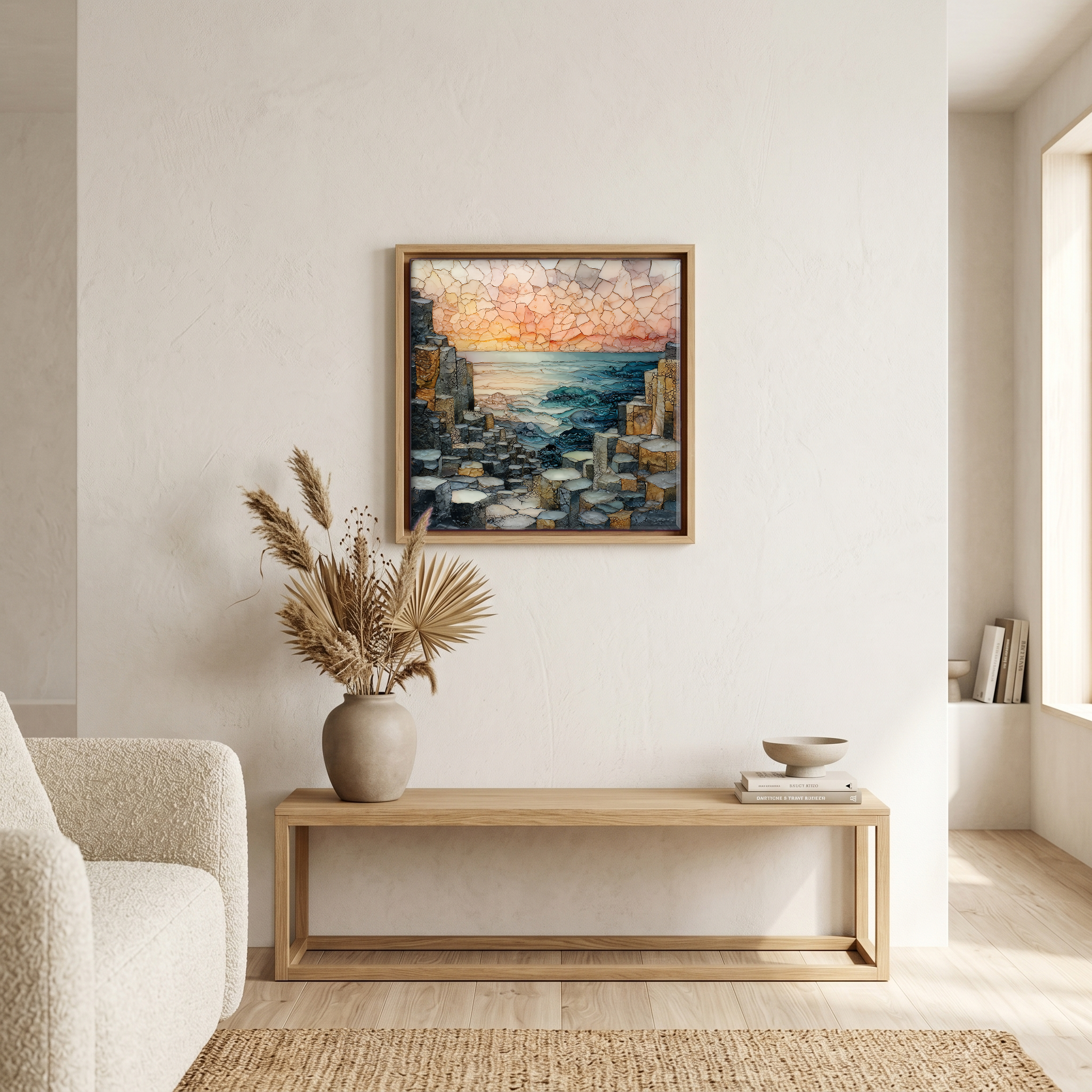
Above the bench, in a warm oak surround.
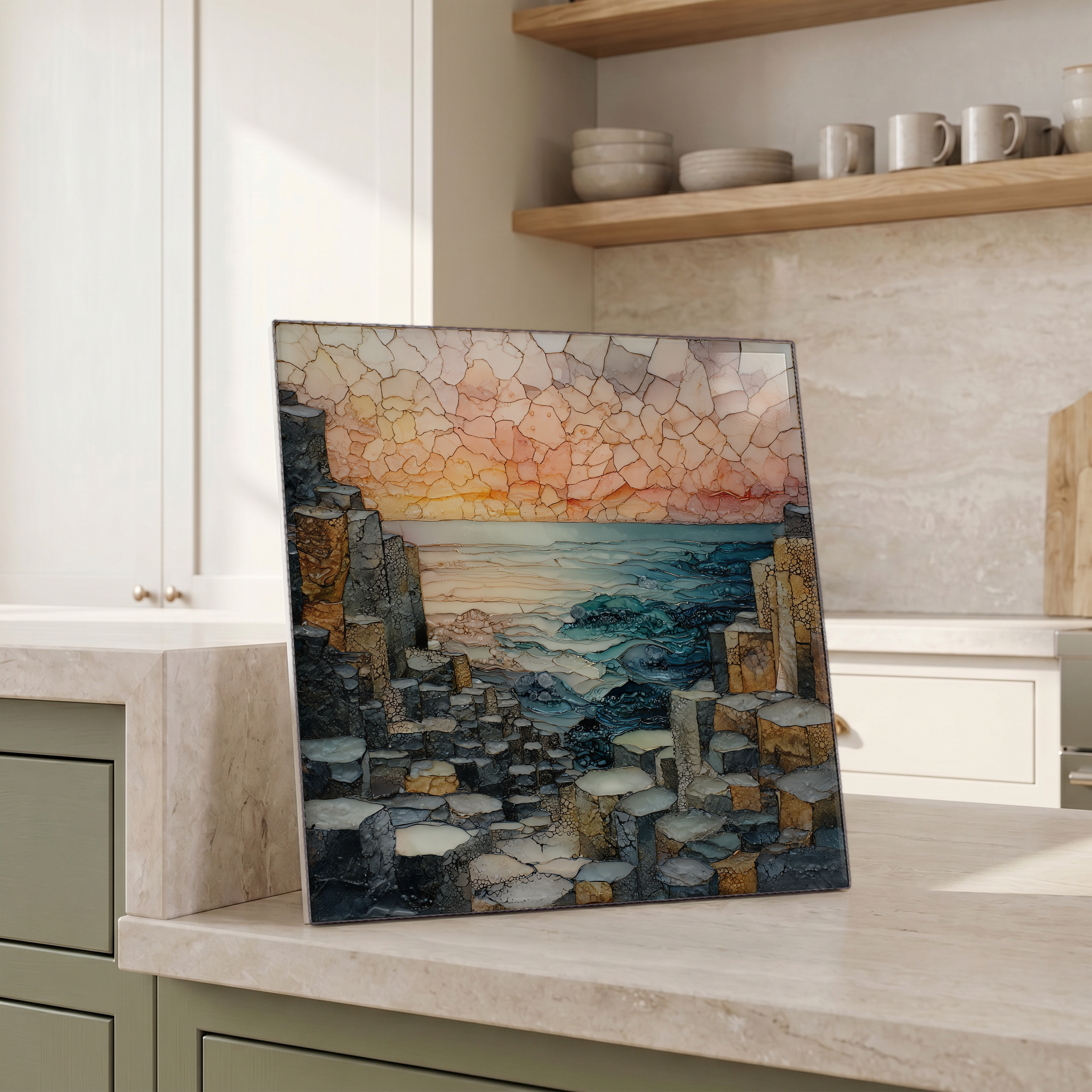
Beside the kettle, propped on the counter.
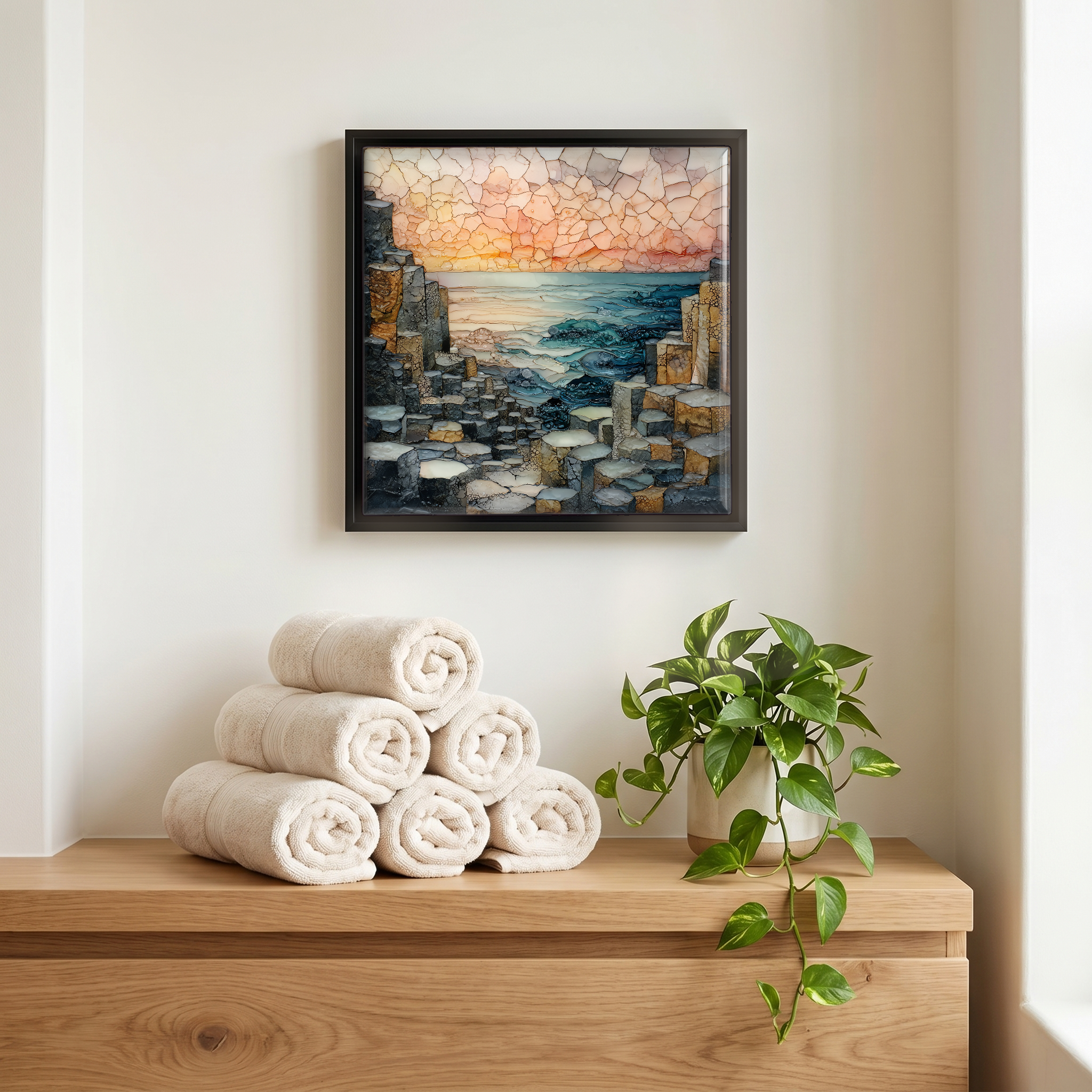
Above the linens, in a slim black surround.
On the nightstand, on a light oak stand.
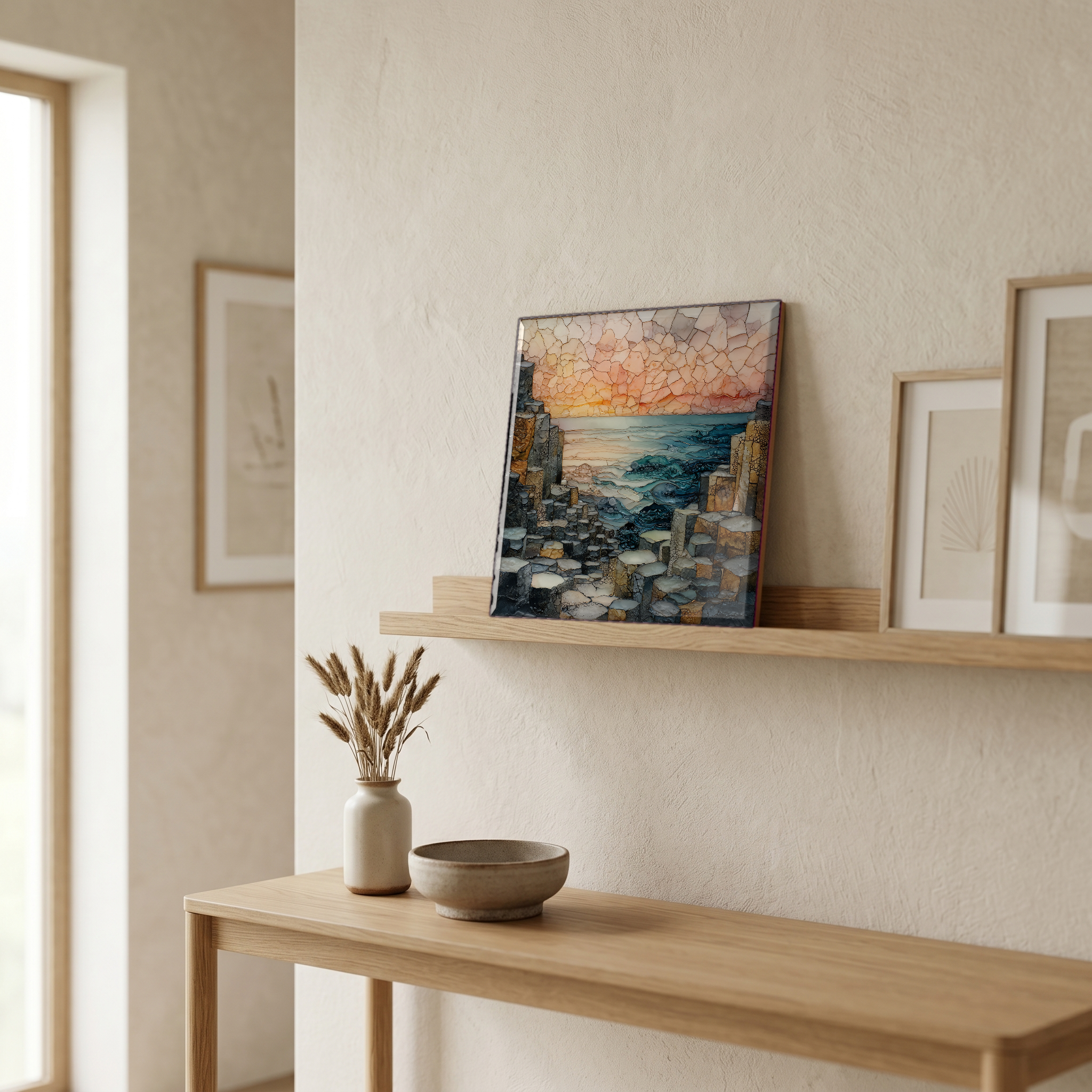
On a picture ledge, where the light comes in.
a note from the studio

The Atlantic edge of County Antrim, where roughly forty thousand basalt columns step down into the sea. They formed about sixty million years ago, when a sheet of lava cooled and cracked into mostly six-sided pillars. The locals will tell you the giant Fionn built it to cross to Scotland. The Scottish island of Staffa carries the same formation — same lava sheet, different shore. The columns show clearest when the morning tide is low and the slabs lie wet and dark. The National Trust keeps the path; the rest is North Atlantic weather. People walk out, find a stone the right size, sit.
from the studio
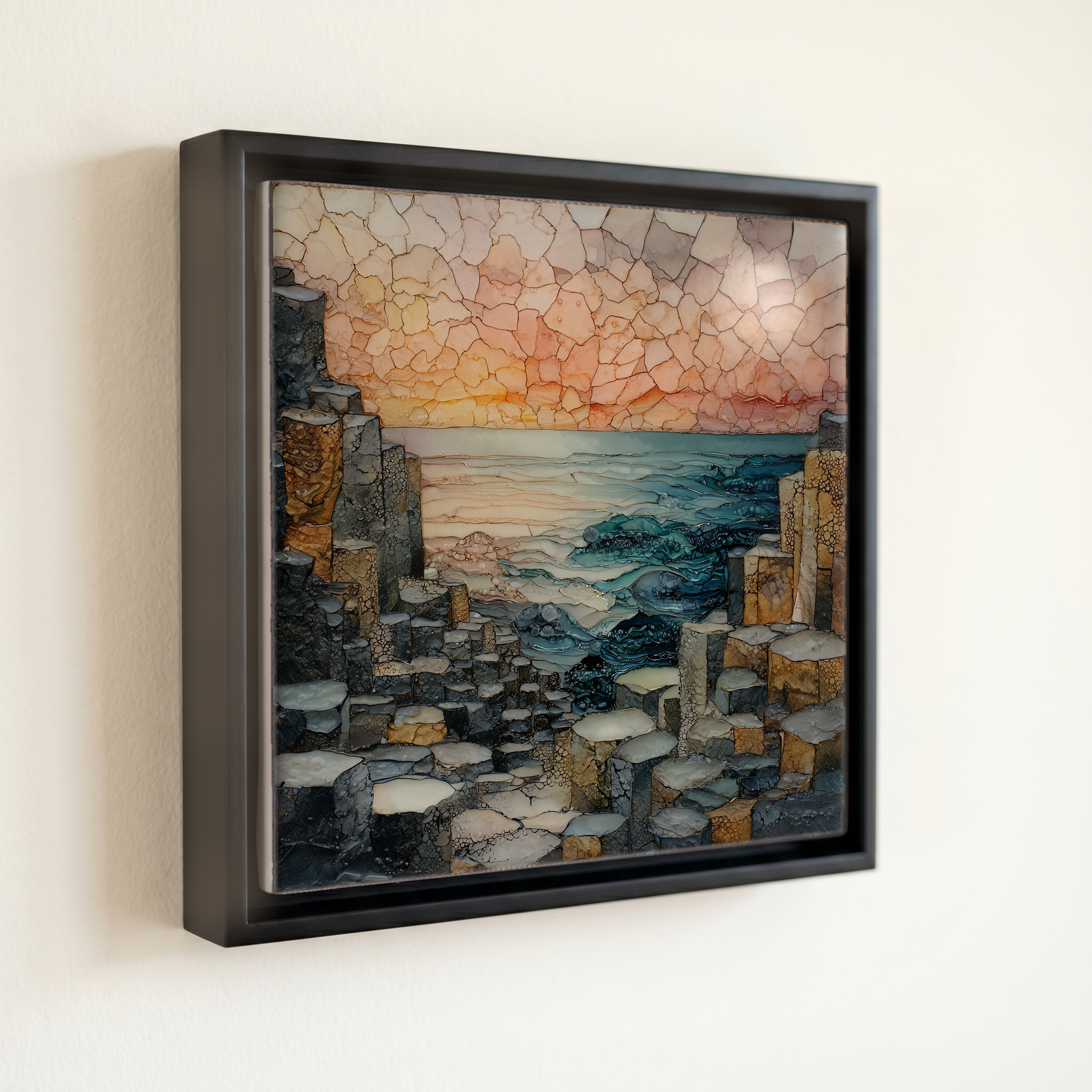
shown in a slim black floating frame · 6 × 6 in
— bring it home

Giant's Causeway, on ceramic.

Each tile is finished by hand in our Knoxville studio. Artwork is slowly infused into the ceramic surface under high heat and pressure, and rests beneath a thin glossy finish. The colour lives in the surface, not on top of it.

What kind of piece?
One tile — square or rectangle.
How big?
the popular one — counter, shelf, nightstand
6 × 6 in · 15 cm · 1.6 lb
Surface finish
A clear glossy finish — the artwork reads as if under resin. Ideal for show-pieces and framed wall art.
How it sits
A hidden cleat — sits ¼″ proud of the wall.
$58
Hand-finished and shipped from our studio at the foot of the Smokies. On your wall in about ten days.
size
6 × 6 in
15 cm
weighs
1.6 lb
solid in the hand
surface
ceramic, hand-finished
art rests beneath a thin glossy finish
from
Knoxville, TN
our family studio, at the foot of the Smokies
— start a Coaster Set

Pick any four 4-inch tiles — National Parks you've been to, a Smokies set, the four seasons of one place. $ for a set of , cork-backed, ready to live on the table.
comes gift-ready
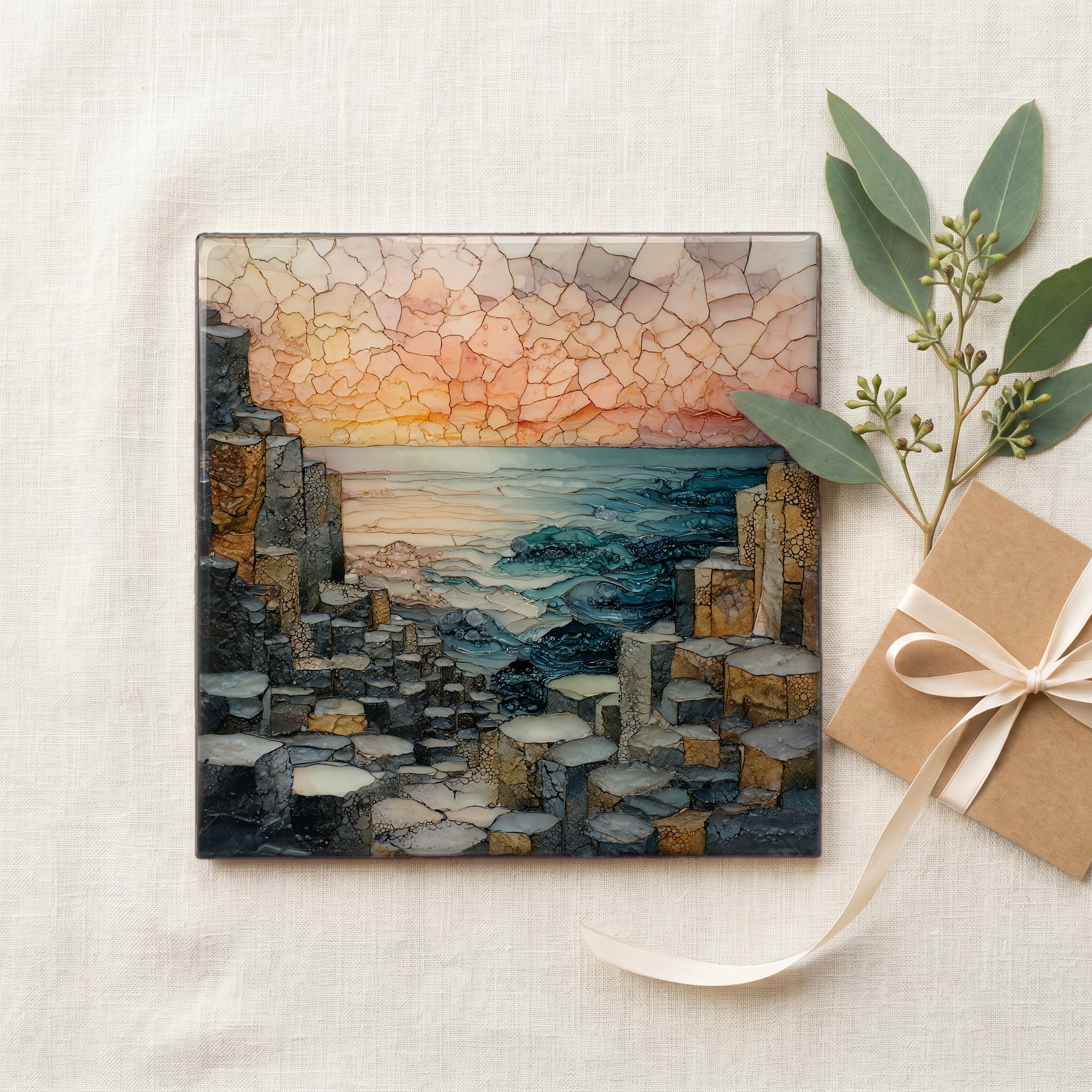
comes gift-ready

Each tile ships in a kraft box, tied with cream ribbon, with a handwritten note from the studio if you'd like to add one.

or build a grouping
or build a grouping

Three or five different vistas, hung together — a chapter of places you've been, or want to go.

about Giant's Causeway

The place, in three passes.

A little of what's known, in case you fall down the rabbit hole — or want to go see it yourself.
the place

The basalt columns lie at the end of the Causeway Coast, a stretch of the North Antrim shore between Portrush and Ballycastle. The site sits about 5 km northeast of Bushmills and was designated a UNESCO World Heritage Site in 1986. Roughly 40,000 columns step from the cliff base down into the sea; the tallest reach about 12 metres. The National Trust has cared for the site since 1961, with the current visitor centre completed in 2012. The walk from the cliff-top car park down to the columns is just under a kilometre, sometimes shuttled by a National Trust minibus. Belfast International Airport lies about 90 km south.

the stone

The columns are basalt, formed roughly 60 million years ago during fissure eruptions in the Paleogene as the North Atlantic was opening. Molten lava flowed across an older chalk landscape, ponded in a wide valley, and cooled slowly enough that the shrinking surface cracked into a pattern of polygons. The shapes are mostly hexagons, though four-, five-, seven-, and eight-sided columns mix in along the formation. The same volcanic episode produced Fingal's Cave on the Scottish island of Staffa, about 130 km to the north, where the columns surface again. Sir Richard Bulkeley described the columns to the Royal Society in 1693, and Susanna Drury's 1740 paintings brought wider European attention. The tallest pillars stand close to 12 metres.

the visit

The basalt site is always open and free to walk; the National Trust charges admission to the visitor centre and car park, with Trust members admitted free. The visitor centre opens every day of the year, with shorter winter hours. The Causeway itself stays accessible at dawn and dusk, when the columns hold the light differently from the midday crowd. The walk from the centre down to the stones is about a kilometre on a paved path; a shuttle runs at regular intervals for those who skip the descent. Rain is the default forecast on this stretch of the North Atlantic coast; the rocks are slick when wet, and the seaward edge has no railing. Summer brings the heaviest visitor numbers; early spring and late autumn are quieter.

— informed by National Trust
where
United Kingdom · County Antrim, Northern Ireland
within
Causeway Coast Area of Outstanding Natural Beauty
elevation
0 m · 0 ft
position
55.2408° N · 6.5117° W
the neighborhood

What's nearby.

A handful of named places within an hour's walk or short drive. Some we've already painted; some we will.
5 km W
Dunluce Castle
ruined castle
5 km SW
Old Bushmills Distillery
whiskey distillery
6 km E
Whitepark Bay
Atlantic beach
11 km W
Portrush
seaside town
14 km E
Carrick-a-Rede Rope Bridge
rope bridge
17 km S
The Dark Hedges
beech avenue
N
Giant's Causeway
Dunluce Castle
Old Bushmills Distillery
Whitepark Bay
Portrush
Carrick-a-Rede Rope Bridge
The Dark Hedges
common questions

What people ask.

A few questions we get about Giant's Causeway — and about bringing the piece home.
about the place

On the north coast of County Antrim, Northern Ireland, about 5 km northeast of Bushmills along the Causeway Coast. Belfast lies roughly 90 km to the south. The nearest seaside town is Portrush, about 11 km west.

The columns are basalt, formed about 60 million years ago in the Paleogene period. Lava from fissure eruptions cooled slowly across a wide valley, and the shrinking surface cracked into mostly six-sided columns. The same lava sheet surfaces again at Fingal's Cave on the Scottish island of Staffa.

Roughly 40,000 interlocking basalt columns step down from the cliff base into the Atlantic. Most are hexagonal, but the formation also includes four-, five-, seven-, and eight-sided columns. The tallest stand close to 12 metres above the surrounding rock.

Irish folklore says the giant Fionn mac Cumhaill (Finn McCool) built the causeway as stepping stones to Scotland to fight the giant Benandonner. The same basalt formation surfacing at Staffa, off the Scottish coast, gave the story its anchor on both sides of the sea.

Yes. UNESCO inscribed the Giant's Causeway and Causeway Coast on the World Heritage list in 1986, citing the columns' scientific importance for understanding basaltic volcanism and the opening of the North Atlantic. The site is owned and managed by the National Trust.

The columns are accessible every day, but light and crowds vary. Early morning and late afternoon in spring or autumn give the lowest visitor numbers and the most directional light across the basalt. Summer is busiest. Low tide reveals more of the lower columns.

The basalt site itself is free to walk and always open. The National Trust charges admission to the visitor centre and car park, with Trust members admitted free. A shuttle runs from the centre down to the stones for visitors who skip the kilometre descent.

about the piece in your home

It's been a meaningful gift for customers whose families trace to Antrim or the Causeway Coast. The Giant's Causeway is one of the most loved places on the island, and the work carries well as a Keepsake or Small with a handwritten note from the studio.

The piece sits well in Coastal-modern, Atlantic-cottage, and Mountain-modern rooms. The basalt blacks and sea-greens read as grounded rather than bright, and the geometry suits both spare minimal walls and richer dark-walled libraries.

Yes. Biophilic design favours natural geometry like honeycomb, fractal, and columnar patterns, and the hexagonal basalt is one of the cleanest natural examples of it. The work brings that pattern into the room without leaning decorative.

A single Large reads well above a console or an armchair. Above a standard sofa, a 4-tile Mural carries the wall; for a long sectional or a feature wall, the 9-tile Mural holds the room. The Triptych suits stairwell columns and narrow vertical walls.

Yes. The Dura Satin and Matte finishes are scratch-resistant and built for vertical wet-space installation: backsplashes, shower surrounds, the wall beside a tub. The Glossy finish is intended for dry framed wall art and show pieces.

A soft microfibre cloth with water handles everyday dust and fingerprints. For stuck-on grime in a kitchen install, a small amount of mild dish soap on the cloth is safe. Avoid abrasive pads and ammonia-based cleaners.

Yes. Every WenderVista piece is original to the studio, painted by Reid Wender's eye and slowly infused into the ceramic surface under high heat and pressure. The work is not licensed from any other source.

if this one stayed with you

A few you might also love.

Hand-picked by the eye that found Sorapis. Same air, same kind of quiet.