Wender·Vista
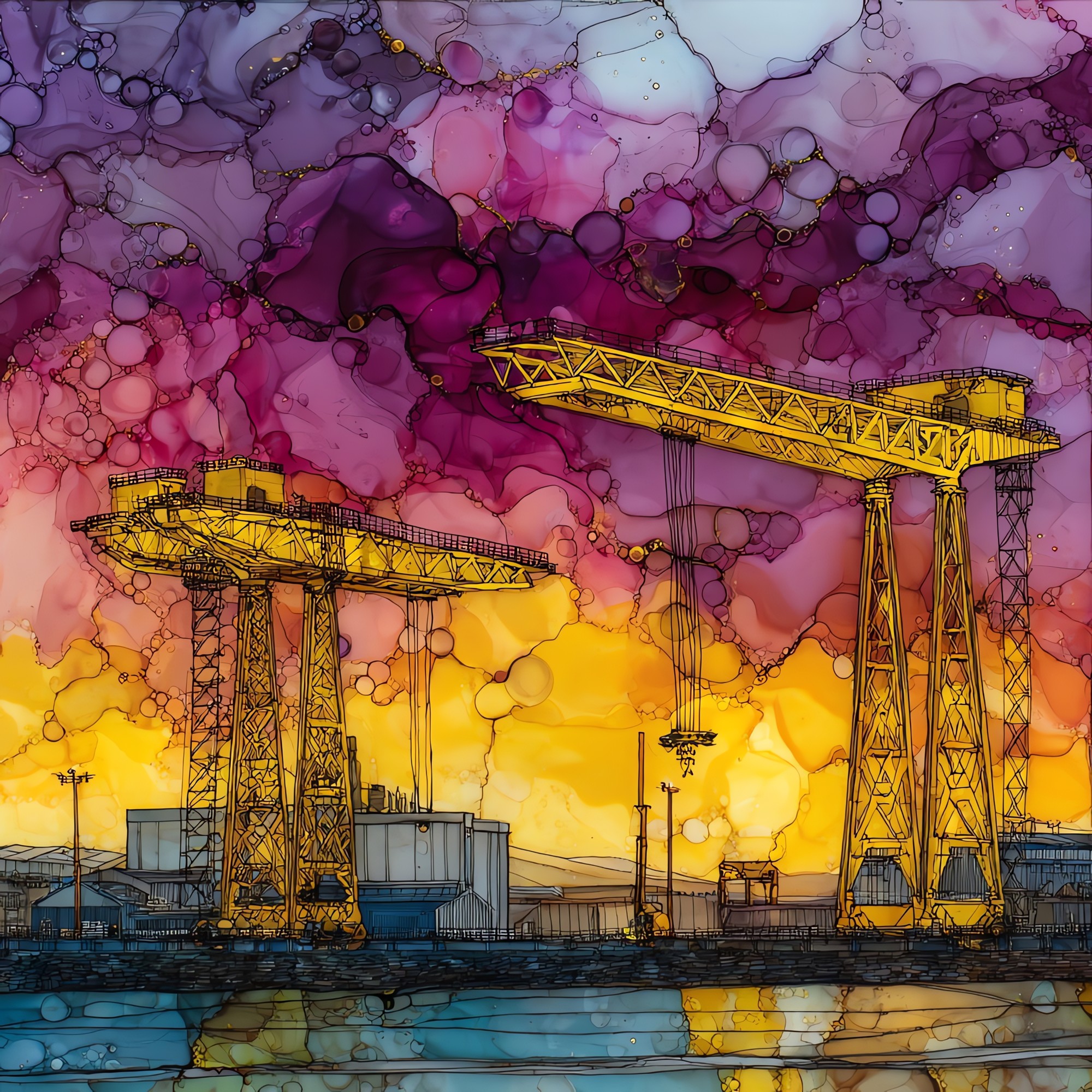
Belfast Shipyard Cranes
shown on ceramic, 12-inch tileIreland
on Queen's Island, where the Lagan meets Belfast Lough

Belfast Shipyard Cranes

— Samson and Goliath, still keeping watch.

Where it lives

Not only on a wall.

A small tile on the nightstand catching the morning. A larger one above the fire. Yours, wherever you spend the slow hours.
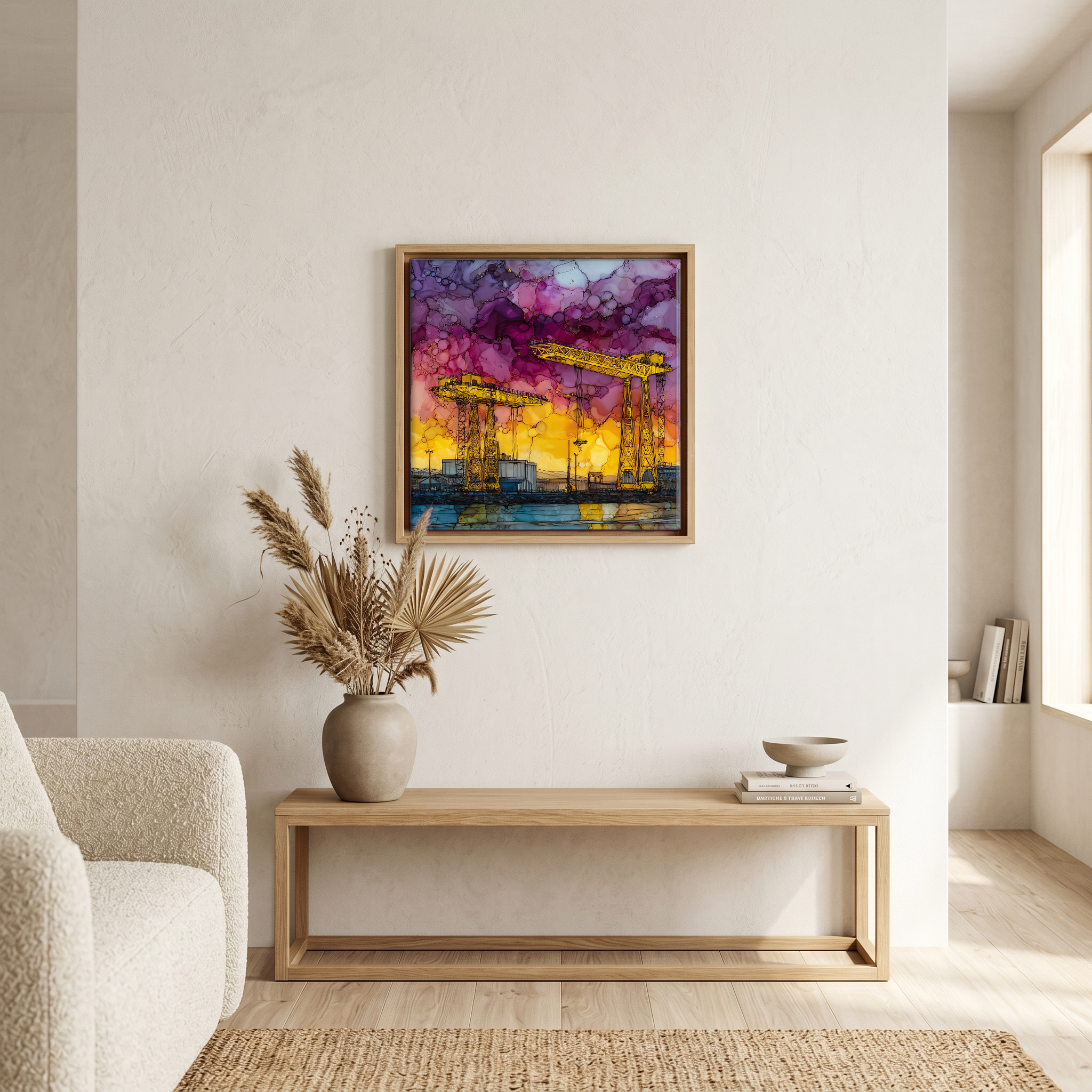
Above the bench, in a warm oak surround.
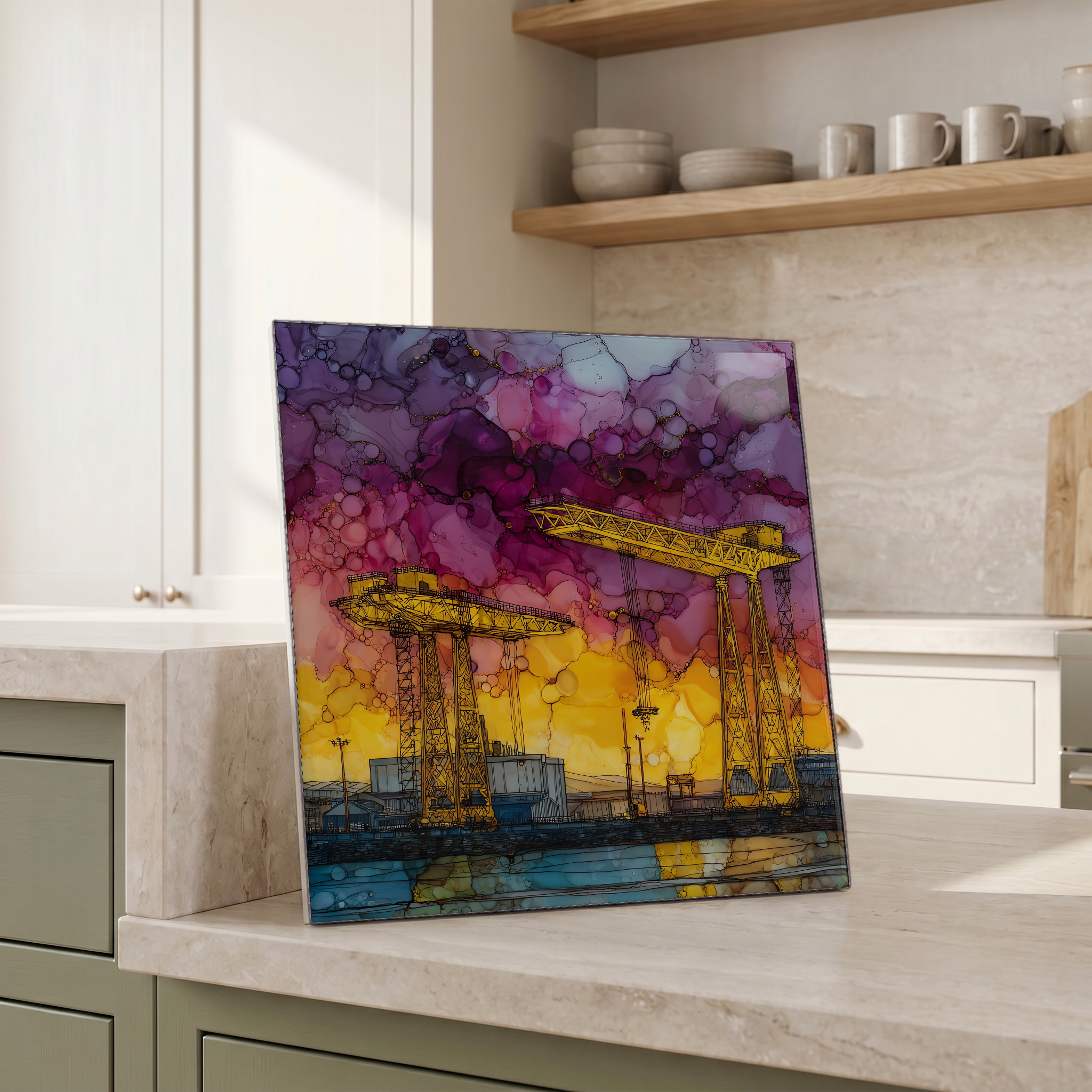
Beside the kettle, propped on the counter.
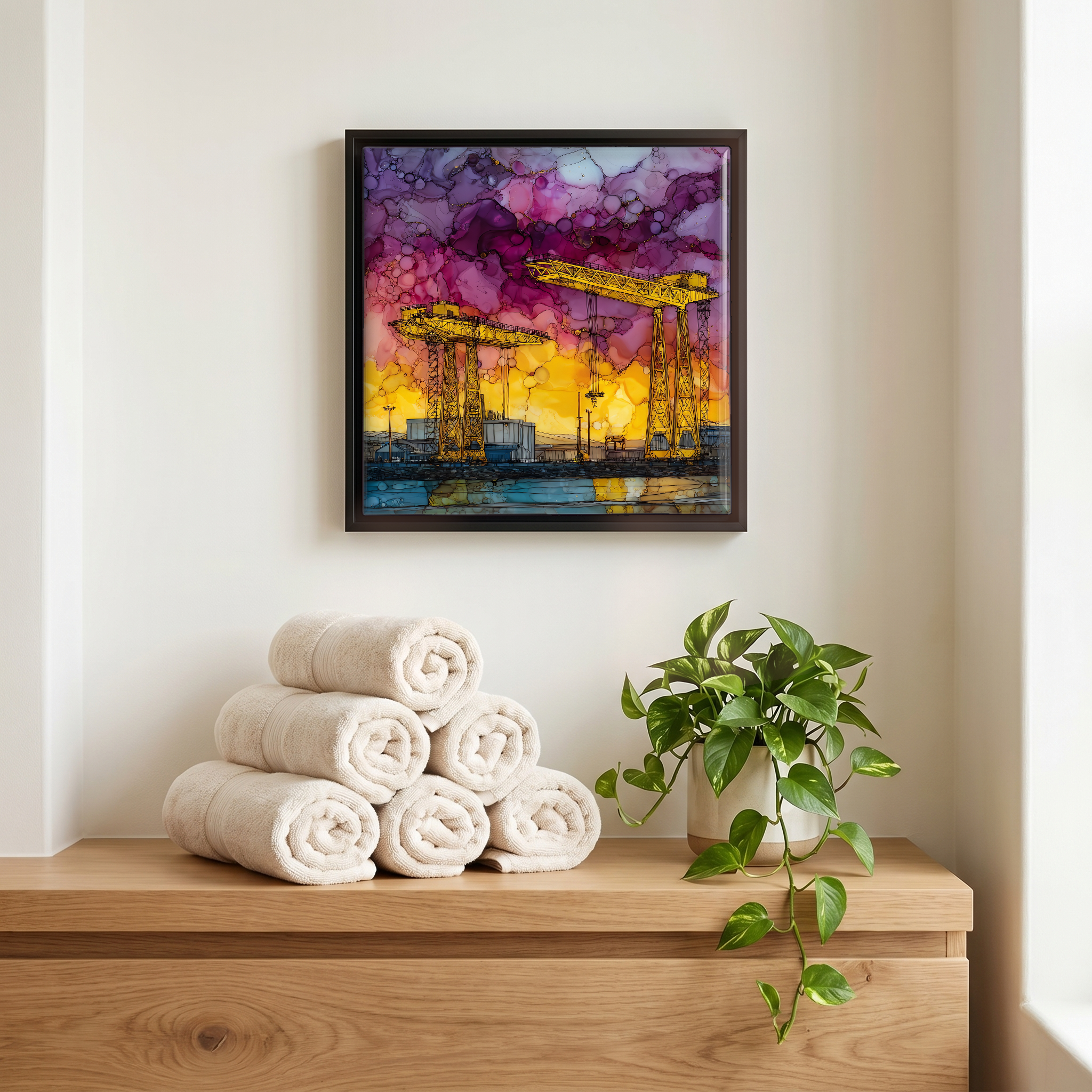
Above the linens, in a slim black surround.
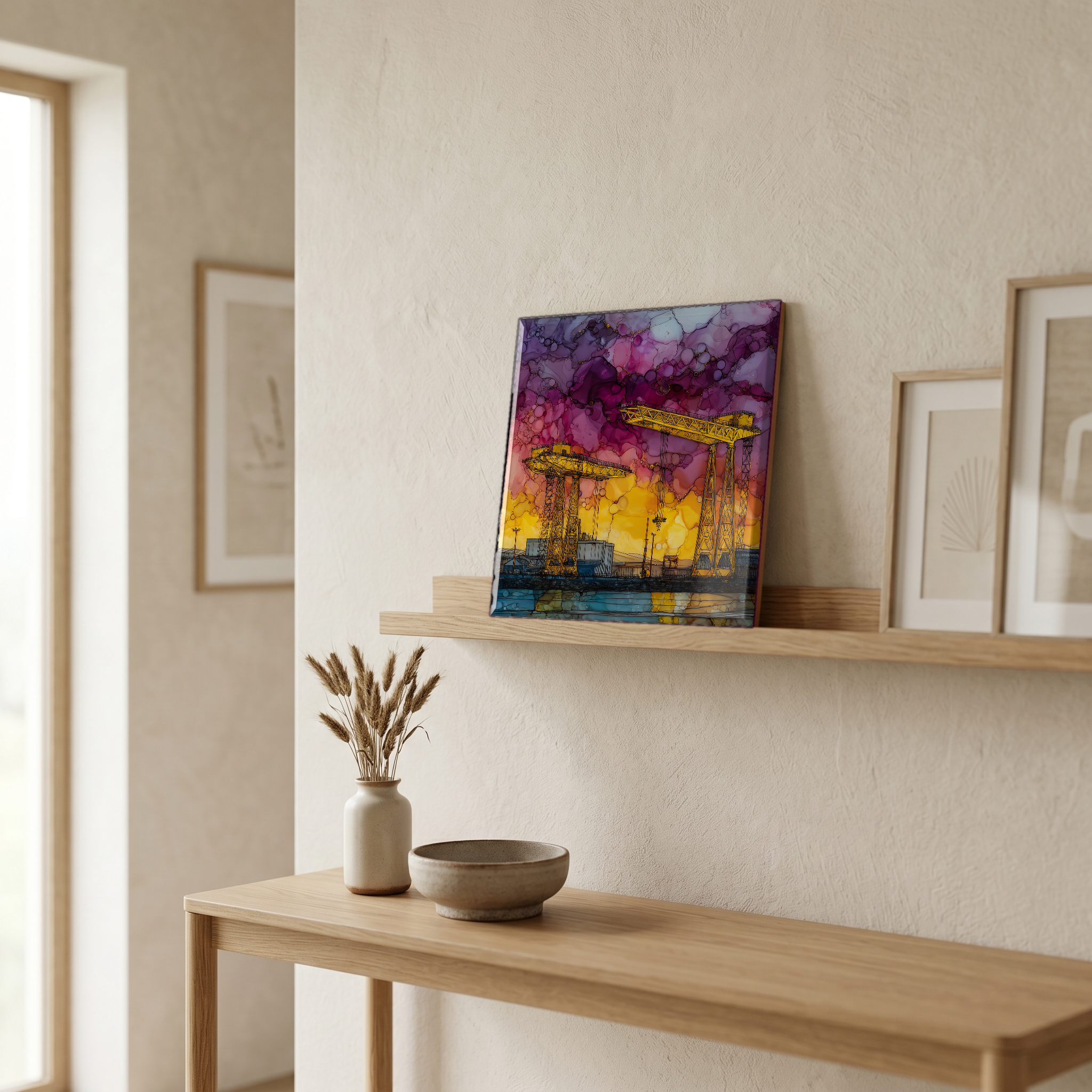
On the nightstand, on a light oak stand.
On a picture ledge, where the light comes in.
a note from the studio

Two yellow gantry cranes above the Lagan in east Belfast, on Queen's Island where ships were built for more than a century. Locals call them Samson and Goliath; they have been on the skyline since the 1970s, scheduled as protected monuments by 1995. Goliath went up first. Samson followed five years later, taller by ten metres. The shipyard around them has gone quiet for long stretches and roared back to life in shorter ones. The cranes stay. Children growing up in east Belfast learn to find their way home by them.
from the studio
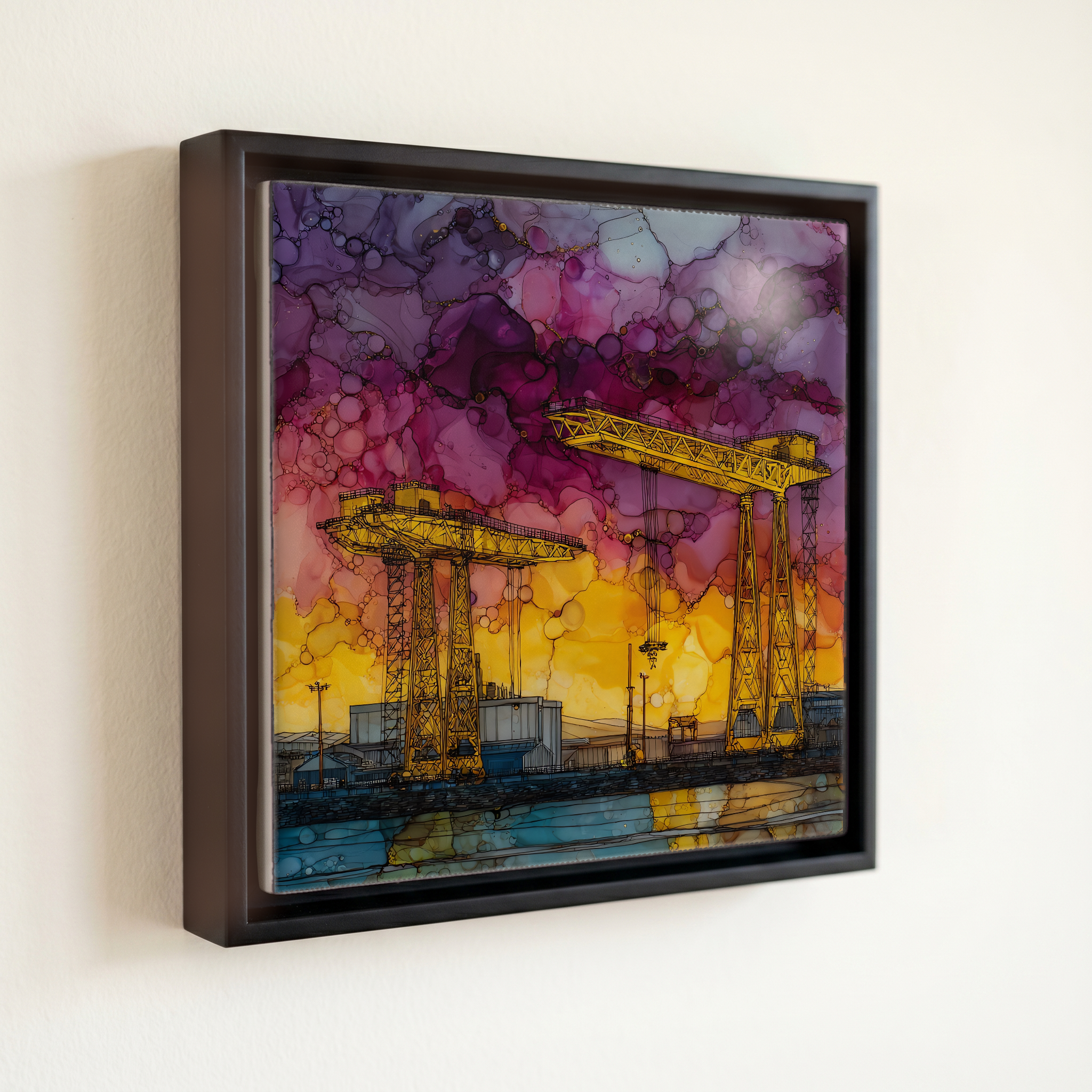
shown in a slim black floating frame · 6 × 6 in
— bring it home

Belfast Shipyard Cranes, on ceramic.

Each tile is finished by hand in our Knoxville studio. Artwork is slowly infused into the ceramic surface under high heat and pressure, and rests beneath a thin glossy finish. The colour lives in the surface, not on top of it.

What kind of piece?
One tile — square or rectangle.
How big?
the popular one — counter, shelf, nightstand
6 × 6 in · 15 cm · 1.6 lb
Surface finish
A clear glossy finish — the artwork reads as if under resin. Ideal for show-pieces and framed wall art.
How it sits
A hidden cleat — sits ¼″ proud of the wall.
$58
Hand-finished and shipped from our studio at the foot of the Smokies. On your wall in about ten days.
size
6 × 6 in
15 cm
weighs
1.6 lb
solid in the hand
surface
ceramic, hand-finished
art rests beneath a thin glossy finish
from
Knoxville, TN
our family studio, at the foot of the Smokies
— start a Coaster Set

Pick any four 4-inch tiles — National Parks you've been to, a Smokies set, the four seasons of one place. $ for a set of , cork-backed, ready to live on the table.
comes gift-ready
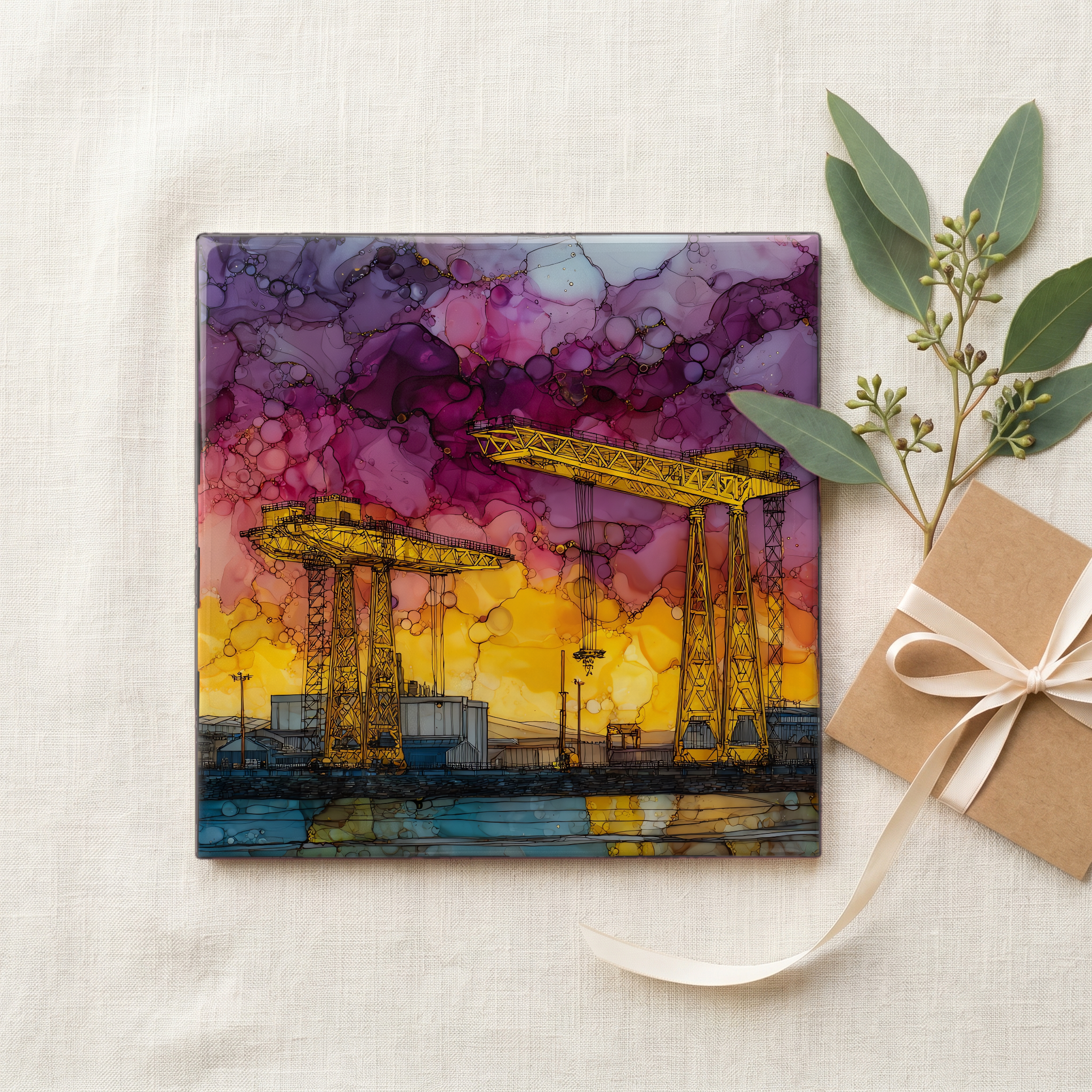
comes gift-ready

Each tile ships in a kraft box, tied with cream ribbon, with a handwritten note from the studio if you'd like to add one.

or build a grouping
or build a grouping

Three or five different vistas, hung together — a chapter of places you've been, or want to go.

about Belfast Shipyard Cranes

The place, in three passes.

A little of what's known, in case you fall down the rabbit hole — or want to go see it yourself.
the place

The cranes stand on Queen's Island in Belfast Harbour, a finger of reclaimed land where the River Lagan empties into Belfast Lough. The site has been a shipyard since 1853, when Edward Harland and Gustav Wolff laid out their first slipways there. The yard built the Olympic-class liners including RMS Titanic, launched from Slipway 3 in 1911. The cranes themselves came much later and now dominate the city's eastern skyline. The campus is bounded on one side by the Titanic Quarter regeneration and on the other by the working dry docks of the modern Harland & Wolff yard. The hills of County Down hold the southern horizon.

the stone

Samson and Goliath are twin gantry cranes built for Harland & Wolff between 1969 and 1974 by the German engineering firm Krupp. Goliath went up first at 96 metres tall; Samson followed at 106 metres, taller by ten metres. Each spans 140 metres across the Building Dock, painted the yard's distinctive yellow and lettered H&W in black. Each is rated to lift up to 840 tonnes, putting them among the largest gantry cranes in the world at the time of their construction. Northern Ireland's Historic Environment Division scheduled both as protected monuments in 1995, recognising them as industrial heritage of national significance and the most visible surviving symbol of Belfast's shipbuilding past.

the visit

The cranes are best seen from across the Lagan, where the Titanic Quarter regeneration meets the river along the Maritime Mile walkway. Titanic Belfast, which opened in 2012 on the slipway where RMS Titanic was built, sits within a few hundred metres of the cranes' base and offers the closest public vantage. The cranes themselves remain working equipment on a private industrial site and are not open to visitors. From the SS Nomadic moored nearby, or from any tour boat on the river, both Samson and Goliath fill the eastern sky. They are visible from much of east Belfast and from the city centre on clear days.

where
United Kingdom · Belfast, Northern Ireland
position
54.6090° N · 5.8940° W
the neighborhood

What's nearby.

A handful of named places within an hour's walk or short drive. Some we've already painted; some we will.
0.3 km W
Titanic Belfast
museum
0.4 km W
SS Nomadic
museum ship
2 km N
Belfast Lough
sea inlet
5 km E
Stormont Estate
parliament building
6 km NW
Cave Hill
basalt hill
N
Belfast Shipyard Cranes
Titanic Belfast
SS Nomadic
Belfast Lough
Stormont Estate
Cave Hill
common questions

What people ask.

A few questions we get about Belfast Shipyard Cranes — and about bringing the piece home.
about the place

The two cranes are named Samson and Goliath. Goliath, built in 1969, stands 96 metres tall; Samson, built in 1974, stands 106 metres. Both belong to the Harland & Wolff shipyard on Queen's Island in Belfast and are painted the yard's distinctive yellow.

Northern Ireland's Historic Environment Division scheduled both cranes as protected monuments in 1995. They were recognised as industrial heritage of national significance, among the largest gantry cranes in the world, and the most visible surviving symbol of Belfast's shipbuilding past.

Goliath was completed in 1969 and Samson in 1974. Both were built by the German engineering firm Krupp for Harland & Wolff, who had been building ships on the Queen's Island site since 1853. The cranes' bright yellow paint and H&W lettering have become the colour of the Belfast skyline.

The cranes stand on Queen's Island in Belfast Harbour, east of the city centre, where the River Lagan flows into Belfast Lough. The Titanic Belfast museum and the Maritime Mile walkway sit directly across the river from them, within a few hundred metres of the cranes' base.

No. RMS Titanic was launched in 1911 from Slipway 3 at Harland & Wolff, more than half a century before either crane was built. Samson and Goliath span the later Building Dock, where the heavier ships of the post-war and oil-tanker era were assembled.

The cranes remain part of a working industrial yard and are not open to the public. The closest legal vantage is the Titanic Quarter, with Titanic Belfast and the SS Nomadic both within a few hundred metres. Tour boats on the Lagan pass directly beneath them.

about the piece in your home

It's been a meaningful gift for many of our customers with Belfast roots. Samson and Goliath are how the city draws itself — the first shape on the skyline coming in by ferry from Stranraer, the last shape leaving. A Medium framed in dark oak carries the weight of the subject well.

The piece reads well in Industrial-modern, Maximalist, and Mountain-modern interiors. The yellow holds against brick, against deep navy, against unfinished steel. Customers have also placed it alongside other harbour and shipyard pieces in dedicated maritime walls.

Yes. The piece sits cleanly in industrial-modern and steel-and-brick interiors, where the yellow becomes a focal point rather than competing with the room's other textures. It also works in jewel-tone Maximalist rooms where saturated colour is already part of the language.

A single Large reads as a focal piece above a standard three-seat sofa. For longer walls, a 4-tile Mural lets the cranes anchor the full sweep of the room. A 9-tile Mural is the choice for a double-height entry or a stairwell.

Yes. We recommend ordering the Dura Satin or Matte finish for any room where the tile will see steam or splash. Both finishes hold the colour as faithfully as the Glossy and resist scratching from normal cleaning.

A soft microfibre cloth and clean water are all the surface needs. The colour is slowly infused into the ceramic under high heat and pressure, so the image cannot be scratched off by normal cleaning. Avoid abrasive scouring pads and harsh solvents.

Yes. Every WenderVista piece is original to the studio. The Belfast Shipyard Cranes are part of our atlas of working harbours and industrial landmarks. There is no licensing or third-party imagery in the line.

if this one stayed with you

A few you might also love.

Hand-picked by the eye that found Sorapis. Same air, same kind of quiet.