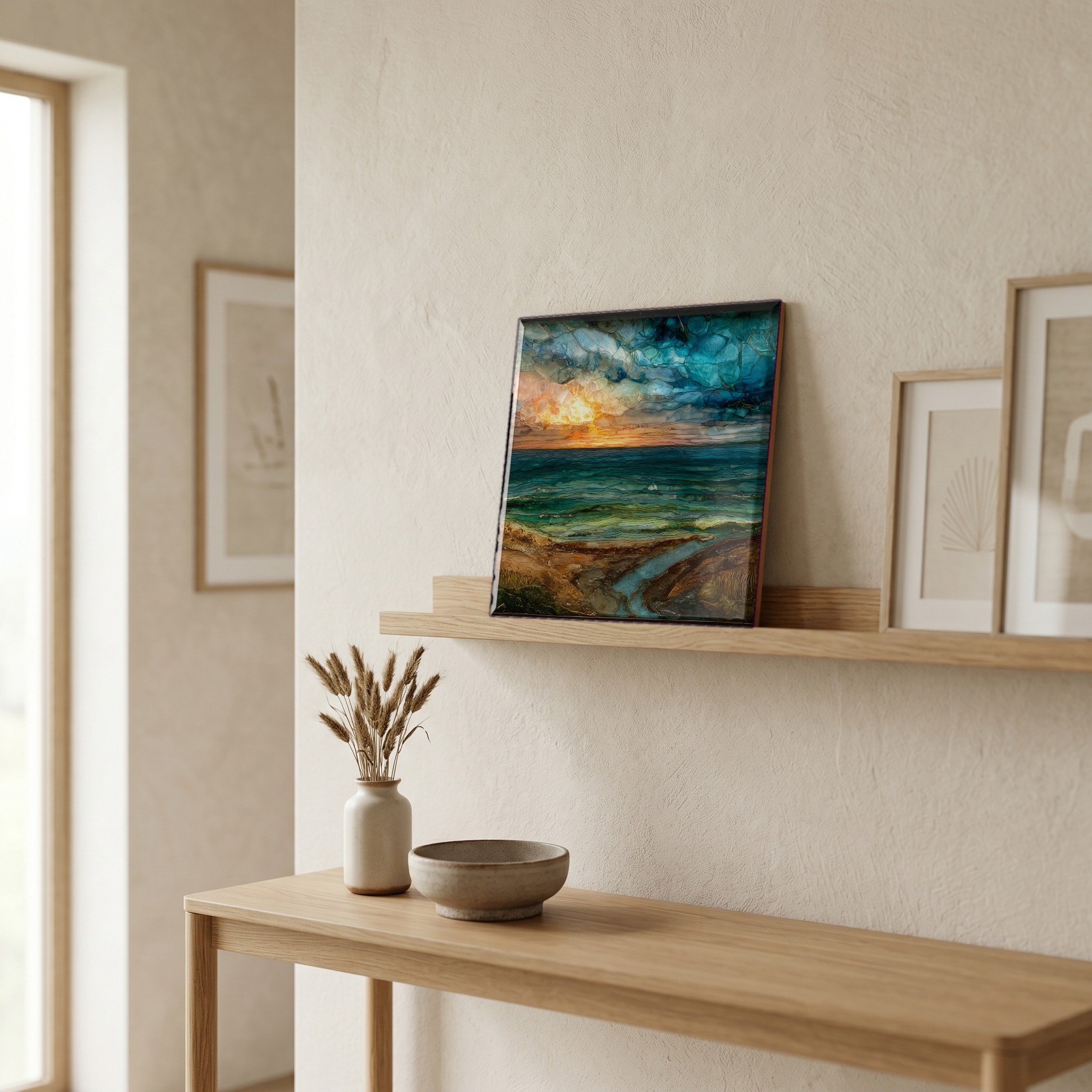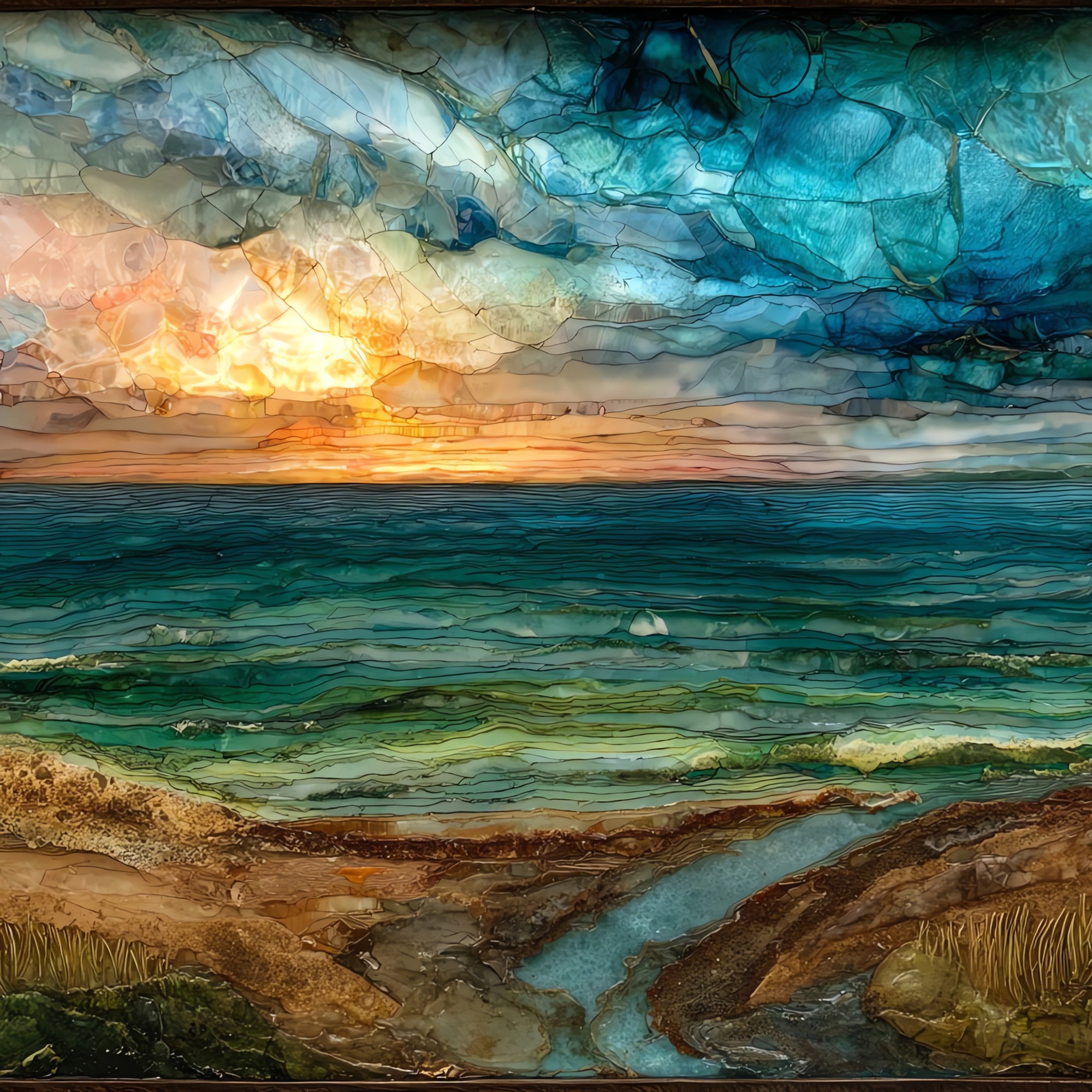
Wender·Vista
Utah Beach
shown on ceramic, 12-inch tileFrance
on the Norman coast, the western end of the D-Day shore

Utah Beach

the shore the world keeps walking back to.

Where it lives

Not only on a wall.

A small tile on the nightstand catching the morning. A larger one above the fire. Yours, wherever you spend the slow hours.
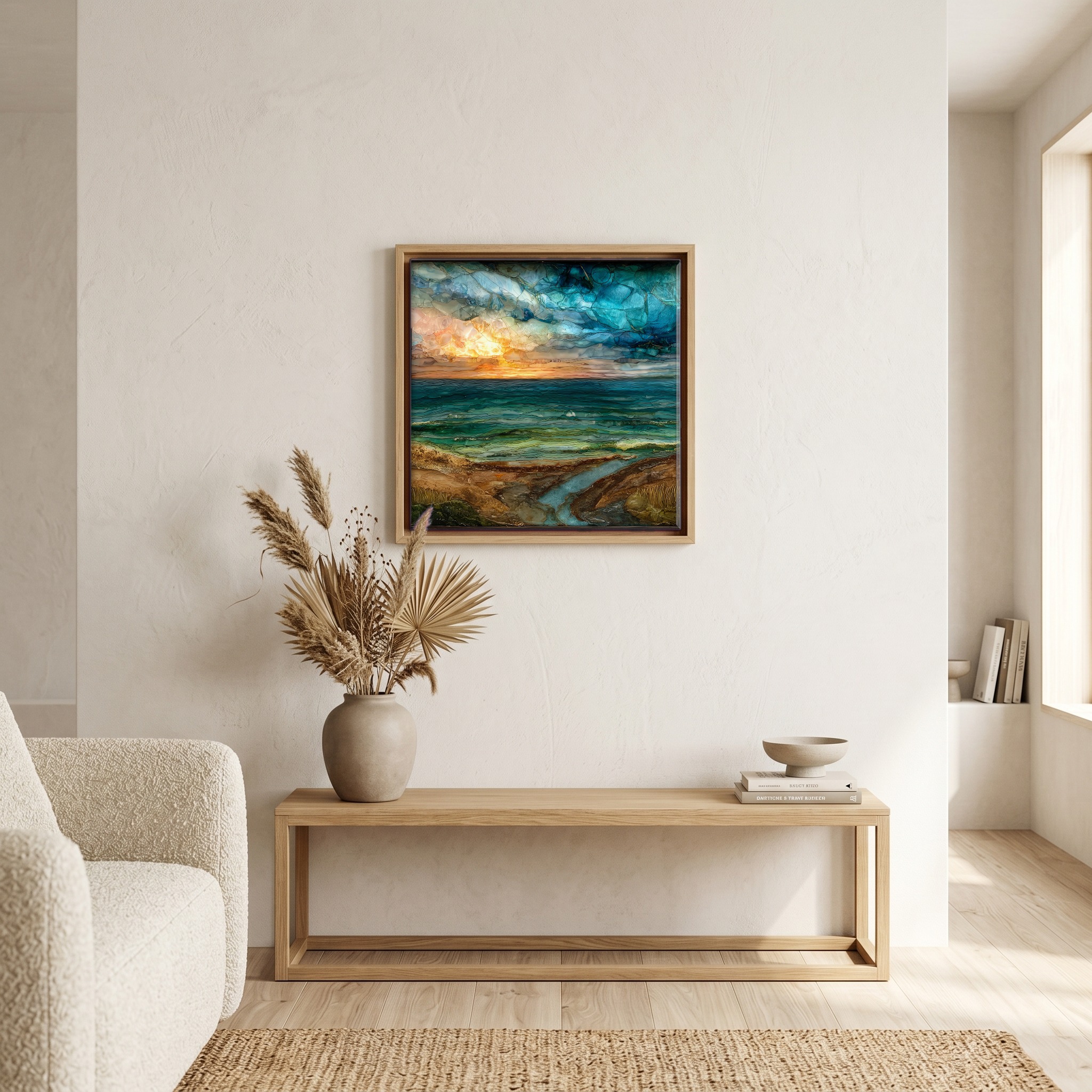
Above the bench, in a warm oak surround.
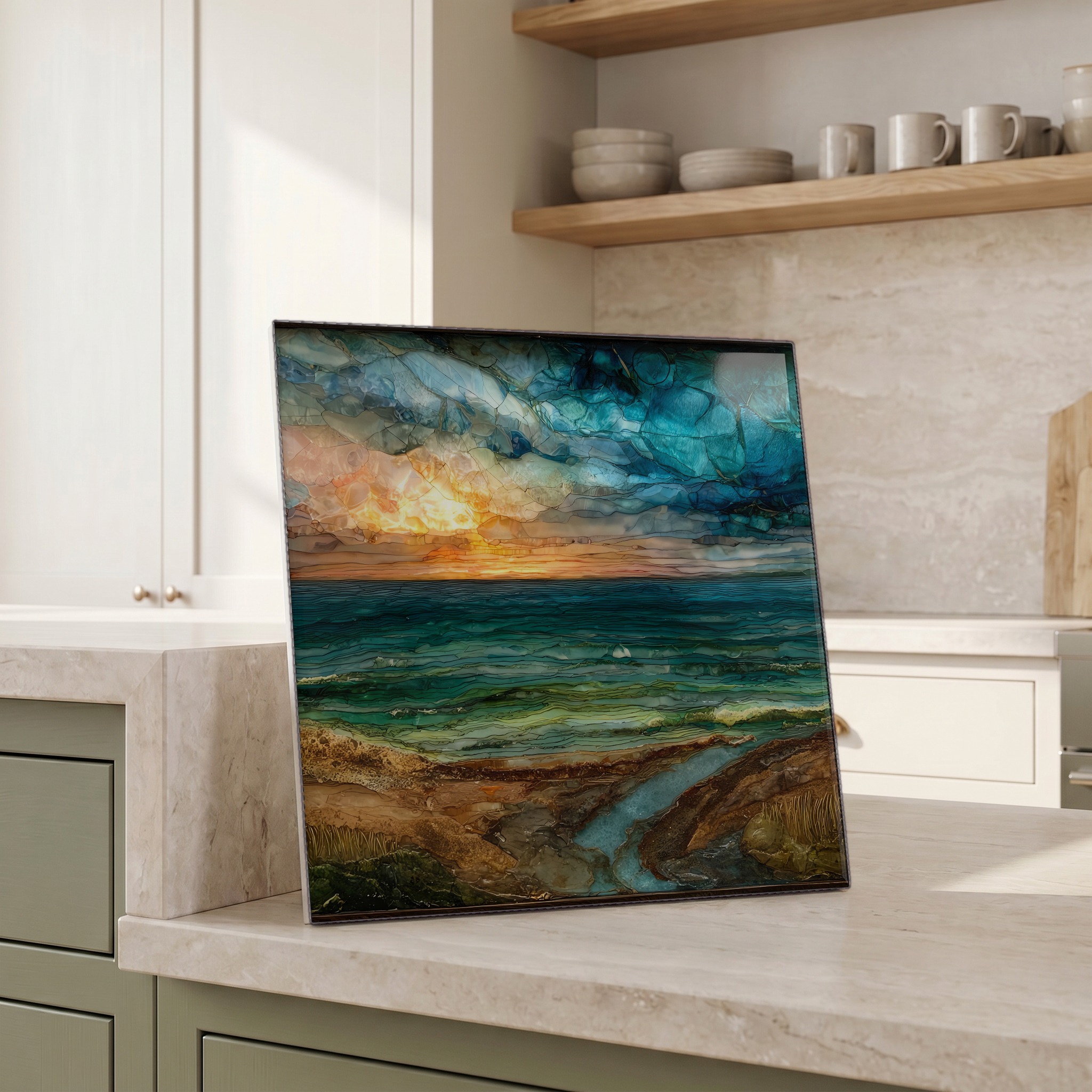
Beside the kettle, propped on the counter.
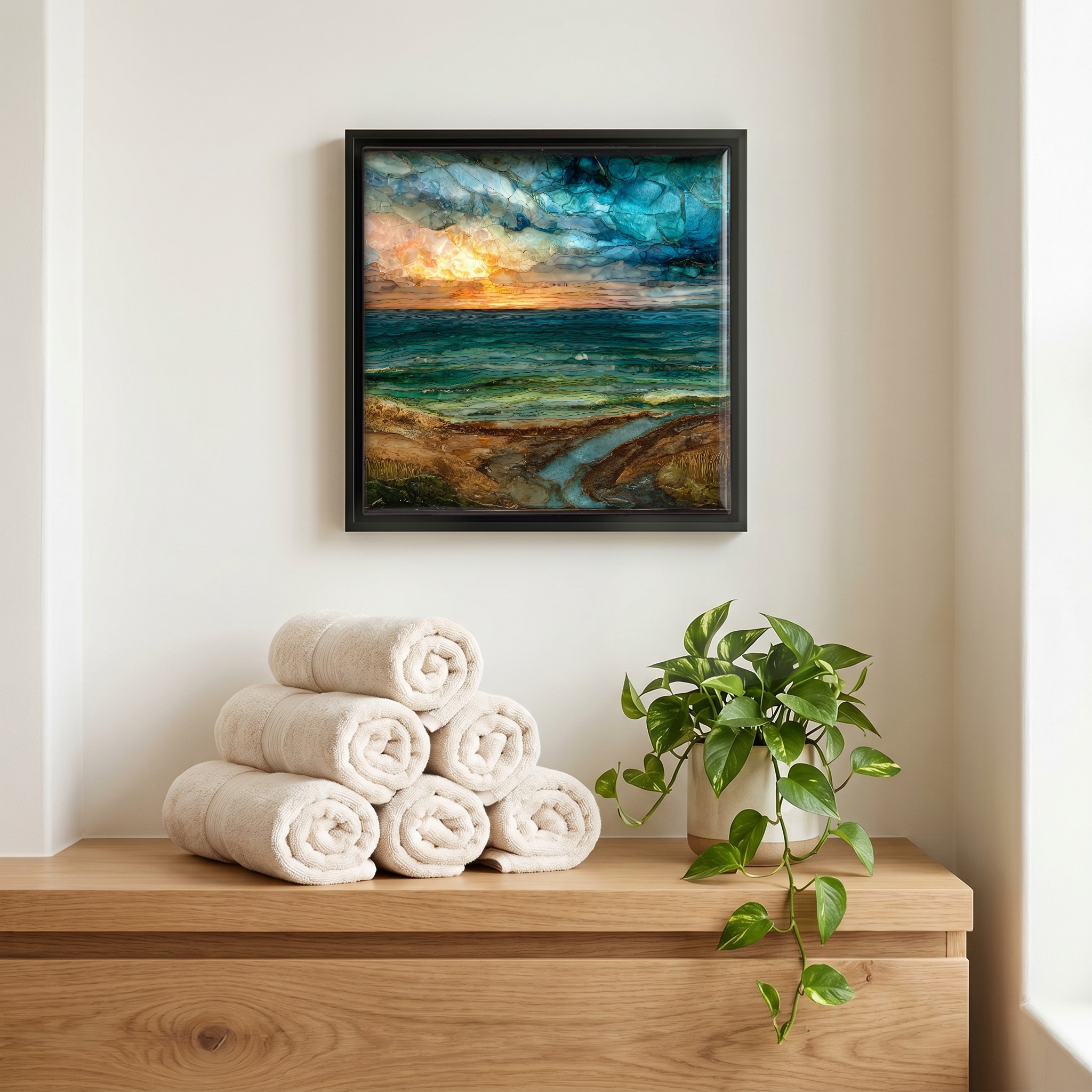
Above the linens, in a slim black surround.
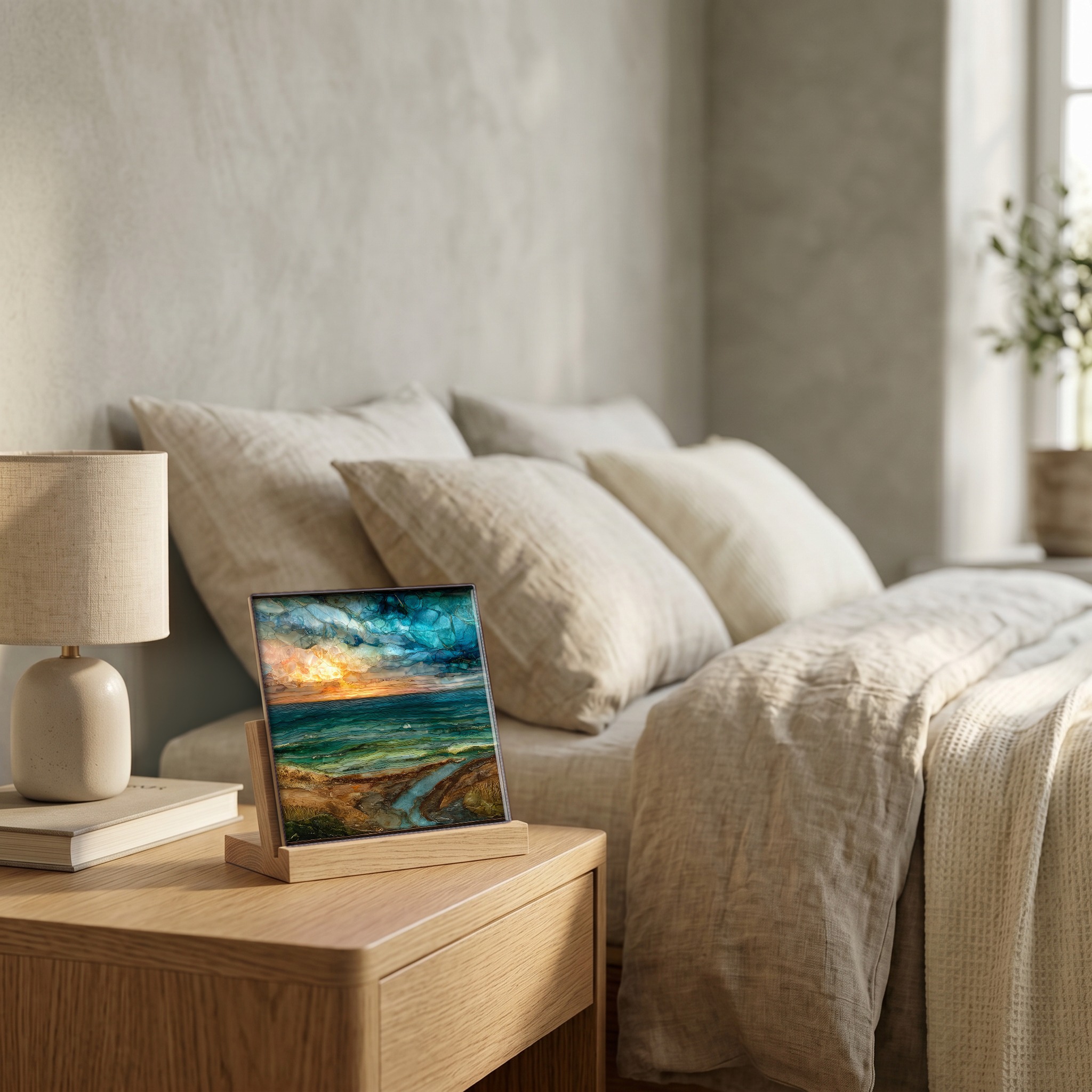
On the nightstand, on a light oak stand.
On a picture ledge, where the light comes in.
a note from the studio

A wide flat beach on the eastern shore of the Cotentin Peninsula, opening onto the Bay of the Seine. The westernmost of the five Allied landings on 6 June 1944. Strong currents carried the first wave nearly two kilometres south of the planned line; the spot they reached turned out to be the less defended one. Today the dunes hold the museum, a Sherman tank above the high-water mark, and the long quiet of the off-season, when the wind comes off the Channel and the tide pulls back a long way before turning.
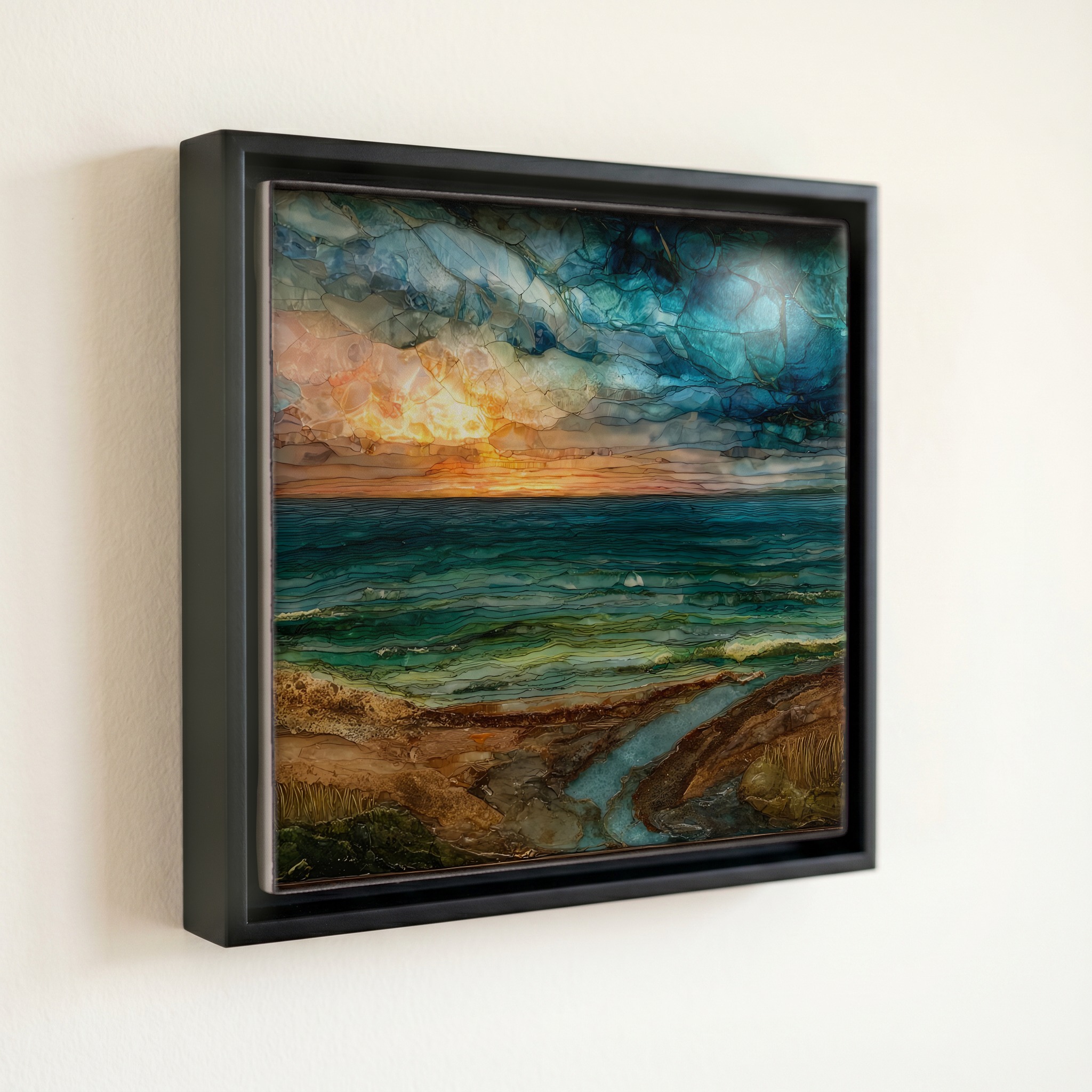
from the studio
shown in a slim black floating frame · 6 × 6 in
— bring it home

Utah Beach, on ceramic.

Each tile is finished by hand in our Knoxville studio. Artwork is slowly infused into the ceramic surface under high heat and pressure, and rests beneath a thin glossy finish. The colour lives in the surface, not on top of it.

What kind of piece?
One tile — square or rectangle.
How big?
the popular one — counter, shelf, nightstand
6 × 6 in · 15 cm · 1.6 lb
Surface finish
A clear glossy finish — the artwork reads as if under resin. Ideal for show-pieces and framed wall art.
How it sits
A hidden cleat — sits ¼″ proud of the wall.
$58
Hand-finished and shipped from our studio at the foot of the Smokies. On your wall in about ten days.
size
6 × 6 in
15 cm
weighs
1.6 lb
solid in the hand
surface
ceramic, hand-finished
art rests beneath a thin glossy finish
from
Knoxville, TN
our family studio, at the foot of the Smokies
— start a Coaster Set

Pick any four 4-inch tiles — National Parks you've been to, a Smokies set, the four seasons of one place. $ for a set of , cork-backed, ready to live on the table.
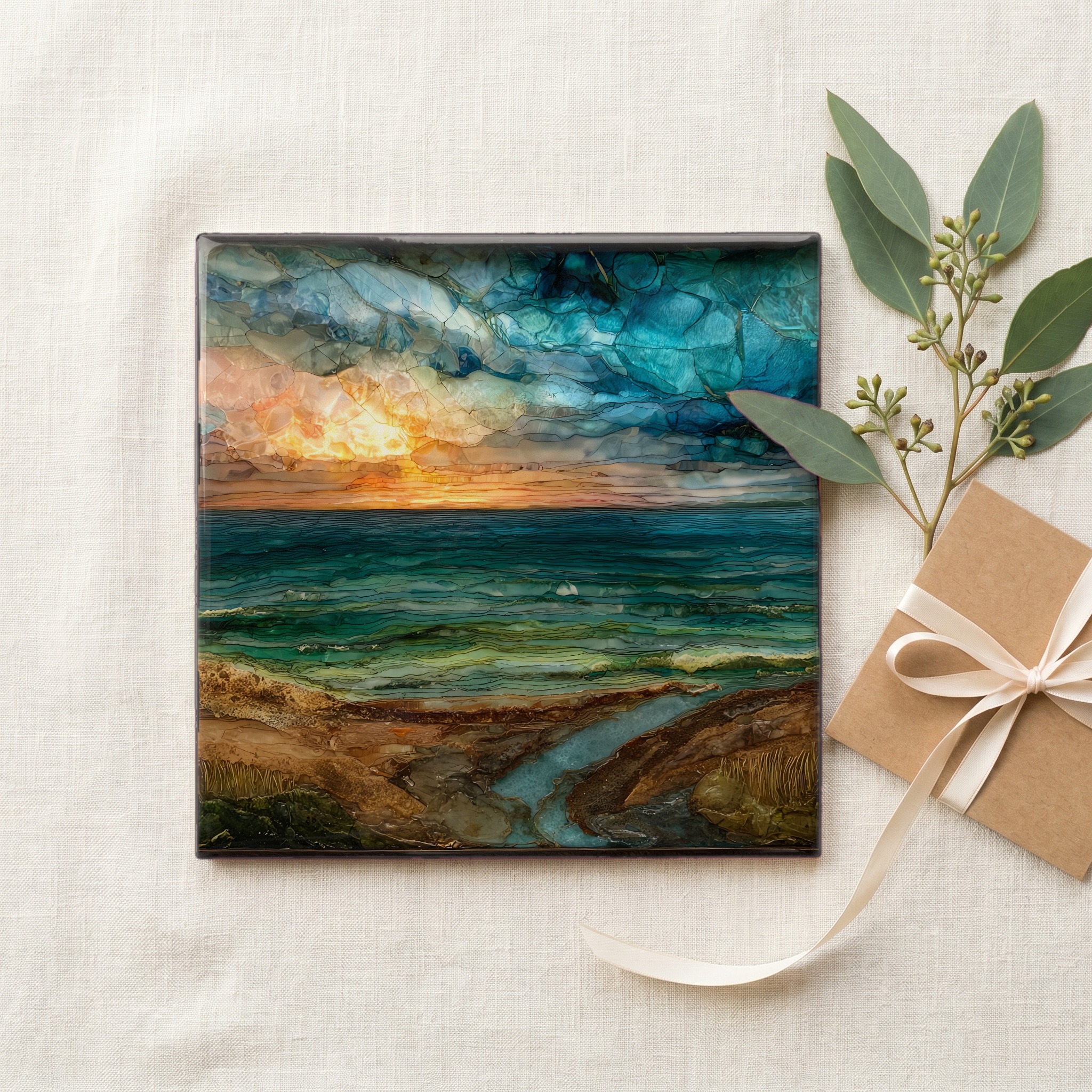
comes gift-ready
comes gift-ready

Each tile ships in a kraft box, tied with cream ribbon, with a handwritten note from the studio if you'd like to add one.
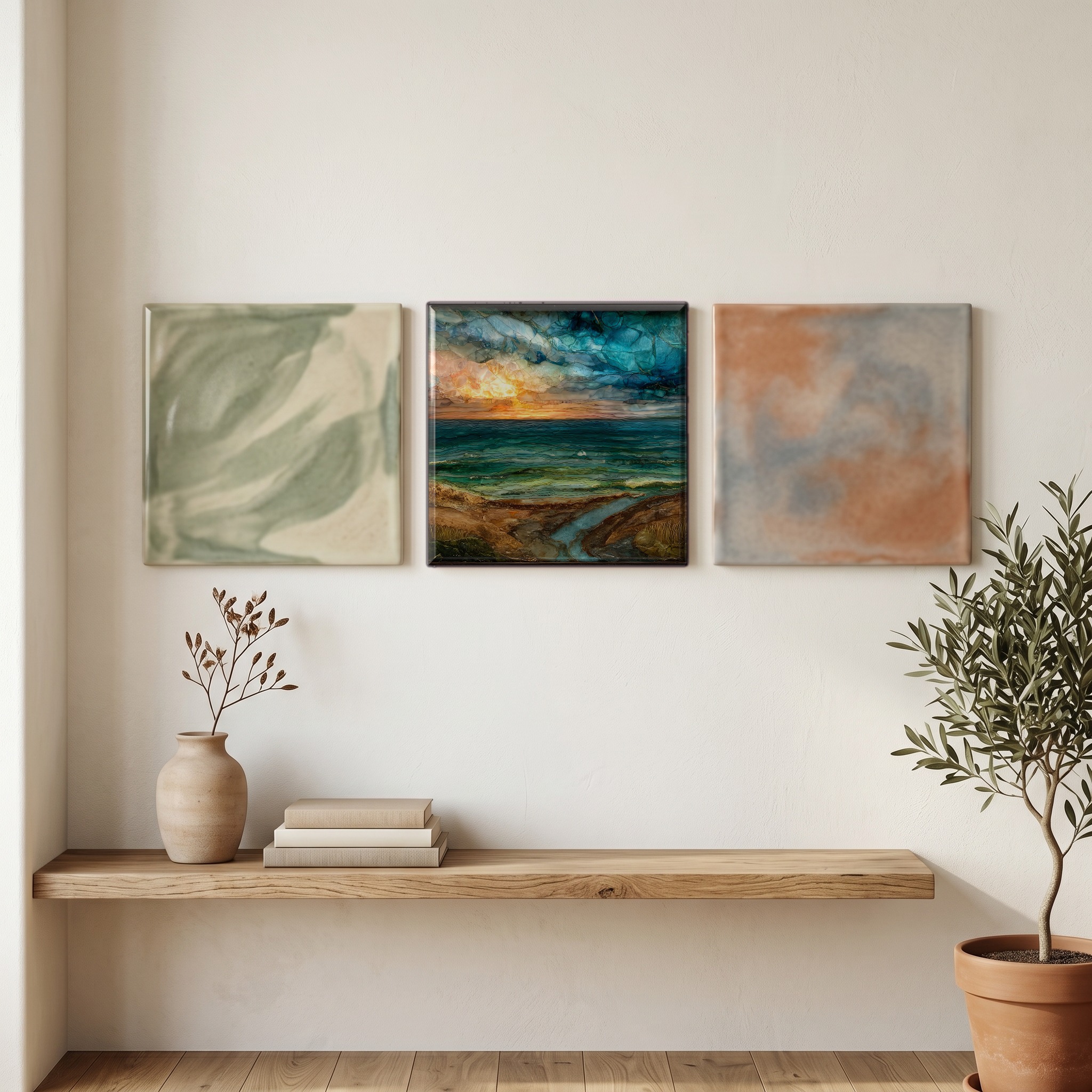
or build a grouping
or build a grouping

Three or five different vistas, hung together — a chapter of places you've been, or want to go.

about Utah Beach

The place, in three passes.

A little of what's known, in case you fall down the rabbit hole — or want to go see it yourself.
the place

Utah Beach lies on the eastern shore of France's Cotentin Peninsula, in the commune of Sainte-Marie-du-Mont in the Manche department of Normandy. It is the westernmost of the five Allied landing beaches of Operation Overlord; from the dunes the sand runs roughly five kilometres north along the Bay of the Seine, with Pointe du Hoc and Omaha Beach lying about thirty kilometres to the east. The nearest village is Sainte-Mère-Église, eight kilometres inland, where the American paratrooper John Steele hung from the church steeple on the night of 5 June 1944. The closest airport is Caen-Carpiquet, and the Cherbourg ferry port lies about an hour north by car.

the visit

The Musée du Débarquement Utah Beach sits on the dunes at La Madeleine, on the exact stretch where the first wave of the U.S. 4th Infantry Division came ashore at 06:30. The museum opened in 1962 and was rebuilt in 2011 around a restored Martin B-26 Marauder bomber, one of only six surviving examples in the world. The site is open most months of the year with seasonal hours; admission as of 2025 runs about 9 euros for adults. The beach itself is free, walkable in either direction, and largely empty outside summer weekends. A Sherman tank, the Higgins Boat monument, and a long row of unit memorials stand above the high-water mark.

the year

Every sixth of June, the beach fills with veterans, descendants, French villagers, and serving units from across the Allied nations. The commemorations centre on the museum and on the village of Sainte-Mère-Église; reenactors camp in the fields, period aircraft pass overhead, and a paratrooper drop is staged into the same drop zone the 82nd and 101st Airborne used in 1944. The 80th-anniversary ceremony in June 2024 drew heads of state from the United States, the United Kingdom, France, Canada, and Germany. The rest of the year the beach belongs to the wind and to the dog-walkers from Sainte-Marie-du-Mont. The two faces of the place are equally true and rarely overlap.

where
France · Sainte-Marie-du-Mont, Manche, Normandy
position
49.4153° N · 1.1750° W
the neighborhood

What's nearby.

A handful of named places within an hour's walk or short drive. Some we've already painted; some we will.
8 km W
Sainte-Mère-Église
paratrooper village
15 km S
Carentan
liberated town
30 km E
Pointe du Hoc
Ranger assault cliff
35 km E
Omaha Beach
D-Day landing beach
45 km N
Cherbourg
Channel ferry port
50 km E
Bayeux
Norman cathedral town
N
Utah Beach
Sainte-Mère-Église
Carentan
Pointe du Hoc
Omaha Beach
Cherbourg
Bayeux
common questions

What people ask.

A few questions we get about Utah Beach — and about bringing the piece home.
about the place

Utah Beach is on the eastern coast of France's Cotentin Peninsula, in the commune of Sainte-Marie-du-Mont in the Manche department of Normandy. It is the westernmost of the five Allied D-Day landing beaches, with Omaha Beach about thirty kilometres to the east.

On 6 June 1944, the U.S. 4th Infantry Division landed on Utah Beach beginning at 06:30. Strong currents carried the first wave roughly two kilometres south of the planned line, onto a less defended stretch. Casualties were the lightest of the five beach landings, with about 197 American killed or wounded.

Utah was added in early 1944 at the request of General Eisenhower and General Montgomery to give the Allies a foothold on the Cotentin Peninsula and a faster route to the deep-water port of Cherbourg. The earlier Overlord plan included only the four eastern beaches.

Yes. The beach is open and free to walk. The Musée du Débarquement Utah Beach sits on the dunes at La Madeleine, on the actual landing line, and is open most months with seasonal hours. The nearest village is Sainte-Marie-du-Mont, about four kilometres inland.

Brigadier General Theodore Roosevelt Jr., assistant commander of the 4th Infantry Division and the only American general to come ashore with the first wave at Utah, said it after realising his men had landed off-target. He chose to advance from the wrong spot rather than reorganise, and was awarded the Medal of Honor for his actions that day.

Sainte-Marie-du-Mont, a village of about seven hundred residents, sits roughly four kilometres inland from the landing line. Sainte-Mère-Église, the larger and better-known village from the paratrooper drops, lies about eight kilometres further west.

Utah and Omaha were the two American sectors on D-Day. Utah, the western beach, saw light resistance and around 197 first-day casualties. Omaha, with high bluffs and heavy German positions, saw more than two thousand. The two beaches are about thirty kilometres apart along the Norman coast.

about the piece in your home

It has been a meaningful gift for many of our customers: veterans' families, descendants of the 4th Infantry Division, military historians, history teachers, and travellers who walked the beach themselves. A Medium or Large with a handwritten note from the studio is the common request. For grandchildren, the Keepsake size carries well.

The piece reads well in a study, a library, a den, or a quiet hallway, rooms that hold weight. It anchors traditional and transitional interiors, sits naturally in wood-panelled rooms, and works in coastal-modern spaces that lean toward the muted Atlantic end of the palette rather than the bright.

Yes. The slow, observed aesthetic fits the broader Quiet Maximalism movement and the return to weighty, history-grounded wall art that anchors a room rather than blends in. It also suits the recent shift in coastal-modern toward the cooler, more northern end of the palette.

A single Large works well above a console table or a smaller settee. For above a sofa, the four-tile Mural is the right scale in most rooms; a nine-tile Mural is the right scale for a long wall, a study fireplace, or a stair landing.

Yes, with the Dura Satin or Matte finish. Both are scratch-resistant and stand up to humidity and the occasional splash, which suits a coastal-house bathroom or a kitchen backsplash. The Glossy finish is reserved for framed wall art away from steam and grease.

A soft microfibre cloth and water. The colour is slowly infused into the ceramic surface under high heat and pressure and lives in the surface itself, so it will not lift, fade, or scratch off in normal cleaning. Avoid abrasive pads and household chemical sprays.

Yes. Every WenderVista piece is original work from a single studio in Knoxville, Tennessee, drawn from Reid Wender's atlas of places. The work is not licensed, not stocked from a third party, and not repeated across other brands.

if this one stayed with you

A few you might also love.

Hand-picked by the eye that found Sorapis. Same air, same kind of quiet.