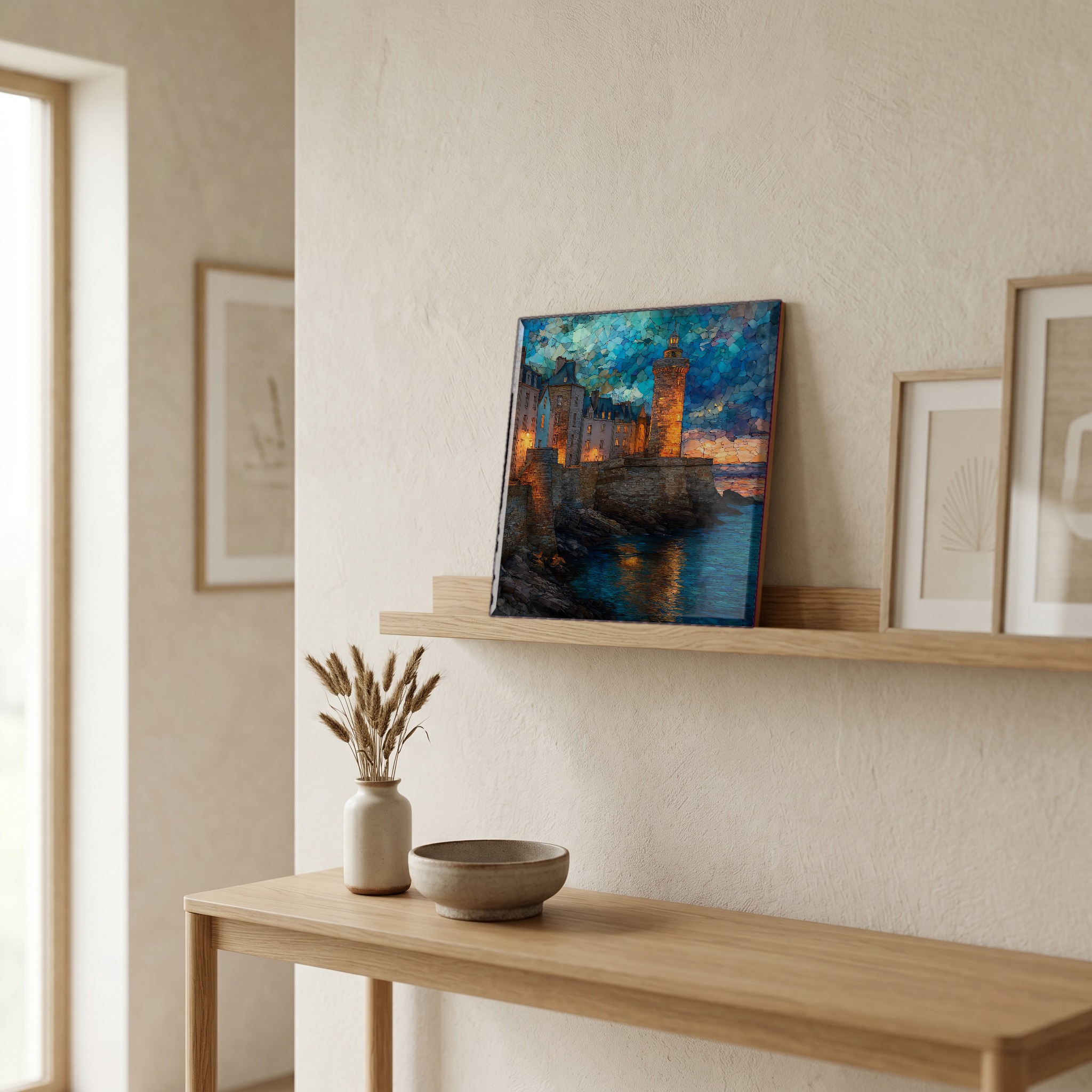
Wender·Vista
Saint-Malo Ramparts
shown on ceramic, 12-inch tileFrance
on the north coast of Brittany, at the mouth of the Rance

Saint-Malo Ramparts

a circle of stone above the tide.

Where it lives

Not only on a wall.

A small tile on the nightstand catching the morning. A larger one above the fire. Yours, wherever you spend the slow hours.
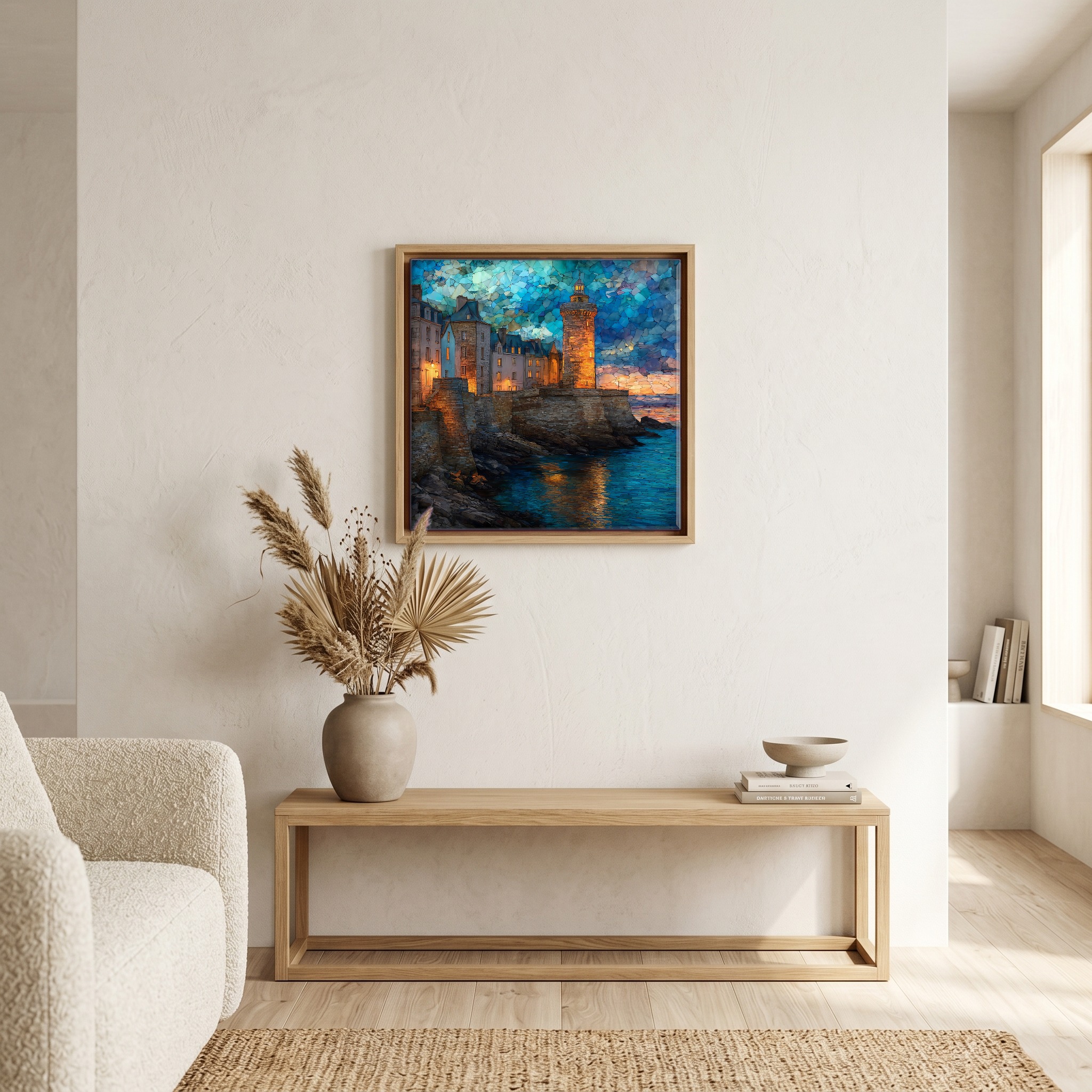
Above the bench, in a warm oak surround.
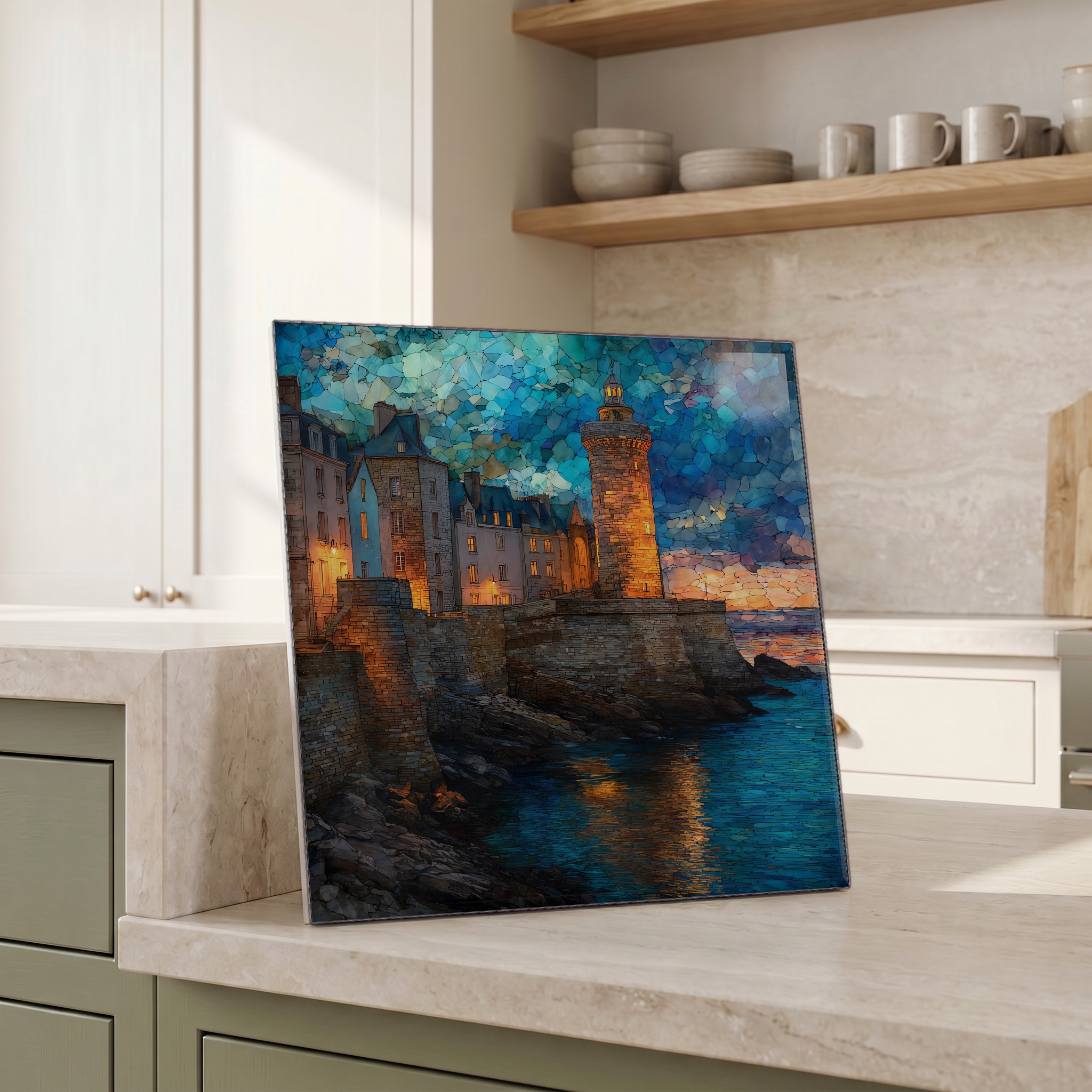
Beside the kettle, propped on the counter.
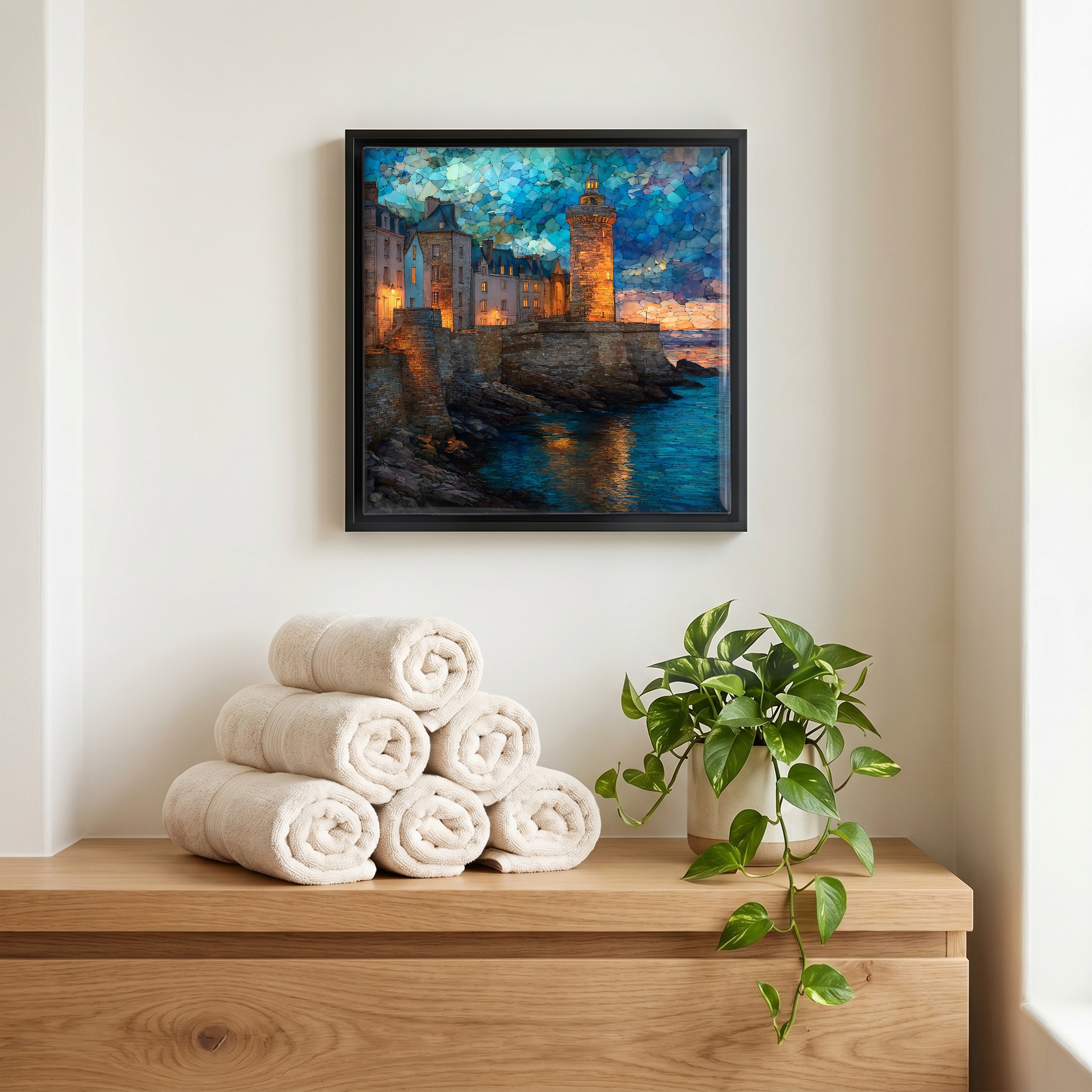
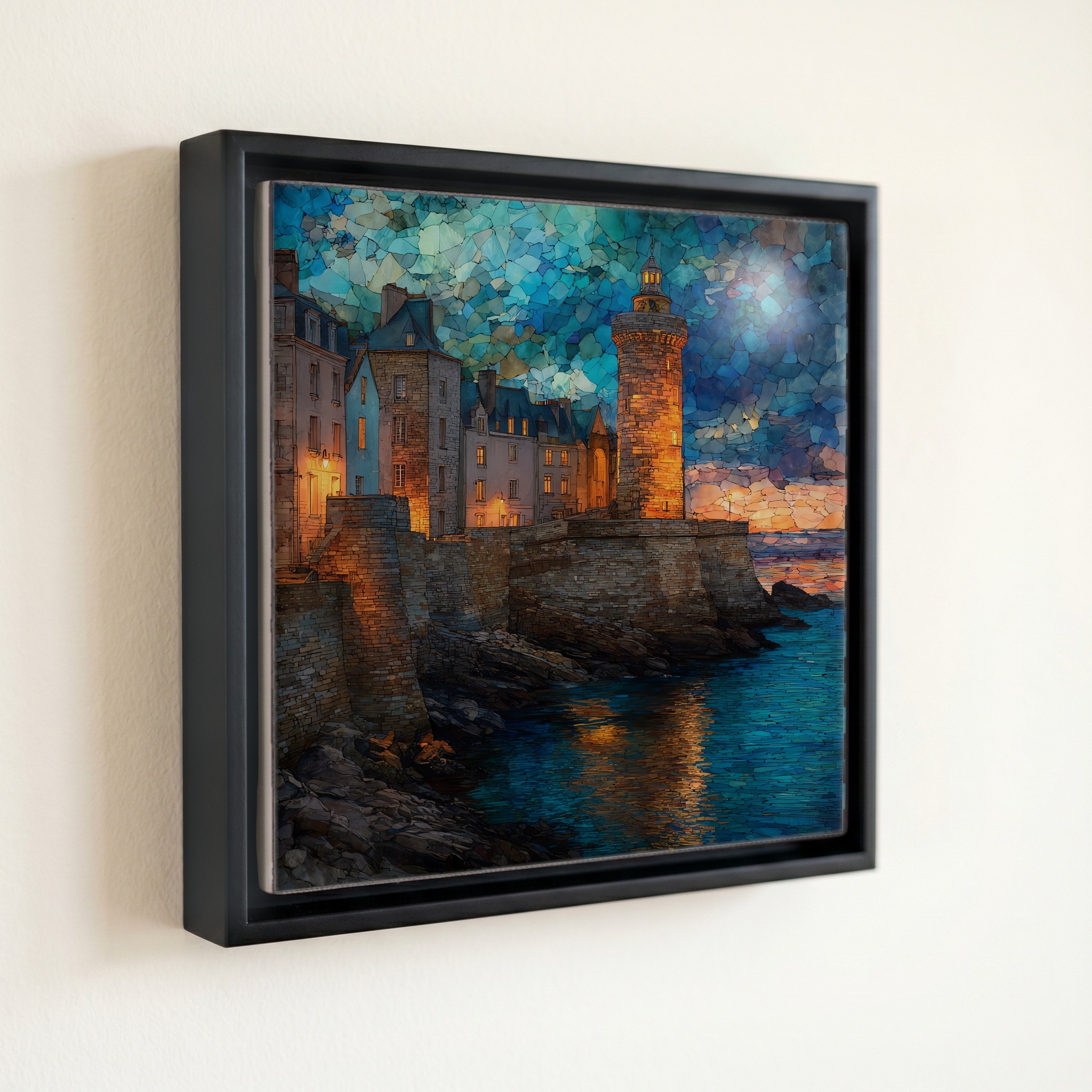
Above the linens, in a slim black surround.
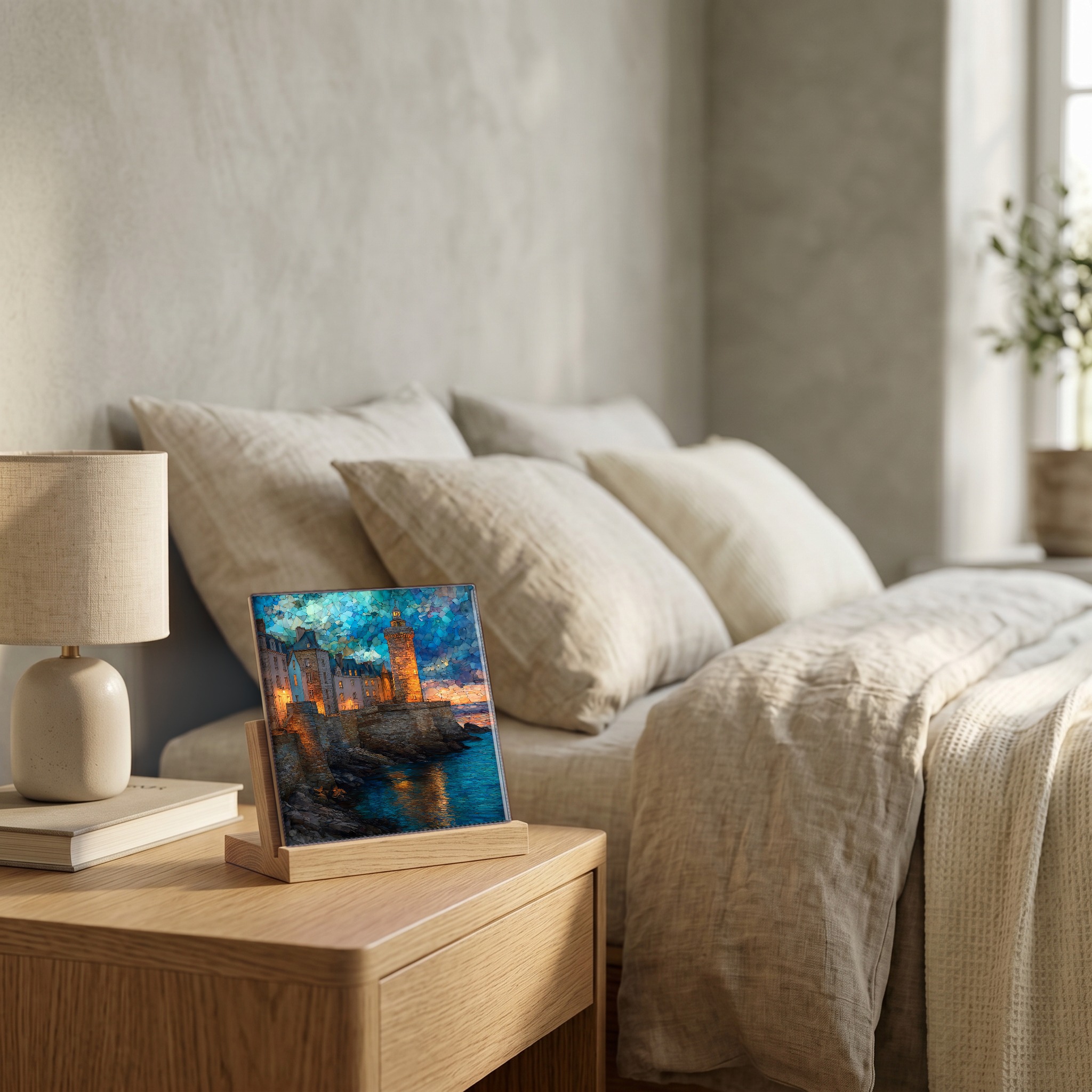
On the nightstand, on a light oak stand.
On a picture ledge, where the light comes in.
a note from the studio

A walled granite city at the mouth of the Rance, on the north coast of Brittany. The full circuit of the ramparts runs about a mile along the top of the city walls, and the loop carries you above the water for most of its length. At low tide the offshore islands become walkable; at high tide the Channel rises to the foot of the wall. Most of the city behind the walls was destroyed in August of 1944 and rebuilt almost stone for stone over the next decade. The walls themselves came through.
from the studio
shown in a slim black floating frame · 6 × 6 in
— bring it home

Saint-Malo Ramparts, on ceramic.

Each tile is finished by hand in our Knoxville studio. Artwork is slowly infused into the ceramic surface under high heat and pressure, and rests beneath a thin glossy finish. The colour lives in the surface, not on top of it.

What kind of piece?
One tile — square or rectangle.
How big?
the popular one — counter, shelf, nightstand
6 × 6 in · 15 cm · 1.6 lb
Surface finish
A clear glossy finish — the artwork reads as if under resin. Ideal for show-pieces and framed wall art.
How it sits
A hidden cleat — sits ¼″ proud of the wall.
$58
Hand-finished and shipped from our studio at the foot of the Smokies. On your wall in about ten days.
size
6 × 6 in
15 cm
weighs
1.6 lb
solid in the hand
surface
ceramic, hand-finished
art rests beneath a thin glossy finish
from
Knoxville, TN
our family studio, at the foot of the Smokies
— start a Coaster Set

Pick any four 4-inch tiles — National Parks you've been to, a Smokies set, the four seasons of one place. $ for a set of , cork-backed, ready to live on the table.
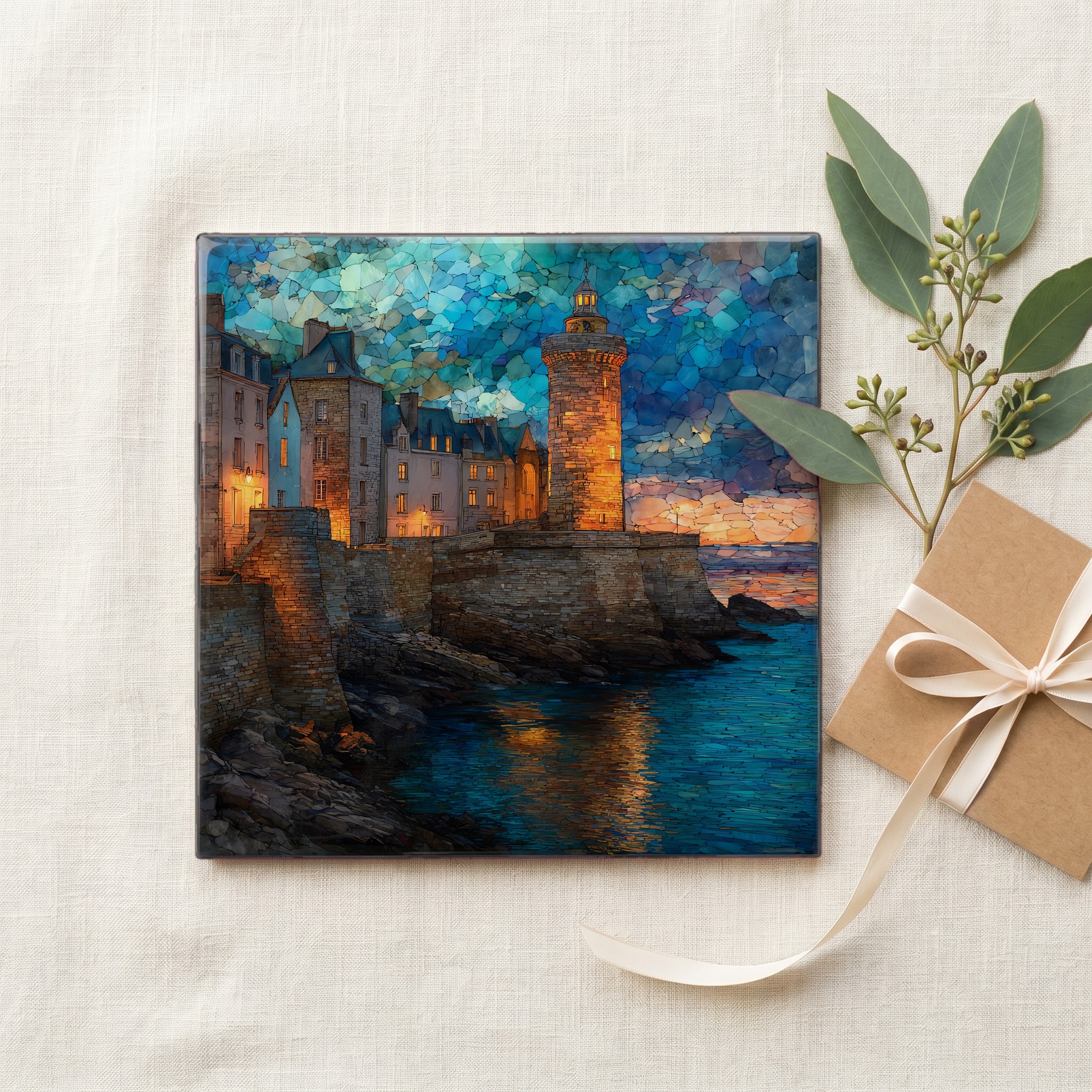
comes gift-ready
comes gift-ready

Each tile ships in a kraft box, tied with cream ribbon, with a handwritten note from the studio if you'd like to add one.

or build a grouping
or build a grouping

Three or five different vistas, hung together — a chapter of places you've been, or want to go.

about Saint-Malo Ramparts

The place, in three passes.

A little of what's known, in case you fall down the rabbit hole — or want to go see it yourself.
the place

Saint-Malo sits on the north coast of Brittany, in the Ille-et-Vilaine department, at the mouth of the Rance estuary on the English Channel. The walled old city, called intra-muros, is built on a granite outcrop that was a tidal island for much of its history, joined to the mainland by a narrow causeway called the Sillon. The ramparts encircle this old city in a continuous walkable loop of roughly 1.7 kilometres. Around the walls lie the offshore tidal islands of Grand Bé, where the writer François-René de Chateaubriand is buried, and Petit Bé, with its 17th-century fort. The town today has a population of about 45,000.

the stone

The defensive walls were begun in the 12th century by Bishop Jean de Châtillon and extended in stages through the 18th. The most consequential expansion was overseen by Sébastien Le Prestre de Vauban, Louis XIV's chief military engineer, who reinforced the seaward fortifications and added the offshore Fort National in 1689 to guard the harbour. The stone is local Breton granite, grey when dry and silvering when the sea fog comes through. In August of 1944, during the Allied advance, much of the city inside the walls was destroyed by bombing and fire. The reconstruction that followed, largely complete by the early 1960s, rebuilt the houses in their pre-war stone. The ramparts had come through the battle and formed the spine of the city that returned.

the water

The tides at Saint-Malo are among the largest in Europe. The mean spring tidal range here exceeds 12 metres, and the highest equinox tides push past 13. Twice a day the sea retreats far enough to expose the rocky causeways out to Grand Bé and Petit Bé, and twice a day it returns to slap the foot of the wall. The neighbouring Bay of Mont-Saint-Michel, about 50 kilometres east, holds Europe's largest tidal range at roughly 14 metres. The 17th-century Fort National, sited on a tidal islet just off the ramparts, is reachable on foot only at low water. The yacht basin in the harbour stays usable through a sea lock that traps water at high tide.

where
France · Saint-Malo, Ille-et-Vilaine
position
48.6494° N · 2.0257° W
the neighborhood

What's nearby.

A handful of named places within an hour's walk or short drive. Some we've already painted; some we will.
1 km N
Fort National
tidal fort
1 km NW
Grand Bé
tidal island
1 km W
Petit Bé
tidal island fort
2 km S
Tour Solidor
medieval keep
3 km SW
Dinard
seaside town
4 km N
Île de Cézembre
offshore island
15 km E
Cancale
oyster harbour
N
Saint-Malo Ramparts
Fort National
Grand Bé
Petit Bé
Tour Solidor
Dinard
Île de Cézembre
Cancale
common questions

What people ask.

A few questions we get about Saint-Malo Ramparts — and about bringing the piece home.
about the place

Saint-Malo sits on the north coast of Brittany, France, in the Ille-et-Vilaine department, at the mouth of the Rance estuary on the English Channel. The walled old city, called intra-muros, is the historic heart and the part most visitors come to see.

Yes. The full circuit runs about 1.7 kilometres along the top of the city walls and is open to walkers at all hours, free of charge. Most people walk it counter-clockwise starting from Porte Saint-Vincent, near the main harbour gate.

The first ramparts were begun in the 12th century by Bishop Jean de Châtillon. The walls were extended in stages over the following centuries, with the most significant seaward reinforcements designed by Sébastien Le Prestre de Vauban, Louis XIV's chief military engineer, in the late 1600s.

Intra-muros is Latin for within the walls and refers to the walled old city of Saint-Malo. It sits on a granite outcrop that was a tidal island for much of its history, tied to the mainland by a narrow causeway called the Sillon.

The funnel shape of the Bay of Mont-Saint-Michel, about 50 kilometres east, concentrates the Atlantic tide as it enters. Saint-Malo's mean spring tidal range exceeds 12 metres; equinox tides push past 13. Twice a day the sea retreats far enough to expose causeways out to the offshore forts.

In August 1944, during the Allied advance through Brittany, much of the city inside the walls was destroyed by combined bombing and fire. Reconstruction took roughly fifteen years and rebuilt the houses largely in their pre-war stone. The ramparts themselves survived intact.

François-René de Chateaubriand, the 19th-century French writer and diplomat, is buried on the small tidal island of Grand Bé just off the ramparts. His tomb faces the sea, with no inscription beyond a plain cross, in accordance with his own request.

about the piece in your home

It's been a meaningful gift for our customers with roots in the region. Saint-Malo is one of Brittany's defining places, and the ramparts are central to how people remember it. A Small or Medium with a handwritten note from the studio carries well as a homecoming or anniversary gift.

The granite-and-sea palette sits well in coastal-modern, French country, and library or study interiors. The piece holds its own as a focal point in lighter rooms and grounds the wall in darker, more traditional ones. It pairs naturally with bookshelves, ship models, and warm wood.

Yes. The current coastal-modern wave favours weathered stone, deep maritime blues, and Old World references over the bright white-and-rope look of the previous decade. The Saint-Malo tile reads as a working harbour rather than a beach resort, which is the direction the trend has moved.

A single Large works above a standard armchair or a narrow console. For a full sofa or a credenza, a 4-tile Mural gives the proportions room to breathe; a 9-tile Mural is the choice for a wider wall above a long sofa or a king bed.

Yes. Order the Dura Satin or Matte finish for bathrooms, kitchens, and any vertical installation that may see steam or splashes. Both finishes are scratch-resistant and clean with a damp microfibre cloth. The Glossy finish is for framed display pieces, not wet rooms.

A damp microfibre cloth and plain water is enough. The colour is slowly infused into the ceramic surface under high heat and pressure and lives beneath a thin protective finish, so it will not lift or fade with cleaning. Avoid abrasive pads and bleach-based sprays.

Yes. Every Saint-Malo Ramparts piece is the work of Reid Wender, the studio's curator, and is made only at Wender Studios in Knoxville, Tennessee. There is no licensing, no print-on-demand stock house, and no other studio offering this image of the ramparts.

if this one stayed with you

A few you might also love.

Hand-picked by the eye that found Sorapis. Same air, same kind of quiet.