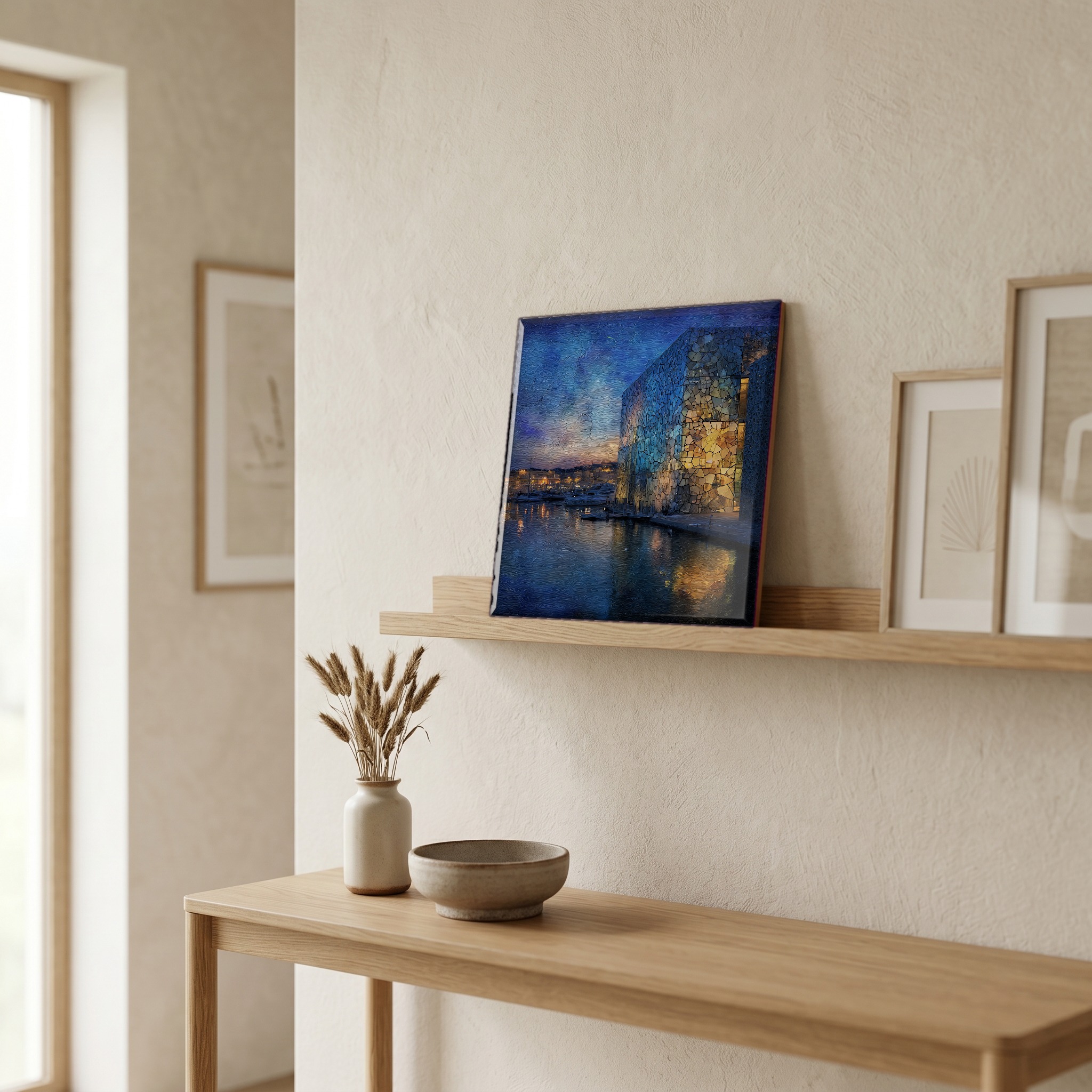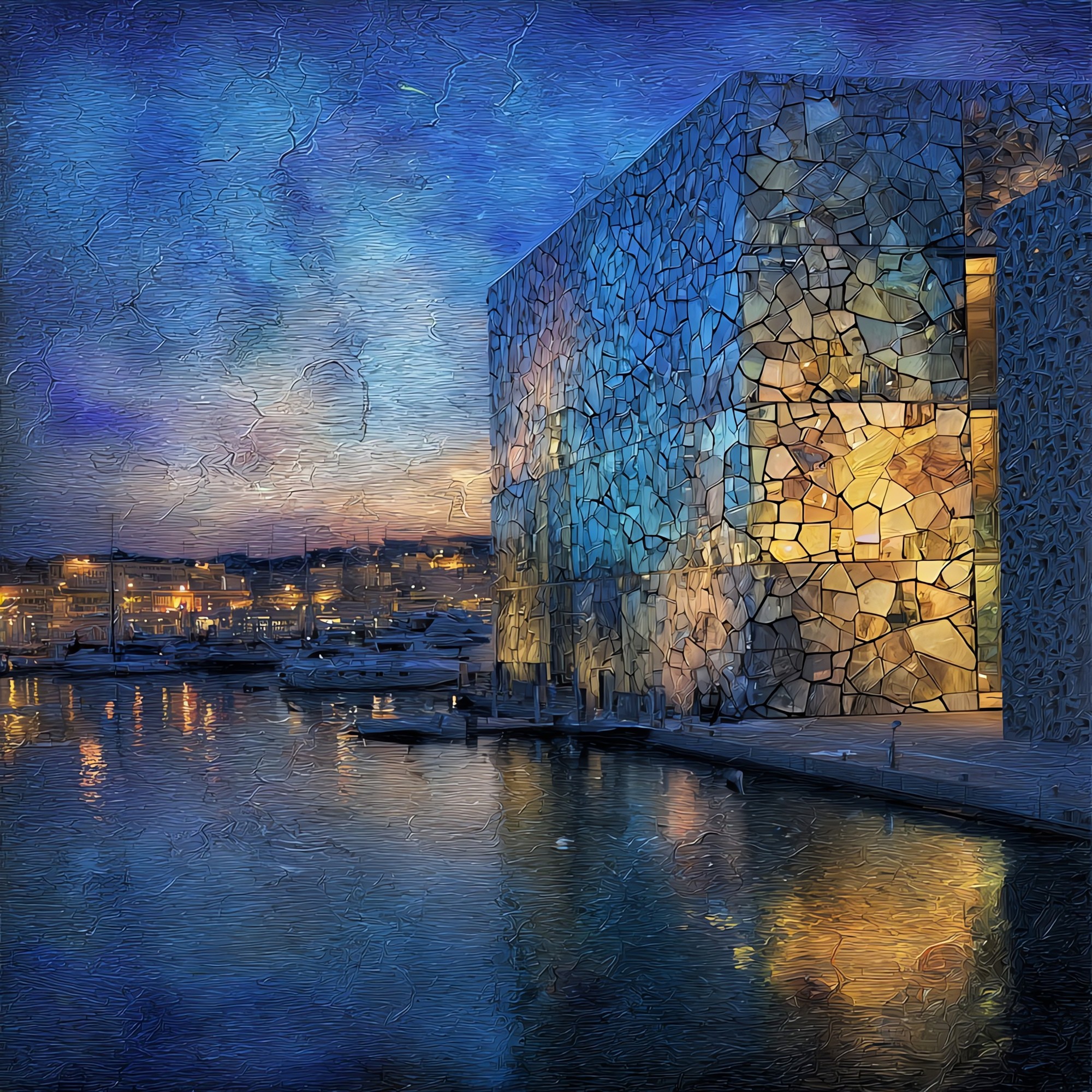
Wender·Vista
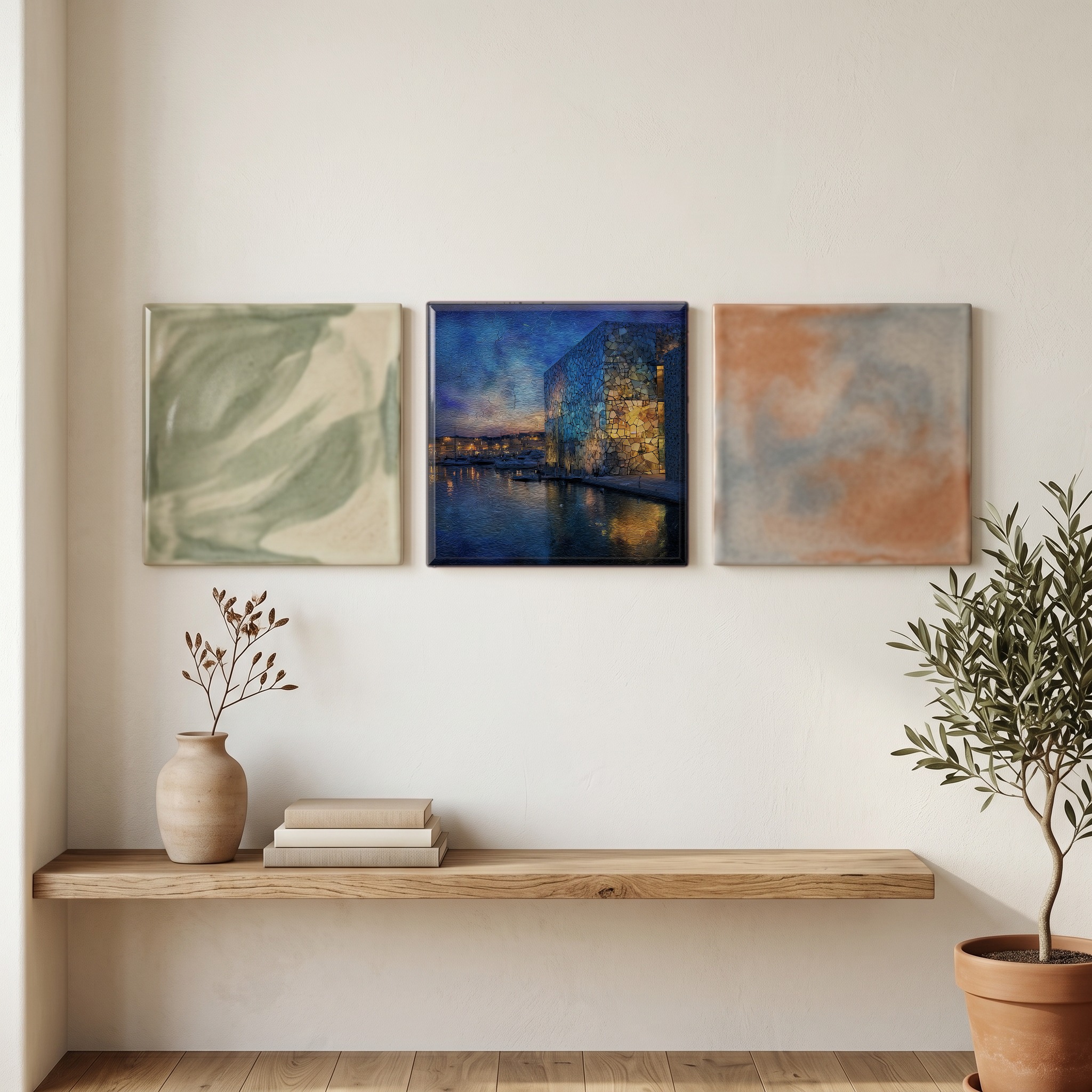
MuCEM Marseille
shown on ceramic, 12-inch tileFrance
at the mouth of Marseille's old port

MuCEM Marseille

a cube wearing the shadow of its own lace.

Where it lives

Not only on a wall.

A small tile on the nightstand catching the morning. A larger one above the fire. Yours, wherever you spend the slow hours.
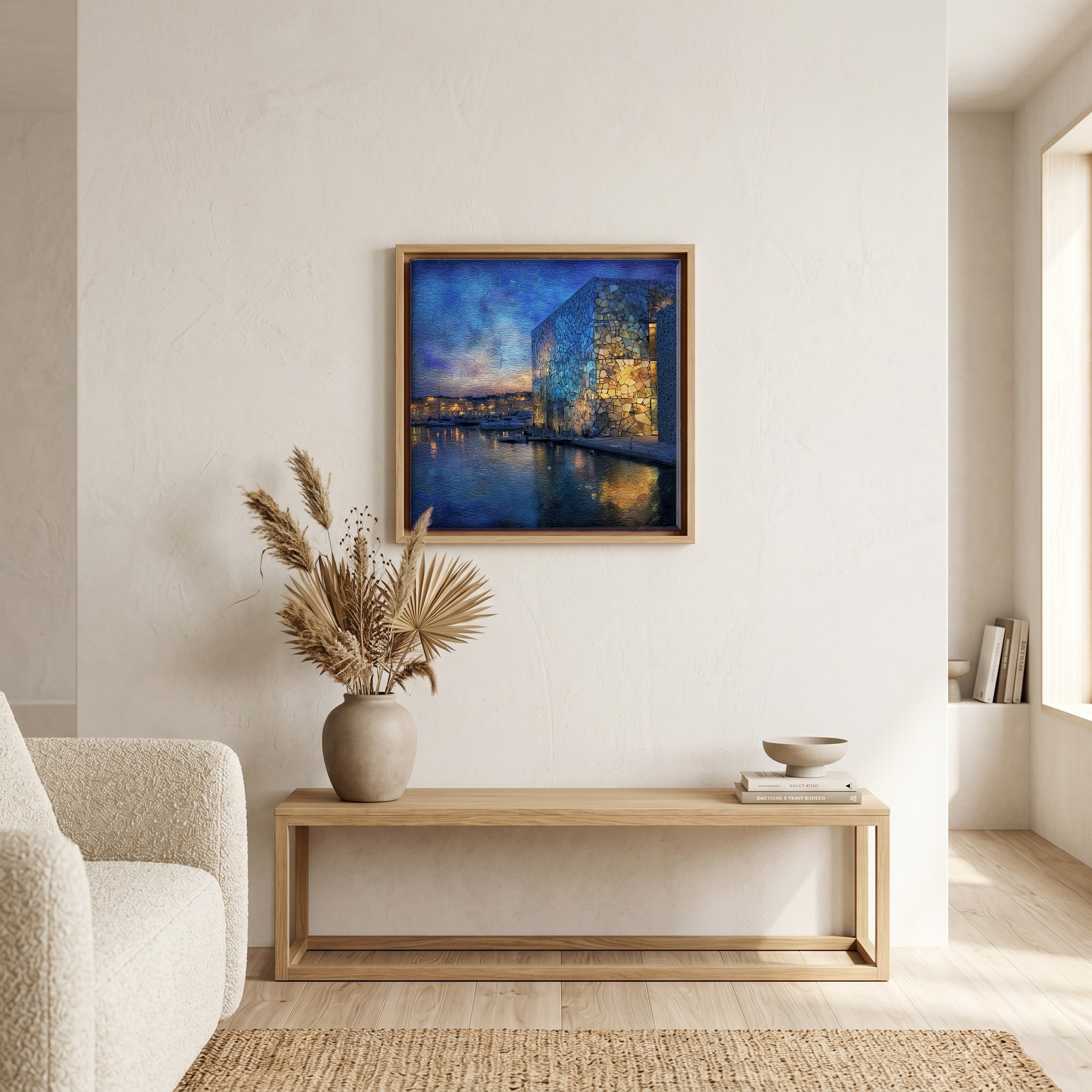
Above the bench, in a warm oak surround.
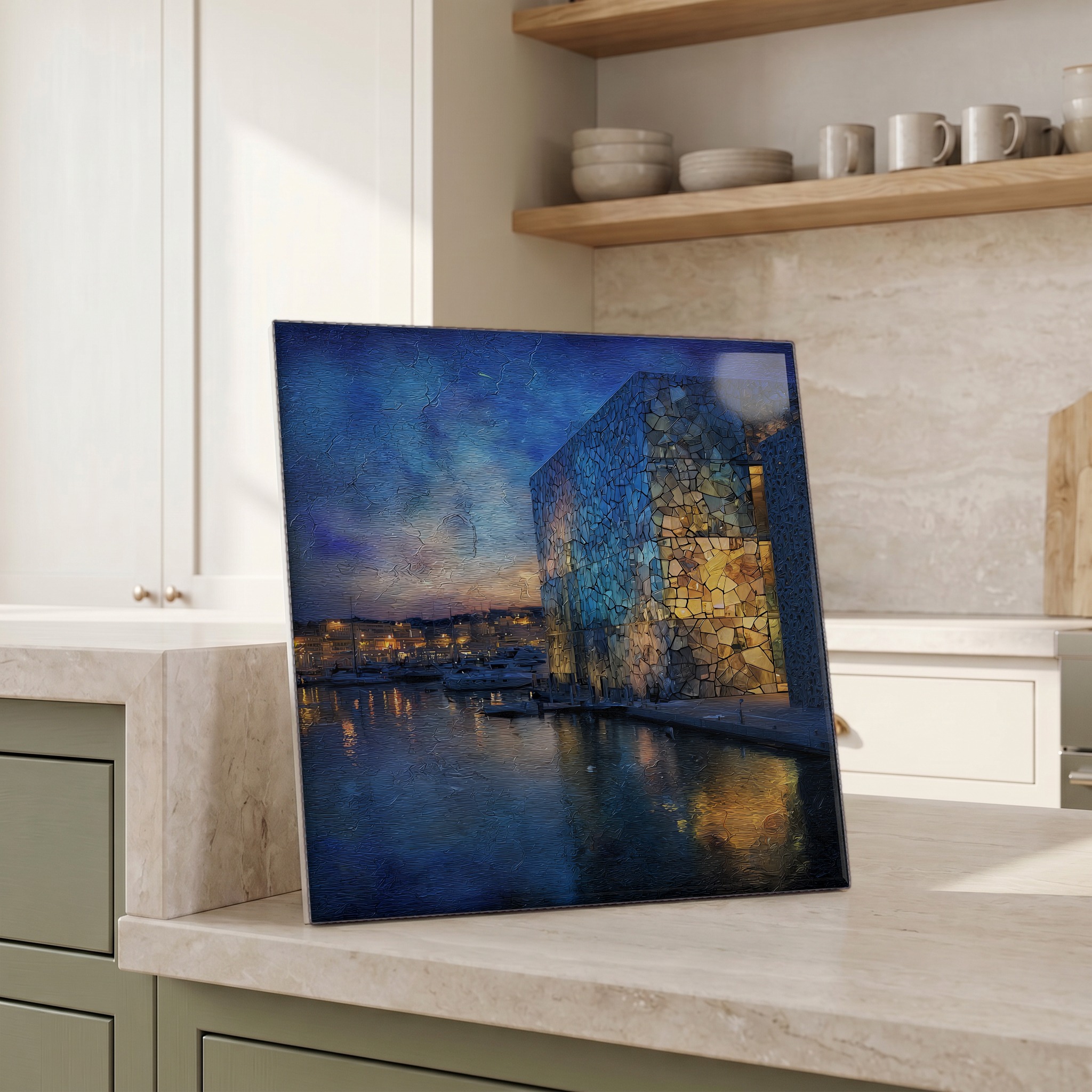
Beside the kettle, propped on the counter.
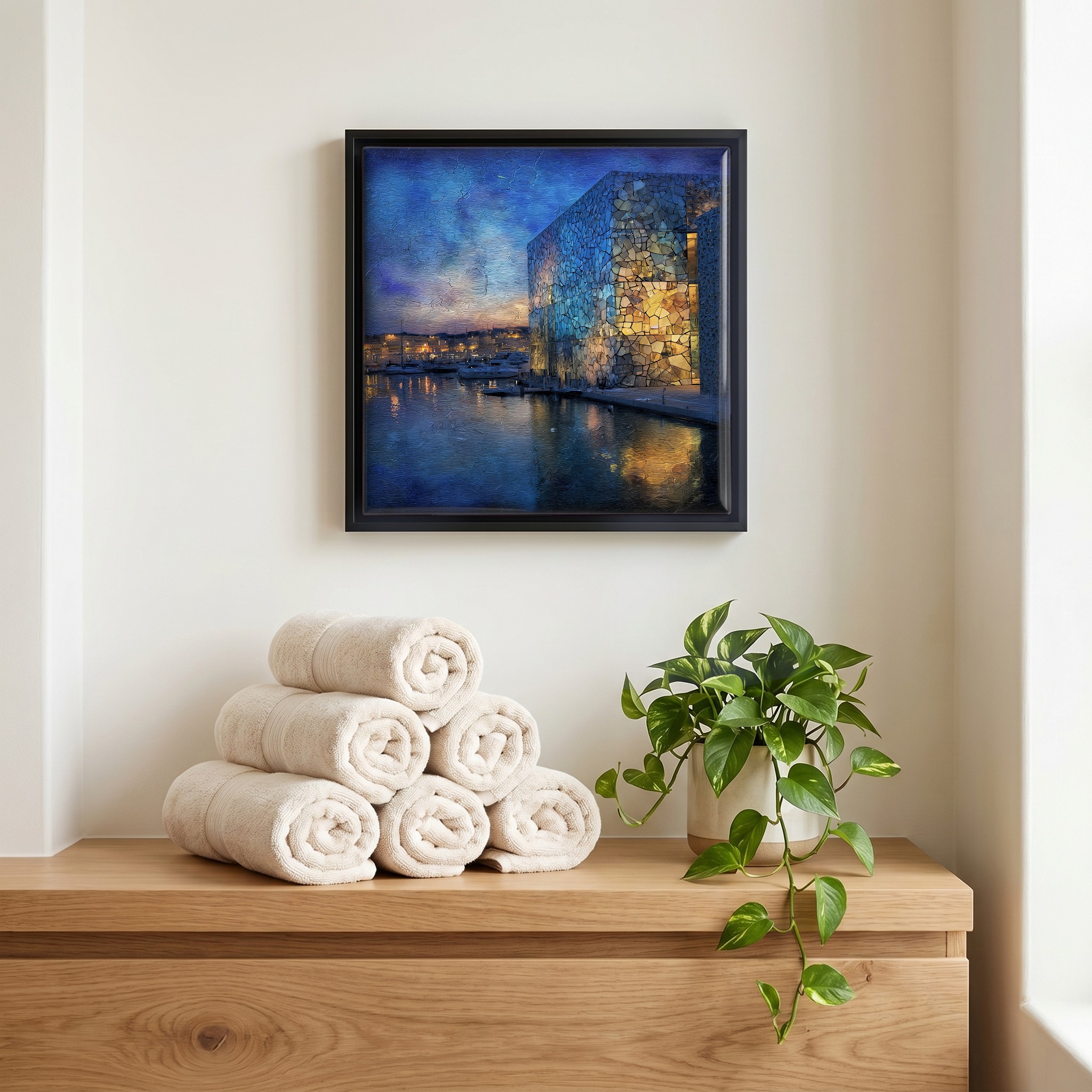
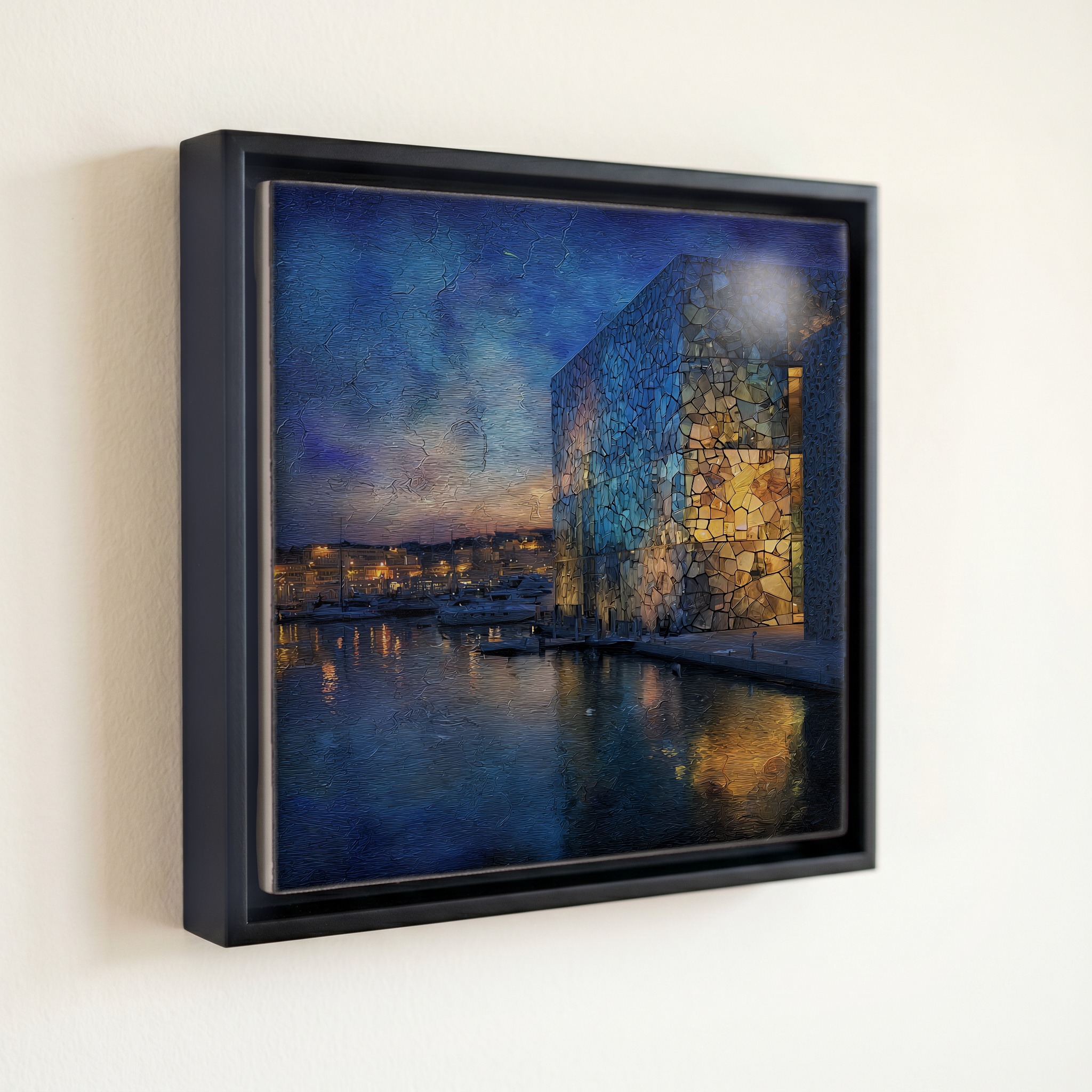
Above the linens, in a slim black surround.
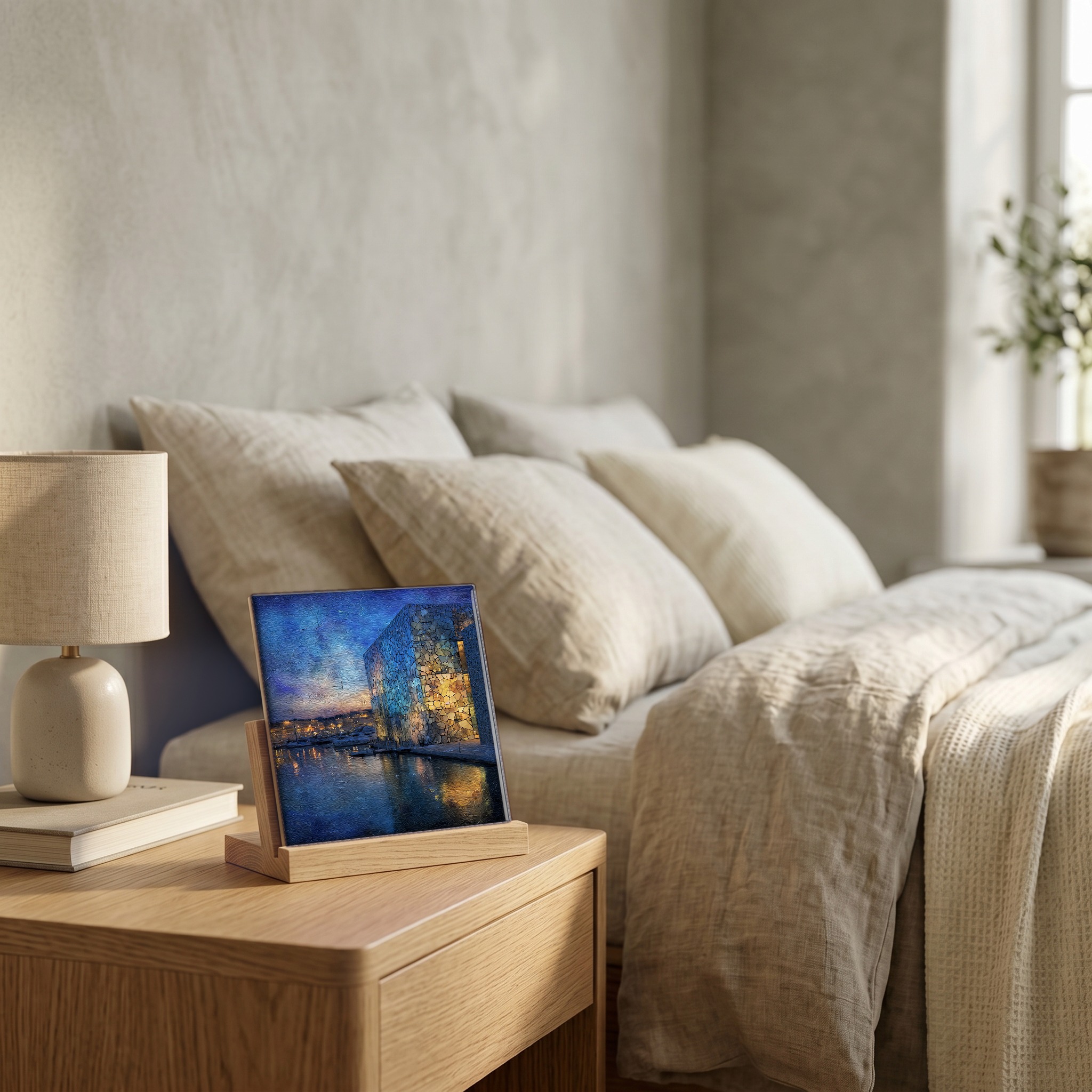
On the nightstand, on a light oak stand.
On a picture ledge, where the light comes in.
a note from the studio

At the mouth of the Vieux-Port, a black cube wrapped in concrete lace. The architect Rudy Ricciotti called it a moucharabieh, after the latticed screens that filter sunlight in traditional Mediterranean houses, cast here in fibre-reinforced concrete so fine it looks knotted. A 115-metre footbridge runs from the roof across to Fort Saint-Jean, the seventeenth-century fortification on the other side of the channel. The shadow the lattice throws on the floor inside moves all day. Across the harbour, Notre-Dame de la Garde sits on her hill. People come for the collection of Mediterranean civilisation gathered into one place, and stay for the way the building handles light.
from the studio
shown in a slim black floating frame · 6 × 6 in
— bring it home

MuCEM Marseille, on ceramic.

Each tile is finished by hand in our Knoxville studio. Artwork is slowly infused into the ceramic surface under high heat and pressure, and rests beneath a thin glossy finish. The colour lives in the surface, not on top of it.

What kind of piece?
One tile — square or rectangle.
How big?
the popular one — counter, shelf, nightstand
6 × 6 in · 15 cm · 1.6 lb
Surface finish
A clear glossy finish — the artwork reads as if under resin. Ideal for show-pieces and framed wall art.
How it sits
A hidden cleat — sits ¼″ proud of the wall.
$58
Hand-finished and shipped from our studio at the foot of the Smokies. On your wall in about ten days.
size
6 × 6 in
15 cm
weighs
1.6 lb
solid in the hand
surface
ceramic, hand-finished
art rests beneath a thin glossy finish
from
Knoxville, TN
our family studio, at the foot of the Smokies
— start a Coaster Set

Pick any four 4-inch tiles — National Parks you've been to, a Smokies set, the four seasons of one place. $ for a set of , cork-backed, ready to live on the table.
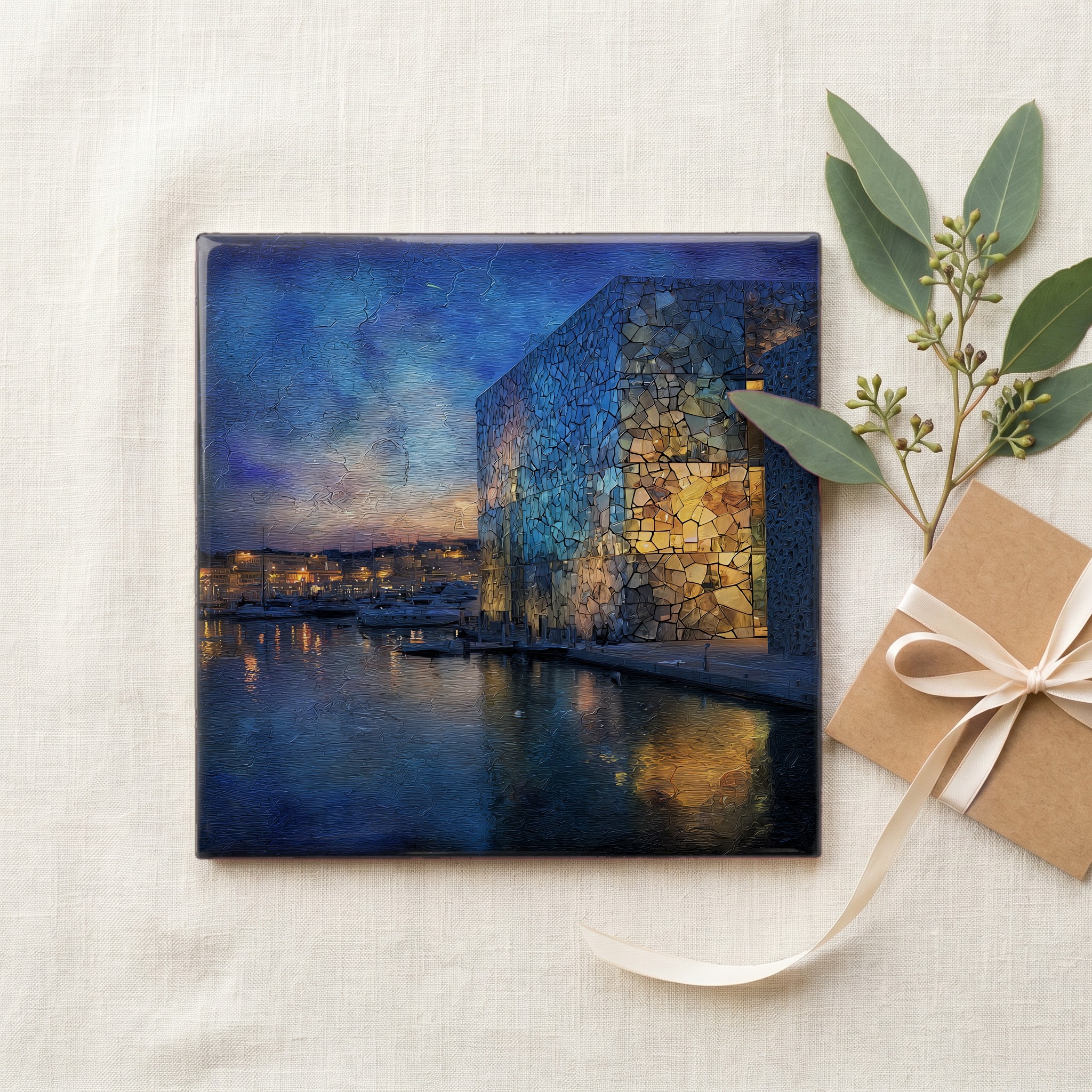
comes gift-ready
comes gift-ready

Each tile ships in a kraft box, tied with cream ribbon, with a handwritten note from the studio if you'd like to add one.
or build a grouping
or build a grouping

Three or five different vistas, hung together — a chapter of places you've been, or want to go.

about MuCEM Marseille

The place, in three passes.

A little of what's known, in case you fall down the rabbit hole — or want to go see it yourself.
the place

The MuCEM opened on 7 June 2013, the year Marseille held the title of European Capital of Culture. Its principal building, called the J4, sits on the former dock J4 at the mouth of the Vieux-Port in the second arrondissement of Marseille, in the Provence-Alpes-Côte d'Azur region of southern France. A 115-metre footbridge crosses the harbour channel to Fort Saint-Jean, a fortification rebuilt between 1660 and 1664 under Louis XIV, with foundations going back to the twelfth century. The museum's full name is the Musée des Civilisations de l'Europe et de la Méditerranée. It is the first national museum in France dedicated to Mediterranean civilisations, and its collection holds roughly 250,000 objects from across the basin.

the stone

The J4 was designed by Marseille architect Rudy Ricciotti, with Roland Carta as associate architect. It is a 72-metre cube of 15,000 square metres on four levels, wrapped on two sides by an outer envelope of fibre-reinforced, ultra-high-performance concrete, the BFUP-class material developed by Lafarge under the name Ductal. Ricciotti has described the perforated outer skin as a moucharabieh, after the latticed wooden screens used to filter light in traditional Mediterranean and North African architecture. The result is a black cube that reads as a dark veil from outside and casts a constantly shifting pattern of shadow inside. The pillars holding up the floors are so slender they read more as reeds than as structural columns.

the light

Marseille receives roughly 2,800 hours of sunshine a year, among the highest totals in France, and the Mediterranean light there is unusually direct. The J4's perforated concrete envelope was designed against that fact. Where most museums treat sunlight as a problem to be filtered out, Ricciotti let it through and used it. From inside, the lattice throws a pattern of shadows across the floor and walls that moves with the hour. From outside, the same envelope reads as a layered black scrim against the sea. Across the harbour, the gilded statue of the Virgin atop Notre-Dame de la Garde takes the same Provençal light from the opposite direction.

where
France · Marseille, Provence-Alpes-Côte d'Azur
position
43.2953° N · 5.3603° E
the neighborhood

What's nearby.

A handful of named places within an hour's walk or short drive. Some we've already painted; some we will.
0.1 km E
Fort Saint-Jean
17th-century fortification
0.1 km N
Villa Méditerranée
exhibition centre
0.3 km N
Cathédrale de la Major
cathedral
0.3 km E
Vieux-Port
old harbour
0.5 km NE
Le Panier
historic quarter
1.6 km SE
Notre-Dame de la Garde
basilica
3.2 km SW
Château d'If
island fortress
N
MuCEM Marseille
Fort Saint-Jean
Villa Méditerranée
Cathédrale de la Major
Vieux-Port
Le Panier
Notre-Dame de la Garde
Château d'If
common questions

What people ask.

A few questions we get about MuCEM Marseille — and about bringing the piece home.
about the place

The MuCEM stands at the mouth of the Vieux-Port in Marseille, France, on the former dock known as J4, in the second arrondissement. A 115-metre footbridge connects its roof to Fort Saint-Jean, the seventeenth-century fortification on the other side of the harbour channel.

The museum opened on 7 June 2013, the year Marseille held the European Capital of Culture title. It was the first national museum in France dedicated to Mediterranean civilisations and remains one of the few national museums located outside Paris.

The J4 building was designed by Marseille-born architect Rudy Ricciotti, with Roland Carta as associate architect. The lattice envelope, which Ricciotti calls a moucharabieh, is made from fibre-reinforced ultra-high-performance concrete developed by Lafarge under the name Ductal.

MuCEM is short for Musée des Civilisations de l'Europe et de la Méditerranée, the Museum of European and Mediterranean Civilisations. Its collection of roughly 250,000 objects covers anthropology, history, and everyday life from across the Mediterranean basin.

The museum sits a short walk from the Vieux-Port metro station on line 1. Visitors can enter through Fort Saint-Jean from the Esplanade Jean-Paul II in the Le Panier quarter, or directly into the J4 building from the Esplanade J4 on the harbour.

Architect Rudy Ricciotti described the perforated concrete envelope as a moucharabieh, after the latticed screens that filter sunlight in traditional Mediterranean and North African houses. The skin lets Provençal light through into the galleries while casting shifting shadow patterns across the floor.

Yes. A 115-metre pedestrian footbridge runs from the J4 building's roof terrace across the harbour channel to the upper terrace of Fort Saint-Jean. A second footbridge connects the fort to the Saint-Laurent church neighbourhood on the other side.

about the piece in your home

It has been a meaningful gift for many customers with Marseille connections. The MuCEM is a relatively recent landmark, opened in 2013, and locals tend to feel ownership of it. A Small or Medium with a handwritten note from the studio carries well.

The piece sits well in Mediterranean-modern, Architectural Minimalist, and Coastal-contemporary interiors. The dark tones of the concrete envelope and the lattice patterning give it weight without busyness. It also reads well in rooms with a warm-brutalist or Bauhaus orientation.

Yes. The MuCEM piece reads as architecture more than as travel imagery, which fits the current move toward design-led wall art in considered interiors. The lattice patterning gives the eye something to settle into without competing with furniture or other art.

Above a standard sofa around 84 inches wide, a Large tile holds the wall on its own. For a stronger statement, a 4-tile Mural reads as a single architectural object. Above a narrower console, the Medium sits in proportion.

Yes. Choose the Dura Satin finish for a wet area like a bathroom or near a kitchen splash zone, or the Matte finish if you want no sheen. Both are scratch-resistant. The Glossy finish is best reserved for protected wall art.

A microfibre cloth with water is enough for everyday cleaning. The colour is slowly infused into the ceramic surface under high heat and pressure, beneath a thin glossy or satin finish, so it lives in the surface and will not lift.

Yes. Every WenderVista piece is made in our studio in Knoxville, Tennessee. The painting is original, the ceramic finishing is done in-house, and we do not license or resell other artists' work.

if this one stayed with you

A few you might also love.

Hand-picked by the eye that found Sorapis. Same air, same kind of quiet.