Wender·Vista
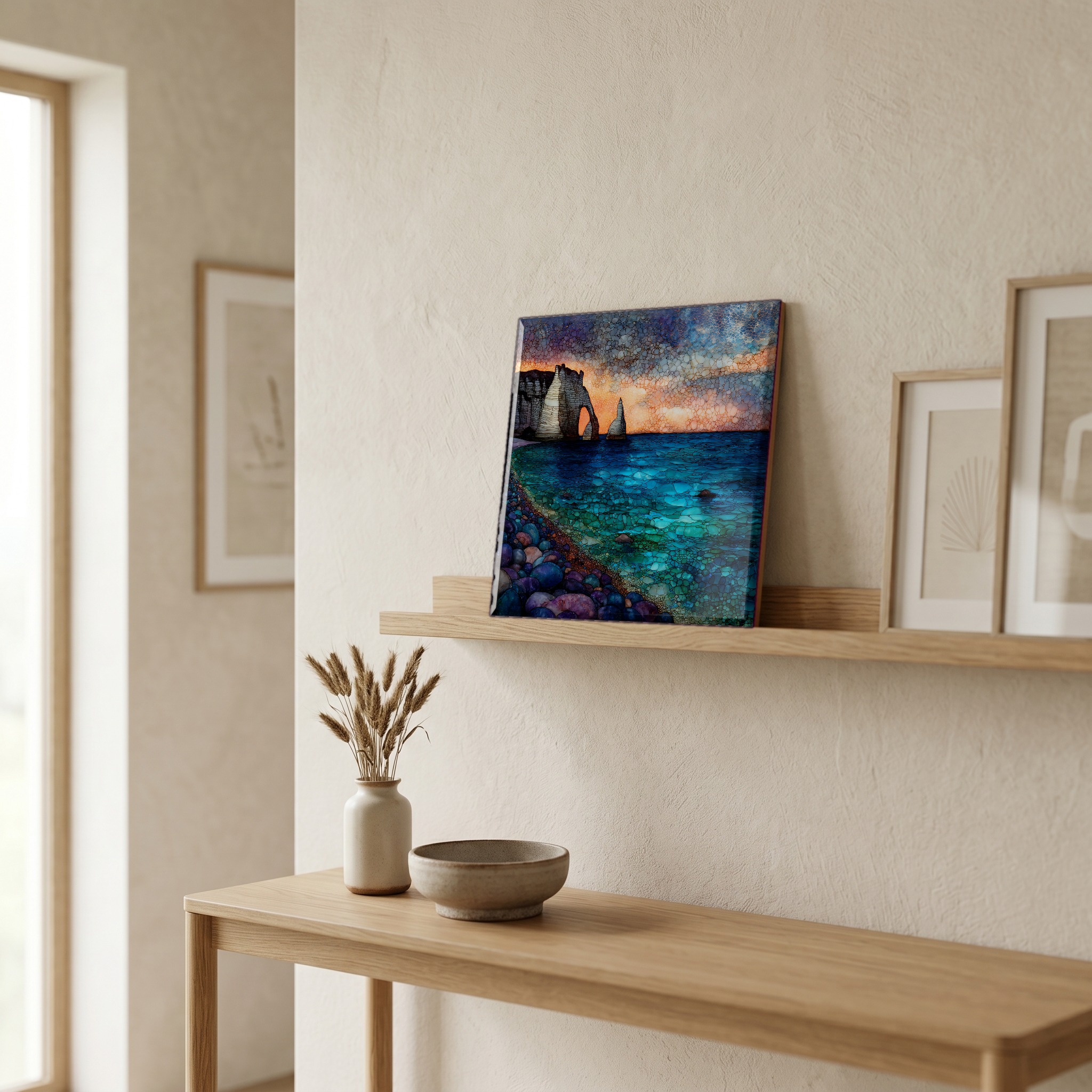
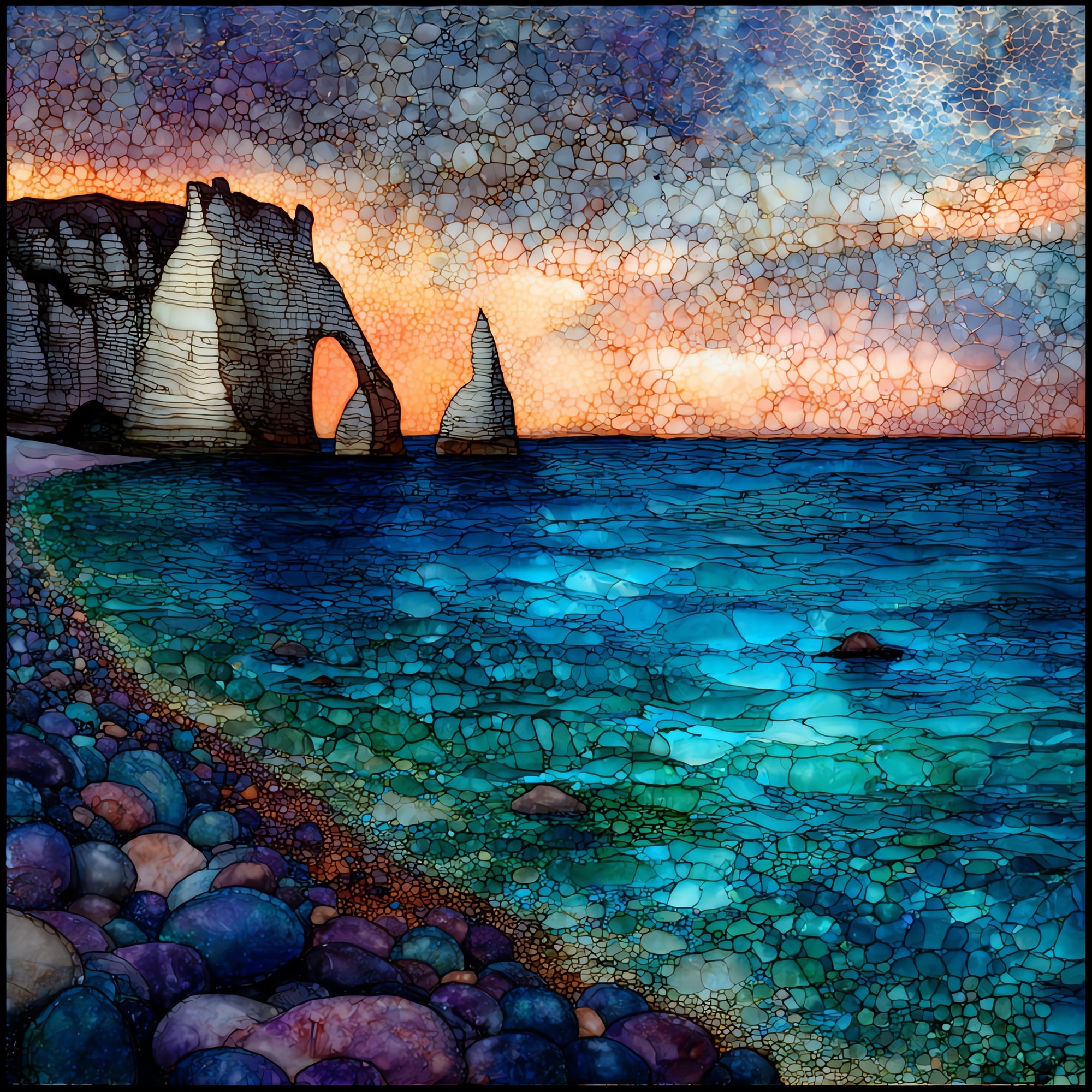
Etretat Pebble Beach
shown on ceramic, 12-inch tileFrance
on the Alabaster Coast of Normandy

Etretat Pebble Beach

the door the cliff opens for the sea.

Where it lives

Not only on a wall.

A small tile on the nightstand catching the morning. A larger one above the fire. Yours, wherever you spend the slow hours.
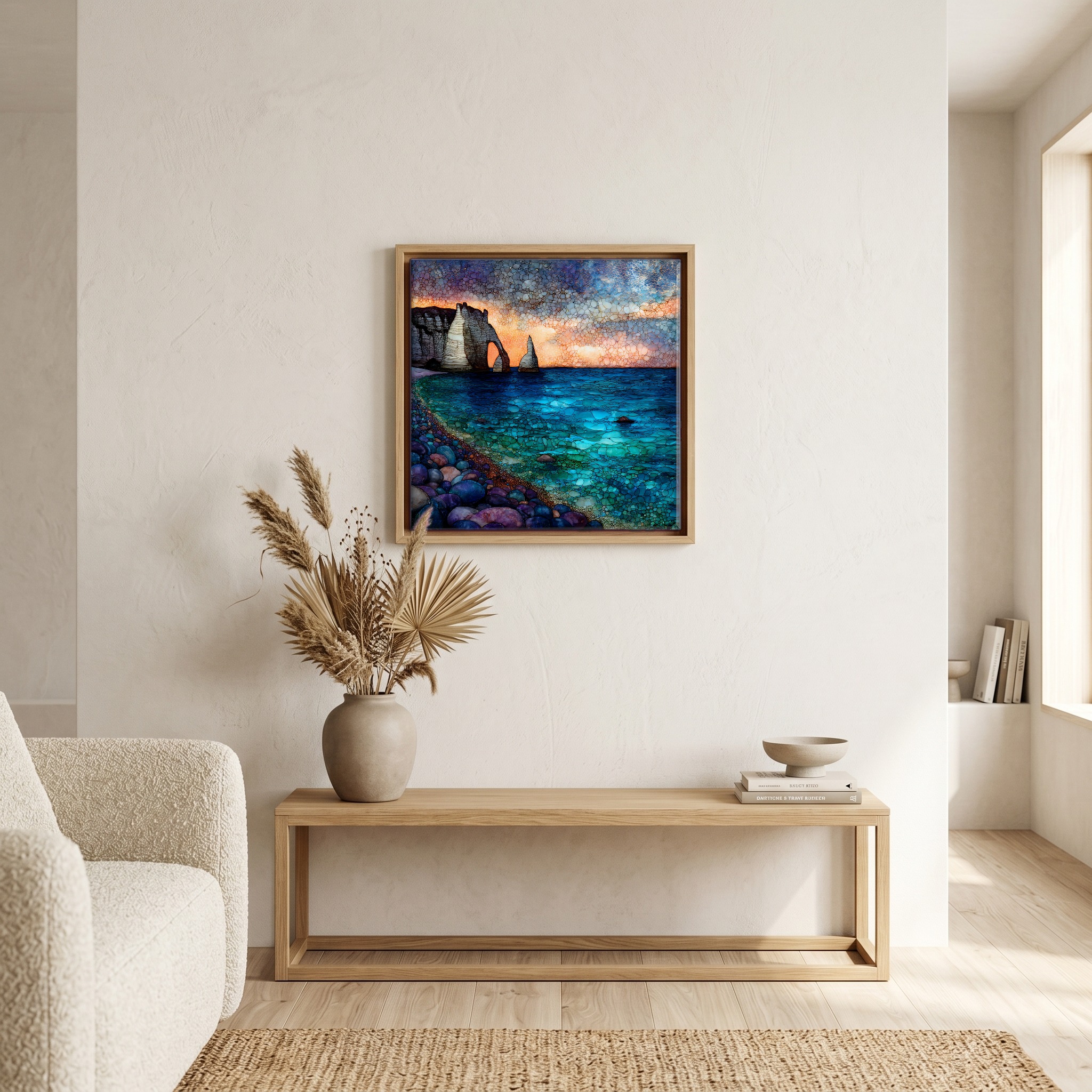
Above the bench, in a warm oak surround.
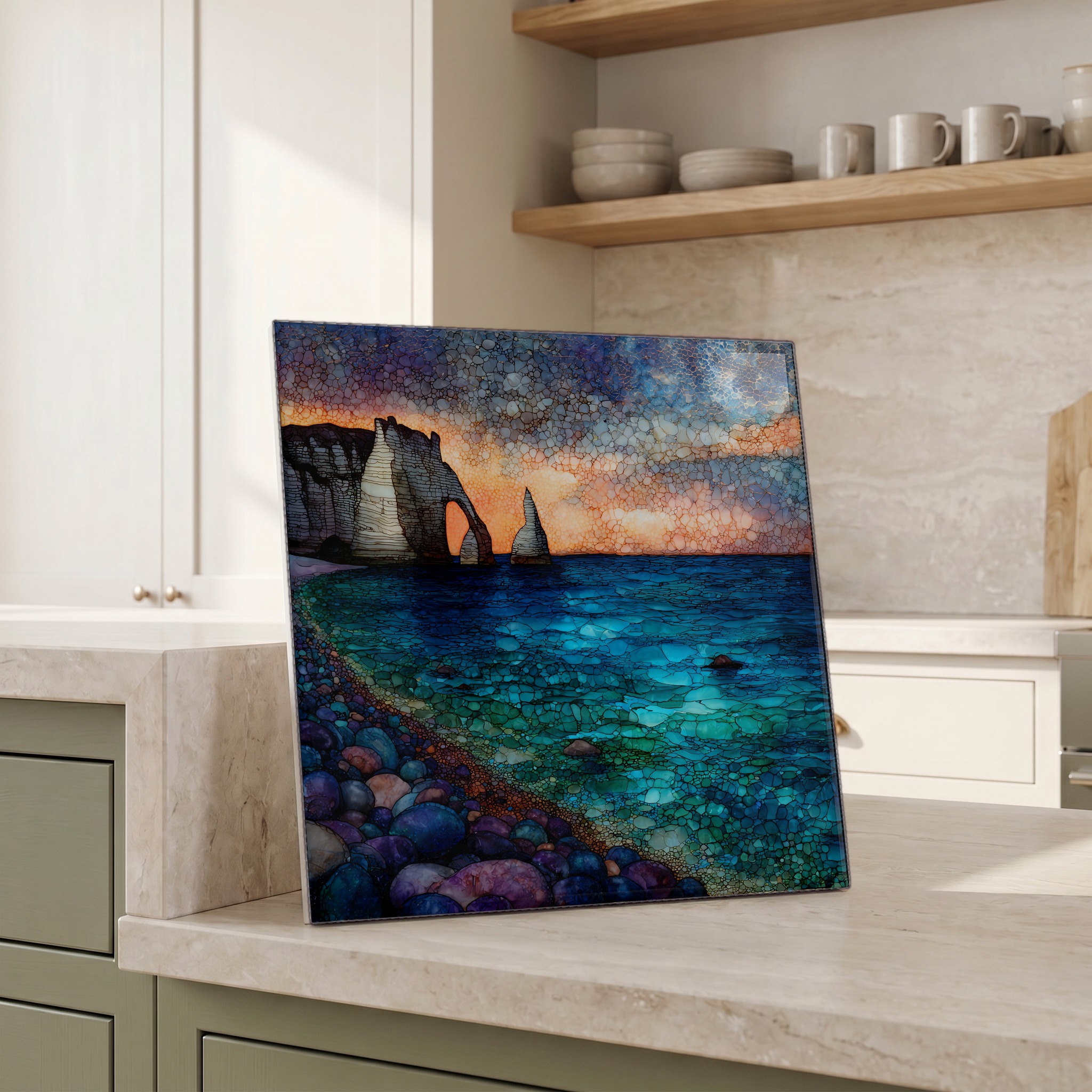
Beside the kettle, propped on the counter.
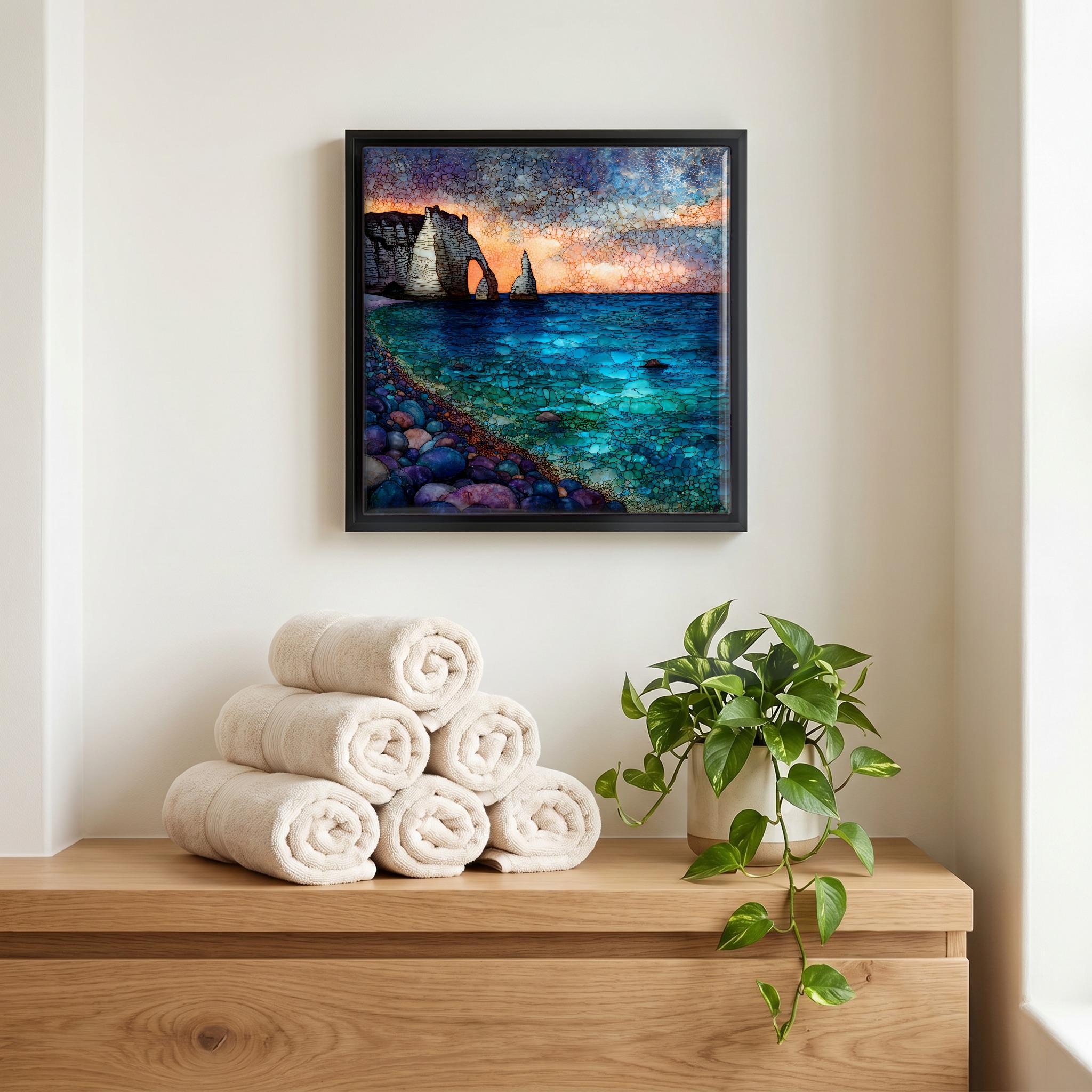
Above the linens, in a slim black surround.
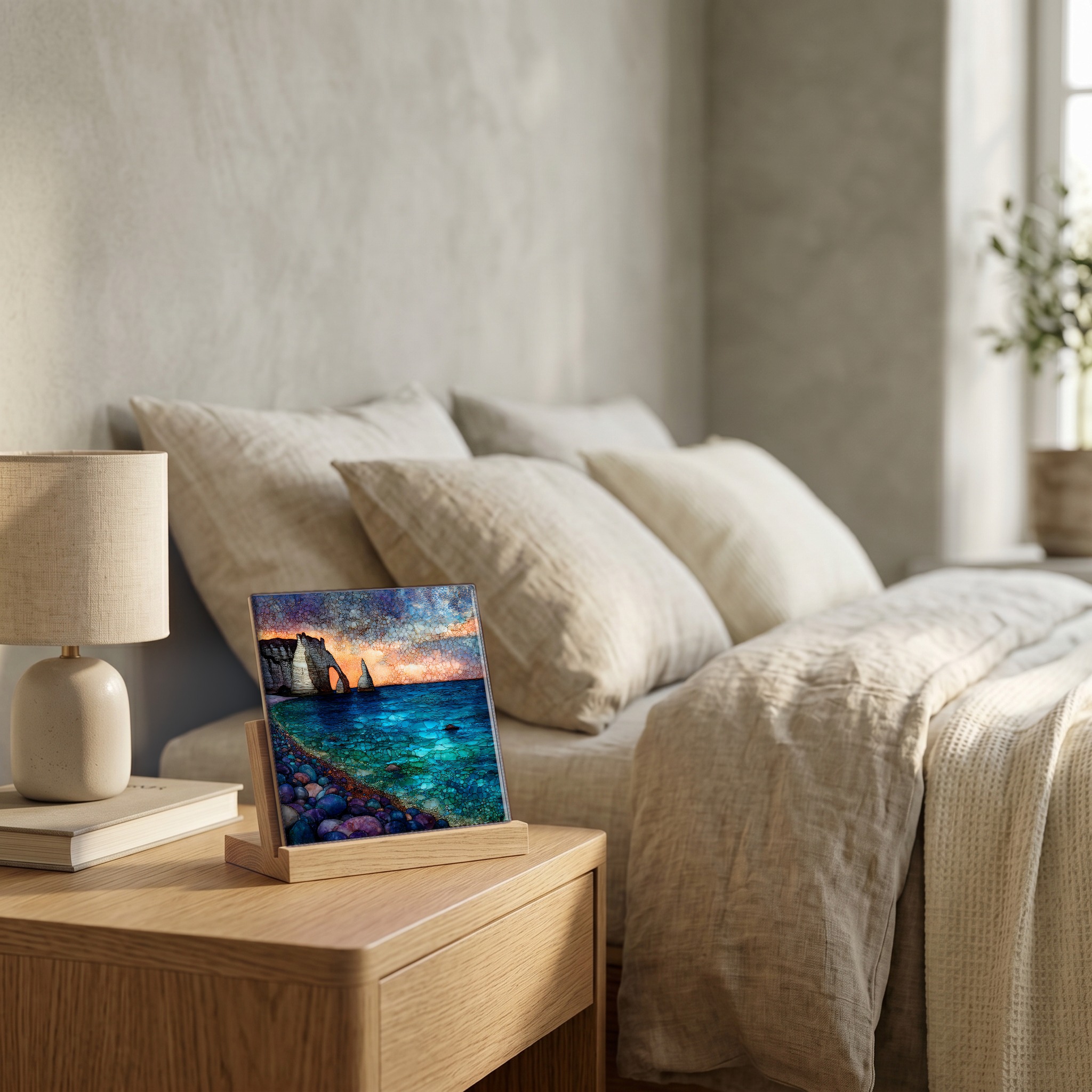
On the nightstand, on a light oak stand.
On a picture ledge, where the light comes in.
a note from the studio

A pebble beach on the Alabaster Coast of Normandy, two hours northwest of Paris. The cliff above the waterline opens into an arch, the Porte d'Aval, with the seventy-metre Needle, l'Aiguille, standing apart in the surf beyond it. Monet came back to paint these chalk walls more than fifty times, mostly in autumn weather, mostly under a flat Channel sky. The pebbles are flint, smoothed by the sea and noisy underfoot. The light is rarely showy and more often the colour of weather coming in.
from the studio
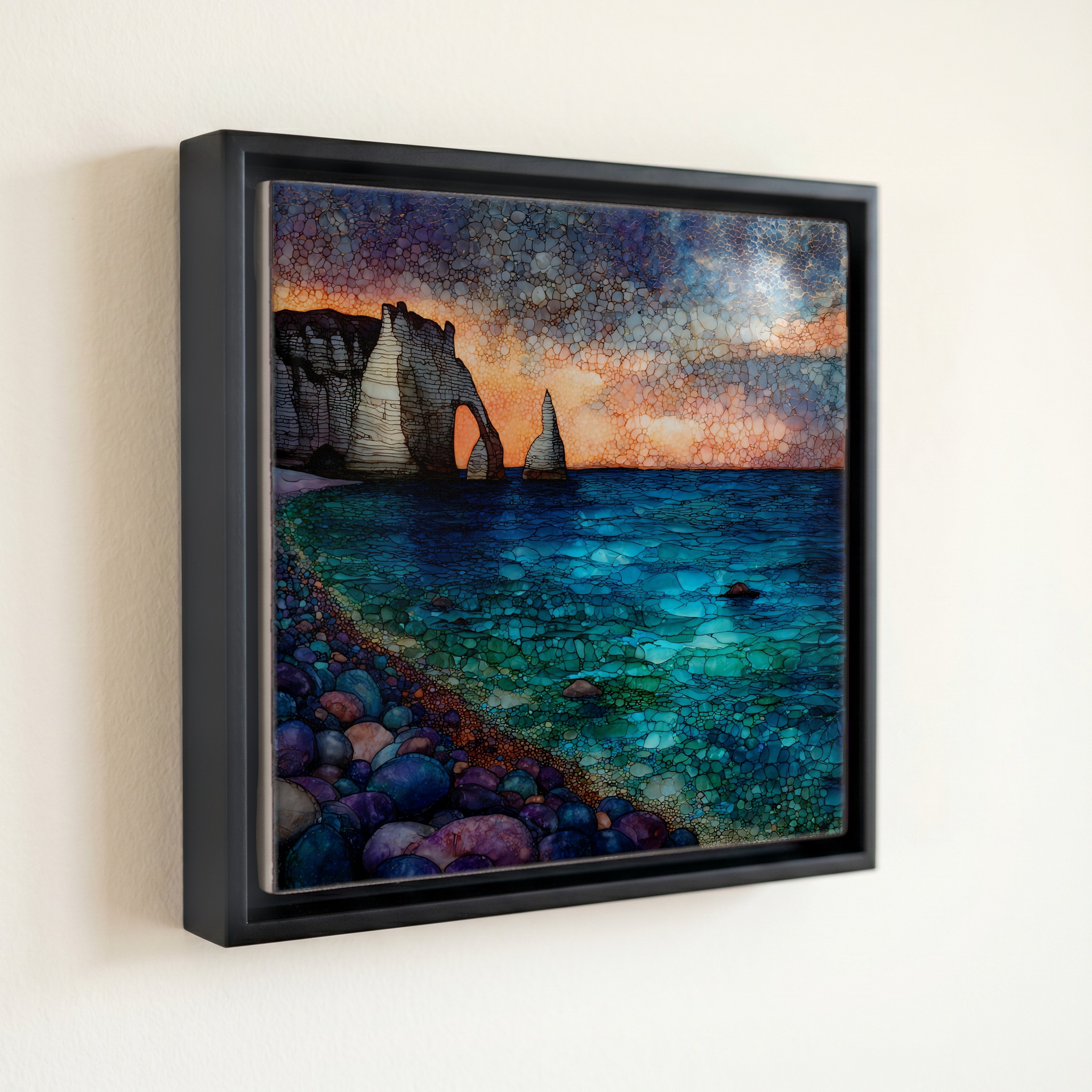
shown in a slim black floating frame · 6 × 6 in
— bring it home

Etretat Pebble Beach, on ceramic.

Each tile is finished by hand in our Knoxville studio. Artwork is slowly infused into the ceramic surface under high heat and pressure, and rests beneath a thin glossy finish. The colour lives in the surface, not on top of it.

What kind of piece?
One tile — square or rectangle.
How big?
the popular one — counter, shelf, nightstand
6 × 6 in · 15 cm · 1.6 lb
Surface finish
A clear glossy finish — the artwork reads as if under resin. Ideal for show-pieces and framed wall art.
How it sits
A hidden cleat — sits ¼″ proud of the wall.
$58
Hand-finished and shipped from our studio at the foot of the Smokies. On your wall in about ten days.
size
6 × 6 in
15 cm
weighs
1.6 lb
solid in the hand
surface
ceramic, hand-finished
art rests beneath a thin glossy finish
from
Knoxville, TN
our family studio, at the foot of the Smokies
— start a Coaster Set

Pick any four 4-inch tiles — National Parks you've been to, a Smokies set, the four seasons of one place. $ for a set of , cork-backed, ready to live on the table.
comes gift-ready
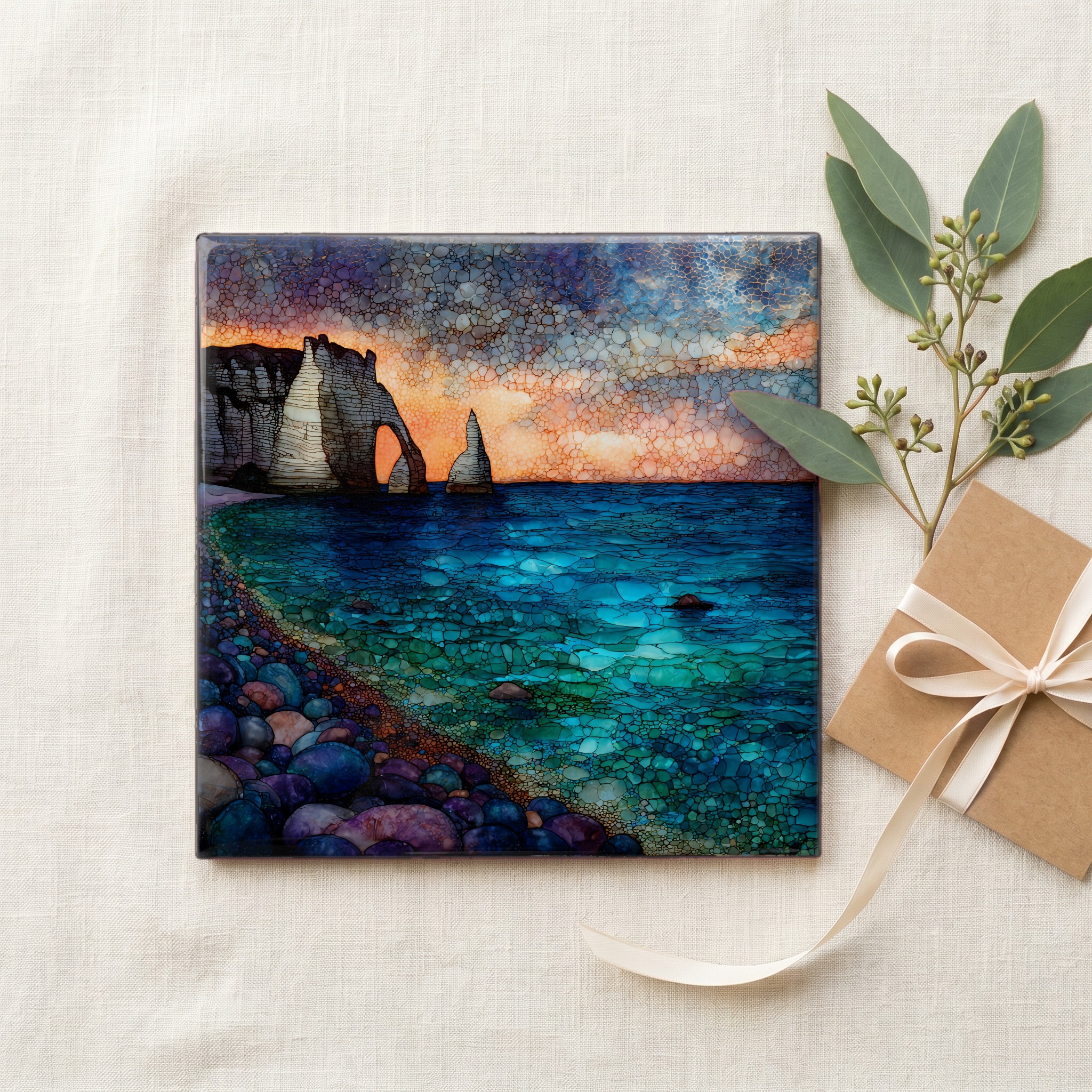
comes gift-ready

Each tile ships in a kraft box, tied with cream ribbon, with a handwritten note from the studio if you'd like to add one.
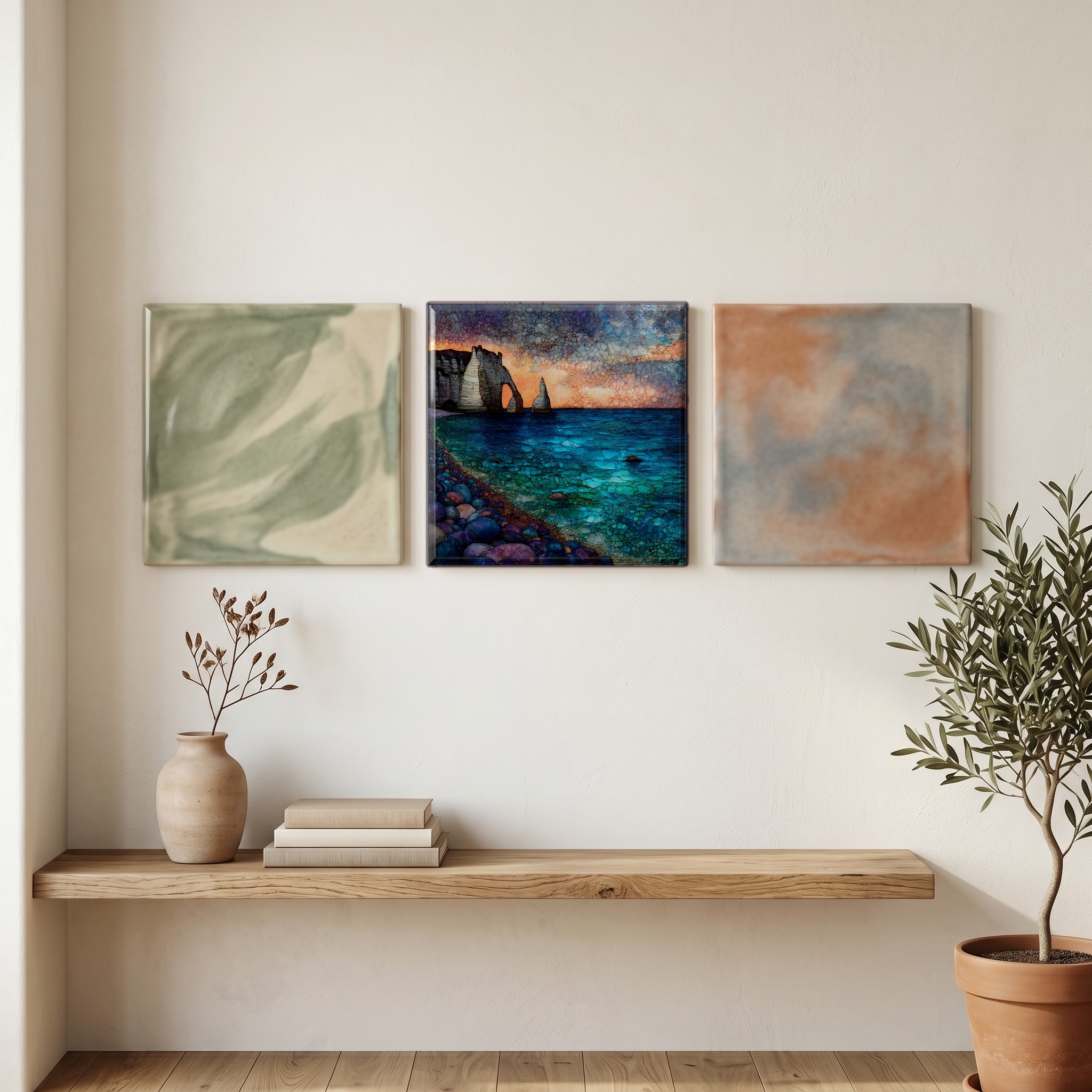
or build a grouping
or build a grouping

Three or five different vistas, hung together — a chapter of places you've been, or want to go.

about Etretat Pebble Beach

The place, in three passes.

A little of what's known, in case you fall down the rabbit hole — or want to go see it yourself.
the place

Étretat sits on the Côte d'Albâtre, the alabaster coast of Normandy that runs roughly 130 km from Le Havre to Le Tréport along the English Channel. The commune is small, with fewer than 1,500 residents, and the beach is a curved bay of flint pebbles bracketed by two chalk cliffs. To the south, the Falaise d'Aval rises to about 80 metres and carries the most photographed arch in France. To the north, the Falaise d'Amont holds the Chapelle Notre-Dame-de-la-Garde, rebuilt after the Second World War and lit at night. Paris is about 200 km southeast by road; Le Havre, the nearest large city, sits half an hour to the south.

the stone

The cliffs at Étretat are Cretaceous chalk, roughly 90 million years old, laid down when this part of France lay beneath a shallow sea. Wave action and groundwater have carved three natural arches along this stretch of coast: the Porte d'Amont to the north, the Porte d'Aval in the centre, and the Manneporte a short walk further south. Standing free in the water beyond the Porte d'Aval is L'Aiguille, the Needle, a chalk pinnacle about 70 metres tall that Maurice Leblanc made famous as the hiding place of Arsène Lupin in L'Aiguille creuse in 1909. The chalk is soft; the coastline is retreating measurably each century, and the arches will not last indefinitely.

the light

Claude Monet painted at Étretat across several visits between 1883 and 1886, producing more than fifty canvases of the cliffs and the arches under different weather. Eugène Boudin worked this coast earlier; Gustave Courbet's La Falaise d'Étretat après l'orage of 1870 hangs in the Musée d'Orsay. The light that drew them is the light of the English Channel: diffuse, often overcast, more grey than gold, with brief windows of horizontal sun at the ends of the day. Sunset behind the Porte d'Aval is the most-photographed moment of the year. In summer the cliff-top walk along the GR21 above the chapel gives the best view, especially in the half-hour before the sun is gone.

where
France · Seine-Maritime, Normandy
elevation
0 m · 0 ft
position
49.7077° N · 0.2056° E
the neighborhood

What's nearby.

A handful of named places within an hour's walk or short drive. Some we've already painted; some we will.
0.5 km W
Porte d'Aval
chalk arch
1 km NE
Chapelle Notre-Dame-de-la-Garde
cliff-top chapel
1 km SW
Manneporte
chalk arch
17 km NE
Fécamp
fishing port and Benedictine abbey town
30 km S
Le Havre
port city at the mouth of the Seine
N
Etretat Pebble Beach
Porte d'Aval
Chapelle Notre-Dame-de-la-Garde
Manneporte
Fécamp
Le Havre
common questions

What people ask.

A few questions we get about Etretat Pebble Beach — and about bringing the piece home.
about the place

Étretat is a small commune on the Côte d'Albâtre, the alabaster coast of Normandy, on the English Channel coast of France. It lies about 30 km north of Le Havre and roughly 200 km northwest of Paris by road. The town centres on a curved pebble bay framed by two chalk cliffs.

The beach is built from flint nodules eroded out of the surrounding chalk cliffs. Waves and longshore drift along the Alabaster Coast tumble the flint into the smooth, palm-sized galets that line the shore. The pebbles are noisy underfoot and shift visibly with the tide.

The cliffs are Cretaceous chalk roughly 90 million years old. Sea action and freshwater seeping through fissures have hollowed out three natural arches along this stretch of coast: the Porte d'Amont to the north, the Porte d'Aval in the centre, and the Manneporte a short walk further south.

Monet visited Étretat across several trips between 1883 and 1886 and produced more than fifty paintings of the cliffs under different weather. The site gave him a fixed architectural subject, the same chalk arch, that he could study under variable Channel light, anticipating the serial method he later used at Rouen and Giverny.

L'Aiguille, the Needle, is a free-standing chalk pinnacle about 70 metres tall in the water beyond the Porte d'Aval arch. Maurice Leblanc made it famous in his 1909 Arsène Lupin novel L'Aiguille creuse, The Hollow Needle, which imagined a secret kings' treasury hidden inside the rock.

May through September brings the warmest weather and the longest light, with sunset behind the Porte d'Aval as the marquee moment. Autumn and winter give the moody, overcast skies the impressionists came for. The cliff-top GR21 trail is best in dry conditions; the chalk can be slick after rain.

Yes. Stepped paths climb both the Falaise d'Aval to the south and the Falaise d'Amont to the north, where the rebuilt Chapelle Notre-Dame-de-la-Garde sits above the bay. The cliff-top GR21 trail continues for kilometres in either direction along the Alabaster Coast.

about the piece in your home

It's a thoughtful one. Étretat is on the short list of places a Normand reads as home, and the Alabaster Coast is to that region what the Smokies are to East Tennessee. A Coaster or Small with a handwritten note from the studio carries well; a Medium or Large reads as a serious gift.

The piece lives easily in three families: French Country (off-white walls, oak, linen), Coastal-modern (pale blue and bone, woven textures), and Quiet Maximalist (a deep teal or indigo wall where the chalk light reads as luminous against the surround). The greys and chalks pull the rest of the room toward calm.

Coastal-modern has moved away from beachy pastels toward chalk, fog, and slate. Étretat sits squarely in that palette. The piece works well in rooms that already lean on natural linen, pale oak, and grey-blue ceramics; it gives those rooms a single deep horizon to settle around.

Above a standard sofa (about 84 inches), a single Large tile reads as a deliberate focal point. A 4-tile Mural fills the wall above; a 9-tile Mural turns the wall into the view. Above a 60-inch console, a single Medium or a 4-tile Mural sits in proportion.

Yes. Choose the Dura Satin or Matte finish for any room with moisture or splash; both are scratch-resistant and read well in a powder room, a primary bath, or a kitchen backsplash. The Glossy finish belongs in the dry-wall spaces of the home: above a bed, a sofa, a console, a mantel.

A microfibre cloth and plain water. The colour is slowly infused into the ceramic surface under high heat and pressure, beneath a thin protective finish, so it does not lift or fade under normal household cleaning. Skip abrasives and harsh solvents; they aren't needed and can dull the surface.

Yes. Reid Wender chose Étretat for the WenderVista atlas and hand-finished the tile in our Knoxville, Tennessee studio. No licensing, no stock imagery. Every WenderVista piece originates in our family studio at the foot of the Smoky Mountains.

if this one stayed with you

A few you might also love.

Hand-picked by the eye that found Sorapis. Same air, same kind of quiet.