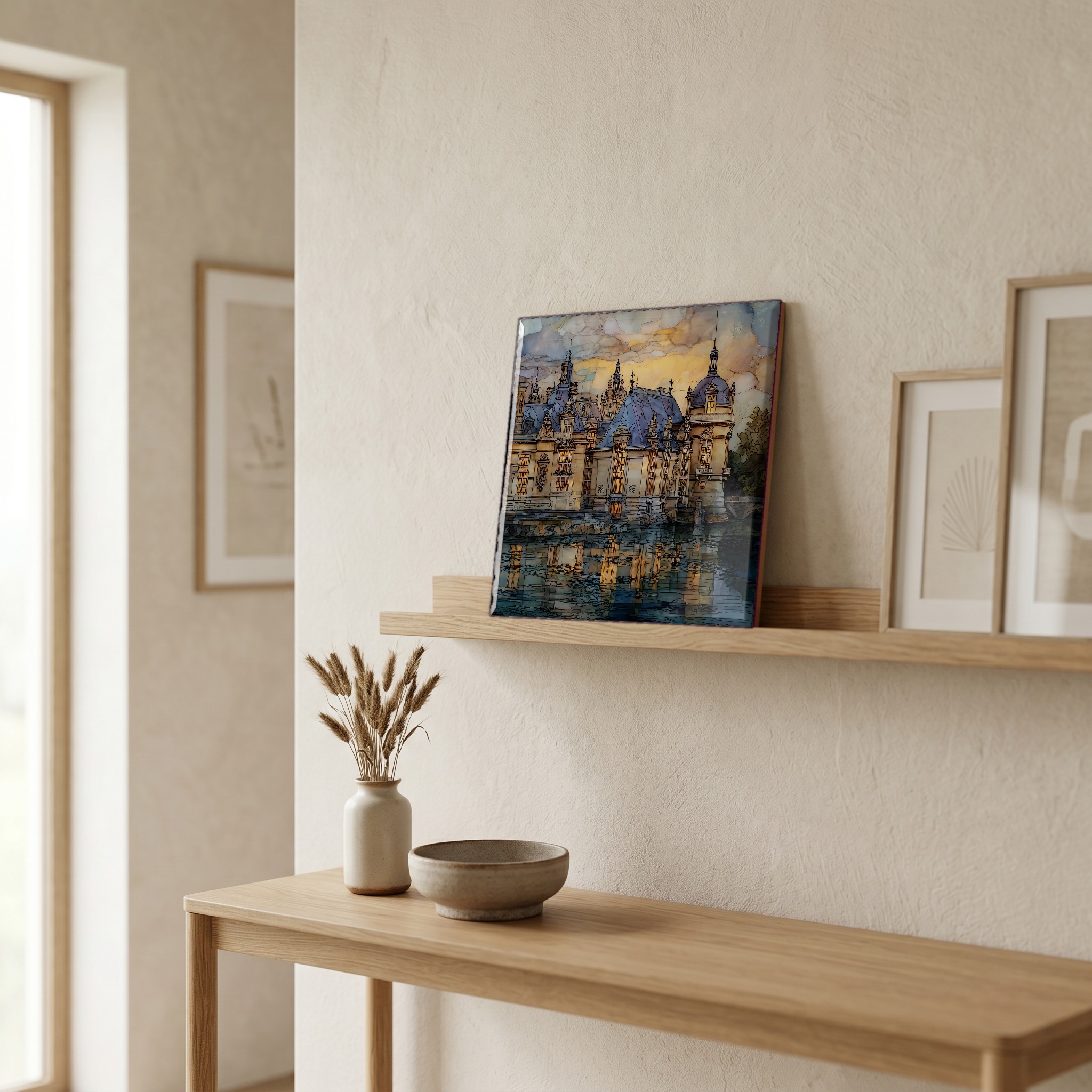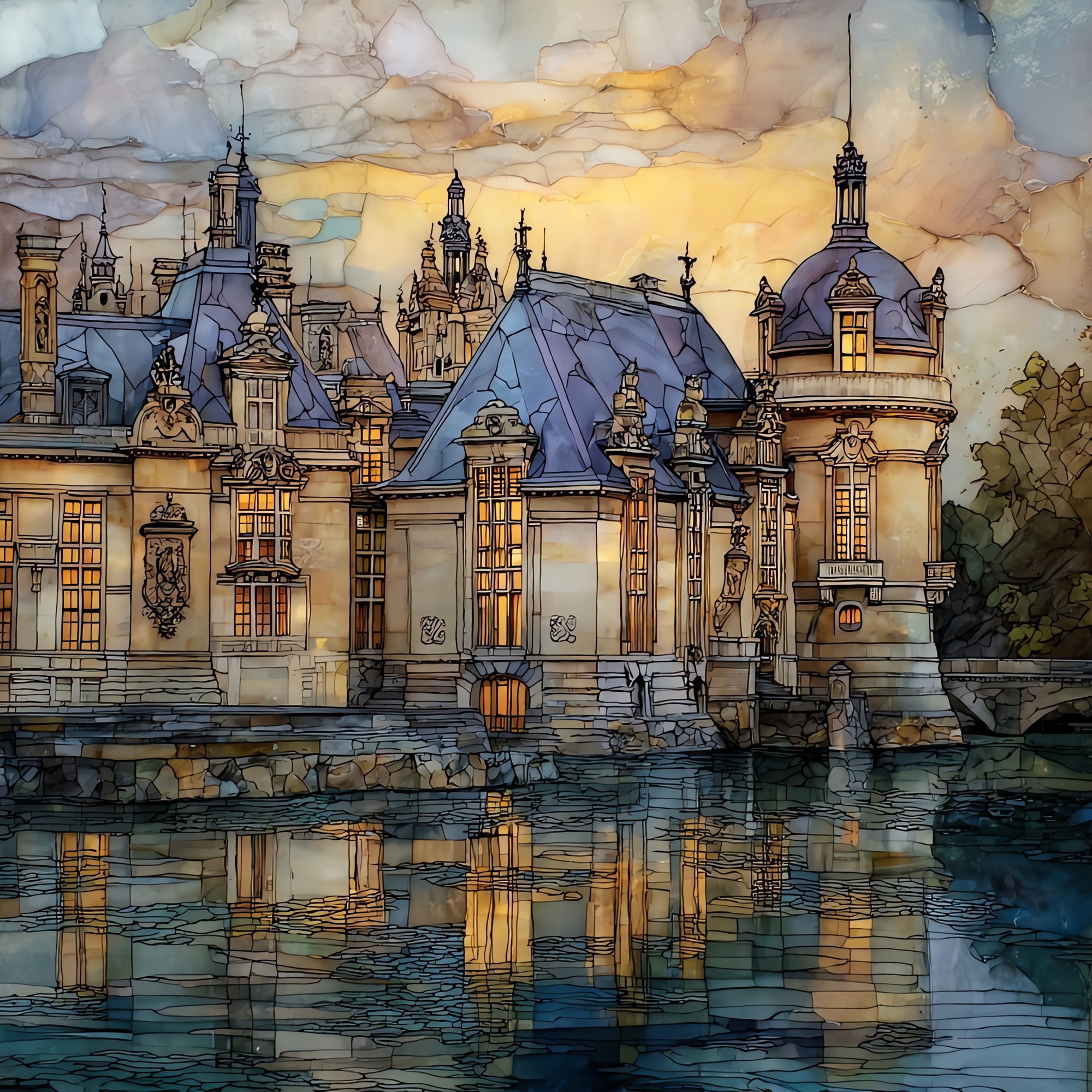
Wender·Vista
Chateau de Chantilly
shown on ceramic, 12-inch tileFrance
north of Paris, where the forest opens onto water

Chateau de Chantilly

the kind of stillness that doubles a building.

Where it lives

Not only on a wall.

A small tile on the nightstand catching the morning. A larger one above the fire. Yours, wherever you spend the slow hours.
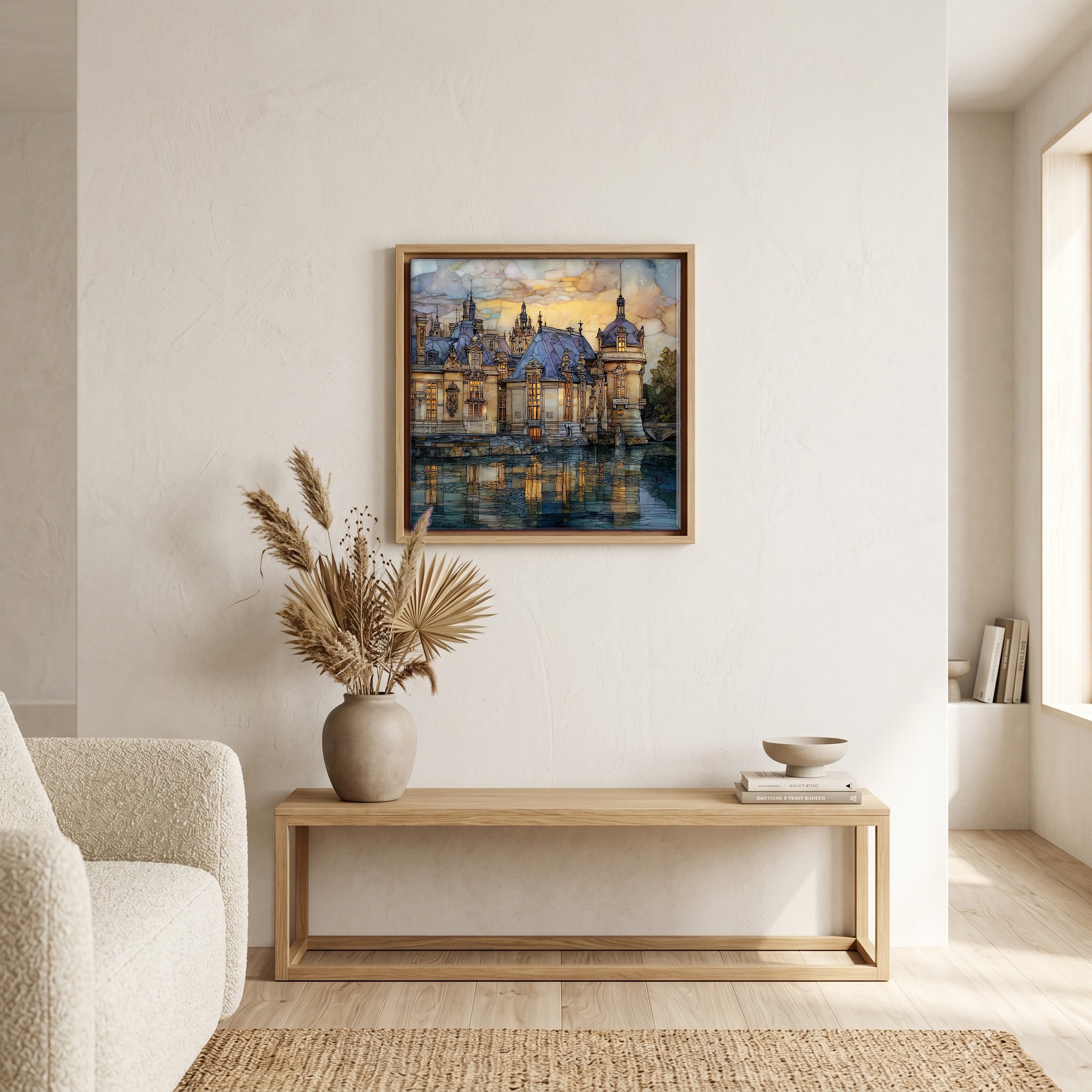
Above the bench, in a warm oak surround.
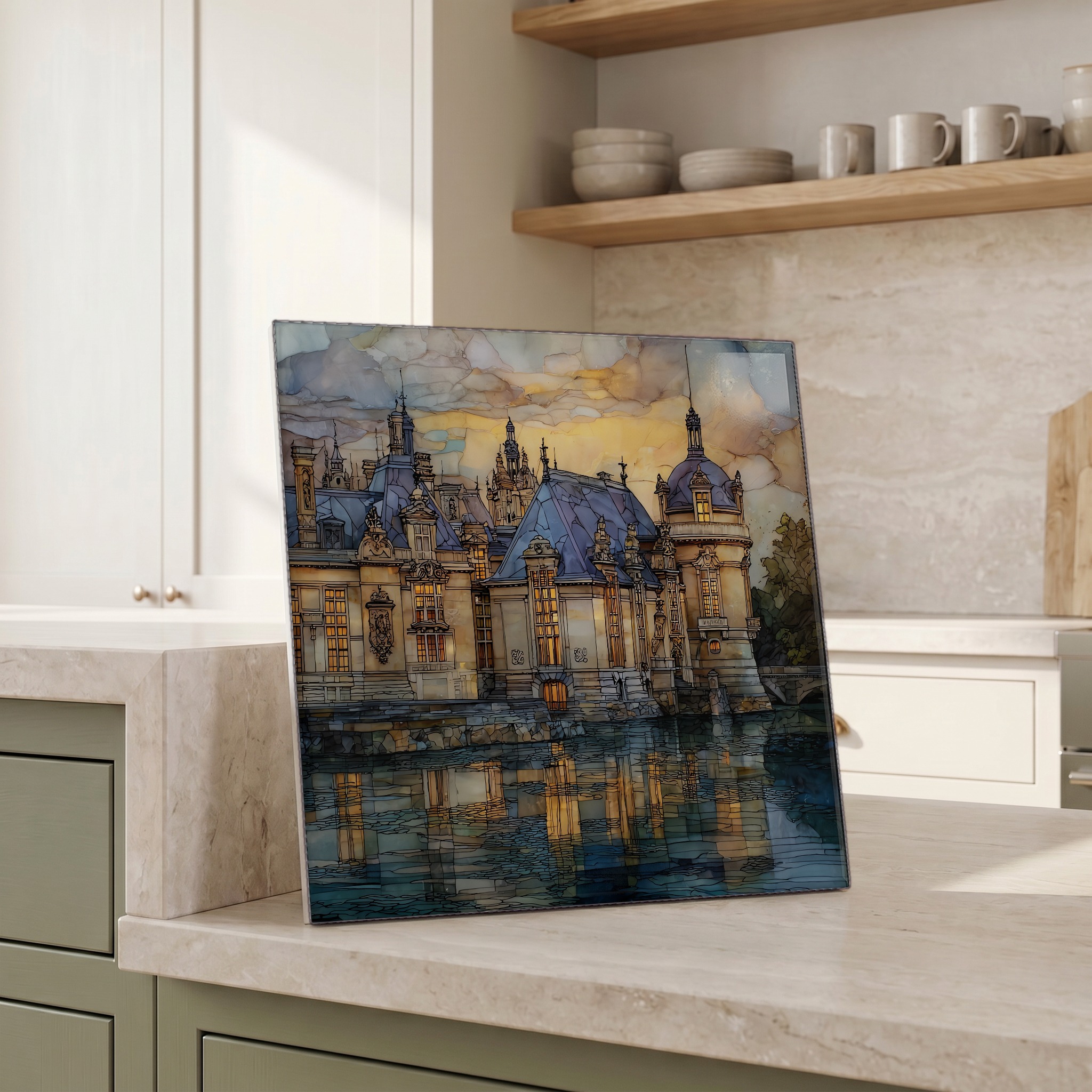
Beside the kettle, propped on the counter.
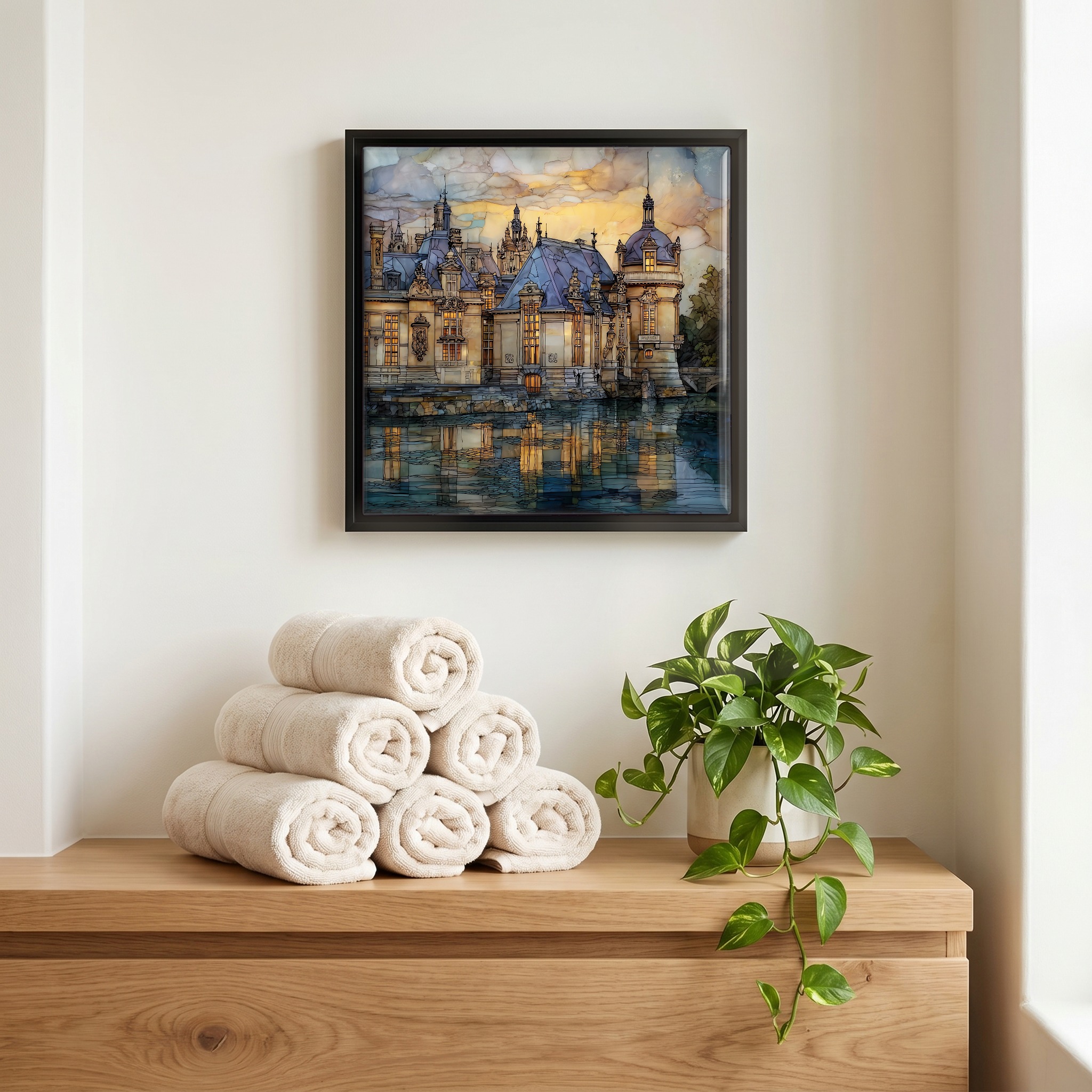
Above the linens, in a slim black surround.
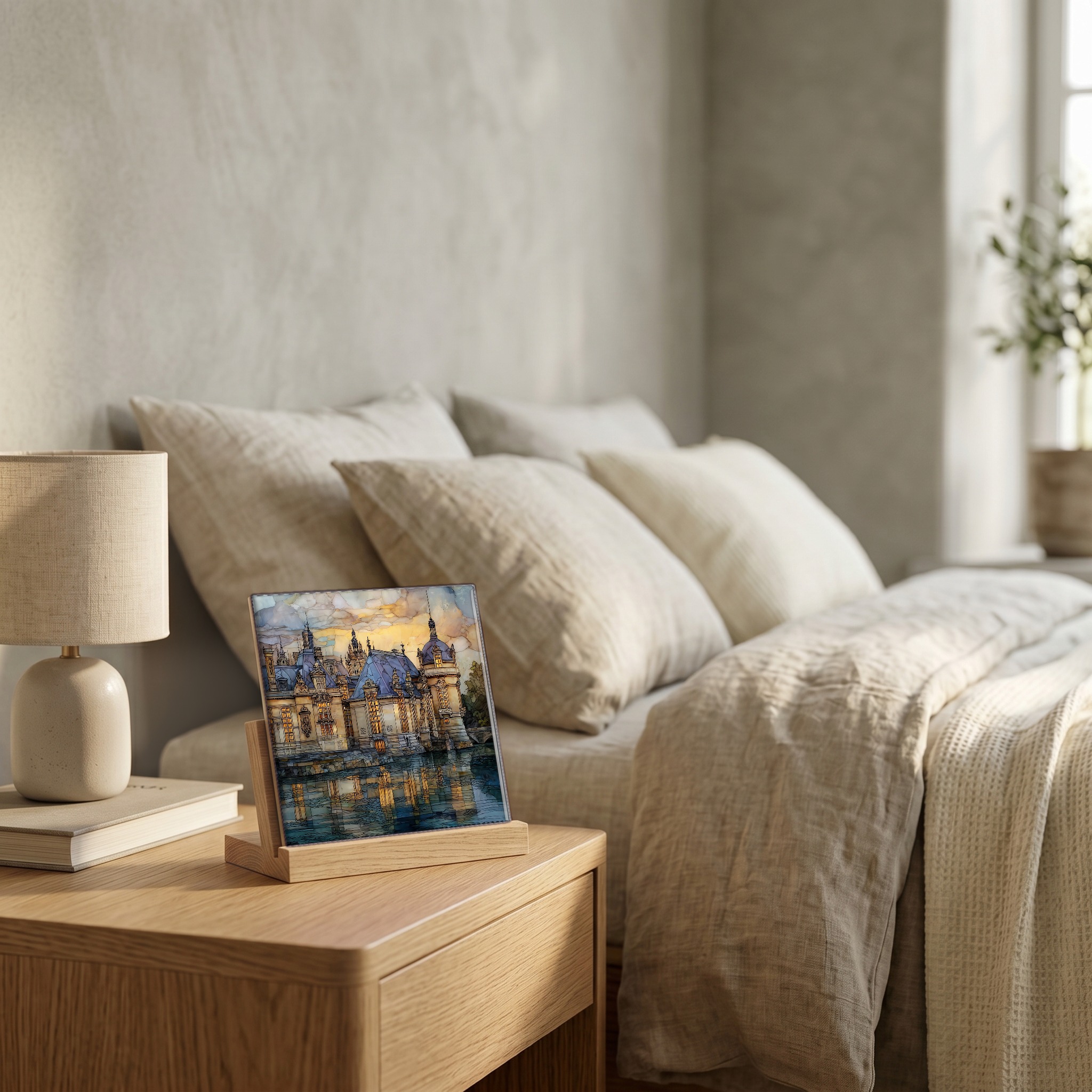
On the nightstand, on a light oak stand.
On a picture ledge, where the light comes in.
a note from the studio

North of Paris, where the forest opens onto water, the Château de Chantilly sits twice: once on its island, once in its moat. The Petit Château survived the Revolution; the Grand Château was rebuilt by the Duke of Aumale in the 1870s to hold his paintings. Inside, the Musée Condé carries the second-largest collection of antique paintings in France after the Louvre. The gardens were drawn by André Le Nôtre. The Great Stables down the lawn are nearly as grand as the house, built for a prince who believed he would come back as a horse. On a still afternoon the water gets the whole building right.
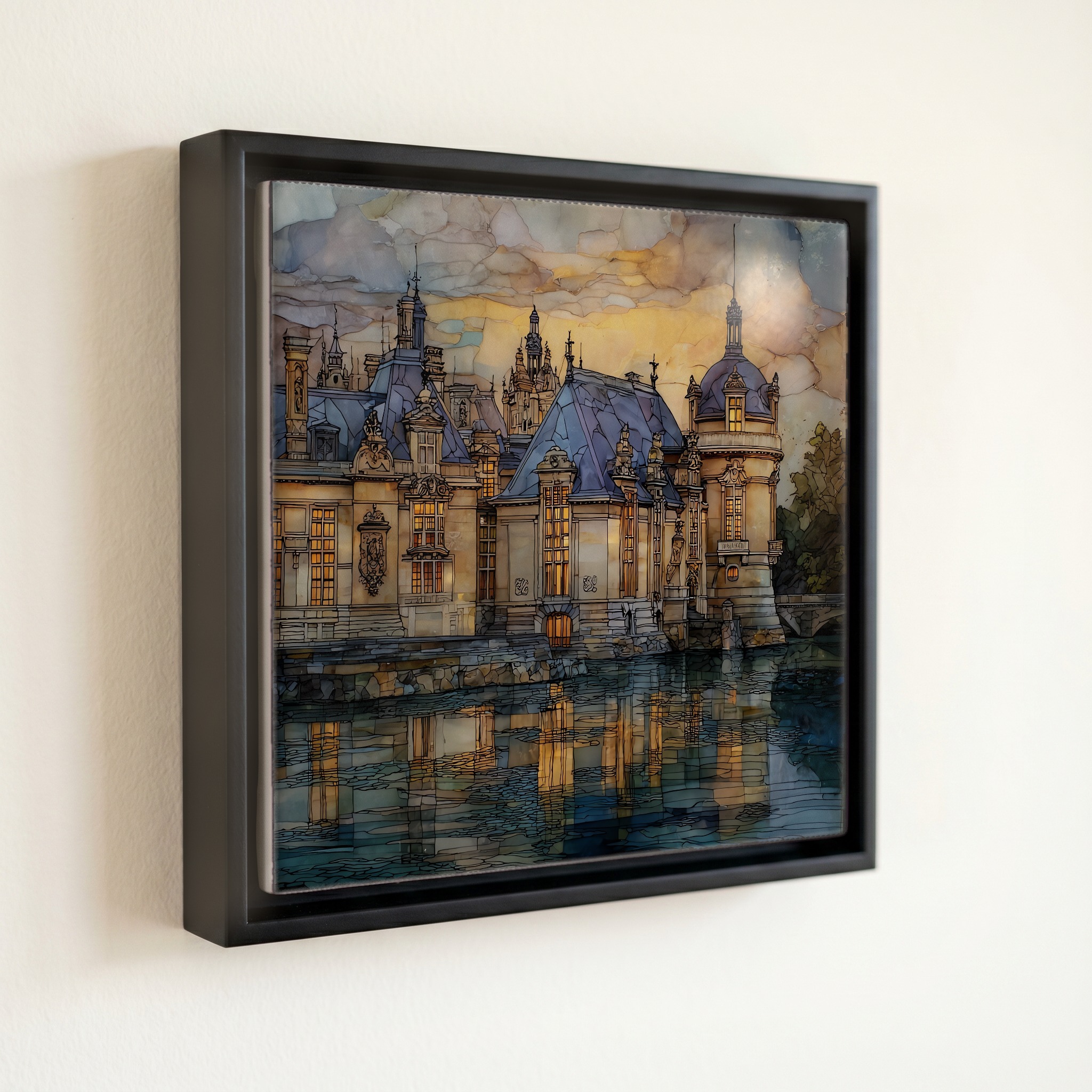
from the studio
shown in a slim black floating frame · 6 × 6 in
— bring it home

Chateau de Chantilly, on ceramic.

Each tile is finished by hand in our Knoxville studio. Artwork is slowly infused into the ceramic surface under high heat and pressure, and rests beneath a thin glossy finish. The colour lives in the surface, not on top of it.

What kind of piece?
One tile — square or rectangle.
How big?
the popular one — counter, shelf, nightstand
6 × 6 in · 15 cm · 1.6 lb
Surface finish
A clear glossy finish — the artwork reads as if under resin. Ideal for show-pieces and framed wall art.
How it sits
A hidden cleat — sits ¼″ proud of the wall.
$58
Hand-finished and shipped from our studio at the foot of the Smokies. On your wall in about ten days.
size
6 × 6 in
15 cm
weighs
1.6 lb
solid in the hand
surface
ceramic, hand-finished
art rests beneath a thin glossy finish
from
Knoxville, TN
our family studio, at the foot of the Smokies
— start a Coaster Set

Pick any four 4-inch tiles — National Parks you've been to, a Smokies set, the four seasons of one place. $ for a set of , cork-backed, ready to live on the table.
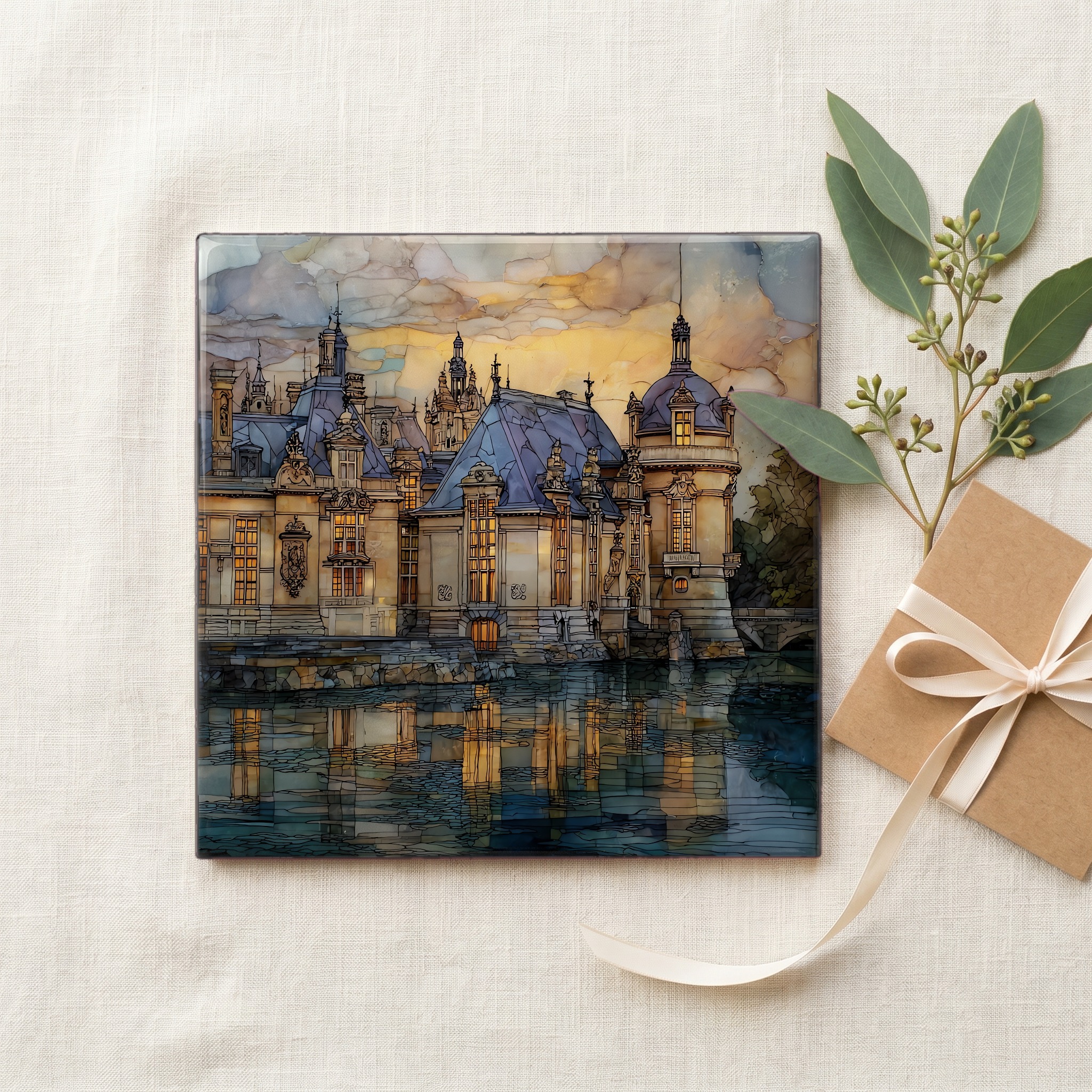
comes gift-ready
comes gift-ready

Each tile ships in a kraft box, tied with cream ribbon, with a handwritten note from the studio if you'd like to add one.
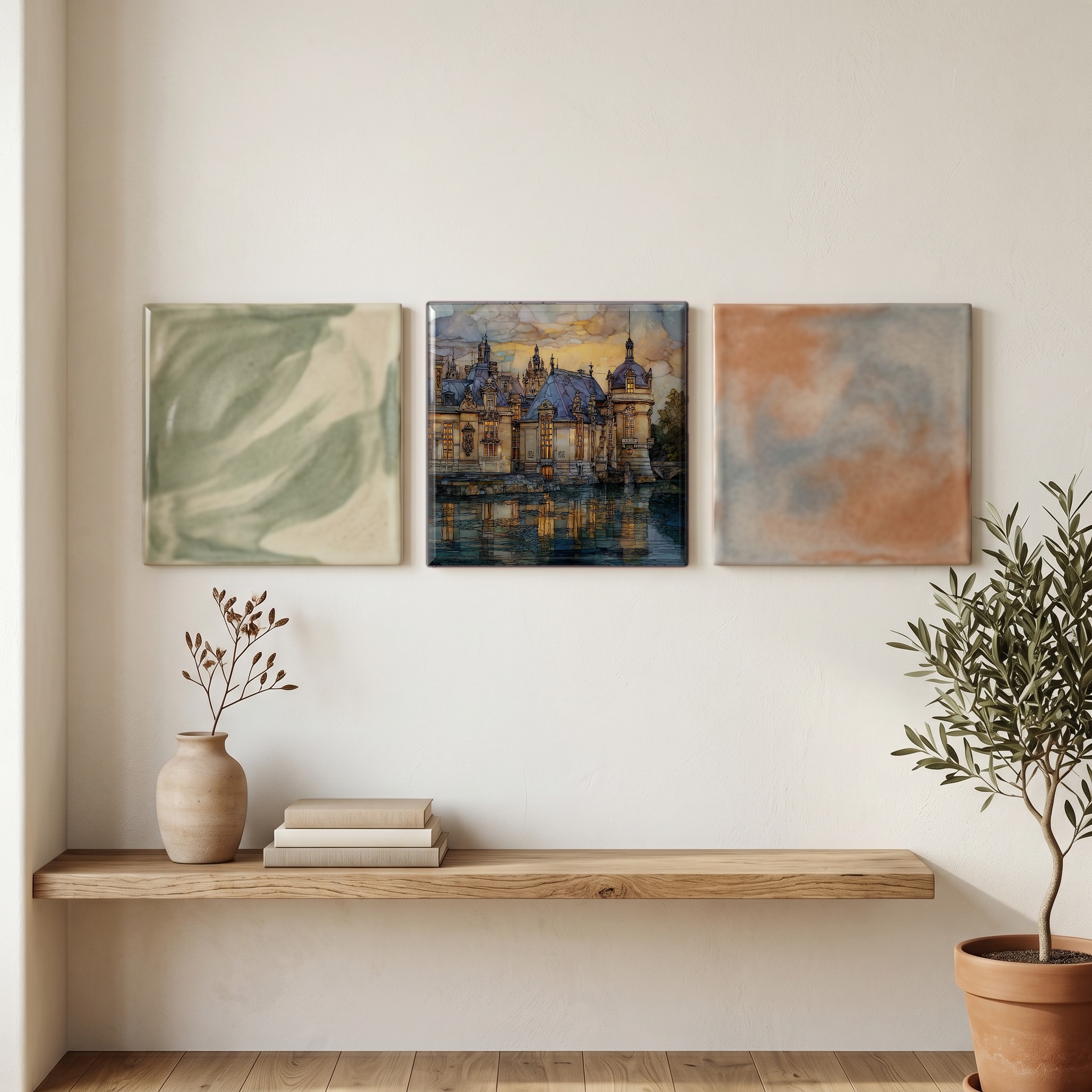
or build a grouping
or build a grouping

Three or five different vistas, hung together — a chapter of places you've been, or want to go.

about Chateau de Chantilly

The place, in three passes.

A little of what's known, in case you fall down the rabbit hole — or want to go see it yourself.
the place

The Château de Chantilly sits in the town of Chantilly, in the Oise department of Hauts-de-France, about 40 kilometres north of Paris. It is reached in roughly 25 minutes by direct train from Gare du Nord to Chantilly-Gouvieux, then a short walk through the edge of the Forêt de Chantilly. The estate is part of the Domaine de Chantilly, a roughly 7,800-hectare property that includes the château, the Musée Condé, the Grandes Écuries, the Hippodrome, and one of the largest forests in the Île-de-France basin. The whole estate was left to the Institut de France by Henri d'Orléans, Duke of Aumale, whose 1886 deed of gift took effect at his death in 1897.

the stone

What stands today is two buildings joined as one. The Petit Château, built around 1560 by the architect Jean Bullant for the Constable Anne de Montmorency, survived the destruction of the original Grand Château during the French Revolution. The current Grand Château beside it was reconstructed between 1875 and 1882 by Honoré Daumet for Henri d'Orléans, Duke of Aumale, who returned from exile in England with one of the great private picture collections of the 19th century and wanted a house to hold it. The two châteaux share a single roofline above the moat and read, from the lawn, as one continuous façade.

the visit

A combined ticket covers the château, the Musée Condé, the Living Horse Museum in the Grandes Écuries, and the 115-hectare gardens drawn by André Le Nôtre between 1663 and 1684. The Domaine is open most of the year, with reduced hours in winter; the château and Musée Condé are typically closed on Tuesdays. The Très Riches Heures du Duc de Berry, one of the most celebrated illuminated manuscripts of the 15th century, lives in the Cabinet des Livres but is shown only in facsimile; the original is kept in climate-controlled storage. The forest and the hippodrome are reached on foot from the gates.

where
France · Chantilly, Oise, Hauts-de-France
position
49.1939° N · 2.4853° E
the neighborhood

What's nearby.

A handful of named places within an hour's walk or short drive. Some we've already painted; some we will.
at the lake
Forêt de Chantilly
forest
1 km S
Hippodrome de Chantilly
racecourse
10 km E
Senlis
medieval cathedral town
15 km SE
Abbaye de Chaalis
abbey ruins
12 km SE
Ermenonville
park and landscape garden
N
Chateau de Chantilly
Forêt de Chantilly
Hippodrome de Chantilly
Senlis
Abbaye de Chaalis
Ermenonville
common questions

What people ask.

A few questions we get about Chateau de Chantilly — and about bringing the piece home.
about the place

The château sits in the town of Chantilly, in the Oise department of Hauts-de-France, about 40 kilometres north of Paris. It is reached in roughly 25 minutes by direct train from Gare du Nord, followed by a short walk through the edge of the Forêt de Chantilly.

The Musée Condé holds the second-largest collection of antique paintings in France after the Louvre. The collection was assembled by Henri d'Orléans, Duke of Aumale, and includes works by Raphael, Botticelli, Fra Angelico, and Nicolas Poussin. Henri bequeathed it to the Institut de France in 1886.

The original Grand Château was demolished during the French Revolution. The 16th-century Petit Château survived. The Grand Château that stands today was rebuilt between 1875 and 1882 by the architect Honoré Daumet for Henri d'Orléans, Duke of Aumale.

The formal French gardens were drawn by André Le Nôtre, the gardener of Versailles, between 1663 and 1684. The grounds also include an 18th-century Anglo-Chinese garden and a 19th-century English garden added under the Duke of Aumale.

The Grandes Écuries are the Great Stables built between 1719 and 1740 by Jean Aubert for Louis-Henri de Bourbon, Prince de Condé. Legend holds that he believed he would be reincarnated as a horse and wanted a fitting residence. They now house the Musée Vivant du Cheval, the Living Horse Museum.

The whipped cream now called crème Chantilly was associated with the château by the 18th century, often attributed to the maître d'hôtel François Vatel, who ran the kitchens of the Prince de Condé. Earlier whipped-cream recipes exist; the name and reputation stuck here.

It is a 15th-century illuminated manuscript commissioned by Jean, Duke of Berry, considered one of the finest examples of late-Gothic French illumination. The original is kept in climate-controlled storage at the Musée Condé and is shown to visitors only as a facsimile.

about the piece in your home

Chantilly is one of the more loved day trips out of Paris, often saved for a second or third visit after the main monuments. For someone with that kind of attachment, a Keepsake or a Coaster Set with a handwritten note from the studio travels well; a Small or Medium works as a framed piece on a shelf or wall.

The deep blues, ivories, and gilt of the tile sit easily with French Country, traditional, and jewel-tone interiors. It also works as a single statement piece in a more minimal room, where the artwork carries the colour and the walls stay quiet.

Yes. The château, the moat reflection, and the deep jewel-tone palette read clearly as grand-millennial and quiet-luxury sources. It also suits the broader European-inspired aesthetic that has held steady through 2025 and into 2026.

A single Large reads well above a console table or a narrow sofa. For a wider room or a longer sofa, the 4-tile Mural carries the architecture, and the 9-tile Mural carries the full sweep of the château and its reflection across the wall.

Yes, in the Dura Satin or Matte finish. Both are designed for humid rooms and resist water, soap, and steam without dulling. The Glossy finish is held back for show pieces in living rooms, hallways, and framed wall art.

A microfibre cloth and water. The colour is slowly infused into the ceramic surface under high heat and pressure, beneath a thin glossy finish, so there is no painted layer to wear off. Avoid abrasive scouring pads and bleach-based cleaners.

Yes. Every piece in the WenderVista atlas is original to the studio. Reid Wender curates the program, the studio paints in its own visual language, and no piece is licensed from another publisher or print house.

if this one stayed with you

A few you might also love.

Hand-picked by the eye that found Sorapis. Same air, same kind of quiet.